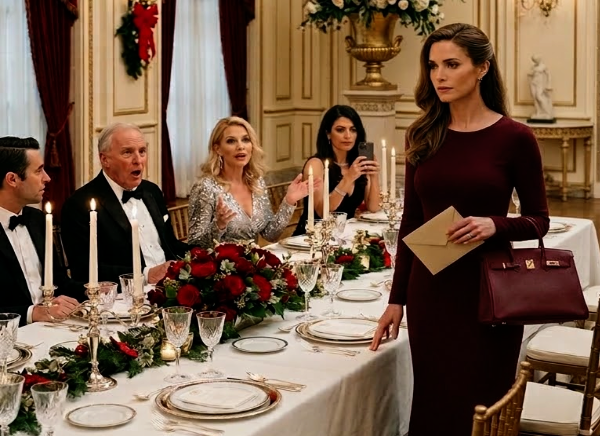
The air inside Chateau Lumiere was thick with the scent of lilies and the metallic tang of high-end silverware hitting porcelain. It was February 28, 2024—Giana Dixon’s 31st birthday. In any other circle, this would be a milestone of maturation, a celebration of a life in full bloom. But in the Dixon family, life was not lived; it was audited.
Giana sat at the head of the table, though she felt less like a guest of honor and more like a defendant in a high-stakes litigation. Her father, Robert Dixon, the CFO of Themes Corporation, adjusted his cufflinks with the precision of a man who measured his pulse in basis points. Her mother, Eleanor, the doyenne of Chicago’s charitable elite, wore a smile that never quite reached her eyes—a practiced, “gala-ready” expression that she used to mask both boredom and disdain. Across from Giana sat her sister, Victoria, who had recently ascended to a senior associate position at Baker and Associates. Victoria’s phone was already propped up against a crystal water goblet, the red “record” light blinking like a warning beacon.
The gift arrived not in a box wrapped in silk, but in a gold-embossed envelope.
“From all of us,” Eleanor announced, her voice carrying that peculiar, melodic lilt she used when delivering a crushing blow in public.
Giana opened it. It was a formal disownment letter. It was a legal severance of blood. As Victoria’s camera captured every micro-expression of Giana’s face for the family’s later entertainment, the irony was thick: they thought they were witnessing her social death. They had no idea they were filming her liberation. To understand why a family would weaponize a birthday dinner, one must understand the Dixon’s internal currency. In their world, children were not individuals; they were brand extensions.
Robert Dixon viewed his family through the lens of a balance sheet. Victoria was a “high-yield asset”—a lawyer who closed nine-figure acquisitions. Giana, however, was “depreciating.” Despite her Northwestern degree and her fluency in four languages, her choice to work in hospitality was viewed as a moral failing.
“Giana’s still serving tables?” Eleanor would ask at every Thanksgiving, her voice dripping with a calculated, performative pity. To Eleanor, “service” was something one received, never something one provided. She couldn’t grasp that Giana wasn’t just “pouring water”; she was practicing a sophisticated form of cultural intelligence (CQ) that her parents, for all their wealth, utterly lacked.
Throughout 2023, the exclusion became a choreographed dance. Giana was edited out of Christmas cards. She was “forgotten” on the guest lists of the Eleanor Foundation’s galas. When she did attend family events, she was treated as an unpaid staff member.
“You’re being too sensitive,” Victoria would say, her eyes never leaving her LinkedIn feed. “It’s just business networking. What would you contribute? Wine recommendations?”
This environment created a physiological toll. Giana’s cortisol levels were chronic. She lived in a state of hyper-vigilance, her hands shaking every time her phone illuminated with a text from “Mom.” She was funding their lifestyle—donating thousands of her modest salary to her mother’s foundation just to buy a seat at the table—only to have that money presented as Eleanor’s own contribution. The catalyst for Giana’s transformation occurred eight months prior at The Meridian, a two-Michelin-star bastion of Chicago dining.
CEO Yamamoto of the Yamamoto Corporation had arrived with a high-level Japanese delegation. Due to a software glitch, their reservation had been purged. The Maître d’ was floundering, offering a standard Western apology that only served to deepen Yamamoto’s sense of “loss of face” (mensetsu).
Giana stepped in. She didn’t just apologize; she pivoted. Speaking in fluent, formal Japanese (Keigo), she acknowledged the depth of the oversight. She understood that for Yamamoto, the issue wasn’t the table; it was the perceived lack of respect for his status.
Giana personally curated a private dining experience that mirrored the seasonal aesthetics of Yamamoto’s hometown. She managed the subtle flow of the evening, ensuring that the hierarchy of the guests was respected in the order of service. By the end of the night, Yamamoto hadn’t just stayed; he had signed a $2 million catering contract for his international conferences.
Watching from a corner table was Marcus Whitmore, the CEO of Grand Plaza Hotels. While Giana’s parents saw a waitress, Marcus saw a virtuoso. He saw someone who could navigate the “white space” of human interaction—the unstated needs and cultural barriers that often derail multi-billion dollar deals. Following the Yamamoto incident, Giana began a double life. While her parents mocked her for “beer money” wages, she was undergoing a rigorous, five-round interview process with Grand Plaza Hotels.
Marcus Whitmore was not interested in her family name. In fact, he demanded total secrecy. “I want to evaluate you without interference,” he told her. “No family connections, no assumptions—just your capabilities.”
The interviews were grueling:
Technical Fluency: A three-hour assessment of her linguistic capabilities in French, Arabic, and Japanese.
Case Study: Designing a guest experience for a visiting Royal Family, requiring knowledge of everything from security protocols to religious dietary nuances.
Simulated Crisis: Managing a high-pressure conflict involving staged difficult guests. Giana resolved the conflict in 12 minutes using a combination of psychological de-escalation and resource management.
On January 10, 2024, Giana signed a contract as the Director of Guest Experience. The compensation package was a staggering $285,000 base salary with $500,000 in equity. It was more than Victoria made. It was more than her father’s annual bonus.
She told no one. She continued to serve tables at The Meridian, letting her family’s insults wash over her like rain on a windshield, knowing that her “show” was about to begin.
V. The Birthday Verdict
Back at Chateau Lumiere, the silence following the presentation of the disownment letter was deafening. The letter, printed on the same Themes Corporation letterhead her father used for hostile takeovers, was a masterpiece of cruelty.
It formally severed her from the Dixon name. It revoked her inheritance. It was signed by her father, her mother, and her sister.
Giana didn’t cry. She didn’t beg. She folded the letter with the same precision she used to fold a linen napkin.
“Thank you,” she said, her voice a calm, steady blade. “This makes everything easier.”
Her parents were baffled. They had expected a breakdown—a scene for Victoria’s social media followers to devour. Instead, they got a graceful exit.
“My show starts tomorrow,” Giana said, gathering her coat. “And you’re not invited.” March 15, 2024. The Grand Plaza Ballroom was a cathedral of light and power. The who’s who of Chicago’s elite were in attendance, including the Dixons. Eleanor had spent weeks bragging about her role on the organizing committee, unaware that the evening’s program had been altered at the highest level.
Marcus Whitmore took the stage. His voice boomed through the hall, commanding the attention of 500 CEOs and investors.
“Tonight, we celebrate transformation,” Marcus began. He told the story of a hostess who saved a $50 million expansion deal through sheer cultural intelligence. He spoke of a woman who had been told daily that she wasn’t enough, despite possessing talents that the industry’s top MBAs couldn’t replicate.
“Ladies and gentlemen,” Marcus concluded, his eyes finding the Dixon table, “please welcome our new Director of Guest Experience… Giana Dixon.”
The spotlight hit Giana as she stepped out in a black Valentino gown. The ballroom erupted. The Dixons, however, remained frozen. Eleanor’s champagne glass shattered on the table—a jagged, crystalline punctuation mark to her shock.
Giana’s speech was a masterclass in professional poise. She didn’t attack her family directly; she did something far more devastating—she ignored their existence while dismantling their values.
“True hospitality,” Giana told the audience, “is about seeing people. Really seeing them. For years, I served tables and learned that respect isn’t inherited; it’s earned. Tonight, we launch the Frontline to Leadership initiative, promoting the very people who are often deemed ‘invisible’ by those who measure worth only by titles.”
The standing ovation was thunderous. The Dixons tried to storm the stage afterward, their faces a frantic mix of greed and desperation.
“Giana, how could you not tell us?” Eleanor pleaded, her hand trembling on Giana’s arm.
Giana signaled for security. “I was disowned, remember? February 28th, 7:43 p.m. You filmed it. These people are causing a disturbance,” she told the guards. “They’re not on the approved contact list.”
VII. The Fall of the House of Dixon
The fallout was swift and systemic. The Chicago Tribune ran a front-page story on the “Charity Chair’s Shameful Family Secret.”
The reputational damage was irreparable:
The Eleanor Foundation: Three major donors pulled their funding, representing 40% of the annual budget. The board issued a vote of no confidence, and Eleanor was removed as chair.
Themes Corporation: The board, sensitive to the negative press regarding Robert’s “leadership judgment,” suggested he take an early retirement. His “golden parachute” was slashed by two-thirds.
Baker and Associates: Victoria was quietly moved from the prestigious Singapore merger to a document review basement. The “rising star” of the firm was now a liability. She eventually moved to Cleveland, her career in Chicago effectively over.
The family wealth, once a monolith of power, fractured. The Dixons’ divorce followed shortly after, as they turned their practiced cruelty on each other once they no longer had Giana as a common target. By September 2024, Giana’s life was unrecognizable. She was promoted to Senior Director with a compensation package of $560,000. She had moved into a penthouse overlooking Lake Michigan—a space filled with light, free from the sterile oppression of her childhood home.
She had built a “chosen family.” It included David Brennan from The Meridian, who had always believed in her; Marcus Whitmore, her mentor; and Michael, a cardiac surgeon who loved her for her mind, not her pedigree.
The disownment letter was no longer in her purse. It was framed on her office wall.
“It’s my freedom certificate,” she would tell curious visitors.
It served as a daily reminder that the very document intended to destroy her had been the key to her cage. Giana Dixon had realized the ultimate business secret: your value is not what someone is willing to pay you, but what you are no longer willing to sacrifice for their approval. Giana’s story is a testament to the power of “Professional Orphans”—those who build empires from the ashes of familial rejection. She didn’t just survive the Dixons; she out-innovated them. She took their obsession with status and replaced it with a commitment to humanity.
As she prepared for her wedding on the Grand Plaza rooftop in the summer of 2025, she looked out over the city. She didn’t feel hate for the people who shared her blood. She felt a profound, quiet gratitude. They had given her the greatest gift a person could receive: the necessity of choosing herself.