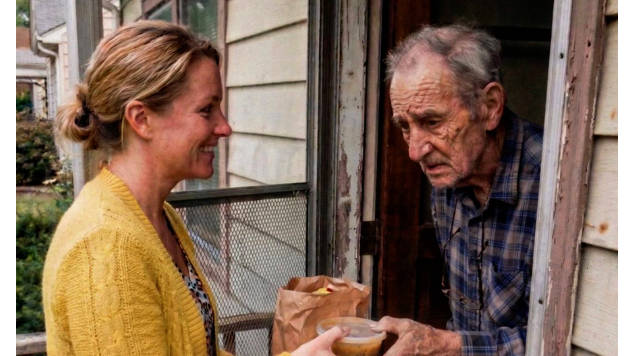
I spent years cooking dinner for the loneliest, meanest 80-year-old man on my street — when he died, his will left me and his 3 children SPEECHLESS.
I’m 45, a single mom of seven kids, and for the past seven years I’ve been cooking dinner for the meanest old man on my street.
Arthur lived alone in that peeling white house three doors down, where newspapers collected on his porch like fallen leaves nobody bothered to rake.
He yelled at my children when they rode bikes too close to his fence. He called them “those wild animals” and told the whole neighborhood I was raising delinquents. When I’d wave hello, he’d turn his back and slam his door.
He never let anyone inside his house. Not a single neighbor in all those years.
Everyone thought I’d lost my mind when I started bringing him plates of food.
But I remembered the morning I found him collapsed on the icy sidewalk, too proud to ask for help. His hands were shaking as I helped him stand—not from the cold, but from something deeper. When we reached his door, he looked at me with eyes that held seven decades of walls.
“What makes you help me?” he whispered. “I don’t deserve it.”
I touched his trembling shoulder and said, “No one deserves to be left alone.”
That’s when I understood. Behind all that anger was just a man who’d forgotten what kindness felt like.
My ex-husband had left me with nothing but bills and broken promises. I worked three jobs—diner mornings, office cleaning afternoons, motel laundry until midnight. Some nights I’d stretch soup with water and crackers, counting spoonfuls so each child got enough. But somehow, I always made one extra plate.
Arthur would stand in his doorway, suspicious and scowling. “I didn’t ask for charity,” he’d grumble. But the plate was always empty the next morning.
One day, the door didn’t close.
I stepped inside for the first time.
And I saw his walls.
Covered in photographs. Kids. Birthdays. Smiles frozen in time.
“Your family?” I asked.
He looked away.
“Had three kids,” he muttered. “They stopped coming.”
No visits. No calls. Not even birthdays.
Seven years of this ritual. Seven years of neighbors calling me crazy.
Then last Tuesday, his porch light didn’t turn on. I found him peaceful in his bed.
At the funeral, his 3 children arrived in designer suits, whispering about inheritance. They didn’t even look at me.
The lawyer pressed play.
Arthur’s voice FILLED THE ROOM.
I kept showing up for someone who never asked me to and rarely appreciated it. I had no idea those small acts would one day lead me somewhere I never imagined.
I’m 45 years old, raising seven kids on my own, and for the past seven years, I’ve been cooking dinner for the meanest old man on my street.
His name was Arthur. He lived three houses down in a worn-out white house with peeling paint and a porch that always looked forgotten. Newspapers piled up by his door, with no one touching them for days.
Honestly, I didn’t blame them.
I’ve been cooking dinner for the meanest old man.
Arthur had a way of making you feel as if you didn’t belong. If my kids rode their bikes too close to his fence, he’d shout from his porch, calling them “those wild animals” and telling anyone who’d listen that I was raising delinquents.
If I waved, he’d turn his back and slam the door.
And no one had ever been inside his house.
He’d shout from his porch.
So yeah… when I started bringing him food, people thought I’d lost my mind.
But they didn’t see what I saw.
It was the middle of winter when everything changed.
I was running late for my morning shift at the diner when I spotted Arthur lying on the icy sidewalk.
He was flat on his back, not calling out or moving.
I dropped my bag and ran over. “Arthur? Can you hear me?”
People thought I’d lost my mind.
I helped him sit up. His hands were shaking, but not from the cold.
When I got him to his door, he stopped and looked at me in a way he never had before.
“What makes you help me?” he whispered. “I don’t deserve it.”
I placed my hand on his trembling shoulder.
“No one deserves to be left alone.”
He didn’t say anything after that, just stepped inside.
But that’s when I understood that behind all that anger was just a man who’d forgotten what kindness felt like.
However, life didn’t get easier for me.
My ex-husband, Darren, has been gone for years. He left behind bills, excuses, and kids who still asked when he was coming back.
I worked mornings at a diner, cleaned offices in the afternoon, and did laundry at a roadside motel until midnight.
Some evenings, I stretched soup with water and crackers just to make it last. I counted spoonfuls so that each kid got enough.
Still… I always made one extra plate.
The first time I brought it to Arthur’s house, he barely opened the door.
“I didn’t ask for charity,” he grumbled.
“Good, because I didn’t ask if you wanted it.”
He took the plate anyway, and the following morning, it was empty.
That became our routine, but Arthur didn’t get nicer, not really.
“I didn’t ask for charity.”
About five years into it, something changed.
I knocked as always, but that day, Arthur didn’t close the door.
“Are you coming in or not?” he called from inside.
And the walls stopped me cold because they were covered with photos.
Kids at birthdays. School pictures. Holidays. Smiles frozen in time.
Arthur stood by the window, looking out.
“Are you coming in or not?”
“I have three kids,” he muttered. “They stopped coming.”
That was all he gave me, but it told me enough.
After that, I understood Arthur a little better.
And I didn’t stop bringing the food.
If anything, I showed up more.
Seven years went by like that.
Neighbors called me crazy.
Arthur’s porch light wasn’t turned on as usual.
I noticed right away. When he didn’t answer my knock, I tried the handle. It was unlocked.
I stepped inside, cautiously.
I walked down the hallway and pushed open a door.
I found him lying in bed peacefully, as if he’d just fallen asleep. He was 80.
Arthur’s funeral was small. I received an invitation by mail through his lawyer.
And that’s when I finally saw his children.
Daniel, the oldest. Claire, the middle child. And Mark, the youngest.
They all wore expensive designer suits and stood together.
I overheard them whispering about their inheritance.
None of them looked at me or asked who I was.
I received an invitation.
After the service, a man approached me.
“I’m Thomas, Arthur’s lawyer. He requested your presence at the will reading this afternoon at my office at 3 p.m.”
I frowned. “Are you sure?”
Thomas gave a small nod. “Very.”
I didn’t understand why, but I showed up anyway.
We sat at a long table in Thomas’s office that afternoon.
Arthur’s children sat across from me.
Claire leaned toward Daniel. “Who is she?”
Thomas sat at the head of the table. “Arthur left specific instructions via a written will and a recording. Let’s listen to what he had to say.”
The lawyer pressed play on a recorder, and Arthur’s voice filled the room.
“This is Arthur, and I want to be clear that I didn’t choose Kylie because of her kindness. Years ago… before she ever brought me cooked dinner… I saw her sitting on her front steps after her husband left her for another woman. Middle of the night. No lights on. Seven kids asleep inside.”
Claire frowned. “What is this?”
I saw her sitting on her front steps.
“She sat there for a long time,” Arthur continued, “as if she were trying to figure out how she was going to survive. I watched from my window and didn’t see weakness. I saw someone who refused to quit. And I knew then… if I ever had to trust someone, it would be you.”
“But I had to be sure. So I acted difficult on purpose. I wanted to see if she’d walk away. She didn’t. I knew she was worthy.”
“I watched from my window.”
“My children had plans to sell my house. My lawyer kept me abreast of things. I transferred ownership to Kylie legally months ago. But there’s a condition. She decides what becomes of it. You can sell it, split the money with my children, or keep it and turn it into something that serves the neighborhood.”
The recording clicked off.
“I transferred ownership to Kylie.”
Then all three turned toward me.
Daniel was the first to stand.
“This is ridiculous,” he said, looking between Thomas and me. “You’re telling me this stranger just gets the house?”
The lawyer remained calm. “I’m telling you that Arthur made a legally binding decision.”
Claire spoke next, her voice tight. “And we’re just supposed to accept that?”
Mark didn’t say anything. He just stared at me, as if he were trying to figure me out.
I swallowed. “I didn’t ask for this.”
“No,” Daniel said sharply. “But you’re not exactly refusing it either.”
“I need some time to think,” I added.
“That works for me. You’ll have three days from now to give us your decision. Same time, same place,” Thomas concluded.
That night, I sat at my kitchen table long after the kids had gone to bed.
My bills were stacked in the corner, a light flickering above me that I kept meaning to fix.
Arthur’s house could change everything.
But his voice kept replaying in my head.
Turn it into something that serves the neighborhood.
I pressed my hands against my face.
Daniel showed up the next morning. When I opened the door, he held out a large box.
Inside were new and expensive toys.
“I thought we could talk,” he added.
“You don’t need to do this.”
“I know,” Daniel replied. “But let’s be realistic. You’ve got seven kids. That house could fix a lot of things.”
He leaned closer. “Sell it. Split the money. Everyone wins.”
His jaw tightened. “Then you’re choosing the hard way for no reason.”
Daniel smiled, then left the box on the porch and walked away.
“Sell it. Split the money.”
Claire came later that afternoon.
When I opened the door, she was holding grocery bags.
Fresh food. Meat. Fruit. Things I hadn’t bought in months!
“I’m not here to argue,” she said. “But I understand pressure, and you’re under a lot of it. Selling isn’t selfish. It’s practical.”
Claire hesitated. “Is complicated.”
That hit something. She didn’t argue, just nodded once and left.
Mark came the following day.
“You’re not seriously thinking of keeping it,” he said.
“This isn’t what he would’ve wanted.”
“He literally said what he wanted.”
“You don’t know what state he was in,” Mark shot back.
“I know he was clear enough to choose,” I said.
“You’re taking something that belongs to us.”
“Your father gave me a choice. That’s different.”
He stopped. Looked at me.
“You’re going to regret this.”
The following morning, I called Thomas and asked to see inside Arthur’s house one more time.
“You’re going to regret this.”
I brought all seven kids. They were part of every decision I made.
Thomas opened the front door.
“You’ve got a few hours.”
The house felt different as I walked through slowly.
The photos were still there. I stepped closer this time. Younger versions of Daniel, Claire, and Mark, smiling.
“You’ve got a few hours.”
I glanced toward the hallway.
“Go ahead, explore,” I told my kids.
Within seconds, they were running through the house, playing and laughing.
I froze because I hadn’t heard that sound in that house before.
I leaned against the wall, closing my eyes.
Arthur had lived here alone for years.
And now… it didn’t feel empty.
It felt as if it had been waiting.
Three days later, we were back in Thomas’ office.
The lawyer looked at me. “Kylie, have you made your decision?”
“I’m not selling the house.”
“This is insane!” Daniel snapped.
“You can’t do this!” Claire added.
Mark shook his head. “Unbelievable!”
“Have you made your decision?”
“You’re taking our inheritance!” Daniel shouted.
Then he reached for the recorder.
“There is one final instruction.”
Daniel leaned back. “Finally.”
Arthur’s voice came through again.
“If you’re hearing this… Kylie kept the house. Good. I knew she would. That decision tells me everything I needed to know.”
“There is one final instruction.”
“I wasn’t always the man you knew. There was a time I built something huge, sold it, and became a billionaire. I gave most of it away to charity over the years. But I kept some.”
Daniel sat up straighter, looking surprised.
Mark frowned. “What is he—”
“Kylie,” Arthur’s message continued, “if you chose to keep that house… then you understood what mattered. And because of that, the rest of my money is now yours. My children… I waited years for you to see me. But I couldn’t wait forever. She did.”
“I wasn’t always the man you knew.”
Claire whispered, “That’s not possible…”
“It’s already arranged,” Thomas added. “Accounts. Transfers. All of it.”
“This isn’t over,” Daniel said, standing up. “We’ll challenge it!”
Thomas didn’t flinch. “You can try. But you won’t succeed because your father planned for that.”
Mark stared at the table.
I signed the papers that afternoon.
The money came through weeks later.
I paid off debts first. Then I fixed what needed fixing. I moved my kids into a bigger house a few streets away from the old one.
For the first time in years… I could breathe.
I did exactly what Arthur asked of his house. I opened it to the neighborhood as a feeding program.
Just a long table, a working kitchen, and staff.
Doors open in the evenings, and anyone who needs a meal comes.
At first, it was just a few neighbors.
Then it became something people counted on.
No one ate alone anymore.
I opened it to the neighborhood.
Then one evening, Mark showed up at his father’s house.
“Is it… Okay if I come in?”
The following week, Claire came. Then Daniel.
Eventually, they stayed longer, talked more, and started helping.
Not because they had to, but because they wanted to.
One night, we were all sitting at that long table.
My kids. Them. Neighbors.
Noise. Laughter. Plates passing back and forth.
I looked around the room.
And I realized something simple.
Arthur didn’t just leave me a house. He gave me a way forward.
And somehow, he finally brought his family home.