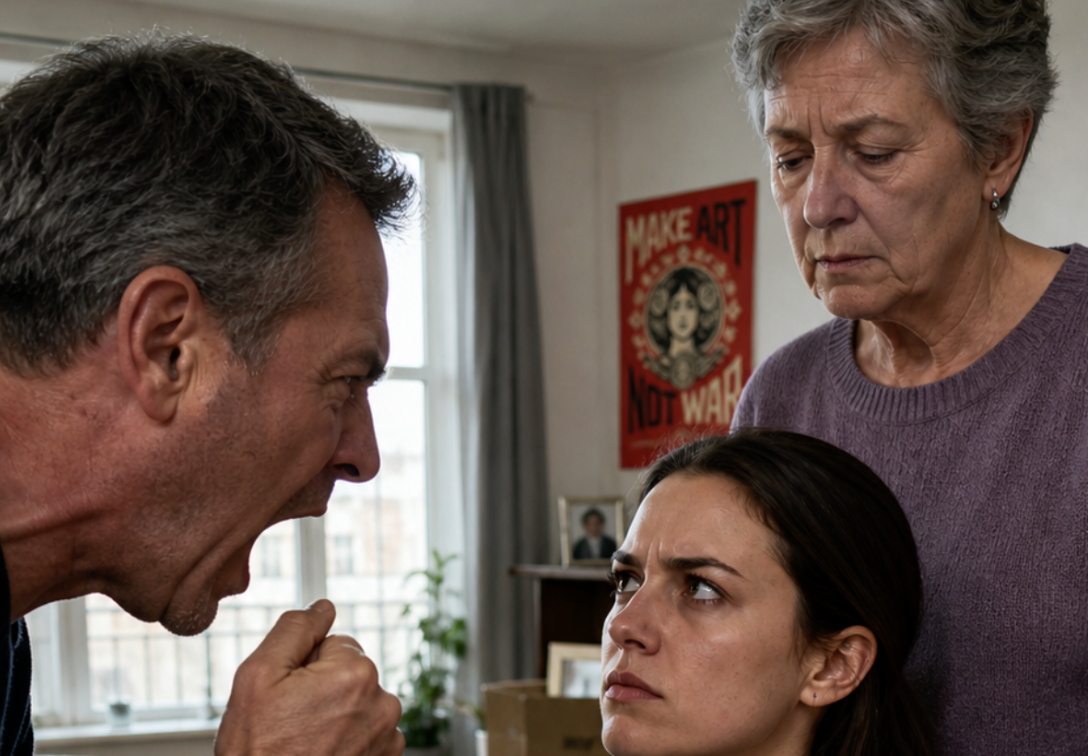
Stop messing with my head! I said my mother is coming, so she’s coming!”
Nina sat on the sofa, pressed into the corner, watching Sergei pace back and forth across their one-room apartment. Back and forth, back and forth — like a trapped animal in a cage. Outside the window, a blizzard drove the snow sideways in heavy flakes, and it felt as though the whole world had shrunk down to these thirty square meters where their fate was now being decided.
“Sergei, listen…” she tried to say, but her voice betrayed her and trembled.
“Don’t ‘Sergei’ me!” He spun around so sharply that he knocked over the cup standing on the nightstand. A brown puddle slowly spread across the surface, but neither of them paid any attention to it. “If you start demanding your rights, I’ll hit you! What my mother says is what will happen! We’re selling the apartment!”
There it was. The thing she had feared for the last three weeks had finally been spoken aloud. Nina felt cold creep under her ribs, even though the radiators were blazing at full strength. We’re selling the apartment. Their only home, the one they had struggled so hard to buy with a mortgage two years earlier. The one they had furnished piece by piece — every item chosen together, every corner holding their shared memories.
“Do you understand what you’re saying?” Nina slowly rose from the sofa. Her legs felt like cotton, but she had to stand. She could not show weakness now. “This is our home, Sergei. Yours and mine.”
“Our?” He smirked, and there was so much poison in that smirk that Nina involuntarily took a step back. “It’s ours when decisions are made together. And what did you decide? Mother is coming, she needs space, she’ll live with us. That’s it.”
Svetlana Petrovna. Her mother-in-law, who appeared in their lives like a tornado — suddenly, destructively, leaving not one stone standing of their fragile family happiness. Three years ago, at the wedding, she had said to Nina, “I only have one son, and I’ll be keeping an eye on him.” Back then it had sounded like a joke. A bitter, unpleasant joke, but still a joke.
And now it was no joke.
“She can rent an apartment,” Nina tried to speak evenly, calmly. “She has a decent pension, plus side jobs. Sergei, we can’t…”
“We can’t?” He came right up to her, looming over her. Sergei was a head taller, and now that advantage felt especially oppressive. “And who paid for your studies while you were sitting around at university? Who gave us money for the down payment? Who?”
There it was — the main card in this dirty game. Money. The five hundred thousand that Svetlana Petrovna had “lent” them three years ago. Since then, that yoke of debt had hung heavily around Nina’s neck, reminding her of itself at every convenient opportunity.
“We paid it back every month,” Nina clenched her fists. “Twenty thousand at a time, regularly. And we’ve already paid back almost everything.”
“Almost doesn’t count!” Sergei kicked a chair, and it crashed to the floor. “Mother called yesterday, crying on the phone. It’s hard for her alone in that house, she’s afraid. Some suspicious neighbors moved in…”
Nina closed her eyes. There it was, Svetlana Petrovna’s signature trick — tears and fears. Every time she needed something, this opera began: “I’m scared, I’m alone, I feel awful.” And Sergei, her only son, her “golden boy,” was ready to tear his hair out from guilt.
“Listen to me carefully,” Nina opened her eyes and looked straight into her husband’s face. Once, she had seen her entire universe in that face. Four years ago, when they met in that coffee shop on Tsvetnoy Boulevard, he had seemed like the most charming guy in the world. Cheerful, easygoing, with those funny dimples in his cheeks and the habit of running his hand through his hair when he was embarrassed.
Where had all of that gone?
“If your mother moves in with us, I’ll leave,” she said quietly, but firmly.
Sergei froze. For one second, then another. Then he burst out laughing — loudly, hysterically, unpleasantly.
“You’ll leave? You?” He wiped away the tears that had appeared from laughing. “And where will you go, Ninochka? To your parents in the village? To your grandmother’s room in a communal apartment? Or maybe you’ve saved up for a rental?”
It hurt. It hurt very badly. Because it was true. Nina had nothing — no money, no connections, no options. She worked as a freelance designer, earning pennies while dreaming of one day opening her own business. All her savings went into their shared budget — groceries, utilities, loan payments.
“I’ll find somewhere,” she breathed, though she herself did not believe the words.
“You’ll find somewhere,” Sergei nodded, and his voice suddenly became cold, almost indifferent. “Well then, get out. My mother matters more to me.”
That sentence hung in the air like a heavy stone. My mother matters more to me. Nina felt something inside her finally break. Not with a crack, not with pain — it simply separated quietly, unnoticed, and fell into the void.
She turned and went into the bedroom. She pulled an old sports backpack from the wardrobe and began throwing things into it. Jeans, sweaters, underwear. Her hands moved on autopilot, while the same thought spun through her head again and again: “This is happening. This is really happening.”
Sergei stood in the doorway and watched. Silently. Nina waited for him to say, “Stop,” “Where are you going?” “Let’s talk.” But he stayed silent. And that silence was more terrifying than any words.
“I’ll pick up my things later,” she said, zipping up the backpack. Her voice sounded foreign, mechanical. “And my documents.”
“Take them,” he muttered and moved away from the door.
Nina put on her down jacket and wrapped her scarf around her neck. Outside, the blizzard had grown serious — snow was flying horizontally, turning the city into white haze. Fifteen degrees below zero, at least. But it was colder inside that apartment.
She grabbed the handle of the front door, and then Sergei suddenly called out:
“Nina.”
She turned around. For one second — just one second — it seemed to her that now he would say something important. Apologize. Stop her.
“Leave the keys on the nightstand.”
Nina silently placed the bunch of keys where they had always been. Then she stepped out onto the stairwell landing. The door slammed shut behind her with a metallic click.
The December frost struck her face and stole her breath. Nina stood outside the door of her — no longer her — apartment and could not move. Where should she go? What should she do? Her phone vibrated in her pocket…
The phone rang insistently, vibrating inside the pocket of her down jacket. Nina took it out with frozen fingers — an unknown number. She declined the call and trudged toward the elevator. She had to get out of there. Quickly. Before she changed her mind, before she returned on her knees to beg forgiveness for something that was not her fault.
The elevator smelled of urine and cheap air freshener. Nina leaned against the cold wall of the cabin and closed her eyes. Just ten minutes ago, she had had a home. A husband. A life she believed was hers. And now — a backpack on her shoulders and a night ahead in fifteen below zero.
Her friend Varya agreed to take her in for a couple of days. She lived on the other side of the city, in an old Khrushchev-era apartment block, but none of that mattered now. What mattered was a roof over her head and a person who would not ask unnecessary questions.
Three weeks passed. Three weeks that Nina spent on a folding cot at Varya’s place, frantically scrolling through rental listings and grabbing any freelance orders she could find. Money was catastrophically short — a room cost at least twenty thousand, plus utilities, plus food.
Sergei did not call. Not once. As if she had never existed at all.
And then Varya called — excited, breathless with laughter:
“Nina, you won’t believe it! Your mother-in-law… She actually came!”
Nina was sitting in a minibus, returning from a meeting with yet another potential client, and felt everything inside her tighten into a knot.
“How do you know?”
“Tanya, my neighbor, lives one floor above your building. She says yesterday evening this huge woman rolled in with suitcases — barely fit into the elevator! Sergei met her, kissed her hands. A circus, basically.”
Nina muted the phone and stared out the window. So it had happened. Svetlana Petrovna had moved into their apartment. Into her apartment, the one Nina had spent two years making into a home — choosing wallpaper, hanging curtains, arranging flowers on the windowsills.
She wanted to go back. To burst in there and start a scandal. But what for? Sergei had made his choice. And in that choice, there had been no place for her.
Another week later, Varya came running home with news so absurd that Nina did not know whether to laugh or cry.
“Listen, this is just epic!” Varya flopped down onto the sofa, kicking off her boots. “Tanya told me everything. Your mother-in-law has caused total destruction over there!”
“What happened?”
“Well, first of all, she broke the toilet!” Varya burst out laughing. “Can you imagine? She sat on it with her huge body — and it just cracked! Sergei is ordering a new one now. No money, so he’s planning to take out a loan.”
Nina said nothing. She imagined Sergei rushing around the apartment with a flooded bathroom and felt nothing. No gloating, no pity. Just emptiness.
“That’s not all!” Varya continued, wiping away tears. “She decided to do laundry. Threw everything in there together — underwear, Sergei’s jeans, some blankets. Turned it on full blast, dumped in a generous amount of detergent. The machine started smoking, and that was it — dead! Burned out completely!”
“Seriously?”
“Tanya says Sergei was yelling so loud the whole apartment heard him, and his mother was sobbing that she didn’t mean to, that appliances nowadays are terrible. They called a repairman — he said it was overloaded, plus she set the wrong cycle. Basically, replacing the motor will cost about thirty thousand. A new machine — all fifty.”
Nina leaned back against the pillows on the folding cot. The washing machine — the very one they had chosen together in the store. Sergei had joked then that it was an investment in their future, in baby diapers and tiny undershirts. What future? What children?
“You know what’s funniest?” Varya leaned closer. “Tanya says the neighbors are complaining. This Svetlana Petrovna blasts music in the evenings, smokes in the stairwell, and throws cigarette butts into the flowerpots. The building committee chair has already come twice to scold her.”
“And what about Sergei?”
“Your Sergei defends his mommy. Says it’s her home now and she can do whatever she wants. The downstairs neighbor threatened to call the police — water started pouring from their ceiling when the toilet cracked. Sergei apologized and promised to pay for the repairs.”
Nina closed her eyes. She had lived in that apartment for two years and had never once quarreled with the neighbors. She kept everything tidy, greeted everyone, helped the old woman from the third floor carry her bags. And now, in her home, chaos had taken over.
“Varya, and Sergei… how is he?” The question slipped out on its own.
Her friend was silent for a moment, then sighed.
“Tanya says he looks bad. Gaunt, bags under his eyes. He’s stopped going to work properly — sometimes late, sometimes not showing up at all. His mother must be driving him insane.”
For some reason, those words made Nina feel even worse. She had thought she would be glad to learn that Sergei was suffering. That justice had triumphed. But instead of joy, there was only a sharp, aching sadness.
“Has he called you?” Varya asked.
“No.”
“Not at all?”
“Not at all.”
Varya shook her head.
“Idiot. Sorry, Nina, but he’s an idiot. He traded you for that… that destroyer of toilets.”
Nina gave a faint smile through the tears rising in her throat. Destroyer of toilets. It sounded almost heroic.
That night, she lay on the folding cot and stared at the ceiling. Outside, the wind howled, driving the snow, and it seemed as though winter would never end. Her phone lay beside her — dark, silent. She waited for a call. For at least one word. At least some hint that Sergei remembered her.
But the phone remained silent.
And one thought kept turning over in her mind: what next? How was she supposed to live with this pain, with this emptiness inside? How could she learn to breathe again when the air cut her lungs like shards of broken mirror?
There were no answers. Only night, only the howl of the blizzard outside the window, and her heavy, uneven breathing.
The divorce was finalized quickly — without scandals, without dividing property. Sergei sent the documents by courier, without even trying to meet. Nina signed where she had to and felt a strange relief. It was over. Officially, legally, finally.
Varya tried to support her:
“Maybe it’s for the best? You got rid of dead weight. Now live for yourself.”
But living for herself turned out to be unbearably difficult. The city pressed down on her — every street reminded her of the past, every café, every bench in the park. Here they had walked. Here they had kissed for the first time. Over there, in that building, they had rented an apartment while saving for their own. Memories strangled her, not letting her breathe fully.
And then Tanya, Varya’s acquaintance, called. Her voice trembled with outrage:
“Nina, can you imagine what’s going on? Svetlana Petrovna got what she wanted! She completely worked Sergei over. Every day she told him, ‘Divorce her, son. She’s not a match for you. We’ll find you a real wife, a good homemaker.’ And he agreed! He filed the documents himself, sped everything up!”
Nina listened and felt nausea rolling over her. So it had not been his will. Not his decision. Svetlana Petrovna had methodically dripped poison into his brain day after day until she got what she wanted. And he — weak, a mama’s boy — had simply surrendered.
“Tanya says it’s a real nightmare there now,” Varya continued. “The apartment is filthy, things are scattered everywhere. Svetlana Petrovna can’t cook, she just drags store-bought convenience food home. Sergei has lost about ten kilos, walks around like a ghost. She controls him — takes his salary, calls his work, checks where he is and who he’s with.”
“Enough,” Nina said quietly. “I don’t care.”
But that was a lie. She did care. And that infuriated her most of all.
The decision to leave came unexpectedly. Nina was scrolling through social media — endless photos of happy couples, New Year trees, festive tables — when she came across a job posting. A designer was needed at a small advertising agency in Sochi. Remote work, but with the possibility of relocation and official employment.
Sochi. The sea. Warmth. A city where nobody knew her, where ghosts of the past did not stand on every corner.
She applied without much hope. She passed the video interview — they liked her portfolio and offered her a one-month remote trial, then they would decide about relocation. The salary was not astronomical, but it was enough to live on.
Nina bought a plane ticket for three days later. Varya tried to talk her out of it.
“Nina, are you sure? This is such a big step… Dropping everything, going thousands of kilometers away…”
“I have nothing to lose here,” Nina answered, and realized it was true.
On the last evening before her departure, she walked through familiar places. She stood near the entrance to their building — their former building. The windows on the fourth floor glowed dimly. There, behind those windows, Sergei was finishing store-bought dumplings and listening to his mother’s complaints. No one was waiting for her there anymore. She had been crossed out, erased, forgotten there.
Nina turned around and walked away. Snow crunched beneath her feet, frost pinched her cheeks. But ahead there was warmth. The sea. A new life she would build herself — without looking back at other people’s opinions, without fear of being inconvenient.
The plane landed in Sochi early in the morning. Nina stepped out of the airport and breathed in the humid, salty air. It smelled of the sea, palm trees, freedom. The sun blinded her eyes after Moscow’s grayness.
She rented a tiny studio in Adler — with a view of the sea, with a balcony where she could sit in the mornings with coffee and listen to the sound of the waves. For the first week, she worked like a madwoman, settled into daily life, explored the city. In the evenings, she went out to the embankment and simply walked along the shore, listening to the rhythm of the surf.
Here, nobody knew her story. Nobody asked why she was alone, why she had run away. She was simply Nina — a girl who drank cappuccino in a café by the embankment, worked on her laptop, and sometimes smiled at strangers.
A month later, Varya called.
“Listen, want some news?”
“Not really,” Nina admitted honestly.
“Well, I’m telling you anyway. Sergei and his mother had a huge fight. She wanted to sell the apartment so they could buy a little house in the village, and he refused. The scandal was terrible. Svetlana Petrovna packed her things and went back, saying her son had betrayed her.”
Nina was silent, looking at the sunset over the sea. The sky burned pink and orange, seagulls cried, and the waves rolled steadily onto the shore.
“Nina, do you hear me?” Varya asked anxiously.
“I hear you.”
“And what do you think?”
Nina closed her eyes and turned her face toward the warm wind.
“You know, Varya… I don’t care. Truly. It’s his life, his choice. And now I have my own.”
And that was the pure truth. The pain had not disappeared — it would remind her of itself for a long time, with sharp stabs at the most unexpected moments. But Nina had learned to live with it. She had learned to breathe through it, to keep going, to build something new on the ruins of the old.
She hung up and looked at the sea. Ahead was the night, tomorrow — a new day, new work, new possibilities. And no one would ever again tell her how to live, whom to love, or what to give up.
She was free.