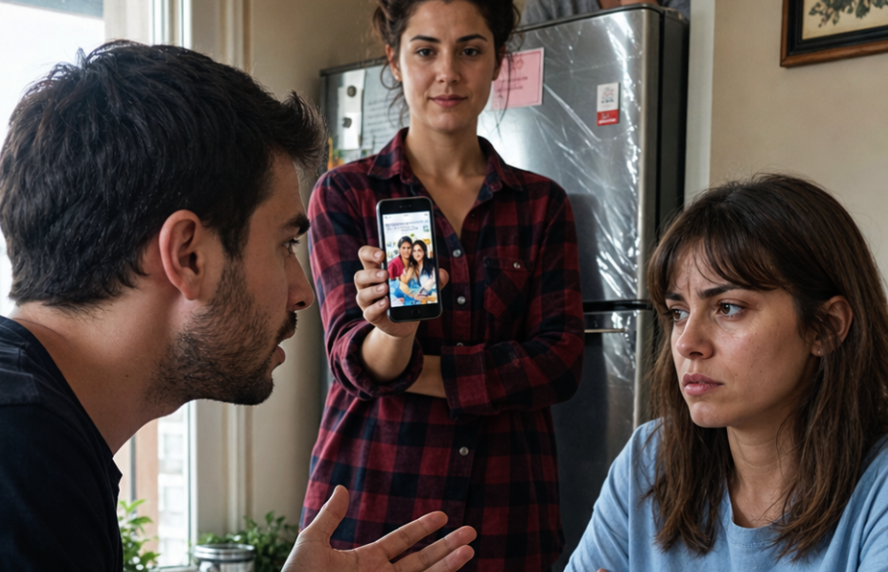
— Are you with your mother again? — Polina slammed the cabinet door so hard the glasses inside trembled. — Every single day it’s the same thing: “Mom needs this, Mom needs that.” What am I, some kind of ATM?
— Don’t start, — Alexey muttered, sitting at the table with a cup of cold tea. — You’re always complaining. A woman is supposed to support her husband, and all you do is count money.
— Support, yes. But support your entire family? — Polina snapped sharply. — How long is this supposed to go on? Utilities, dental work, Elena’s courses… Aren’t you ashamed?
— No, — Alexey said calmly. — They’re my family. That’s sacred to me.
— And what am I? — Polina stepped closer and looked him over from head to toe. — Do you even see that you live with a woman who also has feelings, a job, and exhaustion?
— Who’s to blame if you practically sleep at the office? — her husband snorted. — You chose the career, the office, the laptop, and then you complain that you have no strength.
Polina sat down across from him and took a deep breath.
— You know, at the office they at least respect me. They take me into account. And at home, what am I? A wallet with legs.
— Here we go again, — Alexey waved his hand. — My mother never had these issues. Father worked, she stayed home — and everything was fine.
— Then marry her! — Polina blurted out.
Alexey jumped up, and the chair crashed to the floor.
— Don’t you dare say that! — his face turned red. — My mother is a saint!
— Saint or not, I’m tired, Lyosha. You don’t notice that you’re living at my expense. And not just you — your whole family is sitting on my neck.
He walked to the window and turned away. Outside the glass was an autumn evening, rain tapping, cold.
— And you don’t see how much you’ve changed? — he asked quietly. — You used to be gentle, kind. Now you’re always reproaching me.
— I was kind because I didn’t understand, — Polina gave a bitter smile. — Kindness ends when people turn you into a cash cow.
A heavy silence hung in the room. Only the rain drummed against the window, as if counting down her patience.
Things had been different before. On Sundays, Polina would run around the house, cook lunches, wash shirts, iron ties, listen to her husband’s stories. Back then, everything had seemed right. Alexey joked, brought her coffee in bed, called her “clever girl.” But then everything started sliding downhill.
The first requests from his family seemed like small things, she thought. Helping wasn’t a problem. She wasn’t greedy. But over time, “help” turned into “obligation.” And something inside her broke.
“Polin, Mom asked me to order her medicine,” he would say casually, as if talking about bread.
“Polin, Elena needs a new phone, her old one is acting up.”
“Polin, Mom needs a plumber, you understand.”
At first she agreed. Then she began asking questions. And every question brought a storm: accusations, silence, coldness.
Now he no longer asked — he ordered.
That evening Polina sat in the kitchen, scrolling through her phone. In the messenger were a dozen messages from Marina Petrovna: “Polin, hi. Could you transfer a little money? The refrigerator has completely fallen apart,” and “I’ll pay you back when I get my pension.”
“Sure, of course,” Polina thought, turning off the screen. Nobody ever paid anything back.
She opened the refrigerator — half empty. Eggs, a couple of apples, a jar of yogurt. But through the window she could see the courtyard, where the neighbor women were gossiping on a bench.
“Ira, did you hear Galka and Seryoga split up?” came a voice from below. “He dragged his mother into the house too!”
Polina gave a dry laugh. Apparently, stories like this were everywhere nowadays.
The next day she came home late from work. It was dark outside, and a cold October wind drove leaves into puddles. In the elevator she ran into Aunt Zoya, the eternal gossip from the bench.
“Oh, Polinka,” Aunt Zoya looked her over. “Still managing to run everywhere? Does your husband at least help?”
“He helps,” Polina smirked. “Morally.”
“The main thing is that he doesn’t sit on your neck,” Aunt Zoya added instructively. “A man with nothing to do is worse than a draft.”
Polina silently went upstairs, opened the door — and immediately came across Alexey. He was sitting in the hallway, buried in his phone.
“Hi,” she said dryly.
“Mom called,” he said without looking up. “The refrigerator… she needs a new one.”
“I heard,” Polina replied calmly, taking off her coat. “And?”
“Help buy it. A decent one costs eighty thousand.”
She froze.
“Are you serious? After everything I told you?”
“What’s the big deal? You have money.”
“I could have a million! I’m not giving them another kopeck.”
“Don’t shout, the neighbors will hear,” he muttered, getting up.
“Let them hear! Maybe someone will tell you the truth, since I’m tired of doing it!”
Alexey came closer, looking down at her.
“You want to disgrace me? Discuss my mother with the neighbors?”
“You’re the one forcing people to discuss her,” Polina shouted. “Because you live like a teenager hiding under his mother’s skirt!”
He grabbed her by the wrist, then let go as if frightened by himself.
“Listen, don’t push me. Just do what I’m asking.”
“No, Lyosha. That’s it. Enough. I can’t do this anymore.”
He stood there for a moment, then threw out:
“Fine. If you don’t want to help, live however you want.”
And he slammed the bedroom door.
Polina remained alone in the kitchen. She took out a cup, poured some water — but couldn’t drink. One phrase kept spinning in her head, as if on repeat: “Live however you want.” And that word “live” stung her from the inside.
Days passed, and the house was silent. They barely spoke. Alexey, as if on purpose, called his mother on speakerphone, discussed purchases and money as though everyone needed to hear it. And Polina, coming home, more and more often caught herself thinking: why am I even going back there?
At work, a new project had started. Young colleagues, eyes burning, life buzzing. With them she felt alive. At home, it was as if she were walking through a swamp, where every minute was heavy.
On Friday evening her boss kept her late at the office.
“Polina, you’re excellent as always. Maybe we should celebrate the quarter? Pizza, tea, sit together for a while?”
She agreed. Laughter, conversations, lightness — as if she had long forgotten what that felt like. But when she left the office after midnight, she suddenly felt afraid to return home.
In the metro, she called her friend Svetka, whom she had known since school.
“Svet, can I stay with you for a couple of days? I just want to breathe.”
“Of course, come. The key is under the mat. I’m at the dacha.”
Polina quickly packed a bag — not a suitcase, just the essentials. Alexey was asleep, and his phone screen was glowing on the nightstand. A message from Elena flashed in the messenger: “Did you talk to Polina? I hope she isn’t acting up?”
Polina sighed.
“Everything is clear,” she whispered to herself, and quietly left the apartment.
Outside, it smelled damp. The moon had hidden behind clouds. October had already reached the heart of the city with a cold that cut at the throat. She walked with one bag, and for the first time in a long while, she felt no guilt. Only exhaustion. She wanted silence — without reproaches, without requests, without those endless conversations about “Mom needs help.” Just to live for herself.
She did not yet know that ahead of her was a conversation that would put everything in its place. A conversation after which there would be a “before” and an “after.”
“Polin, you really did it,” Svetka said, pouring tea into a large mug that read, “Live however you want.” “I knew things weren’t sweet between you and Lyokha, but this…”
“It’s my own fault,” Polina answered, wrapping herself in a blanket. “I put up with it for too long. I thought it would pass, that he would understand. But he understood something else — that he could sit on my neck and swing his legs.”
“You know,” Svetka sighed, “it runs in their family. His mother is the same. She complains that life is hard, but she drains her son dry. I grew up in that neighborhood. I saw them.”
Polina was silent, listening to the hum of the city outside the window, the occasional car horn, the knocking in the radiator. October had turned out rainy and chilly — the perfect time to take stock.
“And now what?” Svetka asked. “What’s next?”
“I don’t know,” Polina answered honestly. “I’ll rent an apartment and live alone. I have enough work, enough money. And then we’ll see.”
“Good,” Svetka nodded. “The main thing is don’t go back. All those ‘what if he’s changed’ thoughts are not for men like that. They don’t change. They only demand.”
Polina smiled.
“I already understand everything. When a person tells you that you’re nothing, it’s no longer about love.”
They both fell silent. Svetka slapped her palms on her knees.
“Come on, let’s at least put on a show so we don’t get sad. We’re sitting here like two widows at the window.”
“Let’s,” Polina agreed. “But not for long. Tomorrow I’ll go home and pick up a few things.”
The next morning, she stood outside her apartment for a long time, unable to put the key in the lock. Her heart was pounding as if it knew: this would not be a conversation, but the final full stop.
The door opened, and the smell of fried onions hit her nose. From the kitchen came the sound of a television and someone’s laughter. Polina froze: in the kitchen sat Alexey, his mother, and his sister. Marina Petrovna was stirring a frying pan, Elena was flipping through a magazine, and Alexey was pouring tea.
“Well, look who showed up,” Elena noticed her first, without raising her eyes. “We thought you ran away.”
“Lena, be quiet,” Alexey said, without much sternness. “Hi, Polina.”
“Hi. I came for my things,” she said calmly, taking off her jacket.
“What things?” Marina Petrovna cut in. “You have a husband, by the way, not a public courtyard. Coming and going like a guest.”
“Marina Petrovna,” Polina answered calmly, “your son said the apartment is his and I can leave. So don’t worry — I’m leaving.”
“Oh, stop it,” her mother-in-law waved her off. “Young people quarrel. Don’t sulk. A family must be preserved.”
“A family?” Polina looked her straight in the eyes. “Where did you see a family when the wife works for everyone except herself?”
A pause fell, like silence before thunder. Elena quietly snorted.
“These conversations about money again. Honestly, I don’t understand why you’re so stingy. It’s not like you’re poor.”
Polina turned to her, her eyes serious.
“It’s not about the money, Elena. It’s about respect. When people ask all the time — that’s one thing. When they believe you owe them — that’s something completely different.”
Marina Petrovna shook her head, as if sighing on behalf of all young people.
“Young people these days. Women used to endure. Now at the slightest thing, they grab a suitcase and head for the door.”
“Exactly,” Polina replied. “Because of that endurance, women later sit three at a time on benches and cry about their lives. I don’t want that.”
Elena scoffed. Alexey stood and approached her.
“Polin, stop making a scene. Mom is right — everyone has quarrels. Let’s just talk.”
“It’s too late, Lyosha,” Polina said, gathering documents from the table. “Everything has already been said.”
“You’re talking about that evening again? I said it in the heat of the moment!” His voice grew quieter. “I’m sorry. It happens to everyone.”
Polina stopped and looked straight at him.
“If you had simply shouted then, I would have understood. But you didn’t say it out of anger. You said it because that’s what you think. I felt it.”
He lowered his eyes, as if trying to hide.
“I didn’t want it to turn out this way. It’s just Mom… she’s getting old. I’m used to the fact that she needs help.”
“Help is one thing. Shifting responsibility onto someone else is another,” Polina interrupted. “You didn’t even understand what you were losing.”
“What am I losing?” he flared up. “We can start over!”
“No,” she said firmly. “You don’t want to change. It’s convenient for you when I pay and you get to be ‘the man.’ That’s not a family. It’s a deal.”
The kitchen filled with silence. Elena turned away. Marina Petrovna stopped stirring the pan. Alexey stood there, clenching his fists, words stuck in his throat.
Polina picked up her bag and jacket and zipped the bag shut.
“I wish you happiness, Lyosha. I hope one day you understand that respect isn’t about money.”
“Wait…” he said quietly. “Maybe I can fix everything?”
She smiled bitterly.
“You can fix something that broke by accident. But we had been cracking for a long time. I just didn’t want to hear it.”
And she left.
Autumn breathed cool air straight into her face. Polina walked down the steps and inhaled the damp but fresh air. On the nearby bench sat the same old women who discussed everyone and everything.
“Oh, Polinka!” Aunt Zoya called out. “Why are you without your husband?”
Polina stopped and smiled.
“Nothing, Zoya. I’m just going home.”
“But you lived there…”
“Now I’ll have my own home,” she answered calmly. “Without other people’s orders.”
Aunt Zoya muttered something, but Polina was already walking on.
A week later, she rented a small one-room apartment on the outskirts. It had no fancy renovation, but it was bright, clean, and most importantly — quiet. In the mornings, she brewed coffee, turned on the radio, and for the first time did not wait for someone to ask for money or demand an explanation.
In the evenings, she called Svetka, laughed, made vacation plans. Sometimes she thought about Lyosha — not with resentment, but as a person from the past whom she pitied, yet did not want back.
One day, returning from work, she met that same neighbor, Aunt Zoya, near the entrance.
“Polinka!” she shouted. “Did you hear? Your Lyoshka had a fight with his mother. She yelled at him that the family fell apart because of you.”
Polina shrugged.
“Let her yell,” she said calmly. “Everyone has their own truth.”
Zoya frowned, and Polina went on.
The stairwell smelled of paint — someone was renovating. She climbed the stairs and thought: maybe all of this had not happened for nothing. Sometimes you need to go through scandals and losses to finally hear yourself.
That evening, she lit a candle on the windowsill and sat down with a cup of tea. Outside, sparse snow was falling — the first of the year. White flakes slowly settled on the street, erasing the remains of autumn dirt.
“Well, here’s a clean slate,” Polina said quietly.
Her phone vibrated — a message from an unknown number: “Polina, I’ve realized everything. Forgive me. If you can — let’s talk.”
She looked at the screen for a long time, then turned off the phone and placed it on the table.
“No, Lyosha,” she whispered. “Now I have a different life.”
Outside the window, the snow grew heavier, covering everything with an even layer of white — as if nature itself had put a final full stop.
Polina leaned back in her chair and smiled for the first time in a long while.
Not from joy, but from peace. Because she had understood the main thing: life is not about who supports whom, but about those who stay beside you not for profit, but from the heart.
If fate ever brought such a person into her home, then none of it had been in vain.