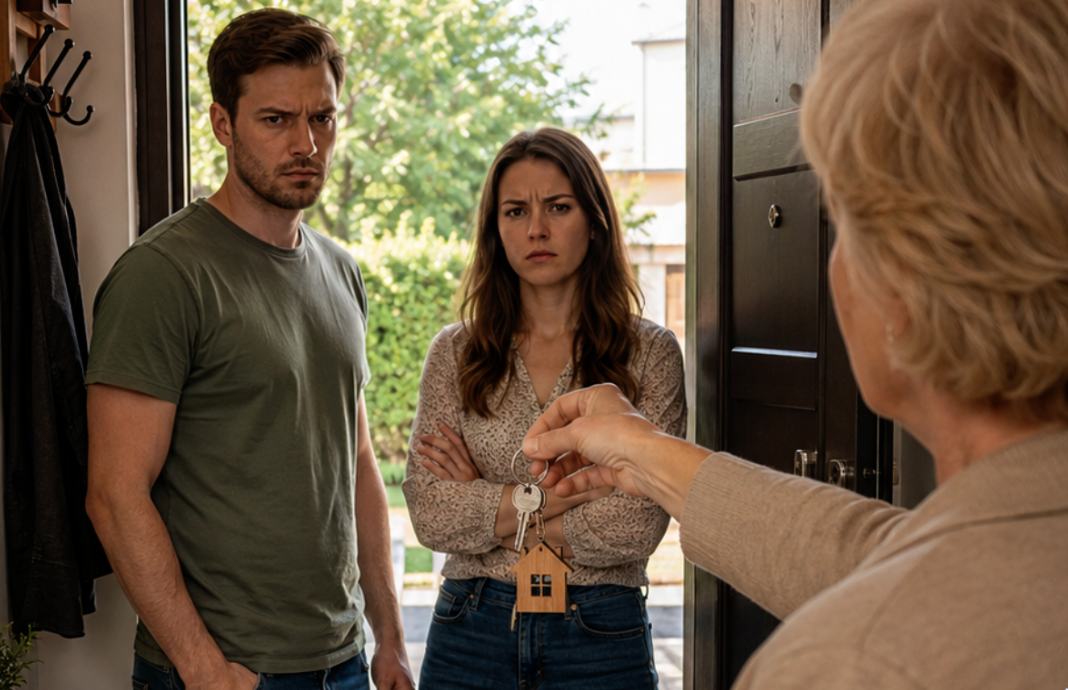
— It’s true. Mom has already filed the paperwork.
Her younger brother’s voice sounded muffled, as if it were coming from underwater. Marina stood in the entryway of her apartment, rainwater dripping from her wet umbrella onto the linoleum floor. Outside the window, the downpour hammered against the cornices, running down the glass in dirty streams. The phone in her hand was still glowing with a message from her second cousin Larisa:
“Congratulations to your mother on making such a successful decision. Kirill will finally have a place to live now. Fair enough — he did so much for her.”
Marina read the message for the fourth time. The words did not change. The dacha by the lake — the very one where her father had spent ten years laying beam after beam, where every board remembered his hands — now belonged to Kirill. Not to her and Ilya. To Kirill.
“Ilyusha,” her voice trembled. “She didn’t even ask us?”
A short pause. She could hear her brother breathing on the other end.
“No. I found out yesterday from one of her friends. I was trying to figure out how to tell you.”
Marina sank down onto the stool in the hallway. The wet umbrella slipped from her hands.
Everything had changed.
The Volkov family had been an ordinary Soviet family: an engineer father, a teacher mother, and two children four years apart. Their father, Sergey Nikolaevich, had died five years ago. Their mother, Tamara Sergeyevna, was left alone in a spacious three-room apartment on Sadovaya Street.
But the family’s true home had always been the dacha. Forty kilometers from the city, on the shore of a forest lake, a six-hundred-square-meter plot of land. Their father had built the timber house over ten years — every weekend, every vacation. Marina remembered how, when she was fourteen, he had taught her to hammer nails in straight, with three clean strikes. Ilya had caught his first pike there when he was eight. They celebrated every birthday, New Year, and May holiday on the veranda.
“Marina, do you remember Kirill Stepanov?” her mother had asked one day three years earlier.
“Aunt Lida’s son? Vaguely.”
“Poor boy. He was left completely alone.”
Lidia Stepanova, her mother’s best friend since university, had died in a car accident ten years earlier. Her son Kirill had been seventeen then. After the funeral, he often visited Tamara Sergeyevna. She helped him with university applications, sometimes gave him money, and fed him lunches.
“Mom, what boy?” Marina had said in surprise back then. “He’s already twenty-seven.”
“He will always be a boy to me. I remember him when he was little.”
Marina and Ilya were neutral toward Kirill. He appeared at family celebrations, smiled politely, and brought their mother flowers on March 8. He worked as a barista in different coffee shops and often changed jobs. He lived with his girlfriend Anya in a rented one-room apartment.
Meanwhile, Marina and her husband Dima were paying off the mortgage on a two-room apartment. Dima had lost his job a year earlier — layoffs, the crisis. Now he did freelance work, but money was barely enough. After his divorce, Ilya paid child support for his daughter and rented a studio apartment.
They had not expected to receive the dacha right away. But they knew that someday it would be theirs. It was family property. It was their father’s memory.
The next morning, Marina stood on the threshold of her mother’s apartment. Tamara Sergeyevna opened the door in a house robe, her hair neatly styled.
“Come in, sweetheart. I made pancakes — your favorite.”
The kitchen smelled of vanilla and hot oil. Her mother set the table slowly and methodically: plates, cups, jam in a crystal dish. As if nothing had happened.
“Mom,” Marina began, sitting down at the table. “Larisa wrote to me about the dacha.”
“Ah, yes.” Tamara Sergeyevna poured tea. “I wanted to tell you myself. I made the right decision.”
“The right decision? Mom, that’s Dad’s dacha!”
“Your father has been gone for five years. Kirill is alive. He needs a roof over his head.”
“He has a roof over his head! He rents an apartment with Anya.”
Her mother sighed as she spread jam over the pancakes.
“Kirill is like family to me. You don’t understand what he went through after his mother died. He has nowhere to return to, no place of his own. And the dacha is just sitting there unused.”
“Unused?” Marina pushed her plate away. “Mom, who paid for the new fence last summer? Who goes there every spring to mow the grass and paint the veranda?”
“Don’t raise your voice.”
“I’m not raising my voice! I’m asking you — why Kirill? Why not Ilya and me?”
Tamara Sergeyevna slowly lifted her eyes. There was fatigue in them, and something else — stubbornness.
“You are strong. You have work, families. You will manage. But Kirill won’t. He is weak, vulnerable. He needs support.”
Marina looked at her mother and, for the first time, saw a stranger. Her mother did not see her and Ilya as children who needed to be protected. They were a resource — strong, capable, they would manage. And Kirill remained the eternal victim who had to be saved.
“Dad built that dacha for us,” Marina said quietly.
“Your father would have wanted me to do what was right.”
A week later, Marina went to the dacha to check the plumbing before winter. An unfamiliar car was parked by the gate. Their neighbor, Aunt Valya, was watering asters over the fence.
“Marina, the realtor came again,” she said instead of greeting her.
“What realtor?”
“The same one who came last week. He was walking around with your Kirill, measuring everything. They say they can offer a good price — the place is by the lake, after all.”
Marina felt the ground drop from under her feet. She pushed open the gate.
The house was cool inside. Kirill stood in the middle of the living room with a tape measure in his hands, typing something into his phone.
“Hi,” he said without lifting his head. “Three by four meters. Fine for a bedroom.”
“Are you planning to sell the dacha?”
Kirill turned around. Irritation flashed across his face.
“So what? The house is old. It needs serious repairs. It’s easier to sell it and buy a studio in the city.”
“This is my father’s memory! He built it with his own hands!”
“So what?” Kirill shrugged. “He doesn’t need the house anymore. I need money.”
Marina turned and walked out. In the car, she called her mother.
“Mom, Kirill is going to sell the dacha!”
“I know,” Tamara Sergeyevna replied calmly. “It’s his dacha now. What he does with it is his business.”
“But do you understand that he’s going to sell Dad’s memory for money?”
“I trust him. He is an adult.”
Marina ended the call.
An adult. The very same person who needed saving because he was weak and vulnerable.
Tamara Sergeyevna’s birthday — sixty-eight years old. The table was set festively: Olivier salad, herring under a fur coat, duck with apples. Everything the way their father had loved it. Marina and Ilya came with flowers and a cake. Kirill was there too, with a bottle of wine and a box of chocolates.
The table was quiet. Forks clinked against plates, someone coughed, someone poured tea. Tamara Sergeyevna smiled tensely and talked about the neighbors, about prices in the store. No one kept the conversation going.
“Do you remember,” Ilya suddenly said, looking down at his plate, “how Dad built the bathhouse? He would come to the dacha after a night shift and lay logs until evening.”
Kirill put down his fork.
“By the way, the realtor says the bathhouse can be sold separately. They’ll pay good money for it.”
Ilya slowly raised his head. Marina saw it: her brother was about to explode.
“Dad built that bathhouse after shifts at the factory. He went days without sleeping. Do you really think he would have wanted it sold to some dealer?”
“Ilya!” their mother flared up. “Don’t you dare hide behind your father! He is dead, and the living need to live!”
Marina placed a hand on her brother’s shoulder. She spoke calmly, looking her mother in the eye.
“Mom, this isn’t about money. Understand that. It’s because you didn’t even ask us. As if we don’t exist.”
“As if we aren’t your children,” Ilya added.
Kirill abruptly stood up, the chair scraping against the parquet.
“You know what? If this dacha is so important to you, take it. I don’t need your scandals and grudges. I just wanted to live normally.”
He headed for the door, but Tamara Sergeyevna stood between him and the exit.
“No! You are not going anywhere. I made my decision, and that’s final. The dacha is legally yours.”
She turned to her children.
“And you… you must understand. Kirill is an orphan. He has no one.”
“He has a girlfriend, a job,” Marina said quietly. “And we, it turns out, have everything except a mother.”
Silence.
Marina understood: this was not about the dacha. It had never been about the dacha. It was about choice. Their mother had chosen a stranger. She had chosen to be a savior instead of a mother.
Three months later, the dacha was sold. Kirill bought a studio apartment in a new building on the outskirts of the city — newly renovated, with a view of the parking lot. He sent Tamara Sergeyevna a photo from the housewarming: him, Anya, and a couple of friends holding glasses of champagne.
Tamara Sergeyevna remained alone in her three-room apartment. The phone fell silent more and more often.
Marina called on Sundays.
“How’s your health, Mom?”
“Fine.”
“Do you need anything?”
“No, I’m managing.”
The conversations lasted three minutes. Ilya stopped by once a month — to bring groceries, pay the utilities. He would sit on the edge of the sofa without taking off his jacket.
In November, Tamara Sergeyevna called Marina.
“The kitchen faucet broke. I flooded the downstairs neighbors.”
“Call a plumber, Mom.”
“They’re asking for a lot of money.”
“Ilya will stop by on the weekend. Or maybe Kirill is free?”
In December, another call came.
“I need to see a cardiologist, but the appointment is only at a hospital on the other side of the city.”
“Call a taxi.”
“I’m afraid to go alone.”
“Then ask Kirill.”
Marina felt a stab of guilt after every conversation. And then, immediately after it, coldness. Her mother had made her choice herself. Now let her call Kirill.
But Kirill was busy. A new apartment, a new job — he had become a manager at an IT company. For Tamara Sergeyevna’s birthday, he sent her a WhatsApp greeting card.
A year later. The May holidays.
Marina was cutting vegetables for salad on the veranda of the new little dacha she and Dima had bought. Six hundred square meters in a gardening community, an hour’s drive from the city. The house was tiny — one room and a veranda. But it was theirs.
Ilya was nailing the last board onto the summer kitchen. His daughter was running after butterflies with a net. Dima was lighting the grill.
“Done!” Ilya stepped back, admiring his work. “Now this is definitely our place.”
That evening, when the shashlik had been eaten and the children had been put to sleep in the tent, the adults sat by the fire. Ilya raised his glass of tea.
“To a new beginning. And most importantly — this is definitely yours. No one will take it away. No one will transfer it to someone else.”
Marina looked into the fire. Flames danced, sparks flew into the darkness. She thought: a home is not walls or documents. A home is where they wait for you, where you are needed.
Her phone vibrated. A message from her mother:
“Marina, you have become so hard-hearted. Ilya too. You have become strangers. I did not raise you like this.”
Marina stared at the screen for a long time. Her fingers froze above the keyboard. What could she answer? That they had not become strangers yesterday, but on the day their mother chose someone else over them?
She locked the screen without replying.
“Everything okay?” Dima asked.
“Yes. Just an ad.”
She looked at her husband, at her brother, at the glowing embers. She thought: when someone cares more about rescuing strangers than being a mother to her own children, who does she lose in the end? The ones she saves? Or the ones who were truly family?
There was no answer. Only the quiet crackling of coals and the stars above their new, real, very own dacha