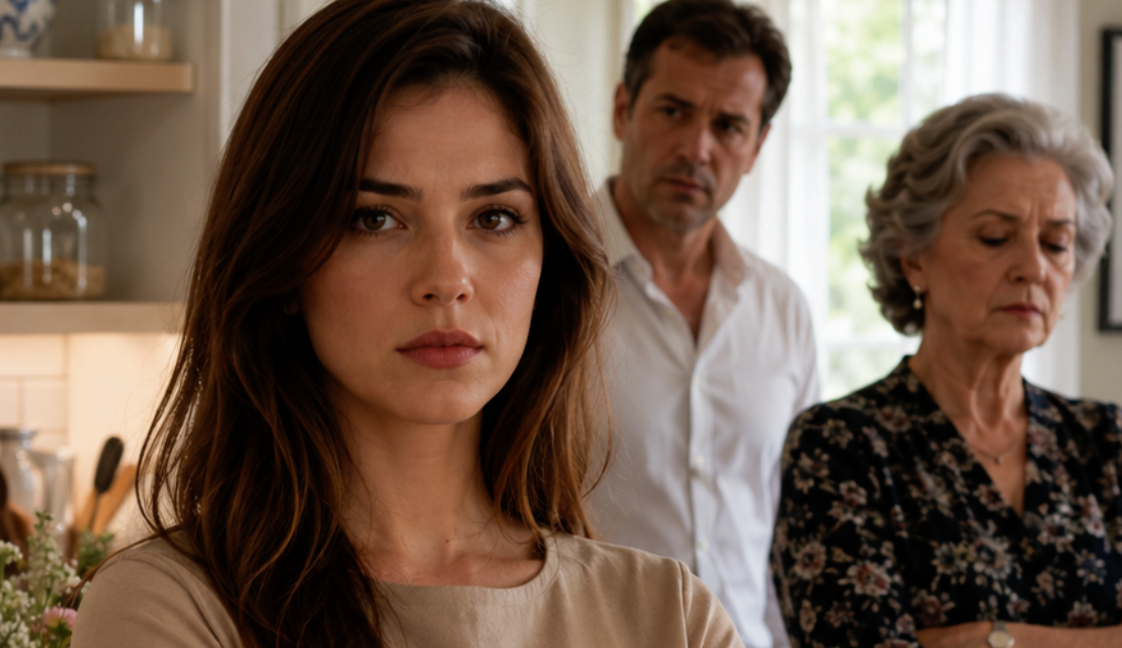
Ksenia stirred the borscht yet again, looking with irritation at the two pathetic pieces of beetroot lazily floating on the surface, while her husband had been digging around on his phone on the sofa for half an hour already.
The kitchen smelled of garlic and irritation.
“Vladimir, I’m asking you very nicely,” Ksenia tried to speak calmly, but her tone still broke, “can you finally take out the trash before your mother gets here?”
“Why are you so worked up?” Vladimir answered lazily, without looking away from the screen. “Mom will say our place is a mess anyway. This way, at least she won’t be saying it for nothing.”
“Brilliant logic,” Ksenia snorted. “Maybe we should tear off the wallpaper and pour mud everywhere too, just to impress her completely?”
She had barely finished speaking when there came a confident, almost commanding knock at the door.
Not the doorbell — a knock.
Ksenia wiped her hands on her apron and went to open it.
As always, Tamara Petrovna was standing on the threshold — wearing a coat buttoned up to her throat, with a hairstyle that looked as if half the hairspray in the store had gone into it. In her hands was a bag, with a loaf of bread and a jar of pickles sticking out of it.
“Oh, the little homemaker!” her mother-in-law said with a venomous squint. “Making your signature dish? That pink little soup again?”
“It’s borscht, Tamara Petrovna,” Ksenia answered patiently. “Classic, just the way you like it.”
“Borscht…” her mother-in-law drawled, peering into the pot. “It looks like compote with onions. Who taught you how to cook?”
“Mom,” Vladimir cut in, getting up from the sofa. “We’ve talked about this. Ksyusha has her own vision.”
“Artists have visions,” Tamara Petrovna snapped. “A housewife should know how to make a proper first course.”
Ksenia bit her tongue so she wouldn’t say something sharp.
But then it got worse. Tamara Petrovna took off her coat, businesslike, placed the bag on the table, and declared:
“All right, children. I’ve come to have a serious talk with you.”
Vladimir tensed. So did Ksenia. Usually, a “serious talk” meant one of them was guilty — and that someone was most often Ksenia.
“Here’s the thing…” her mother-in-law took out her glasses and began leafing through some papers. “A neighbor whispered to me that Ksenia’s grandmother died.”
“A year ago already,” Ksenia replied dryly.
“Exactly!” Tamara Petrovna exclaimed triumphantly. “And that means there was an apartment left behind.”
Ksenia froze.
“How do you know that?” she asked, trying to keep her voice from trembling.
“I have my sources,” her mother-in-law said meaningfully. “So, I think it would be right if you immediately transferred it to Volodya. So it stays in the family.”
“Family.”
“And what am I, not family?” Ksenia crossed her arms over her chest.
“You… well, you understand,” her mother-in-law pretended to choose her words carefully. “Wives come and go. But a son is forever.”
“So I come and go, while Vladimir is here like furniture?” Ksenia narrowed her eyes. “Excellent metaphor, thank you.”
“Ksyusha, don’t start,” Vladimir interfered, scratching the back of his head. “Mom is right. It’s logical.”
“Logical?!” Ksenia almost laughed, but the laugh came out dry. “Vladimir, it’s my grandmother, my apartment. Why on earth should it go to you?”
“Because you’re a wife!” Tamara Petrovna raised her voice. “You should think about your husband, not yourself.”
“And you should think about your son, not someone else’s property,” Ksenia was already boiling. “And yes, the apartment is not a ‘family heirloom.’ It is my personal property.”
“Exactly — as long as you’re in our family,” her mother-in-law remarked poisonously.
Ksenia felt everything inside her tighten.
“Vladimir,” she turned to her husband, “will you ever take my side?”
Vladimir sighed, but looked away.
“Ksyusha, well, I just think Mom is right. We could use that apartment. We could sell it, buy a little house outside the city…”
“And I’d live there on the same plot of land as your mother?” Ksenia laughed. “That wouldn’t be a house anymore. That would be a correctional colony.”
“That only shows how ungrateful you are,” Tamara Petrovna hissed. “My son and I only think of you, and you…”
“Oh, of course, of my happiness!” Ksenia interrupted her. “Especially when you come over every week and inspect how I wash the dishes.”
“Because you wash them as if with your left heel,” her mother-in-law smirked.
Ksenia fell silent. She knew that if she said even one more word, it would turn into a scandal the whole apartment building would hear.
But inside, everything was already tearing its way out.
She sharply took off her apron, threw it onto the table, and said coldly:
“Fine. I understand the purpose of your visit. Thank you for the pickles. Go home.”
“What, are you throwing me out?” Tamara Petrovna raised her eyebrows in surprise.
“I’m asking you to leave. And you too, Vladimir,” Ksenia added, looking at her husband. “I need to think.”
“Ksyusha, you’re going too far,” he began, but Ksenia had already turned and gone into the bedroom, slamming the door behind her.
From the kitchen came an indignant voice:
“You see, son? That’s her true nature!”
And Ksenia stood leaning against the door and, for the first time in a long while, understood:
It looked as though she would have to do more than simply defend the apartment.
She would have to change her entire life.
Ksenia woke up because someone loudly slammed a cabinet door in the hallway.
The sleepy fog dissolved, and in its place came a heavy sense of foreboding.
Vladimir was sitting in the kitchen — with a cup of coffee and the face of a man who was clearly about to announce something unpleasant.
There were some papers lying on the table, and beside them, a phone whose screen was flashing with a message from “Mom.”
“We need to talk,” he said without raising his eyes.
“So much drama first thing in the morning,” Ksenia sat down across from him. “What is it now? The borscht turned out to be the wrong shade again?”
“Ksyusha, don’t joke,” he pressed his lips together. “You understand that the situation with the apartment can’t just hang in the air.”
“It isn’t hanging,” Ksenia answered calmly. “The apartment is mine.”
“You can’t do that,” Vladimir looked up at her. “It’s wrong. Mom is right: we’re family, everything should be shared.”
“Family.”
“Right, shared. Especially when it’s something that came to me,” Ksenia smirked. “But if something is yours, then of course it’s ‘sacred.’”
“Don’t twist things,” he frowned. “We could sell it, pay off the loan, finally buy a car…”
“A car you’ll use to drive your mother to the market every morning?” Ksenia leaned back in her chair. “A wonderful investment.”
“You deliberately turn everything into a joke,” he said irritably. “But I’m serious. If you don’t transfer the apartment to me, I…”
“You what?” Ksenia narrowed her eyes.
“I’ll file for divorce,” Vladimir breathed out, as if a stone had rolled off his chest.
Silence fell.
Only the clock on the wall ticked lazily, as if counting the seconds until an explosion.
“Wonderful,” Ksenia finally said. “Let’s clarify this: you’re ready to destroy our marriage because I don’t want to gift you an apartment my grandmother left me?”
“You’re exaggerating everything!” he jumped up. “It’s not about the apartment. It’s about the fact that you don’t want to think of us as a team.”
“A team?” Ksenia raised her eyebrows. “A team is when both people are playing toward the same goal. Right now, I see that you’re playing with your mother, and I’m playing alone.”
“That’s because Mom is right!” he shouted. “She just wants to help us.”
“Oh yes, I know how she ‘helps,’” Ksenia smirked bitterly. “First she criticizes my cooking, then she hints that I’m unworthy of her son, and now she’s decided to deprive me of my inheritance.”
“You’re going too far,” he repeated again, but more quietly now.
Ksenia felt anger rising inside her. Not just hurt — a desire to grab her bag and leave without looking back.
“Vladimir,” she stood up, looking down at him, “let’s be honest: if I transfer the apartment to you tomorrow, will your mother finally leave me alone?”
“Well…” he hesitated. “I think so.”
“There’s the whole truth,” Ksenia said coldly. “You’re ready to trade our marriage for your mother’s peace of mind.”
He turned away, took out his phone, and started typing something.
“Mom, she doesn’t understand,” Ksenia managed to see on the screen before he put it away.
“Excellent,” her voice trembled, but she pulled herself together. “Tell your mother that I’ve understood something too.”
She went into the bedroom, took out a suitcase, and began packing her things.
A couple of minutes later, Vladimir appeared in the doorway.
“What are you doing, leaving?” There was more confusion than anger in his voice.
“Yes,” she answered shortly. “Since you’ve chosen your mother and her advice, I’ll make room for the two of you to live together.”
“Ksyusha, don’t dramatize,” he took a step toward her, but she stepped back.
“This isn’t drama,” she looked up at him. “This is the end of Act One.”
“You’ve lost your mind,” he grabbed her by the arm, but Ksenia pulled free.
“Let go,” she said firmly. “And yes, I’m taking all my things. Even the kettle.”
“The kettle?” he was stunned.
“Yes. A symbol of our marriage: useful in theory, but always hissing,” she tossed the last sweater into the suitcase and slammed it shut.
Vladimir stood in silence.
Ksenia walked past him without even turning around.
In the hallway, she heard him say quietly, almost in a whisper:
“Mom, she left.”
And suddenly she felt like laughing.
Laughing because they had seriously thought they could pressure her with threats and manipulation.
But somewhere deep inside, the laughter was bitter — because she understood that the real war was still ahead of her.
The new apartment greeted Ksenia with the smell of old wood and silence.
Grandmother would have said, “Walls remember everything.”
Ksenia closed the door behind her and, for the first time in a long while, felt it was her space.
For three days she lived as if in a trance: she called a locksmith, changed the locks, ordered a new door.
Vladimir called, wrote messages, knocked in every messenger app.
She did not answer.
On the fourth day, the doorbell rang in real life.
Through the peephole — Tamara Petrovna, with that same face capable of expressing offense, contempt, and certainty of her own righteousness all at once.
Ksenia slowly opened the door, but left the chain on.
“Do you seriously think you can just walk away like that and that’s it?” her mother-in-law asked with a poisonous smile.
“Yes. I can. And I should,” Ksenia answered calmly.
“Ksyusha,” her voice became soft, but that only made it more vile, “we are family. We have common interests.”
“Family.”
“You and your son do,” Ksenia did not remove the chain. “I have my own now.”
“You are obligated to give up the apartment,” Tamara Petrovna immediately stopped pretending to be kind. “Otherwise Volodya will file for division of property.”
“Let him,” Ksenia shrugged. “At the same time, we’ll divide the kettle.”
“What?” her mother-in-law blinked.
“Long story,” Ksenia smirked dryly.
“Ksyusha, you’re ruining your life!” Tamara Petrovna switched to shouting. “Do you think it will be easy without a husband? You’ll come crawling back in a month!”
“You know,” Ksenia looked her straight in the eyes, “I’d rather sleep alone in my own apartment than share a bed with a mama’s boy.”
Tamara Petrovna turned crimson.
“Did that old hag of a grandmother teach you all this?!”
“Yes,” Ksenia suddenly smiled. “She always said: ‘Protect what’s yours. Husbands can be changed, apartments rarely can.’”
The door slammed.
Tamara Petrovna was left on the other side, muttering something about ungrateful women.
A week later, Ksenia sat in court.
Vladimir came with his mother, and she came with a lawyer.
“The apartment is my client’s personal property,” her representative said firmly. “It was received through inheritance, and therefore is not subject to division.”
Vladimir kneaded the folder in his hands, while Tamara Petrovna kept whispering something into his ear.
The judge quickly issued the decision: the apartment would remain Ksenia’s, and all jointly acquired property would be divided equally.
In the corridor after the hearing, Vladimir tried to approach her.
“Ksyusha, we could have settled everything peacefully…”
“Peacefully?” she turned sharply toward him. “You mean when you and your mother tried to drive me out of my own home?”
“I just… wanted us to…”
“Wanted us to what?” she interrupted. “For me to live by your rules? Absolutely not.”
She turned around and walked away, leaving him with his mother, who was already beginning a new monologue about “women without conscience.”
That evening, Ksenia opened a bottle of champagne.
Alone. Without toasts or guests.
She looked out the window at the city lights and thought that yes, it would be hard.
But hard is when you live someone else’s life.
And now she had her own.
Her phone vibrated:
“Mom, she won.”
The message had been sent to her… by accident.
Ksenia laughed.
For a long time, until she cried. Because this was the final period. Loud. Definitive.