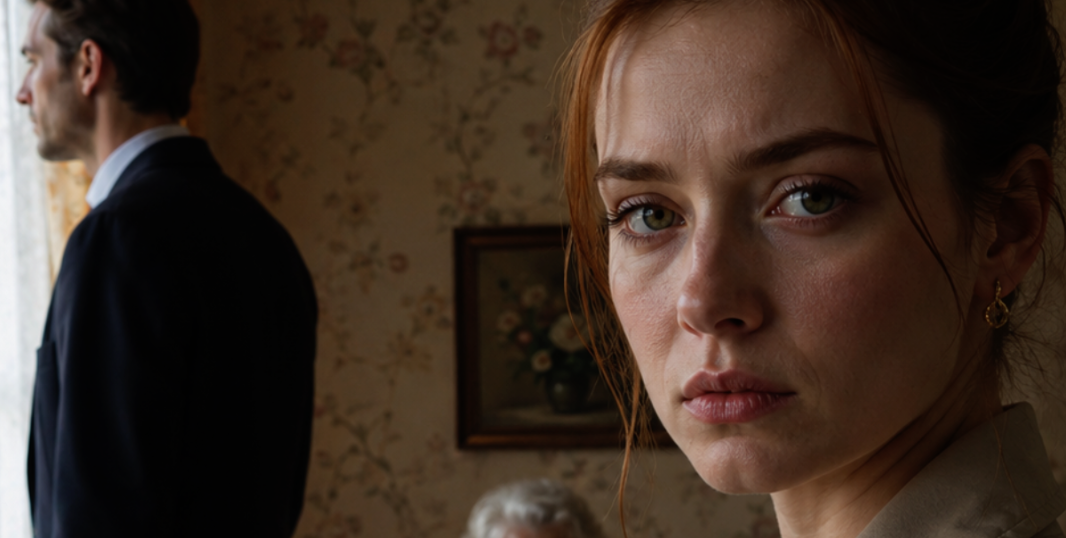
The third step on the fourth floor always made an unpleasant sound. Veronika knew this peculiarity of her building by heart, just as she knew that the elevator in their nine-story apartment block broke down exclusively on Fridays, when grocery bags seemed to weigh an entire ton. She stopped to catch her breath. Blood throbbed in her temples with a dull rhythm: reports, invoices, Chinese customs, delays.
She wanted only one thing: silence. Not the kind that rings in your ears before you faint, but a thick, velvety silence you could wrap yourself in like a blanket. To take off her shoes, stretch out her legs, and stare at one spot for half an hour before turning from head of the logistics department into a cook and a wife.
The key entered the lock with difficulty. Veronika frowned. The lock had been turned twice, although Vadim was usually too lazy and simply slammed the door shut.
The apartment greeted her not with the familiar smell of coffee or, at worst, yesterday’s dinner, but with the thick, sweetish odor of Corvalol and old wool. The smell seemed to hang in the air like a physically tangible cobweb.
“Vadim?” she called, setting the bags down on the hallway floor.
Her husband appeared from the bedroom. He was wearing his favorite stretched-out sweatpants, but he looked as if he were preparing to repel a cavalry attack: disheveled, with shifty eyes.
“Oh, Nika… You’re early.”
“It’s eight in the evening, Vadim. Same as always. What’s going on? Why does it smell like a treatment room in here?”
He blocked her way to the bedroom, spreading his arms in a ridiculous gesture of defense.
“Just don’t get nervous. The situation, you understand, is impossible. Force majeure.”
Veronika, wasting no strength on conversation, simply walked around him. Years of working in logistics had taught her that obstacles had to be either removed or bypassed. She pushed open the bedroom door.
Her bed — wide, with an orthopedic mattress she had bought with her bonus from the previous quarter — had been occupied. Tamara Ilyinichna was reclining on a mountain of pillows. Her mother-in-law looked pale, but very much alive, and on the nightstand beside the lamp stood a whole battery of little bottles.
“Hello, Veronika,” she said in a weak, cracked voice. “My son took me in. A mother shouldn’t be left to die under a fence.”
Veronika slowly turned toward her husband. Vadim pressed his shoulder against the doorframe.
“A stroke?” she asked dryly.
“A mini one,” Vadim hurried to clarify. “The doctors discharged her. They said the progress is positive, but she needs rest and home care.”
“And you decided the best care would be in our bedroom? In my apartment? Without even calling me?”
“Where was I supposed to take her?” Vadim went on the offensive, his voice turning shrill. “To Larisa’s? She has renovations, children, there’s no air to breathe there. Here it’s quiet, the air is good. You and I can make do on the sofa in the living room. We’re not nobility.”
“Vadim,” Veronika said very quietly, but her husband knew that tone — it was how she spoke to suppliers who had missed deadlines. “The sofa in the living room is broken. You’ve been promising to fix the mechanism for six months.”
“I’ll fix it! Tomorrow! Nika, have some conscience. This is my mother.”
That was how the occupation began.
Veronika’s life, built according to a strict schedule, collapsed. The apartment turned into a restricted facility. The morning began not with a shower and coffee, but with checking diapers — even though Tamara Ilyinichna was perfectly capable of walking to the toilet, but claimed she felt “dizzy” — and cooking oatmeal in water.
Vadim masterfully played the role of the suffering son with “helpless little paws.”
“Nika, come on, I’m a man,” he grimaced whenever the bed linens needed changing. “I can’t do it, it makes me sick. You’re a woman. It’s built into your nature.”
“What’s built into my nature is coordinating freight trucks, not carrying bedpans,” Veronika snapped, but she did it anyway.
Because she could not live in filth. Because her upbringing would not allow her to abandon an elderly person, even if that person had spent years making barbed remarks about her cooking skills and the absence of children.
Once Tamara Ilyinichna settled in, she launched a campaign to reeducate her daughter-in-law.
“Veronika!” her demanding voice rang out from the bedroom. “Close the curtains, the sun is hitting my eyes! And why is the soup under-salted again? Are you saving money on salt?”
Veronika silently closed the curtains. Silently carried away the plate. Inside her, somewhere near the solar plexus, a spring was slowly tightening.
Larisa, her sister-in-law, appeared two weeks later. She fluttered in, reeking of heavy oriental perfume, wearing a new suede jacket.
“Mommy!” she chirped, walking to the bed without even taking off her shoes. “My poor dear! You’ve become so thin!”
Veronika stood in the doorway with her arms crossed.
“Larisa,” she said evenly. “The doctor prescribed a new course of vascular medicine. Four thousand. Here’s the prescription. The pharmacy is in the next building.”
Her sister-in-law turned around, and her face reflected all the sorrow of the Jewish people.
“Oh, Veronika… We’re in such a hole right now. The car loan, braces for the twins. Let Vadik buy it. Or you. You’re a boss, you rake in money by the shovel.”
“My shovel broke,” Veronika cut her off. “Vadim spent his advance on groceries.”
“You’re so petty,” Tamara Ilyinichna sighed from her pillows. “God will judge you.”
The denouement came on Saturday. The day was dry and windy, dust beating against the windows. Vadim had gone out “on business” — most likely hiding in the garage with his friends, escaping the atmosphere of the infirmary. Veronika started doing laundry.
She mechanically sorted the clothes: whites, darks, delicates. She picked up her husband’s jeans and, out of habit, checked the pockets — Vadim was always forgetting coins and gas station receipts in them.
Her fingers felt a thick piece of paper folded into four.
Veronika unfolded the sheet. It was not a receipt. It was a residential lease agreement.
The date was three days before her mother-in-law’s “discharge.”
Property: a two-room apartment on Gagarin Street — Tamara Ilyinichna’s apartment.
Price: thirty-five thousand rubles per month plus utilities.
At the bottom was Vadim’s sweeping signature, acting under power of attorney, and the signature of some citizen named Aliyev.
And a handwritten note: “Deposit and payment for two months received in full.”
Veronika sat down on the edge of the bathtub. Something clicked in her head, as if the final piece of a complex puzzle had fallen into place.
There had been no hopelessness. No emergency situation. It was a business plan. A cold-blooded, cynical calculation. Rent out his mother’s apartment, receive one hundred thousand at once — rent plus deposit — and dump the mother herself, with her whims, smells, and medicines, onto the “rich” daughter-in-law. Let Veronika deal with her. She was tough. She would endure it.
The spring inside her released. There was no pain. There was icy, crystalline clarity.
When the front door slammed and Vadim’s voice rang out, “Nika, I bought bread!” Veronika was sitting in the kitchen. The contract lay on the table in front of her.
Vadim entered smiling, but the smile slid off his face like a badly glued mask the moment he saw the paper.
“You… were you spying on me? Going through my pockets?”
“I was doing laundry, Vadim. The thing you should do yourself but don’t, because you have ‘helpless little paws,’” Veronika’s voice sounded calm, almost ordinary. “One hundred and five thousand rubles. Where is it?”
Vadim turned red, the veins in his neck swelling.
“It’s Mom’s money! For rehabilitation! And Larisa needs help too, she has a situation…”
“And what am I, then? A sanatorium?” Veronika stood up. “Here’s how it will be. You have one hour.”
“For what?”
“To pack. Call movers. Take your mother. And leave.”
Tamara Ilyinichna appeared in the doorway. She was leaning on a cane, but she stood quite steadily.
“What are you plotting?” she hissed. “Throwing out a sick woman? How does the earth even carry people like you?”
“The earth carries all kinds, Tamara Ilyinichna. Even those who rent out their own apartment to buy their daughter a car while parasitizing off their daughter-in-law,” Veronika looked her mother-in-law straight in the eyes. “I saw Larisa’s messages on your phone when I put it on charge. ‘Mom, put up with that hag for a couple of months, and we’ll close the mortgage.’ Wasn’t that what it said?”
“We’re family!” Vadim shouted, punching the wall. “You’re obligated! In sorrow and in joy!”
And then Veronika said what had been ripening inside her all those weeks. She did not shout. She simply stated a fact.
“I did not sign up to be a nurse! Take your mother to your sister or get out with her.” Her husband froze in shock, as if he had been slapped. “You brought your mother after a stroke into our bedroom without asking me. You lied to my face. You ate my food, slept under my roof, and considered me an idiot.”
“You’ll regret this!” Vadim’s voice rose to a squeal. “Who needs you, an old divorced woman? I’ll leave!”
“That is the best thing you can do. Time starts now. In one hour I’m changing the lock cylinder. The locksmith is already on his way.”
The packing was chaotic. Vadim threw things into bags, cursing Veronika, calling her hard-hearted, soulless, a “dry cracker.” Tamara Ilyinichna sat on the bench in the hallway, theatrically clutching her heart, but when she noticed her daughter-in-law was not reacting, she began efficiently instructing her son not to forget the blood pressure monitor.
Veronika did not help. She stood by the living room window and looked outside. She did not care. She felt like a logistics specialist who had finally gotten rid of non-liquid cargo that had been taking up expensive storage space.
When the door slammed shut behind them, the apartment became quiet.
Veronika went to the door and turned the deadbolt twice. Then she returned to the bedroom. She threw the window wide open. The autumn wind, cold and sharp, burst into the room, sweeping away the smell of medicine and betrayal.
She stripped off the bed linens, crumpled them, and shoved them into a garbage bag. She would never sleep on them again. Tomorrow she would buy new ones. Dark blue. Silk.
She went into the kitchen, opened a bottle of wine she had been saving for a special occasion, and poured herself a full glass.
The phone rang. The screen showed: “Larisa.” Without flinching, Veronika tapped “Block.” Vadim’s and her mother-in-law’s numbers followed into the blacklist.
She took a sip. The wine was tart and astringent.
Was she afraid of being alone? Veronika listened to herself. No. What was frightening was waking up in ten years on a broken sofa, next to a person who did not respect you, and realizing life had passed you by while you were cooking oatmeal.
Tomorrow she would call a cleaning service. Then she would go to the furniture store and buy that very leather sofa for the living room. White. Impractical. Just for herself.
Veronika smiled at her reflection in the dark window. The wind billowed the curtains, and at last the apartment became easy to breathe in.