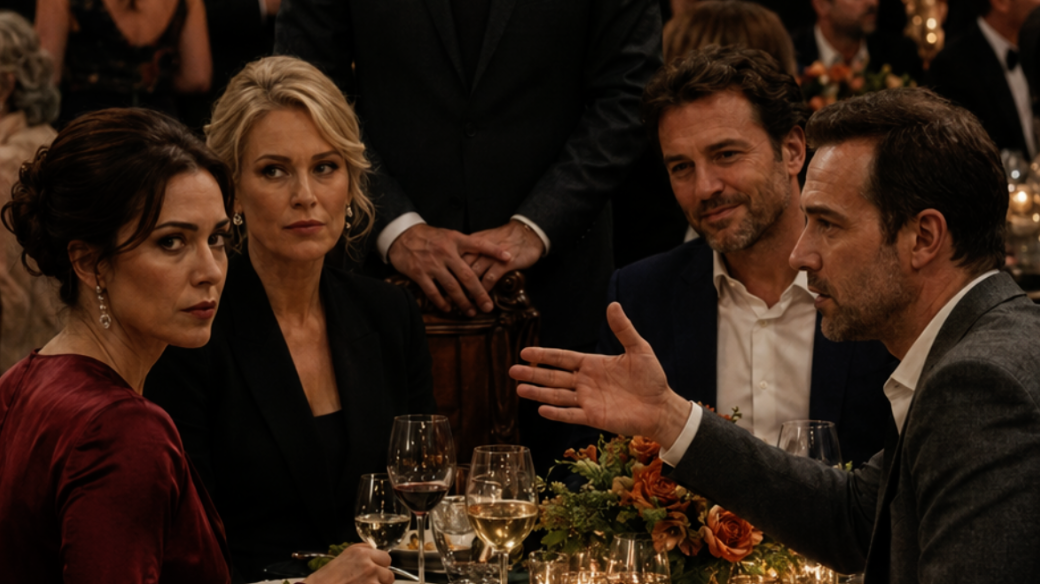
Lena Krylova realized the evening was over before it had even truly begun. The moment her husband Artyom picked up a second glass of mineral water from the table and turned toward his colleagues with that familiar expression — eyebrows slightly raised, lips already creeping into a smirk — she felt the familiar burning under her ribs.
Not hurt exactly. More like a premonition. Like before a thunderstorm, when the air grows heavy and still, and you know for certain: it is about to begin. And there is nowhere to go, because you are sitting in the middle of a banquet hall for thirty-eight people, wearing a new dress you spent two hours choosing, and you have no right to make a scene.
Artyom had invited her to the company party on Thursday, two days before the event. “Invited” was putting it generously. He had more or less presented her with a fact.
“On Saturday, our company has an event. Wives will be there too. Wear something normal.”
“Something normal” — his eternal phrase, the one that made Lena shudder every time. Not because she dressed badly. But because of what stood behind those words: don’t embarrass me.
Lena worked as a pastry chef. She had opened her own business five years earlier, back when Artyom earned half as much as he did now and they lived in a one-room apartment bought with a mortgage on the outskirts of the city.
She started baking to order — wedding cakes, anniversary cakes, corporate cakes. First from their tiny kitchen, then from a rented workshop in an industrial area, and now from her own pastry workshop with two assistants and a two-month waiting list.
A couple of years after opening the workshop, they moved into a new apartment — a two-room place on Leningradsky, also with a mortgage, but this time jointly owned. Lena had paid the down payment from her savings; Artyom covered the monthly payments. An unspoken agreement they both tried not to discuss, because any conversation about money turned into a silent tug-of-war.
Artyom worked as a commercial director at a company that supplied furniture and tableware to restaurants. The job paid well, but it was stressful. His boss, Viktor Stepanovich, was the kind of man who said little, but every word carried weight. Artyom was afraid of him and, at the same time, desperately wanted to impress him.
Only the Lena he intended to show at the company party was not the real Lena.
It was the Lena he had invented himself.
Saturday evening began well enough. Lena arrived at the restaurant straight from the workshop — she had spent the whole day assembling a six-tier cake for an anniversary. She changed in the car. A dark green fitted dress. Medium heels, so she would not be taller than Artyom.
Artyom was waiting at the entrance. He looked her up and down, then nodded. He did not say, “You look beautiful.” He simply nodded — the way people accept goods according to an invoice: matches the description.
Lena was seated next to Artyom. On her right sat his colleague Zhenya, a cheerful man of about thirty-five, who immediately began asking what she did. Lena answered modestly: custom cakes, her own workshop. Zhenya whistled.
“Seriously? Impressive! And here we’ve been envying Artyom for staying so thin. We thought he wasn’t being fed at home.”
Zhenya laughed. Lena smiled. For some reason, Artyom did not.
The problem with Artyom was not that he was a bad person. He had grown up in a family where his mother earned more than his father — and his father had never forgiven it. Not her. Himself. But he poured his anger out on her in words. Small, sharp, precise words.
“Well, of course, you’re the boss around here.”
“Go on, tell us again how you carry the whole family by yourself.”
Artyom had heard that from the age of seven until eighteen. And he had absorbed the lesson: if your wife earns more, then something is wrong with you.
Lena understood that.
But understanding did not make it hurt any less.
When she opened the workshop, Artyom had supported her at first. He painted the walls, drove flour from the wholesale warehouse. But then, as the orders grew, he began making comments. At first they were mild. Then sharper. Then came the jokes — the kind behind which people hide everything they are unable to say directly.
By the middle of the evening, Artyom had relaxed. Zhenya called across the table:
“Artyom, is it true your wife makes cakes? I saw them on social media — they’re so beautiful!”
And then Artyom did what he always did whenever Lena received too much attention.
“Cakes?” He leaned back in his chair and raised his hand, drawing attention to himself. “Yes, she makes cakes. But at home — disaster! Lena can’t cook at all. Nothing but ready-made food at home. I live like an orphan!”
The table burst into laughter. Not everyone — but enough for the sound to spread through the hall. Rita, the wife of one of the managers, who was sitting beside Lena, froze and looked at her with sympathy.
Lena sat motionless.
She remembered how, two nights ago at eleven o’clock, after twelve hours in the workshop, she had stood at the stove frying fish and vegetables for him. How that morning she had left him a container with rice and chicken. How on Sunday she had made dumplings for three days ahead because “Artyom doesn’t like it when there’s no proper food.”
Lena set down her fork.
Carefully.
Without a sound.
She had learned to do that over twelve years — to put things down without making noise while everything inside her was boiling.
He was not simply joking. He was constructing an image. In front of these people, in front of his boss, he was painting a picture: poor hardworking husband and useless wife. Because if they found out she earned twice as much as he did, the whole structure would collapse.
Rita leaned toward her and whispered:
“Are you all right?”
Lena nodded. She smiled — with her lips, not her eyes.
Rita looked away. She was silent for a moment. Then, just as quietly, she said:
“My first husband used to joke like that too. That’s why he’s my first.”
Lena looked at her. Rita returned to her plate and added nothing else. But those three words — “that’s why he’s my first” — hung in the air like a question Lena had never once asked herself. Or perhaps she had, but had never allowed herself to hear the answer.
She sat at the festive table among people who knew her husband and now — according to his version — knew her.
Lena-the-ready-meal.
Lena-who-can’t-cook.
Meanwhile, in her workshop, there stood a six-tier cake. Tomorrow it would be picked up and delivered to a restaurant for one hundred and twenty people, and one hundred and twenty people would eat it, photograph it, and ask, “Who made this?” And someone would answer, “Elena Krylova.” And not one of them would think she couldn’t cook.
Lena was already counting the minutes until they could leave when Viktor Stepanovich approached their section of the table. He was a short, solid man over fifty, in a good suit, with attentive dark eyes. He never raised his voice — people listened to him anyway.
He walked around the table, shook hands. Artyom jumped up and said something obsequious. Viktor Stepanovich nodded to him and turned to Lena.
“And you are Artyom’s wife, if I’m not mistaken?”
“Yes. Lena.”
Viktor Stepanovich shook her hand. Then he narrowed his eyes.
“Wait. You’re Lena Krylova, aren’t you?”
The hall became quieter — conversations at their section of the table died down.
“We ordered a cake from you last year for the company anniversary. Twenty-five years. Chocolate, with a marzipan logo. Do you remember?”
Out of the corner of her eye, Lena saw Artyom’s face slowly changing. He did not turn pale — he turned to stone. That is what a person looks like when the support under his feet suddenly disappears.
“I remember,” Lena said calmly, smiling. “We cast the logo separately. It took some work.”
Viktor Stepanovich turned toward the table.
“Colleagues, for those who don’t know,” he said quietly, though each word fell into the silence, “Lena Krylova is one of the best pastry chefs in the city. We’ve been ordering from her for two years now. The partners still remember the anniversary cake. New Year events, corporate parties, off-site receptions. Everything has been… impeccable.”
The table fell silent. Zhenya looked at Artyom. Rita looked at Lena.
And then Viktor Stepanovich added:
“Artyom, it seems you’ve been modest. Your wife is a professional of such a level, and you keep quiet about it.”
It was said softly, almost kindly. Artyom, however, heard something else: I heard you. And I did not find it funny.
“Yes,” Lena said, her voice even. “That’s me. The very one who can’t cook.”
Zhenya snorted and choked on his water. Someone at the table started clapping — awkwardly, not quite understanding what they were applauding.
They drove home in silence. Twenty-three minutes — Lena checked on her phone. Streetlights flashed past outside the window. She looked at her hands folded in her lap over the green dress and thought that in six hours she had to be at the workshop. A morning order — two cakes for a restaurant anniversary, one hundred and twenty servings. She needed sleep. She had to get up at five. She had to keep living.
And beside her sat the man who had just told thirty-eight people that she couldn’t cook.
Twelve years together.
She had made him breakfasts, lunches, dinners. Not because she was obliged to, but because she loved him. Because she liked watching him eat and praise her. In the first years, he had praised her. He used to say, “Len, you’re a magician.”
Then she began earning more.
And the praise ended.
Gradually, almost imperceptibly, like water from a tap that has been turned halfway off — you don’t notice it at first, and then suddenly there isn’t enough left to wash with.
Then Artyom spoke.
“You could have warned me.”
“About what?”
“That Viktor Stepanovich is your client.”
Artyom gripped the steering wheel more tightly. His fingers turned white. He was silent. Then:
“You set me up.”
Lena did not even turn toward him. She exhaled slowly, controlling every breath the way she did when working with chocolate: temperature, precision, not one unnecessary movement. Because if she let herself go now, she would say something that could never be repaired.
“I set you up?” she asked evenly. “I was sitting there. Quietly. Eating salad. You got up yourself and told everyone I couldn’t cook. And now I set you up?”
“It was a joke.”
“A joke is when both people find it funny.”
“Everyone laughed.”
“EVERYONE IS NOT ME.”
She did not shout. She said it like a verdict: without emotion, measured. That was exactly why the words sounded deafening.
Artyom parked the car. Turned off the engine. For a long time, he sat staring at the steering wheel.
“Do you understand what he thinks of me now?”
Lena unfastened her seatbelt. She turned toward him fully.
“Do you know what hurts the most? Not the joke. I could have survived the joke. What hurts is that you made a choice. Between telling the truth — that your wife is a pastry chef, that she has a two-month waiting list, that she feeds you every day — and making me look useless in front of thirty-eight people. And you chose the second. Because that was more convenient for you. Because if they knew the truth, they would have had to respect not you. Me.”
Artyom was silent.
“And do you understand,” Lena continued, “what everyone at that table now thinks of me? Rita, who was sitting beside me — she felt sorry for me, Artyom. Sorry. While I’m the one feeding her company’s corporate events with my cakes.”
She got out of the car without slamming the door.
Carefully.
As usual.
Twelve years of carefulness, twelve years of “don’t make a scene,” twelve years of “swallow it and move on.”
She went up to the apartment. Took off her shoes. Put on the kettle. Picked up her phone — four missed calls from the client about tomorrow’s cakes. She would call back in the morning.
Lena sat down at the kitchen table and, for the first time that evening, relaxed her shoulders. Here, in the silence of their kitchen — the two-room apartment on Leningradsky, mortgage, jointly owned, down payment hers — she felt in her place.
Because this kitchen knew the truth: Lena Krylova knew how to cook.
And not only knew how — her business, her reputation, and her three million a year depended on it.
Twenty minutes later, she received a message.
Not from Artyom.
From Viktor Stepanovich.
“Lena, forgive me for the late hour. I wanted to say that I feel awkward about what happened at the table. Your husband was apparently joking. But I want you to know: we value your work very highly. And I have a business proposal for you. We are opening a restaurant with a pastry section. We would like the entire dessert line to be yours — your brand, your recipes, your name on the menu. Let’s meet sometime this week.”
Lena reread the message twice. Then she heard Artyom finally enter the apartment and stop in the kitchen doorway.
“Len, listen… I went too far with the joke, all right, it happens. Let’s not make a mountain out of—”
She raised her eyes to him.
Calmly.
No tears, no shouting, no hysteria.
She simply looked at him the way one looks at a worktable before beginning a new order: assessing, sober, fully aware of what can still be made from it — and what can no longer be saved.
“Artyom,” she said. “Do you know how much reputation costs?”
“What?”
“Reputation. Since you like numbers. Last year your boss’s company paid me three million. Three million. For cakes that, according to you, I don’t know how to make. And now Viktor Stepanovich has written to me — offering a partnership. A new restaurant, my name on the menu.”
She showed him the phone. Artyom read it. Raised his eyes.
“He wrote to you… after…”
“After you told him I couldn’t cook. Yes. He wrote to me. Not to you.”
Artyom stood in the doorway of their kitchen — the very kitchen where she had fed him dinners for twelve years, dinners that, according to his version, had never existed. His arms hung at his sides. On his face there was no smirk, no confidence, none of the charm with which he had entertained his colleagues two hours earlier.
Nothing.
Emptiness.
Lena got up from the table.
“I’m going to accept his offer. And from now on, I don’t care what you tell people about me at your company parties. Because now your boss knows who I am. His wife knows. His partners know. My name will be on the menu of the restaurant they’re opening. And your ‘joke’ will remain yours alone.”
She paused.
“By the way, there are dumplings in the fridge. The ones I made on Sunday. The ones made by someone who supposedly can’t cook. Heat them yourself.”
And she went into the bedroom. She closed the door. She did not slam it — she shut it quietly, carefully, as she had been used to doing for twelve years.
Artyom remained standing in the kitchen, with his wife’s phone before his eyes, glowing with a message from the man who paid his salary.
A husband’s joke is not humor.
It is a character reference.
Not of his wife.
Of himself.
Would you be offended by a joke like that from your husband?