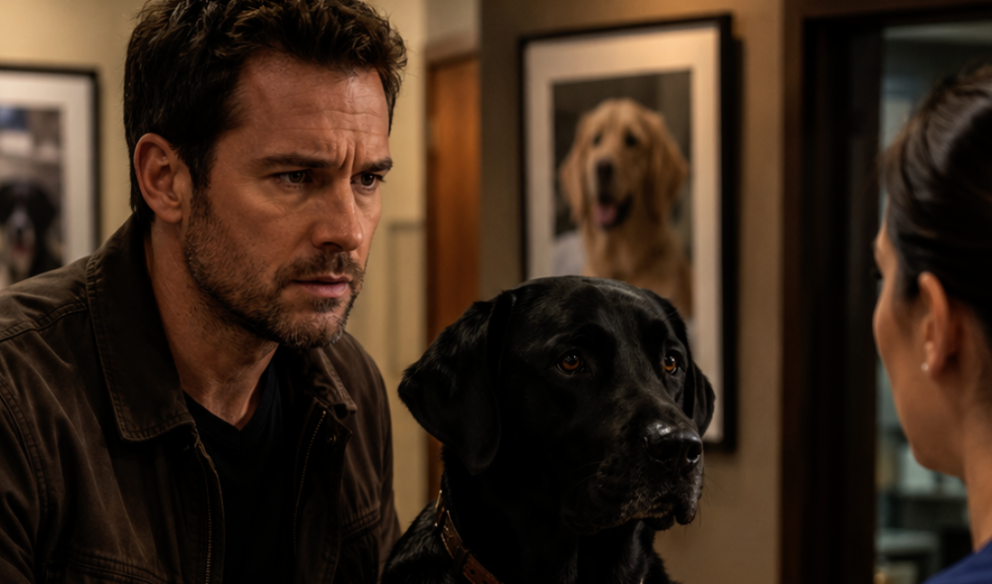
“Either you take him today, or I’ll just tie him up by the highway,” the man in the expensive jacket said irritably, pushing the leash across the counter.
Vera looked up from the intake log and clenched her teeth. At the other end of the leash sat a large black dog with intelligent eyes. He did not bark, strain, or whine. He only looked at the man as if he already understood everything.
“And where is his owner?” Vera asked calmly.
“Dead,” the man snapped. “My uncle. Stroke, hospital, then that was it. I don’t need the dog. I have children.”
“If you don’t need him, that doesn’t mean you can throw him away like old junk,” Vera said quietly.
“Don’t start lecturing me! I’ve just come from a funeral, by the way.”
He was lying. Vera understood that immediately.
A person who has just buried someone close does not smell of expensive cologne and fresh tobacco. And his eyes do not shine the way they do when someone is already mentally counting someone else’s square meters.
“What’s the dog’s name?”
“Grom.”
The dog barely lifted his ears when he heard his name.
“Do you have any documents for him?”
“What documents? He’s a mutt. He lived with my uncle and guarded the apartment. Now that’s it, end of story.”
Vera came out from behind the counter, crouched in front of the dog, and held out her hand. Grom sniffed her palm and sighed heavily. Around his neck was an old leather collar, and a metal tag hung from the ring. Engraved on it were the words: “Grom. If lost, return home.” Below that was an address.
“A story ends only when conscience has ended,” Vera said, standing up. “Leave your phone number. I’ll contact you when we find temporary foster care.”
“No foster care. I don’t have time. I’m leaving.”
“Then take the dog back.”
The man waved his hand.
“Fine, whatever.”
He turned sharply and was about to pull the leash back, but Grom suddenly planted all four paws on the floor and growled quietly. Not at Vera — at him. The man turned pale, muttered a curse under his breath, and let go of the leash.
“Choke on him, all of you,” he threw out. “He won’t last long anyway. His owner’s gone.”
A minute later, the glass door of the clinic slammed shut.
Grom stayed.
Vera worked as an administrator and veterinary assistant in a small private clinic on the first floor of an old building. Dozens of animals passed through her during a shift, but for some reason she became attached to this dog immediately.
Maybe it was because of that look. It was not even quite a dog’s look, but something very human — tired, patient, and wounded.
There was nowhere to keep Grom overnight. All the kennels were occupied by post-operative patients. Vera brought him a blanket into the back room, set down a bowl of water and some food. The dog did not go near the bowl. He lay down by the door and rested his muzzle on his paws.
“Are you offended?” Vera asked.
Grom slowly raised his eyes.
“Or are you waiting?”
He blinked. Then he stared at the door again.
Wet snow began falling during the night.
In the morning, Vera came earlier than everyone else and saw that the back room was empty.
The door had not been closed properly. Apparently, the cleaner had taken out the trash and had not noticed the dog slipping outside.
“That’s just what I needed…” Vera breathed out.
She searched the courtyard, the neighboring yards, the garbage areas, and checked near the bus stop. Grom was nowhere.
At that very moment, on the fourth floor of building number eighteen on Polevaya Street, librarian Nadezhda Sergeyevna was trying to open the door to her apartment and could not understand what was blocking it.
She looked through the crack and shuddered.
Beside her door and the neighboring one, on the mat by Semyon Arkadyevich’s apartment, lay a huge black dog. He was soaked through, but he did not even move when Nadezhda dropped her bunch of keys.
“My God… Grom?” she asked uncertainly.
The dog raised his head.
Nadezhda knew him. The whole building knew him.
Semyon Arkadyevich, a lean pensioner with a straight back and a cane, walked Grom twice a day in any weather. He greeted everyone with the same politeness, and kept the dog close beside him without fuss or shouting.
Grom frightened no one and never bothered people. He simply walked beside his owner as if serving him out of love.
A week earlier, an ambulance had taken Semyon Arkadyevich away.
Grom had howled so terribly then that Aunt Shura, the concierge, crossed herself all day afterward. The next day, the owner’s nephew, Igor, arrived. He carried boxes for a long time, changed the lock, and told everyone the same thing:
“My uncle died. I’m handling the household matters here now.”
No one in the building had seen a wake or a farewell. But anything could happen. Nadezhda had not attached importance to it then. She had enough worries of her own.
At forty-eight, she lived alone, worked in the district library, had long since let her son go to Saint Petersburg, and after her divorce had learned not to ask unnecessary questions. It was easier that way.
But now an unnecessary question had laid itself down at her door.
“How did you get here?” she asked quietly.
Grom slowly stood up, went to his owner’s apartment door, and sat sideways beside it. Then he looked at Nadezhda. There was such stubborn expectation in that gaze that her chest tightened.
“He’s waiting,” she whispered.
Just then Aunt Shura came out of the elevator with a shopping bag.
“Oh, good heavens, he’s been found!” she exclaimed, throwing up her hands. “Yesterday, a neighbor from the third floor told me that Igor had taken this dog somewhere.”
“If he took him, then he took him badly,” Nadezhda replied dryly.
She brought out a bowl of water. Grom drank greedily, but did not touch the sausage. He sat by the door again.
A day passed, then another.
Nadezhda returned from work and saw the same thing each time: the black dog on the mat, his head on his paws, his gaze fixed on one point. Sometimes he went down to the yard, did his business, and returned to the floor again.
At night, Nadezhda placed an old woolen blanket under him. He patiently allowed her to cover him, but as soon as she left, he moved the blanket so that it lay directly by his owner’s door.
On the third day, Igor entered the building. With him were a woman in a light fur coat and a man with a folder.
“Here’s the apartment,” Igor was saying briskly. “Good district, warm building. After some cosmetic renovation, it’ll fly off the market.”
Nadezhda happened to be coming out of her apartment. She flung the door open sharply.
“Which apartment will fly off the market?”
Igor flinched, but immediately stretched his mouth into a smile.
“Ah, neighbor. We’re just putting the place in order. Inheritance matters.”
“It has only been a week since your uncle’s death.”
“So what?”
“So you’re already bringing buyers.”
“What business is it of yours?”
At that moment Grom stood up. He did not rush at anyone or bark. He simply walked over silently and positioned himself between Igor and the door.
He did not bare his teeth, but there was something about him that made the woman in the fur coat instantly step back onto the stair.
“Get that dog away!” she shrieked.
“That’s not my dog,” Igor shrugged. “He’s a stray.”
Nadezhda looked at him in such a way that he was the first to look away.
The buyers left quickly. Igor swore and strode toward the elevator.
“He won’t sit here for long,” he hissed. “Another couple of days and animal control will take him.”
“Don’t you dare,” Nadezhda said quietly.
“And what will you do to me?”
She did not answer. But for the first time in many years, she felt not fatigue, but anger. Pure, clear anger. The kind that makes you want not to cry, but to act.
That evening, she sat beside Grom right on the cold floor of the landing.
“If your owner is dead, why does none of this feel right to me?” she asked.
Grom slowly turned his head and laid his heavy muzzle on her lap.
Nadezhda froze. Then she carefully stroked him between the ears.
“All right,” she exhaled. “We’ll figure this out.”
The next day, she went downstairs to Aunt Shura.
“You see everything. Tell me honestly, what happened back then?”
The concierge took off her glasses, wiped them on her apron, and thought for a moment.
“I remember the ambulance. I remember Igor. But there was no coffin. And no people either. Only two days later some car came, he loaded boxes into it, and that was all. I was surprised too. Semyon Arkadyevich was a noticeable man. The whole building would have come out to see him off.”
“Did he carry any documents?”
“He carried some folder. And he kept repeating on the phone: ‘We need to be in time before he comes to.’ I thought it had something to do with the funeral.”
A chill ran down Nadezhda’s back.
“Before who comes to?”
Aunt Shura gasped and crossed herself.
“Oh no… Could he be alive?”
That same evening, another strange thing happened.
Grom suddenly began digging with his paw at his owner’s door. He did not scratch or whine — he dug, as if remembering something. Nadezhda brought a spatula from the storage closet and carefully lifted the edge of the old doormat. Under it lay a key. And beside it, pressed to the floor, was a small sheet of paper folded in four.
On the sheet, in Semyon Arkadyevich’s handwriting, was written: “Spare key by the door. If something happens to me, call Vitaly Petrovich.”
Below it was a phone number.
Nadezhda stared at the note as if she had not found a scrap of paper, but a living thread.
Vitaly Petrovich did not answer immediately. His voice was hoarse and tired.
“Yes, I’m listening.”
“Did you know Semyon Arkadyevich?”
“Of course. We worked together at construction sites for forty years. What happened to him?”
“Do you know whether he… really died?”
There was silence on the other end.
“Who told you such nonsense?” the man said slowly. “He’s in a rehabilitation center. After a stroke. It’s serious, but he’s alive. I visited him a week ago.”
Nadezhda had to sit down right on the step.
Grom sat beside her and did not take his eyes off her.
“Where is he?” was all she asked.
Two hours later, she was standing at the gates of the regional rehabilitation center together with Vera from the veterinary clinic.
Nadezhda had found Vera by chance: she had decided to take the frozen dog to the nearest veterinary clinic to have him checked, and Vera recognized her “abandoned one” from the doorway and immediately volunteered to help.
“So I wasn’t wrong about that guy,” Vera said angrily as they walked down the corridor. “Thank God the dog ran away.”
At first, the center employee did not want to say anything. But when Grom, trembling with tension, suddenly pulled toward the glass door of the ward and whimpered quietly, almost like a human being, the nurse stepped aside on her own.
Semyon Arkadyevich was sitting on the bed by the window.
Thin, with his right arm lying unevenly, dressed in a gray tracksuit, he seemed both older and smaller. But his eyes were the same — clear and attentive. First confusion flashed in them, then disbelief, and then something broke loose.
“Grom…” he breathed hoarsely.
They opened the door.
Grom did not run to him immediately. First he approached slowly, as if afraid it was a dream. He pressed his nose into his owner’s knees. Froze. And suddenly his whole body began to tremble as if from cold.
Semyon Arkadyevich placed his healthy hand on the dog’s head and began to cry.
Later, the doctor explained: the stroke had been severe, but not fatal. His speech was recovering slowly.
In the first days, Semyon Arkadyevich could barely speak and wrote poorly. His nephew Igor had come, promised to “arrange everything,” and taken the keys and documents from the apartment. Then he suddenly disappeared.
“We thought the relative was helping,” the doctor said guiltily. “The patient was very worried. He kept trying to write something about the dog and the home. But the words got confused.”
When Semyon Arkadyevich calmed down a little, they gave him a tablet and a marker. For a long time, with a trembling hand, he wrote only three words:
“Igor threw Grom out.”
Then another sentence:
“He’s selling the apartment.”
This time, it was not Nadezhda’s hands that trembled — it was her voice.
“He won’t sell it.”
Igor came to the center two days later, as soon as he realized the secret had been uncovered. He burst into the ward with the face of a man who had been deprived of a promised reward.
“Uncle, why did you drag strangers here?” he began in a cheerful voice. “I’m doing everything for you.”
Semyon Arkadyevich looked at him calmly. And beside the bed lay Grom. He did not growl. He simply watched.
“Doing everything?” Nadezhda could not restrain herself. “You buried him alive and were already showing the apartment to buyers.”
“It’s none of your business!”
“It is now.”
“And who are you, anyway?”
Nadezhda wanted to answer sharply, but Semyon Arkadyevich suddenly slowly raised his hand and pointed to the door. Just one gesture. Very weak, but so precise that Igor was lost for a second.
“Uncle, you don’t understand…”
The old man pointed to the door again. Then, with difficulty, as if pushing each sound out from inside himself, he said:
“Go… away.”
Igor turned pale.
At that moment, the head of the department and the local police officer, whom Vera had managed to call in advance, entered the ward. Continuing the performance became impossible.
After that, there was a great deal of unpleasantness. Document checks, conversations, explanations, witness statements from the neighbors.
It turned out that Igor had no right to dispose of the apartment at all. He had simply decided that after the stroke his uncle would not recover quickly and hurried to build his own life at someone else’s expense. He had not managed to complete the sale documents, but he had changed the locks and had already taken away some of the belongings.
When Aunt Shura learned about it, she only snorted:
“So much for blood relatives. Good thing the dog’s heart turned out to be cleaner than a human one.”
Semyon Arkadyevich recovered slowly.
Nadezhda visited him every other day. Sometimes alone, sometimes with Vera. But most often — with Grom. The dog came alive in an amazing way beside his owner. On the road he lay silently, but as soon as he saw the familiar ward, his tail began thumping against the floor as if he were a puppy again.
Gradually, Semyon Arkadyevich himself came back to life too.
First, he learned to say “Grom” again.
Then — “home.”
And one day, while Nadezhda was straightening the glass of water on his bedside table, he suddenly said quietly:
“Thank… you.”
She was so taken aback that she did not answer at once.
“There’s nothing to thank me for.”
“There… is,” he pronounced stubbornly.
During those visits, Nadezhda herself changed too.
The home she had once returned to like an empty box suddenly began waiting for her. Because Grom snuffled by the door there. Because Vera called in the evenings and asked, “How’s our stubborn one?” Because now there was something to be silent about and something to think about in the kitchen.
She had long been used to living quietly. Not asking, not hoping, not becoming attached. Her husband had left for another woman ten years earlier. Her son had grown up, moved away, called rarely, but loved her in his own way.
Nadezhda did not complain to anyone. She had simply, somehow imperceptibly, decided that the main warm things in her life had already happened and would not happen again.
It turned out they would.
On the day Semyon Arkadyevich was discharged, such clear March sunlight shone outside that Grom squinted and blinked comically. The old man came out of the center with his cane, thin and slow, but straight-backed. At the gates he stopped, pressed his palm to the dog’s head, and said almost clearly:
“Home, my friend.”
Nadezhda looked away. Vera also suddenly found it very necessary to adjust her hood.
The three of them entered Semyon Arkadyevich’s apartment.
More precisely, the four of them — with Aunt Shura, who was carrying a pie and believed that important events could not happen without her.
Grom was the first to cross the threshold. He ran through the rooms, looked into the kitchen, nudged his old spot by the radiator with his nose, and only then calmed down. He lay across the hallway and exhaled loudly. That was it. Home was back in place.
On the table in the living room stood a photograph of a young woman. Nadezhda had not seen it before.
“Your wife?” she asked quietly.
Semyon Arkadyevich nodded.
“Gone… long ago. Then my daughter… too. It was just me… and him.”
He looked at Grom.
“And now?” Nadezhda asked, unexpectedly even to herself.
The old man smiled with the corner of his mouth.
“Now… not only him.”
After that evening, everything somehow began happening on its own.
Nadezhda brought groceries and medicine. Vera came by to check Semyon Arkadyevich’s blood pressure and scolded him for eating pickles. Aunt Shura controlled the entrance so strictly that not a single suspicious person got past her.
And Grom relearned how to be calm. He no longer waited by the door for days, no longer flinched at every movement of the elevator, no longer listened anxiously at night.
It was as if he understood: he would not have to lose anyone again.
And yet one evening, when Nadezhda was about to leave, he stood by the threshold and blocked her way.
“Grom, let me pass,” she smiled.
The dog did not move.
Semyon Arkadyevich sat in his armchair and watched this with an expression as if he had decided everything long ago, but did not know how to say it.
“Stay… for tea,” he finally managed to say. “And… in general… stay.”
At first Nadezhda did not understand.
“Who?”
“You. Sometimes. Often. As… you wish.”
It was said so awkwardly and so honestly that her nose began to sting.
Igor was never seen in the building again. People said he had gone to another city. They said his wife had left him too. They said different things.
In April, Nadezhda’s son came for the weekend and watched for a long time as his mother laughed in the kitchen, as Semyon Arkadyevich grumbled over oversalted soup, and as Grom, old and dignified, carried her slipper in his teeth.
“Mom,” he said later, surprised, “life is really buzzing here.”
Nadezhda only smiled.
Yes, life. The kind you value especially when you have almost stopped waiting for it.
And that evening, Grom walked up to Semyon Arkadyevich, then to Nadezhda, and heavily lay down between them, placing his muzzle on her slipper and his paw on his owner’s foot, as if he himself had summed up everything they had lived through.
Semyon Arkadyevich stroked him and said softly:
“Faithful… turned out to be wiser than all of us.”
Nadezhda looked at the gray dog’s muzzle, at his calm eyes, at the man whom the dog had literally waited out of disaster, and thought: perhaps this is what true devotion looks like.