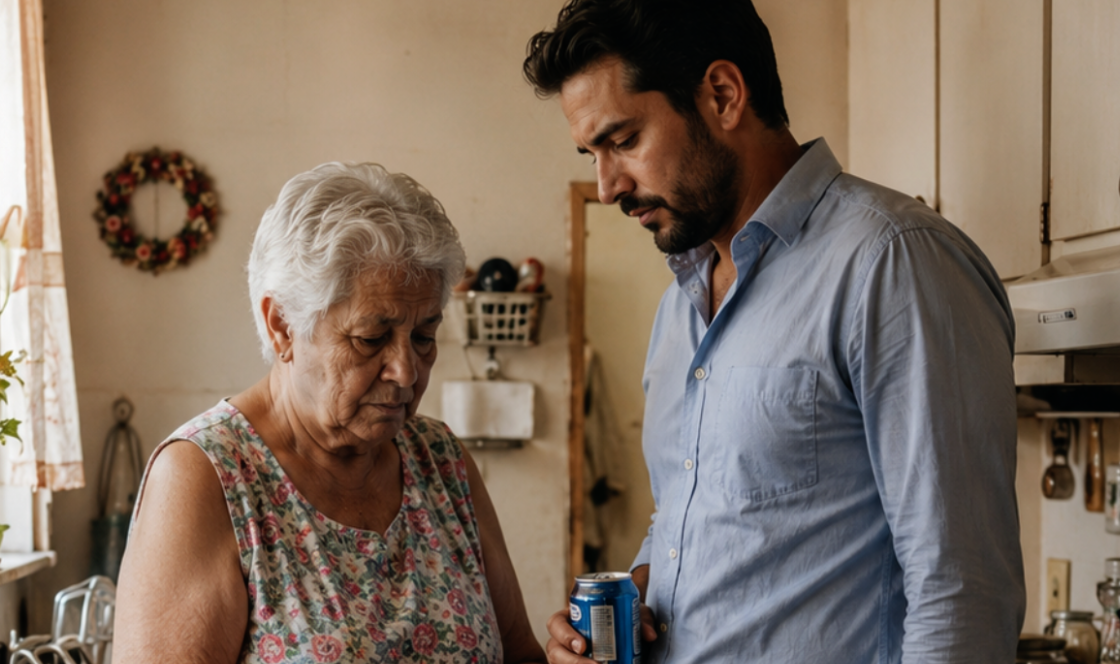
Elena Pavlovna appeared in the kitchen as if she were about to save the motherland. A cabinet door slammed, dishes clinked.
“Have you completely lost your nerve? Shampoo for eight hundred rubles?! What is it, golden soap? Do you understand how much money that is? If you want luxury, buy it with your own salary!”
Miroslava did not even turn around. Her hands were covered in soap foam, the plates were shining, and a cold wave of irritation ran down her back.
“It’s my shampoo, Elena Pavlovna. I bought it with my own money. Mine, not yours.”
“Oh yes, yours…” her mother-in-law drawled with so much venom it could have disinfected a wound. “And whose apartment is this? Whose furniture? Who pays for the gas? My dear Seryozhenka! And you’re a queen, apparently. You won’t even pick up a rag.”
“I happen to be holding a rag right now,” Miroslava said through clenched teeth. “Did you notice?”
“Don’t be rude to me! I worked in a school for thirty years, not to tolerate this!”
“And I’m thirty years old, and I’m only just beginning to understand how much unnecessary things I’ve been tolerating. Thank you for the lesson.”
Elena Pavlovna snorted, filled the kitchen with the smell of jasmine and her own resentment, and left.
Miroslava remained by the sink. The water kept running, her fingers grew cold, and inside her, a tight, prickly knot was forming. Six years. Six years of this — small but daily humiliation. A mother-in-law who, if she could, would write down in a notebook how many minutes her daughter-in-law sat and in which direction she looked.
Sergey had been different at the beginning. Soft, almost timid, as if he came from another family. He said he was living with his mother temporarily, until he got things sorted out. One year. Two. And somehow there was always money — for a car, for a jacket, for repairs in “Mama’s” kitchen, for a trip to Sochi “with Mama.” But for an apartment — never.
She took mineral water from the refrigerator, opened it, and sat down at the table. She did not drink alcohol or smoke, but sometimes, after evenings like this, she wanted everything at once.
Sergey came home late, like a thief. A bag from Pyaterochka, a can of beer, and a look as if he expected to find a ready roast chicken with a side dish in the refrigerator.
“Have you eaten?” he asked without turning around.
“Yes. Your mother and I had an argument for the first course, the second course, and dessert. Very filling.”
He grimaced, sat down, and opened the beer. He was silent.
“Mira, don’t start again.”
“I’m not starting. I’m finishing. I’m tired. This isn’t life — it’s some kind of teachers’ council for the re-education of a daughter-in-law.”
“Well, you know what my mother is like. She can’t be changed. You just have to put up with it…”
“Put up with it? Until I’m forty? Until our child hears Grandma calling his mother a freeloader? Or until I throw myself out the window?”
He fell silent. Again. His favorite strategy — to be physically present and morally disappear.
“Do you want me to talk to her…”
Miroslava laughed quietly, but in such a way that he flinched.
“You? She’ll put you back in your place with one sentence. Your ‘Mommy, that’s enough’ sounds like ‘Mommy, pour me some soup.’ She doesn’t see me as a person. And she doesn’t see you as a man.”
“You’re exaggerating.”
“No, Seryozha. You’re bending. There’s a big difference.”
The refrigerator clicked, like an arbitrator passing judgment.
“Tomorrow I’m taking the day off. I’m going to the notary. A letter came: my grandfather died and left me an apartment in Sergiev Posad. If it’s true, I’m moving. Alone. If you want, you can come. But without your mother. Never again.”
“You’re joking?”
“No. But if you want, we can arrange a family evening at the notary’s — tea and inheritance. Only this time, I’m the mistress of the house. And the shampoo will cost as much as I decide.”
Sergey looked at her as if he were seeing a living being for the first time. Not his mother’s helper, not a mediator in family matters — a woman who could leave.
“Have you lost your mind, Mira? Move there alone? What about me?”
“You can come. But on one condition: your mother doesn’t. Not for a day. Not ‘just to stay while repairs are being done.’ Only us. Or I go alone.”
“You’re making me choose between my wife and my mother?”
“No. You put yourself there, after six years of silently swallowing the way she called me a freeloader.”
He turned toward the window. A neighbor was walking outside with a garbage bag. Everything looked ordinary, except that something in his life was breaking off right now.
“Let’s not act rashly. Maybe it’s not even an apartment… We’ll go, take a look. And then come back.”
“No. I’ll start over there.”
“Start over? Alone? Without a job? Do you think anyone is waiting for you?”
“Seryozha, you were always soft. But right now, you’re simply a coward. And I’m not afraid anymore. I don’t want to grow old in a three-room apartment with your mother, who reminds me every day that I’m unwanted.”
He had already opened his mouth to say something when, as if on cue, there was a knock at the door.
“Open up! It’s me!” The voice behind the door was so familiar that there was no point arguing with it.
Miroslava looked at her husband.
“You always said, ‘Don’t touch my mother.’ So go ahead and deal with her.”
He reluctantly got up, reached for the lock, and clicked it open.
“Why have you locked the door as if you’re hiding from enemies? Or are you already hiding from me?” Elena Pavlovna entered the apartment like the owner of a theater arriving for a dress rehearsal. “Sergey, I bought your favorite. Liver stew, remember? And it looks like you’re celebrating something here — the kettle is whistling. Miroslava, why do you look like that?”
“I’m packing,” she said briefly. “I’m leaving for Sergiev Posad. For good.”
The bag in her mother-in-law’s hands sagged like a fish in the sun.
“What?! And why is that?”
“I have an apartment there now. From my grandfather. And I’m starting over. Without…” She stumbled, swallowed. “Without pressure.”
“And Sergey? Did you think about him? He’ll work, while you lie around on the stove there? Or seduce the neighbors while your husband works himself to death in Moscow?!”
Miroslava closed her eyes. Her hands were trembling, but her voice remained steady.
“I thought about myself. For the first time in six years.”
“You little…” Elena Pavlovna stepped closer, and at that moment the unbelievable happened — Sergey stood between them.
“Enough, Mom.”
Both women froze.
“What did you say?”
“Enough. Don’t pressure her. Don’t shout. Don’t insult her. She’s leaving — and maybe that’s right. I don’t know. But I’m tired of standing between you.”
“So you’re going to support her?! She’s destroying the family!” his mother’s voice rose to a shriek.
“Mom, we haven’t had a family for a long time. We’ve just been living on autopilot.”
He turned to Miroslava.
“If you want, I’ll go with you. If not, I’ll understand.”
She nodded.
“I don’t want that. Not until you grow up.”
In the morning, Miroslava stood on the platform. A backpack, a bag with documents, a stack of her grandfather’s letters. Her heart was tearing apart, but her hands held on firmly.
Sergey did not come. He did not call. Elena Pavlovna had probably cooked porridge, as always at eight, and grumbled with displeasure when her son refused to eat.
The train arrived, and Miroslava stepped into the carriage. She took a step into a new life.
Now she was standing on the balcony of her new apartment — an old building, peeling tiles, but a view of monastery domes. In Sergiev Posad, spring smelled of bird cherry and fresh earth.
She had been living there for two weeks already. She slept badly, but woke up early — and for the first time in many years, she felt it: she was home. Her own home.
The apartment turned out to be better than she had expected: a two-room flat with a balcony, solid, though furnished with furniture from the eighties. She rolled up the carpets, threw out the small cabinets, and took Brezhnev’s portrait off the nail. In the kitchen, the electric kettle buzzed like an airplane, but the tea boiled in it — and tasted like freedom.
The first week, she simply slept and drank coffee. The second, she called employers. A school in a neighboring district was looking for a Russian language teacher. Yesterday, she took on a student for tutoring.
Sergey did not call. Not at all. He disappeared as if he had never existed. And the worst part was — she did not care.
In the third week, her phone vibrated.
“Hello?”
“It’s me,” said a tired, soft voice. “Sergey.”
She remained silent.
“I’ve been thinking… Maybe you shouldn’t have left like that, in the heat of the moment. We were together for so many years…”
“In the heat of the moment?” she gave a bitter smile. “And when your mother threw a slipper at me because I wanted children — what was that? Cautious?”
He sighed.
“You knew what she was like… She just took her father’s death very hard.”
“And I took the absence of support very hard. And you know what, Seryozha? I understood something: all that time, I lived in someone else’s house. And now I live in my own. Maybe it’s peeling, maybe it’s without you, but it’s mine. And I feel calm.”
A pause.
“I was still thinking of coming. To see the apartment. To see you. Maybe something can still be saved.”
“Come. But alone. Without your mother. And you won’t see the apartment — it isn’t for guests. It’s for me.”
“You’ve become cruel.”
“No, Seryozha. I’ve simply stopped being convenient.”
That same evening, he came anyway. With a box of chocolates and the face of a schoolboy caught smoking.
“May I come in?”
“No. But we can talk. On the bench. Five minutes.”
They sat down. He fiddled with the box as if it were a talisman.
“I miss you. Everything feels wrong there without you…”
“Seryozha, you don’t miss me. You miss the way I saved you from your mother and from life. I didn’t leave because I hated you. I left because I loved myself.”
He lowered his head.
“I could try to change everything.”
“Too late. I’ve already changed everything myself.”
He stood up, walked away, then came back.
“And if I still decide? If I tell Mom that’s enough? Will you give me a chance?”
She looked at him for a long time. Then she smiled.
“I will. But only if you understand this: you won’t be living with a wife who helps your mother. You’ll be living with a woman who has an apartment, a job, freedom, and pride. Can you handle that?”
He nodded — uncertainly.
She closed the door. There was lightness in her chest. No one would break her again.
A month later, she filed for divorce. Sergey did not come. He only sent the papers and a note: “You were right. Forgive me.”
She placed the documents in a folder next to her diploma. As a reminder: she had managed it. She had dared. She had saved herself.