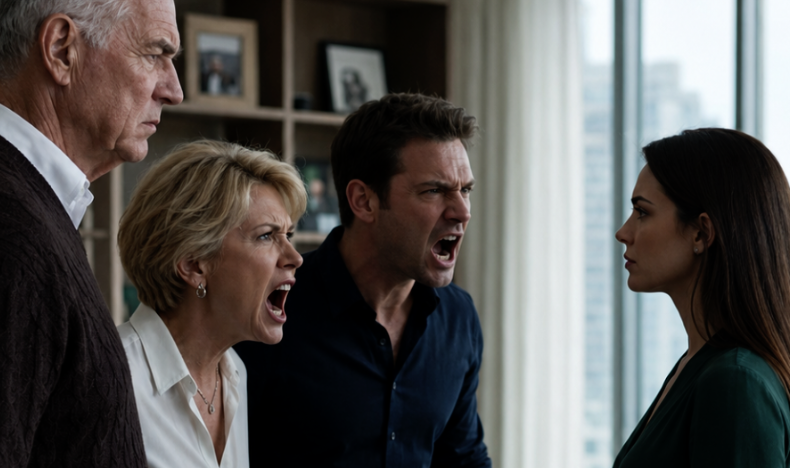
“Stayed late at work again?” her mother-in-law’s voice came from the living room, sounding as if Olya had not entered an apartment, but an interrogation room. “It would be one thing if you were at least useful. But no—no children, no dinner, no order in the house! Useless little tramp!”
Olya set her bag down by the door and did not answer. She simply walked into the living room, where Tamara Semyonovna was sitting in an armchair like an empress—back straight, lips pressed tight, knitting in her hands, something she seemed never to finish. The needle flashed. Her gaze did not blink.
“Hello,” Olya said.
“Well, hello, hello,” her mother-in-law hissed without looking at her. “Finally decided to come home.”
Maxim was lying on the sofa with his phone. He did not even turn his head. Thirty-four years old, and lying there exactly as he probably had in childhood. Olya had thought that more than once—and each time she caught herself thinking she would have been better off not thinking it.
“Is there anything to eat?” he asked.
“I just got home.”
“So go cook.”
Tamara Semyonovna snorted—quietly, almost imperceptibly, but Olya heard it. She had learned to recognize that sound over three years: that short little “hm” that meant, See? Completely useless.
Olya worked as a designer—remotely, for a studio in Saint Petersburg. The money was decent, the clients were serious, and her portfolio had grown so much over the past year that even she was sometimes surprised. But in this apartment, her work was not considered work. “Sitting at the computer,” her mother-in-law called it. And Maxim added, “Drawing pictures.”
At dinner, Tamara Semyonovna talked about the neighbor from the fifth floor, who had bought a new kitchen. Her mother-in-law described it with such envy that it seemed the kitchen itself was a personal insult. Maxim ate and nodded. Olya looked down at her plate.
“By the way,” her mother-in-law said casually, “Maximchik, I wanted to ask you something… I need a new refrigerator. The old one is barely working.”
“I’ll buy one,” Maxim answered without thinking.
Olya raised her eyes. She and Maxim had been saving money for the last two months—she had thought for something shared. Apparently not.
“But we agreed…” she began.
“What are you talking about?” Maxim looked at her for the first time that evening, and there was neither curiosity nor interest in his gaze. Only irritation.
“Our joint savings.”
“Mother needs a refrigerator. That’s more important.”
Tamara Semyonovna tactfully remained silent. She knew how to keep quiet exactly when silence worked better than any words.
The scandal happened the next day—and, as usual, over nothing. Olya asked Maxim not to leave dirty dishes in the sink. She was already washing up after two people: him and his mother, who came over every day as if reporting for work.
“Do you even hear yourself?” Maxim came out of the bathroom with a towel over his shoulders. “I’m on my feet all day, and you’re talking to me about plates!”
“I work all day too.”
“Work!” he laughed, and that laugh was worse than any shouting. “You sit at home—is that work? My mother is even ashamed to tell people what you do!”
“Maxim…”
“My mother is ashamed to tell the neighbors what kind of wife her son has—an empty place!” He was no longer laughing. His voice rose, his face reddened. “No children, no order, no real job! An empty place—that’s what you are!”
Olya stood in the middle of the living room. Under her feet was the same carpet they had chosen together three years ago, in the first month after the wedding. Back then, she had thought it mattered—to choose things together.
She did not cry. She simply felt something inside—not break, no—just fall into place. Like the last piece of a puzzle that had been missing for a long time, and then suddenly appeared.
“All right,” she said.
“What do you mean, ‘all right’?” He had clearly expected something else.
“All right. I’m glad you said that.”
He shrugged and went into the room. For him, the conversation was over.
The next morning, Olya went to the city center—not for any particular business, just because. She needed to breathe, to walk, to look at something other than those walls. She walked down the avenue past cafés and shop windows, and her mind was unexpectedly clear.
She did not stop at the small real estate agency on Leningradskaya Street on purpose. She simply noticed the advertisement in the window. A small house in the suburbs, forty minutes from the city. A plot of land. Her own territory.
The price was… unexpectedly realistic.
Olya took out her phone and photographed the advertisement. Then she went inside.
The manager—a young man in glasses—looked up from his monitor.
“This house,” Olya said. “Tell me more about it.”
As he spoke, she thought about her bank account. About how much money was there—her money, only hers, the money Maxim did not know about. Not because she had hidden it. He had simply never asked. He had never been interested. He thought she “drew pictures.”
After leaving the agency, she walked for a long time. Past the market, past the old cinema, past the park where dogs were running. The city lived its own life—noisy, hurried, indifferent. And in that indifference, Olya suddenly felt something almost like freedom.
At home, she said nothing. She put the kettle on, answered work emails, and nodded habitually to her mother-in-law, who came over “for a minute” at half past five and stayed until nine.
Maxim watched a TV series. Tamara Semyonovna talked about the neighbor’s kitchen—now about the cabinets.
And Olya sat with a mug in her hands and looked out the window. She thought: One month. I need about one month.
No one at the table had the slightest idea what she was thinking about. They had never really wondered what she thought, what she wanted, what she felt. She was an empty place, after all. Empty places do not think.
How wrong they were.
For the next two weeks, Olya lived in two parallel realities at once.
In one, everything was as before. Breakfasts, work deadlines, her mother-in-law with her knitting, Maxim with his phone. The familiar noise of an apartment where she had long ago stopped feeling like the mistress of the house. More like unpaid service staff without days off.
In the other, she methodically, calmly, and completely silently gathered her life into one point.
She viewed the house in the suburbs on Wednesday. She asked a colleague—Sasha, with whom she had corresponded for a long time about work and who lived in that area—to stop by beforehand and look at the roof and the fence. Sasha wrote: “Solid. The owners took care of it. Good plot.” That was enough.
She started preparing the documents on Thursday.
During those days, Maxim was especially himself. Meaning especially unbearable, though of course he did not think so.
On Friday evening, he came home with his mother—they had gone somewhere together on business—and announced from the doorway that on Saturday his school friend Boris and his wife were coming over.
“Have you ever tried warning me in advance?” Olya asked.
“I’m telling you now. What’s wrong?”
“Now is Friday evening.”
“So what? You sit at home anyway. What else do you have to do?”
Tamara Semyonovna was taking off her coat in the hallway at that moment. She pretended not to hear, but from her shoulders it was obvious: she heard everything and approved of every word her son said.
Olya did not argue. She nodded and went to the kitchen. Maxim and his mother settled in the living room, turned the television louder, and through the wall came their laughter—friendly, domestic, as if there were two people living in that apartment, not three.
That night, Olya lay and stared at the ceiling. Beside her, Maxim slept soundly, dreamlessly, like a man whose conscience was perfectly clean. Maybe it was. Maybe he truly did not understand. Or maybe he did—and simply did not care. Olya had long stopped trying to figure out which was worse.
The guests came on Saturday at one in the afternoon and stayed until eight in the evening.
Boris turned out to be a loud man with a firm handshake and a habit of finishing other people’s sentences. His wife, Svetlana, was small, neat, with an expensive haircut. All evening she looked at Olya with a strange expression. Not pity, no. More like recognition.
Maxim and Boris talked about cars, football, and who earned how much. That conversation, apparently, was something of a ritual for them. Tamara Semyonovna, whom no one had invited but who appeared on her own at half past one, sat beside her son and added comments with the air of a person everyone had been eagerly waiting for.
Olya carried plates, cleared plates, sliced, arranged. At some point, Svetlana came into the kitchen—supposedly to help.
“How long has it been like this for you?” she asked quietly while Olya was cutting bread.
“Like what?”
Svetlana made a vague gesture with her hand—toward the living room, toward the voices coming from there.
“Ah,” Olya said. “Three years.”
Svetlana was silent for a moment. Then she said, “I lasted four. With my first husband.” And then, even more quietly, she added, “Then I stopped lasting.”
They looked at each other. Olya almost smiled. Svetlana did too.
They did not return to the subject again, but something had formed between them—quiet, understandable, without unnecessary words.
On Monday, Olya transferred the first payment for the house.
She sat at her work desk, the screen glowing, the city humming outside the window, and pressed the confirmation button as calmly as if she were paying an ordinary internet bill. No trembling. No panic. Only an even, almost physical sensation that the ground beneath her feet had become a little firmer.
At the same time, she wrote to two new clients, both of whom she had been negotiating with for a month. The contracts were signed that same day. Her workload increased, and her income would increase the very next month. She understood that and had calculated it in advance—calmly, without rushing.
That evening, Maxim asked why she was so quiet.
“I’m tired,” she answered.
He nodded and asked nothing else. That suited him perfectly well.
Tamara Semyonovna sensed something before her son did. She had that instinct—animal-like and precise, the instinct of a person who had spent her whole life making sure everything remained under control.
She came on Wednesday, supposedly to return some baking pan she had borrowed a month earlier. She walked around the apartment, looking. She glanced into the bedroom under the pretext that she wanted to take a magazine from the nightstand. She did not take the magazine.
“Olya,” she said in the kitchen while Olya was washing mugs, “are you ill?”
“No. Why?”
“You look somehow…” She searched for the word. “Detached.”
“I just have a lot of work.”
Her mother-in-law looked at her for a long time, studying her the way one looks at an object that has always stood in one place and is now standing slightly differently, and it is unclear whether it only seems that way or not.
“All right,” she finally said.
And left.
Olya exhaled when the door closed.
Less than two weeks remained. The documents were almost ready. As for belongings—only the essentials. She had long been walking around the apartment mentally noting what she would take and what she would leave. It turned out there was surprisingly little that mattered. Her laptop, clothes, several books, a box of work materials. And a small wooden candleholder—a gift from her mother, the only thing in that house that was truly hers.
Everything else—the carpet, the dishes, the appliances they had bought together—could stay. She was not going to divide anything or bargain over it. Not because she was afraid. She simply did not want to. It mattered to her to leave without dragging even one extra kilogram of that life behind her.
She imagined the house in the suburbs—small, with bright windows, with a plot where three apple trees already grew and an old lilac bush stood along the fence. Her own desk by the window. Her own silence. No television behind the wall, no knitting in the armchair, no voice that seized control of her from the doorway.
Just silence. And work. And a morning that belonged only to her.
Very little remained before that morning arrived.
She filed the divorce petition on Thursday.
Not through scandal, not through tears. She simply came to the public services center on Sadovaya Street, took a number, sat on a plastic chair under fluorescent light, and submitted the documents. The woman at the reception asked in an ordinary tone, “Will you be dividing jointly acquired property?” Olya answered, “No.” The woman blinked—apparently, that was rare—and silently ticked the box.
Outside, the sun was shining. Olya bought coffee in a paper cup and walked to the metro. No special thoughts. Just steps and coffee, and the feeling that she had done something long overdue—like throwing away something that had been taking up space and no longer worked.
She told Maxim that same evening.
Not because she was ready for the conversation, but because there was no point in delaying it any longer. He was sitting in the living room with his phone. She entered, stopped in the middle of the room—on that same carpet—and said evenly:
“I filed for divorce. The documents are already in court.”
He raised his head. He looked at her for a long time, as if waiting for a continuation, some correction, some softening.
“Are you serious?” he finally asked.
“Yes.”
“Because of what, exactly?” His voice had changed—not angry yet, more confused. Olya was almost surprised. She had expected shouting, not confusion.
“Because of everything, Maxim.”
“That’s not an answer.”
“For me, it is.”
He stood up. Walked across the room—there and back—rubbed the back of his head. Then he stopped and looked at her differently—familiar now, with narrowed eyes.
“Where are you even going to go? To your parents?” There was something like a smirk in his voice. “They only have a one-room apartment.”
“I bought a house.”
The pause was long. Maxim stood there and seemed not to understand at once what he had heard.
“What?”
“A house. In the suburbs. The documents are done. I have the keys.”
“With what money?”
“My own.”
He looked at her, and Olya saw something in him rearranging itself. The confusion disappeared, and in its place came what she knew well: irritation, wounded pride, the desire to find a pressure point.
“You were saving secretly from me.”
“I was earning. And spending as I saw fit.”
“That’s called deceit.”
“No,” she said calmly. “That’s called having a head on your shoulders.”
Tamara Semyonovna arrived the next morning. Apparently, her son had called her immediately after Olya went to bed. Her mother-in-law appeared at half past nine with the air of a person arriving at the scene of a disaster and knowing exactly how to fix everything.
“Sit down,” she said to Olya in the living room. “Let’s talk like human beings.”
Olya sat down. Folded her hands on her knees. Waited.
“Do you understand what you are doing to this family?” Tamara Semyonovna began. Her voice was soft, almost sympathetic—she knew how to switch into that mode when she sensed pressure would not work. “Every family is compromise. Patience. I went through a lot myself with Maxim’s father, but I did not run away.”
“I’m not running,” Olya replied. “I’m leaving. Those are different things.”
Tamara Semyonovna tensed slightly—almost imperceptibly.
“He is a good husband. He does not drink, he works—”
“Tamara Semyonovna,” Olya interrupted her quietly, without rudeness, “for three years you called me an empty place. Sometimes directly, sometimes through hints. You turned this apartment into your second home. You made decisions for both of us, and Maxim was always on your side—not because I was wrong, but because that was easier. I’m not angry. I’m simply explaining why there is nothing left to talk about.”
Her mother-in-law was silent. For the first time in three years, truly silent—without that short “hm,” without calculated pauses. She simply looked at Olya, and there was something in her face that Olya did not immediately recognize. Then she understood: it was astonishment. Tamara Semyonovna had not expected such a speech from an empty place.
During her last week in the apartment, Olya lived almost invisibly. She packed her things gradually, in the evenings—bag after bag, nothing unnecessary. Maxim would either remain silent or suddenly begin talking—offended, circling around, returning again and again to the same thing: You saved money, you hid it, you decided everything in advance. Olya listened. She did not justify herself.
One evening, he sat across from her and asked, no longer angry, almost tired:
“Were you ever happy with me? At least ever?”
Olya thought honestly. She remembered the first year. There had been moments, yes. There had been good evenings, funny incidents, something alive.
“I was,” she answered. “At the very beginning.”
“And then?”
“Then you chose your mother. Every time there was a choice to be made.”
He did not object. Maybe for the first time in all those years, he did not object.
On Friday, a small cargo car-sharing van arrived—Olya had ordered it in advance, just herself and the driver. No one else was needed. Her belongings amounted to three bags and two boxes. She carried everything out in two trips. She wrapped the candleholder in a sweater and placed it on top.
Maxim stood in the doorway of the room and watched. He did not help, did not interfere—just stood there.
“Leave the keys,” he said when she picked up the last box.
Olya placed the keys on the shelf by the mirror. She looked at her reflection for a second—calm face, straight shoulders. Almost unfamiliar. Or, on the contrary, very familiar, simply not seen for a long time.
She left. The door closed quietly, without a slam.
The house greeted her with the smell of old wood and silence.
Olya put the boxes in the hallway, walked into the kitchen, and opened the window. Out there was the garden—three apple trees, lilacs along the fence, grass no one had mowed yet that year. An ordinary view. Completely ordinary—and for some reason it took her breath away.
She put the kettle on. Took her favorite mug from the box. Placed the candleholder on the windowsill.
Her phone showed a message from Svetlana—the same Svetlana, wife of Boris’s friend.
How are you? Just two words.
Olya answered: Good. I’m home.
She sent it—and was surprised by how easily that word had come. Home. For three years she had lived in someone else’s apartment and had not understood it as clearly as she did now, standing by the window with a mug in her hands, looking at her garden, her apple trees, her sky above the fence.
An empty place. Imagine that.
Empty places do not buy houses. They do not leave quietly and without losses. They do not stand like this by the window—calm, whole, their own.
The kettle boiled. Olya poured the hot water, took the first sip, and thought that tomorrow she needed to buy a lawnmower, sort out the boxes, and write to the new client from Moscow who had been waiting for her reply since Monday.
Life was not starting over.
It was simply—finally—starting.
A year passed.
Olya was sitting at her work desk by the window—the very same one with a view of the apple trees. They were blooming now, white and slightly untidy, like clouds that had descended too low. There was coffee on the desk, and beside it lay a tablet with a new project—a large order from Moscow, with a good budget. She had been working for two hours already, and not once had anyone walked in, interrupted her, or said something from an armchair.
The silence was working silence. Living silence. Her own.
She learned that the divorce was final from a short notification on her phone. The court hearing had taken place without her, in absentia; everything had been processed cleanly and quickly. Maxim did not call. Tamara Semyonovna did not either. Olya did not know how they were living now, and she did not look for an answer. Some chapters close—and there is no need to reread them.
Svetlana had written sometime in November—just because, for no particular reason. They occasionally exchanged messages, easily, without obligation. It was pleasant to know there was a person who had understood without explanations.
Her neighbor over the fence, Raisa Pavlovna, seventy years old, with a strong character and a vegetable garden, had perhaps become the first person in a long time beside whom Olya felt something simple and reliable. They drank tea on Saturdays. Talked about nothing. Sometimes they were silent—and that was good too.
Olya put the tablet aside, picked up her coffee, and went out onto the porch.
The apple trees were in full bloom. The grass had already been cut—she had bought a lawnmower back in autumn, a small red one, funny-looking. She had learned to use it herself. At first crookedly, then more evenly.
She stood on the porch and thought about how a year ago she had stood in the middle of someone else’s living room, on someone else’s carpet, and heard the words that were supposed to break her.
An empty place.
Two words, thrown with such certainty that she had almost believed them herself.
Almost.
The garden smelled of apple blossoms. Somewhere beyond the fence, a car passed quietly. The phone in her pocket was silent.
Olya finished her coffee, went back into the house, and sat down to work again.