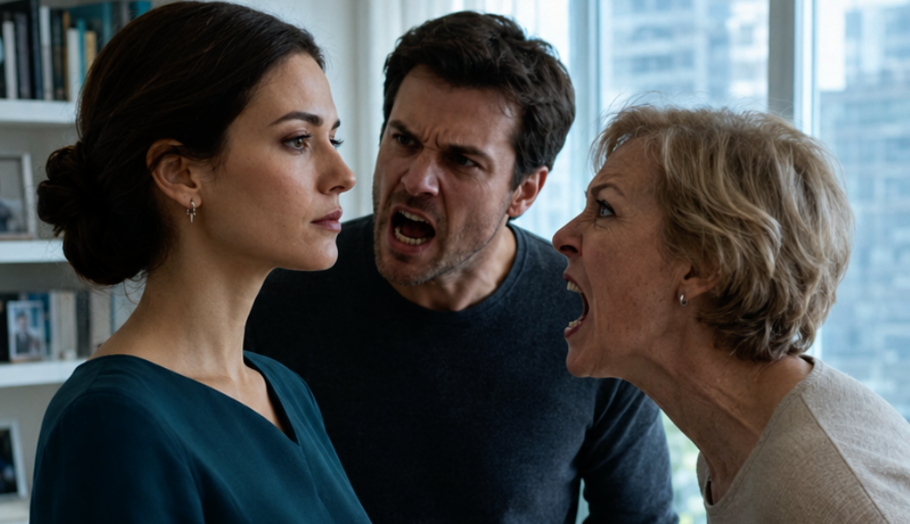
Forget about your birthday — my mother’s blood pressure is high and she feels terrible!” her husband declared, not knowing his wife was celebrating already — in a new apartment, and without him
“Have you completely lost your mind?!” Artyom burst into the living room and threw his jacket over the back of the armchair — a place where he never usually put it. “How many times have I told you not to touch my things on the shelf?”
Katya stood by the window and looked at him calmly. Too calmly — Artyom sensed it, but he didn’t understand it. In general, he rarely understood anything the first time if it had to do with his wife.
“There was Mom’s postcard there. Mom’s! You moved it somewhere, and now I can’t find it.”
“It’s on the refrigerator,” Katya said. “Under the magnet.”
Artyom went into the kitchen. Something clattered there; he moved things around and muttered under his breath. Then he came back — without a word of thanks, of course.
Katya turned thirty-two today.
Thirty-two was not eighteen, when a cake with candles and balloons were mandatory. But still, she wanted something. At least a “happy birthday,” even in passing.
Nothing.
She had bought herself a small honey cake at the pastry shop on the corner on her way home from work. She put it in the refrigerator. She didn’t tell anyone.
That evening, her mother-in-law called — Raisa Mikhailovna, a woman with the voice of a prosecutor and the gaze of an accountant checking someone else’s expenses.
“Artyomushka,” Katya heard from the hallway, “you haven’t forgotten that I have a doctor’s appointment tomorrow, have you? My blood pressure is acting up again. I didn’t sleep all night.”
Artyom immediately transformed. His voice became soft, almost tender — a voice Katya had never heard directed at her in all seven years of marriage.
“Mommy, of course I remember. Everything will be fine. I’ll come by tomorrow morning.”
Katya walked past him into the kitchen, took the honey cake out of the refrigerator, and cut herself a slice. She ate in silence, standing by the sink.
Artyom finished the call and appeared in the doorway.
“I’m going to Mom’s tomorrow morning. Her blood pressure is high.”
“All right.”
“And anyway,” he frowned, “why are you like that? Are you offended about something?”
“No.”
“Well, good.”
He went off to watch a TV series.
Katya finished the honey cake, washed the plate, and stood for a long time, gripping the edge of the sink. Outside the window, an advertising banner flashed — some fitness club. Happy people on the screen were jumping and laughing.
Interesting, she thought. Are they really that happy, or are they just paid well to smile?
The story with Raisa Mikhailovna’s blood pressure happened about once every two months — always right on time.
When Katya was planning to go to her sister’s anniversary party — blood pressure.
When she and Artyom planned to go to St. Petersburg for the weekend — blood pressure.
When Katya’s mother was in the hospital and needed help — her mother-in-law’s blood pressure turned out to be especially bad. Artyom didn’t go with his wife; he stayed to “support Mom.”
Raisa Mikhailovna lived ten minutes away, alone in a three-room apartment. According to Raisa herself, that apartment “should someday go to Artyomushka — but only if everything is done properly.”
What “properly” meant was never clarified. But everyone understood.
Katya worked as a designer in a small studio. She earned decent money — by the standards of their district, even good money. For the past two years, she had been saving. Quietly, methodically, without unnecessary words.
Artyom wasn’t interested in her account. In general, he wasn’t interested in much, except his mother’s postcards and his TV series.
That Saturday, while Artyom left early in the morning for Raisa Mikhailovna’s — “blood pressure, you understand” — Katya got up at half past seven.
Without rushing, she made coffee. She drank it by the window. Then she took out her phone and wrote to Olesya, a realtor she had known since university:
“I’m ready. When can we sign?”
The reply came three minutes later:
“I’m already at the office. Come over.”
Katya packed a bag — the one she had kept ready for three weeks. Documents, laptop, her favorite mug with a polar bear on it, a few books. Some clothes.
Nothing else was needed. She would buy the rest herself.
On the table in the living room, she left a note.
Briefly:
“I’m moving out. The keys are on the shelf. Documents later through a lawyer.”
No explanations.
Seven years of explanations were enough.
The apartment was on the eighth floor of a new building by the river. Small — one room, a kitchen, a balcony. Olesya helped arrange everything quickly. Katya had paid the first installment a month ago, and today she received the keys.
Ordinary keys — two of them, on a simple ring.
She stood by the door and looked at them. Something inside her tightened and then instantly released, as if she had been holding her breath for a long time and had finally exhaled.
The apartment was empty.
It smelled of fresh paint and new linoleum. Sunlight fell through the window in a long strip, and dust swirled in it — slowly, beautifully, without any hurry.
Katya walked into the room, put her bag on the floor, and looked around.
This is mine, she thought simply, without pathos.
Mine.
Then she took out her phone — and only then saw that Artyom had already called. Three times. The last call had been fifteen minutes ago.
She called him back.
“Where are you?!” His voice was tense, but not frightened. More irritated — the way a person sounds when an object suddenly isn’t where he left it.
“In my apartment.”
A pause.
“What apartment? What nonsense is this?”
“I rented an apartment, Artyom. Did you see the note?”
“I…,” he stopped short. “Are you serious?! And did you think about me? Mom is feeling really bad today, her blood pressure—”
“Artyom,” Katya interrupted calmly, “today is my birthday.”
The silence lasted a long time.
“So what? I remember. It’s just Mom—”
“You didn’t remember. You didn’t say a single word to me. This is the third year in a row.”
He started saying something — about his mother, about blood pressure, about how she was dramatizing everything. Katya listened only halfway, looking out the window.
Down below, people were walking along the embankment. Someone rode a scooter, someone walked a dog, someone simply walked and looked at the water.
“I’ll call you back later,” she said, and ended the call.
She put the phone in her pocket.
In her bag, under the books, lay a small pastry shop box. Honey cake — this time a bigger one. She had bought it that morning before going to Olesya’s.
Katya placed the box on the windowsill, opened it, and took out a plastic fork. She ate the first piece right there by the window, looking at the river.
No one wished her happiness. No one called with congratulations — except her sister, who had sent a voice message at seven in the morning, laughing and saying something about “a new life,” not yet knowing how right she was.
But for some reason, Katya felt — right now, with a fork and honey cake beside a window that was still unfamiliar — that this birthday would be the most important one.
Not the happiest.
Not the loudest.
But the most real.
Artyom called back twenty minutes later.
Katya didn’t answer.
Then Raisa Mikhailovna called.
Now this is more interesting, Katya thought, and picked up.
“Katenka,” her mother-in-law’s voice was velvety, almost affectionate, “what is going on? Artyom told me you went somewhere. He’s completely upset. He can’t find a place for himself.”
Katya smirked.
Artyom being “upset” was something new. Usually, he was “busy,” “tired,” or “not in the mood to talk.”
“Everything is fine, Raisa Mikhailovna. I moved out.”
“Moved where?” The pause was short but meaningful. “Is this some kind of joke?”
“No.”
Raisa Mikhailovna fell silent. Katya could hear her breathing — evenly, calmly, not at all like a person suffering from high blood pressure. Then her mother-in-law gathered herself.
“Do you understand what you’re doing to the family? Artyom doesn’t deserve this kind of treatment. He is a good husband, a caring son. Maybe you’re the one doing something wrong, hmm?”
There it was.
Always the same — first velvet, then thorns.
“Raisa Mikhailovna, I wish you good health,” Katya said evenly. “Tell Artyom that the lawyer will contact him next week.”
And she hung up.
She placed the phone face down on the windowsill. She stood there, looking at the river. Then she took another piece of honey cake.
They had met seven years earlier — in line at a government services center, which in itself sounded like the beginning of a joke. Artyom had been different then — or seemed different, which was basically the same thing.
Cheerful, quick, able to make her laugh in any situation.
Back then, Katya had just returned from Yekaterinburg, where she had worked for two years in a strange city among strangers, and she had missed simple human warmth.
Artyom seemed warm.
Raisa Mikhailovna appeared on the third date — she called right in the café, and Artyom answered without apologizing. He talked for about ten minutes while Katya looked out the window and drank her juice, which had gone warm.
Back then, she decided: it’s nothing terrible. A mother is a mother.
That was her first mistake.
After that, the mistakes came one after another — quietly, imperceptibly, like cracks in a wall that you don’t notice until the plaster falls down.
By lunchtime, her sister called — Vera, four years older, practical and straight as a ruler.
“Well? Did you sign?”
“I signed.”
“And how is it there?”
Katya looked around. An empty room, bare walls, a strip of sunlight on the floor. Somewhere behind the wall, music was playing softly — apparently a neighbor.
“It’s good,” she said. “Quiet.”
“Did Artyom call you?”
“Yes. And his mommy too.”
Vera snorted — briefly and expressively.
“And how is Raisa Mikhailovna? Did her blood pressure rise from the news?”
“Her voice sounded energetic.”
“That’s what I thought.” Vera was silent for a second. “Katya, I’m proud of you. Saying it is one thing. Actually doing it is another.”
Katya didn’t answer right away. She stood by the window, watching a sightseeing boat move slowly along the river.
“I was scared,” she admitted at last.
“I know. But you did it.”
After talking to her sister, Katya decided not to sit in the empty apartment. She got dressed and went outside.
The neighborhood was unfamiliar — she had chosen it deliberately, farther away from the part of the city where she had lived for the last five years. New buildings, wide sidewalks, a coffee shop on the corner with large windows and a line of people with thermoses and backpacks.
She went in, got a cappuccino, and sat by the window.
At the next table, two people were discussing something energetically — a young man and a woman with a laptop. Judging by their gestures, they were arguing about something work-related. And laughing at the same time.
Katya looked at them and thought: that’s how it should be — arguing and laughing at the same time.
Her phone vibrated.
An unknown number.
She answered.
“Ekaterina Sergeevna?” A male voice — businesslike, unfamiliar. “This is Pavel, a lawyer. Vera gave me your number. She said you need a consultation about divorce.”
Katya nearly choked on her cappuccino.
“Vera gave you my number?”
“Yes, this morning. She said her sister would be ready by evening.”
Katya looked out the window.
Then she laughed — quietly, to herself.
Vera had known everything in advance. Of course she had. She always knew — before Katya herself did.
“Yes,” Katya said. “I need a consultation. When are you available?”
Artyom wrote at eight in the evening.
He didn’t call — he wrote, which was already eloquent in itself.
“We need to talk. You can’t just leave like this. This isn’t serious.”
Katya read the message while lying on an inflatable mattress — the only furniture in the apartment so far. Above her was a white ceiling. Beside her stood the mug with the polar bear; tea was cooling in it. Outside the window, darkness was falling.
She thought about what to answer.
In the end, she simply wrote:
“I’ve already spoken to a lawyer.”
Three dots appeared — he was typing.
For a long time.
Then the dots disappeared.
There was no reply.
About ten minutes passed.
Then the phone vibrated again — but it wasn’t the chat with Artyom anymore. It was a message in the shared chat of their building — the new building, apartment eight.
An unfamiliar contact wrote:
“Hello, neighbors! I’m on the third floor, moved in a month ago. If anyone is new — welcome. And sorry if the music was audible — that was my fault.”
Katya smiled.
So the neighbor with the music was on the third floor.
Not a bad beginning to life in a new building.
She wrote in the chat:
“Hello. Apartment eight. I moved in today.”
The answer came quickly:
“Oh, welcome! If you need help with anything, knock.”
Katya put the phone aside. She looked at the ceiling. Outside, one streetlamp glowed in the dark sky, swaying slightly like a pendulum.
Tomorrow she needed to buy a bed. And a table. And curtains — definitely light ones.
Life begins with little things, she thought.
With a mug with a bear on it, with an inflatable mattress, with an unfamiliar neighbor who apologizes for music.
And Raisa Mikhailovna could treat her blood pressure.
They would manage without Katya.
Morning in the new apartment began strangely.
Katya woke up at half past six — earlier than usual — and for several seconds lay there without understanding where she was. A white ceiling, sunlight pouring through the curtainless window, a car honking somewhere below.
Then she remembered.
And instead of the usual heaviness with which she had woken for the last three years, she felt something light. Almost forgotten.
She got up and put on the kettle. It had come from her bag, old, with a chipped handle — but it was hers.
While it boiled, she looked out the window. The river below was quiet, morning-like, and one lonely person in orange sneakers was running along the embankment.
I should start running too, Katya thought, and surprised herself with the thought.
Before, somehow, she never thought about it.
Artyom appeared at half past ten.
He didn’t call to warn her. He found out the address through Vera, although Vera later swore she had told him nothing. Katya heard the doorbell, looked through the peephole, and saw her husband — in the same jacket as yesterday, with a crumpled face and his hands in his pockets.
She opened the door.
He came in and looked around. Empty room, inflatable mattress, boxes. His gaze stopped on the mug with the polar bear on the windowsill — and Katya couldn’t read whatever flashed in his eyes.
“Are you serious?” he said at last. “This is your plan?”
“Yes.”
“Katya.” He took off his jacket, tried to hang it on nothing — there was nowhere to hang it — and simply shifted it from one hand to the other. “Do you understand that we could have talked? Just talked, like adults?”
“We talked for seven years.”
“So what?! Things happen. Everyone has problems. Mom really isn’t feeling well right now. It’s not made up.”
Katya poured herself some tea.
She didn’t offer Artyom any — not out of anger, simply because she didn’t have a second mug yet.
“Artyom,” she said calmly, “yesterday was my birthday. For the third year in a row, you didn’t notice it. You didn’t congratulate me, didn’t ask how I was. You left for your mother’s in the morning and called only when you found the note.”
He was silent.
“It’s not about the birthday,” she continued. “It’s about the fact that I don’t exist in your life. There is the apartment, there is a wife as a fact, there is your mother — and your mother is always more important.”
“You’re exaggerating.”
“No.”
He sat on the windowsill opposite her — the only place where one could sit. He looked at the floor. Katya could see that he wasn’t angry. He was confused, and for Artyom that was rare. Usually, he had a ready answer for everything.
“So what now?” he asked quietly.
“I’ve already spoken to a lawyer.”
A pause.
“Mom will be shocked,” he said.
And that was the first thing he said.
Not “I will be shocked.”
Not “I don’t want this.”
Mom.
Katya looked at him for a long time. Without anger — she simply looked.
“I know,” she answered.
He left half an hour later.
Without a scandal, without slamming the door — he simply left. Katya closed the door behind him, stood in the hallway for a second, and went to finish her tea.
Vera called her.
“Well?”
“He came.”
“I know. He called me too — asking for the address. I didn’t tell him, honestly. Maybe he found it through the neighbors or through the realtor.”
“Olesya wouldn’t tell him.”
“Then somehow he found it himself.” Vera was silent for a moment. “Katya, are you holding up?”
“Yes. I’m fine, Vera. Really fine.”
And that was true.
The furniture arrived on Thursday. Katya ordered it through an app — simple, without excess: a bed, a table, two chairs, and a small sofa.
The assemblers worked for about three hours. She made them coffee, and they thanked her with expressions as if it had been unexpected.
When they left, the apartment became different.
Alive.
Katya arranged her books on the floor along the wall — there was no shelf yet — and it looked unexpectedly cozy. She hung her own towel in the bathroom — blue, her favorite. She placed the mug with the polar bear on the kitchen table.
That evening, someone knocked at the door.
She opened it.
On the threshold stood a man of about thirty-five, holding a paper bag and wearing a slightly guilty expression.
“Third floor,” he said. “Dmitry. I wrote in the chat about the music.”
“I remember.” Katya smiled. “Apartment eight. Katya.”
“Well, here.” He held out the bag. “We have this tradition in our entrance. Well, not a tradition, I made it up myself — when a new neighbor moves in, I bring something. It’s just coffee and cookies. Probably silly.”
“Not silly,” Katya said, taking the bag. “Thank you.”
He nodded and turned to leave.
“Dmitry,” she called after him. “I now have two chairs. If you want — there’s coffee.”
He turned around in surprise — and laughed.
Simply, without ceremony.
“I do.”
They sat for an hour and a half.
It turned out Dmitry worked as an architect — a small bureau, private projects, sometimes city contracts. He had moved to the neighborhood six months ago; before that, he had lived in the center, but had grown tired of the noise.
Divorced — he said it easily, without drama, as a fact of biography.
Katya told him about the studio, about design. He listened attentively, asked questions not out of politeness, but real ones.
It felt unusual.
When he left, she cleared the cups, washed them, and set them to dry. She stood by the window — the river below glowed with reflected streetlights.
Nothing special had happened.
Just a neighbor had stopped by for coffee.
But for some reason, it felt warmer.
Raisa Mikhailovna called on Friday.
This time, without velvet.
“Do you understand that you’re taking his apartment from him?!” she began immediately. “His father and I — may he rest in peace — invested in that apartment. I helped with the renovation, and now you simply leave and want half?!”
“Raisa Mikhailovna,” Katya sat down on the sofa, “the apartment is registered to both of us. That is the law.”
“The law!” Her mother-in-law’s voice became harder. “You lived there for seven years, used everything, and now — the law! Artyom is a good person. You broke him!”
Katya listened and thought: there she is — the real Raisa Mikhailovna, without blood pressure and the velvety voice.
Fast, angry, precise — like an accountant who has found someone else’s mistake in a statement.
“The lawyer will arrange everything properly,” Katya said. “Goodbye.”
She hung up.
She put the phone in the desk drawer and went out onto the balcony.
Down below, people were walking along the embankment. Someone with a dog, someone with a stroller, someone just because. In the building opposite, one window was lit — someone was moving there, a silhouette, an ordinary life.
Katya thought she needed to buy some kind of flower for the balcony.
Or two.
And a small table — to sit there in the mornings with coffee.
And running shoes.
Long overdue.
From behind her, inside the room, came the sound of a notification.
Probably Artyom.
Or Raisa Mikhailovna from a new number.
Or the lawyer with documents.
Katya didn’t go check.
She stood a little longer, holding the railing with both hands.
The river below flowed calmly, without hurry — toward wherever it needed to go.
It had always known where.
And now I know too, Katya thought.
And for the first time in a long while, it didn’t feel like an exaggeration.
Three weeks passed.
The apartment on the eighth floor began to look like a home — curtains appeared, light ones, almost white; a bookshelf; a rug by the entrance; and two pots of geraniums on the balcony. Little things, but that is exactly what creates the feeling of home.
The divorce was proceeding quietly. Artyom didn’t make a scene — to Katya’s surprise, he simply signed what needed to be signed and stayed silent.
Once he wrote:
“Maybe you’ll still think about it?”
She answered briefly:
“No.”
He didn’t ask again.
Raisa Mikhailovna called two more times. Katya answered, listened for a minute, and politely said goodbye. The third time, she simply didn’t pick up — and felt not guilt, but relief.
It was unexpected and right at the same time.
On Saturday, she and Dmitry went to the market by the river. He knew a place there where they sold good seedlings and old records in the same row. Katya bought another geranium and a tiny cactus with a red flower. Dmitry bought a record — jazz from the fifties, the cover worn.
They walked back along the water.
They talked about all kinds of things — his project, her new order, the fact that a proper bakery would soon open in the neighborhood. Nothing important.
But that is exactly how it happens — when the important hides inside the ordinary.
At the entrance, he said:
“Next Saturday, a new exhibition opens at the museum. Architecture and the urban environment. I’m going. If you want, company wouldn’t hurt.”
Katya looked at him.
“I want to,” she said simply.
That evening, Vera called to congratulate her on finishing all the paperwork.
“So how is it?” her sister asked.
“Normal,” Katya answered. “Even good.”
“Not scary being alone?”
Katya looked at the geranium on the balcony, at the mug with the polar bear, at the record Dmitry had forgotten on her table.
“No,” she said. “Not scary at all.”
And that was true.