Grandmother died on Thursday. Quietly, just as she had lived these last years: without an ambulance, without fuss, in her room on Lomonosov Street, where it smelled of Corvalol and old books.
I found out from my mother. She called at half past eight in the morning, her voice even, as if she were dictating a grocery list.
“Zinaida Pavlovna has passed away. The funeral is on Saturday. Come, if you can.”
If you can. Not “come.” Not “we need you.” If you can. I had been hearing that intonation for twenty-eight years, and every time something inside me tightened just above my ribs, on the right.
I could.
My name is Rita. I’m thirty-two. I live in Kaluga and work as a logistics coordinator at a building materials warehouse. I have a small rented apartment, a cat named Shurup, and not a single photograph from family holidays.
That isn’t a complaint. It just turned out that way.
Grandma Zina was the only one who called me on Sundays. She didn’t ask about my personal life, didn’t give advice. She talked about the weather, about her neighbor Klava, about how the pigeons had once again dirtied the windowsill. Then she would fall silent, and I would hear her breathing into the phone, and that breathing made me feel calm.
The last time she called was eleven days before she died. She said something strange.
“Ritka, do you remember my little box? The one with the mother-of-pearl lid?”
“I remember, Grandma.”
“Good.”
And she hung up. I called back an hour later, but she didn’t answer.
Everyone came to the funeral. My mother, Lyudmila Sergeyevna, in a black coat with a faux-fur collar, her lips pressed together so tightly that pale lines appeared around her mouth. Uncle Boris, Grandma’s younger son, six foot one, broad-shouldered, with hands like shovels. He stood slightly aside, smoking and shielding his cigarette with his palm, though there was no wind. His wife, Ella, thin, with a long neck and an expensive dusty-rose scarf, held on to his elbow as if it were a handrail on a bus.
There was also my cousin Kristina, Boris’s daughter. Twenty-five years old, chestnut hair down to her shoulder blades, a ring with a stone on her ring finger that she turned every few seconds, as if winding something up inside herself.
And me. In a gray sweater, because I didn’t own a black coat and didn’t buy one just for a single day.
At the cemetery, my mother came up to me once. She said:
“It’s good that you came.”
Then she turned away toward Boris and began discussing the memorial meal.
The memorial dinner was held at a café on Sadovaya Street. Tables with salads, pancakes, kutya. Boris gave a speech in which he repeated the word “bright” three times. Ella dabbed at her eyes with a napkin, but her mascara didn’t run. Kristina picked at her vinaigrette with a fork and looked at her phone.
No one truly cried. Or maybe they cried inside, I don’t know. I sat in the corner, drinking compote from a faceted glass and feeling the skin on my chest burn beneath my sweater. Not from heat. From something else.
After the memorial meal, my mother pulled me aside.
“In ten days, the notary. The will. Will you come?”
Again, not a question. Again, an instruction wrapped in politeness.
“I’ll come.”
“Good.”
She didn’t say thank you. But she nodded as if she had checked off a box on a list.
Ten days. I spent them at work, sorting invoices for bricks and drywall, feeding Shurup, boiling pasta, staring at the ceiling before sleep. Thinking about Grandma.
About how she taught me to bake apple charlotte when I was nine. How she would say, “Ritka, cut the apples into big pieces, don’t make them too small. Life will make things small enough.” How her hands smelled: laundry soap and dill.
I tried not to think about the little box. But it kept surfacing. The mother-of-pearl lid, heavy for its size, with a small crack in the left corner. Grandma kept it on the top shelf of the wardrobe, behind a stack of towels. I had seen that box as a child, but I had never opened it. Grandma hadn’t forbidden me. She just hadn’t offered.
And now she had asked whether I remembered it.
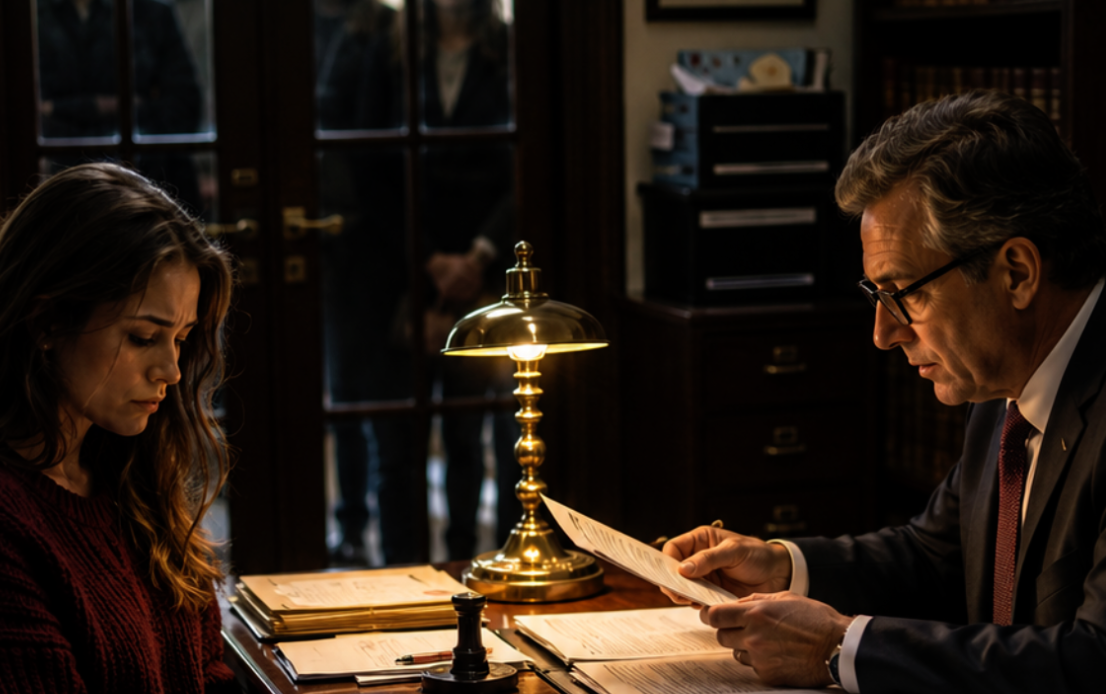
The notary’s office was on the first floor of an apartment building, between a pharmacy and a curtain shop. It smelled of coffee and something papery, like a library, only drier.
There were five of us. My mother, Boris, Ella, Kristina, and me. Mother sat first, right in the center, her back straight, her handbag on her knees. Boris took up two chairs, one for himself and one for his briefcase. Ella settled beside him, crossing her legs. Kristina took out her phone and put it away when Boris looked at her.
I stood by the wall. There were no more chairs.
The notary came out three minutes later. A man of about fifty, gray temples, a neat beard, glasses with thin frames. He moved unhurriedly, like a person used to being waited for.
“Good afternoon. My name is Anton Viktorovich. I have handled Zinaida Pavlovna Koltsova’s affairs for the past four years.”
He looked us over, and his gaze lingered on me a little longer than on the others. Or maybe it only seemed that way.
“Before we begin, I must carry out the testator’s wishes.”
My mother leaned forward. Boris placed his hand on his briefcase.
“Zinaida Pavlovna left an instruction: the first part of the will reading is to take place in the presence of only one person.”
Silence. Ella looked at Boris. Kristina raised her eyes from her knees.
“I ask everyone except Margarita Dmitrievna Koltsova to leave the office.”
My mother stood first. Slowly, the way blood pressure rises: imperceptibly, but forcefully.
“Excuse me, I don’t understand.”
Anton Viktorovich repeated himself.
“Zinaida Pavlovna specified that the first part of the will is to be read in the presence of her granddaughter Margarita. The remaining heirs will be invited in afterward.”
Boris turned crimson. It was visible even without looking directly at him: his neck reddened, and a vein at his temple began to twitch.
“What kind of circus is this? I’m her son. Her biological son.”
“Boris Pavlovich, I understand. This is the testator’s will, and I am obligated to carry it out.”
Ella tugged at her husband’s sleeve. He didn’t move.
“We won’t leave until we get an explanation.”
The notary took off his glasses, wiped them with a napkin, and put them back on. Not a single muscle in his face moved.
“You will receive an explanation. In fifteen minutes. In this same office. But now I ask you to step out.”
Mother turned to me. Her eyes were dry, her chin slightly raised. She looked at me as if I had stolen something from the table in front of guests.
“Did you know?”
“No.”
She didn’t believe me. I could tell by the way her nostrils flared slightly. Then she picked up her handbag, turned, and left. Ella followed her, and Kristina followed Ella. Boris lingered. He stood there, looking at the notary, then at me, then back at the notary.
“My lawyer will hear about this.”
“Of course. The door is straight down the hallway.”
Boris left. The door didn’t slam. He closed it carefully, which was worse than a slam.
We were left alone. Anton Viktorovich gestured to the chair beside him.
“Please sit down, Margarita Dmitrievna.”
I sat. My palms were damp, and I wiped them on my jeans beneath the table, where he couldn’t see.
“You are probably surprised.”
“Yes.”
“Your grandmother came to me four years ago. She made a will, then amended it twice. The last time was three months ago.”
He took an envelope from a folder. Plain white, with no writing on it. Inside was another smaller envelope and a sheet of paper folded into quarters.
“This is a letter. Zinaida Pavlovna asked me to give it to you personally. Read it here, in my presence. After you’ve read it, I will announce the terms of the will.”
I took the envelope. My fingers wouldn’t obey me; I had to lift the flap with my nail. The paper had yellowed. Grandma’s handwriting, small, slanting to the right, the letters with long tails.
“Ritka.
If you are reading this, it means I have walked my road. Don’t cry. I lived. That is enough.
I am writing to you because out of all my family, you were the only one who heard me. Not listened, but heard. There is a big difference, Ritka. Lyudmila listens when she needs to. Boris doesn’t listen at all. But you stay silent on the phone and breathe, and I know you are there.
Now to the matter at hand.
I leave the apartment on Lomonosov Street to you. Not because the others don’t need it. They do. Boris is already calculating how much it is worth, I can see it in his eyes, though he thinks he is hiding it. Lyudmila is calculating too, only more quietly. But the apartment is mine, and I decide.
Let Boris take the dacha in Malinki. He loves it. In his own way, but he loves it. Let him have the garage too.
And to you, besides the apartment, I leave the little box. You know which one. Mother-of-pearl lid, crack on the left. There is something inside it that no one knows about. Not even Lyudmila.
The notary will explain everything to you. But I will say the most important thing myself: you are not a stranger, Ritka. You never were. They were the ones who moved away. Not you.
I kiss you. Grandma Zina.”
I finished reading and placed the letter on the table. The letters blurred, but I didn’t cry. My eyes simply burned, as if from wind.
Anton Viktorovich waited.
“Are you ready?”
“Yes.”
“Zinaida Pavlovna left you the two-room apartment at 12 Lomonosov Street, apartment forty-one. Its full cadastral value is approximately four million eight hundred thousand rubles. And also a bank deposit in the amount of one million three hundred thousand rubles. The deposit is assigned to your name by testamentary disposition.”
He paused.
“And as a separate clause: the contents of the little box kept at the apartment, on the top shelf of the wardrobe in the bedroom.”
“Do you know what’s in the box?”
“No. Zinaida Pavlovna did not consider it necessary to tell me. But she insisted that you collect it personally before the other heirs receive access to the apartment.”
Something grew hot beneath my ribs. I pressed my palms to my knees and felt the denim bite into my skin.
“What do the others receive?”
“Boris Pavlovich receives the dacha in Malinki with the land plot and the garage. Lyudmila Sergeyevna, your mother, receives the car and a set of silver cutlery. Kristina Borisovna, the granddaughter, receives jewelry.”
“Does my mother know?”
“She will know in a few minutes.”
He looked at me over his glasses.
“Margarita Dmitrievna, I am obliged to warn you. Your relatives may challenge the will. That is their right. But the will was drafted correctly, notarized, and Zinaida Pavlovna was legally competent, which is confirmed by a psychiatrist’s certificate. The chances of successfully challenging it are minimal.”
“Grandma knew there would be a scandal.”
“She used a different word, but the meaning was the same. Yes.”
They were called back in twelve minutes later. I know exactly because I was watching the clock above the door.
Mother entered first. She sat in the same chair. Boris behind her. Ella. Kristina.
Anton Viktorovich read the remaining clauses. His voice was even, without a single unnecessary intonation. A professional.
When he got to the apartment, Boris interrupted.
“Wait. Who gets the apartment?”
“Margarita Dmitrievna.”
Boris turned toward me. His face became the way I remembered it from childhood, when he argued with Grandma about money: dark, with heavy folds around his mouth.
“Did you talk the old woman into this?”
I didn’t answer. The notary continued.
“Boris Pavlovich, you have been left the dacha in the village of Malinki, with a land plot of twelve hundred square meters, and the garage.”
“The dacha? The dacha is worth pennies compared to the apartment.”
“I am reading the testator’s will, not evaluating the fairness of the distribution.”
Ella put her hand on Boris’s knee. He shook it off.
Mother was silent. That was scarier than shouting. She sat motionless, and only the fingers of her right hand slowly, very slowly, worried the clasp of her handbag. Click. Click. Click.
“Lyudmila Sergeyevna is left a 2019 Lada Granta automobile and a set of silver cutlery.”
Mother nodded. Once, briefly, as if from a blow.
“Kristina Borisovna is left jewelry, according to the attached list.”
Kristina looked at her father. Boris looked at no one.
“I will challenge it.”
“That is your right, Boris Pavlovich. My contact details are on the business card.”
The notary stood. The audience was over.
In the hallway, what I had expected began.
Boris came right up to me. He smelled of tobacco and cologne, heavy, evening-like, though it was two in the afternoon.
“Do you understand what you’ve done?”
“I didn’t do anything, Uncle Boris.”
“Didn’t do anything. You visited her, sat there, listened to her nonsense. Worked on her.”
Ella stood aside, pressing her scarf to her throat.
“Borya, not here.”
“Where, Ella? In court?”
Mother came over. She stood between us, but faced me.
“Rita, we need to talk. Not here.”
“All right.”
“Today. At my place.”
“All right, Mom.”
She turned and went toward the exit. Her heels clicked on the tile evenly, like a metronome.
I went to my mother’s by minibus. Forty minutes through traffic, the smell of gasoline and someone’s mandarins, worn handrails. Outside the window, courtyards, playgrounds, garages flashed by. An ordinary city. An ordinary day. And inside me, something hummed like a transformer on a pole.
Mother lived in a two-room panel-block apartment on Gagarin Street. Floral wallpaper, ruffled curtains, the smell of boiled potatoes. Everything was as it had been ten years ago, twenty years ago. Nothing changed.
She opened the door without greeting me. Went into the kitchen. I followed.
The kettle was already on the stove. That meant the conversation would be long.
“Sit down.”
I sat. The stool creaked. On the table lay an oilcloth with sunflowers, and I thought that those sunflowers had been there when I was twelve.
“Rita, did you know about the will?”
“No.”
“Don’t lie to me.”
“I’m not lying.”
She placed a mug in front of me. White, with a crack in the handle. She poured boiling water, dropped in a teabag.
“Zinaida Pavlovna could be stubborn. But she wasn’t insane. If she left you the apartment, you did something to make that happen.”
I looked at the steam rising from the mug. A thin thread that broke apart and disappeared.
“I called her on Sundays, Mom. That’s all I did.”
Mother sat beside me. She pressed her lips together until they turned white.
“I called too.”
“Once a month. For fifteen minutes. About blood pressure and medication.”
Silence. The kettle on the stove clicked as it cooled.
“How do you know how often I called?”
“Grandma told me.”
“What else did she tell you?”
I could have lied. Could have softened it. But Grandma was gone now, and the truth belonged only to me.
“That you came when you needed money. That Boris came when he needed the dacha for the summer. That Kristina had last been to Lomonosov three years ago.”
Mother stood. Went to the window. Her shoulders were straight, not trembling. But her fingers on the windowsill had gone white from pressure.
“She had no right.”
“She had every right.”
“I am her daughter.”
“So what?”
That “so what” hung in the air. Two short words, and yet they contained everything: thirty years of distance, conversations about nothing, birthdays without calls, my childhood school performances to which my mother sent a gift but never came.
She turned.
“Are you planning to keep the apartment for yourself?”
“Yes.”
“Boris will sue.”
“Let him.”
“Do you understand that now you won’t have a family?”
I took a sip of tea. Hot, tasteless, from a cheap teabag. And suddenly I remembered how Grandma brewed tea: in a ceramic teapot, with a blackcurrant leaf, and always covered it with a towel.
“Mom, I never had a family. I had a gathering of people with the same surname.”
She didn’t answer. She simply came to the table, picked up her own mug, and began to drink. Silently. Without looking at me.
The next day, I went to Lomonosov Street.
Grandma’s apartment greeted me with a smell that made my throat tighten. Corvalol, dill, old books. All at once, like a blow.
I took off my shoes in the hallway. Slippers stood by the wall: Grandma’s felt ones, worn through at the heels. Beside them, one pair to the left, men’s slippers. Grandpa had been gone a long time, but the slippers were still there.
The bedroom was dim. The curtains were drawn, and on the nightstand stood a glass of water, clouded with time. The bed was neatly made. Grandma had made it herself. On her last day.
The wardrobe. The top shelf. A stack of towels: white, with blue stripes, folded so evenly you could check them with a ruler. Behind them, right against the wall, was the box.
I took it out. Heavy, just as I remembered. The mother-of-pearl had dulled, but the crack in the left corner of the lid was still there. I ran my finger over it: the edge was rough, catching slightly on the skin.
I opened it.
Inside were documents. A savings book, old, Soviet, with stamps. Beneath it, a birth certificate. Not Grandma’s.
Mine.
And beneath the certificate, carefully folded, was a photograph. Black-and-white, with a scalloped edge. In it, a woman of about thirty, in a dress with a round collar, was holding an infant. The woman was smiling, but her eyes were serious. On the back, in pencil, in Grandma’s handwriting: “Ritka, 3 months. First day with us.”
I turned the photograph back over and studied the woman. Not my mother. Not my mother.
Grandma.
An infant in her arms. First day with us.
Under the photograph was another letter. Not in an envelope, simply a folded notebook page.
“Ritka.
If you have reached the little box, then I was right to leave it to you.
Now listen.
Your mother gave birth to you when she was nineteen. You know your father, Dmitry; he left when you were a year and a half old. You know that. But here is what you don’t know.
When you were three months old, Lyudmila brought you to me. She said: I can’t. I can’t cope. Take her for a week. That week stretched into a year and a half. You lived with me, slept in a drawer from the dresser that I lined with a blanket, ate porridge from my spoon. Lyudmila came on Saturdays. Sometimes.
Then she took you back. She married Gennady, and she needed a child. Not you, Ritka. A child. For the picture. For normality.
I didn’t argue. I had no right. She was your mother.
But I remembered. I remembered every day. How you slept on my shoulder and snuffled into my ear. How you grabbed my finger and wouldn’t let go, even when you fell asleep.
That is why the apartment is yours. Because you grew up in it for the first year and a half of your life. Because these walls remember you. And I want you to know that.
Don’t be angry with your mother. She is not bad. She simply doesn’t know how. No one taught her. No one taught me either. But at least I tried.
Your Grandma Zina.”
I sat on the floor, leaning against the wardrobe. The box on my knees, the letter in my hands. Outside the window, a trolleybus hummed, and someone in the courtyard called a child: “Anton! Home!”
The tears came on their own. Not beautiful, not quiet. With sniffling, ugly sobs. Shurup was in Kaluga, and there was no one to press a muzzle into my knee.
A year and a half. I had lived here for a year and a half and remembered nothing. But my body, apparently, remembered. Because every time I came to Grandma’s, something inside me relaxed, as if I were returning. Not visiting. Coming home.
Boris called two days later. His voice was iron, every word like a nail.
“Rita, I hired a lawyer. We’re going to challenge it.”
“On what grounds?”
“On the grounds that Mother had not been in her right mind these last years.”
“The notary has a psychiatrist’s certificate. Grandma was fully legally competent.”
A pause. I could hear him breathing. Heavy, with a whistle.
“You don’t deserve that apartment.”
“Maybe. But Grandma decided otherwise.”
“Grandma. You even call her ‘Grandmother,’ not ‘Granny.’ Like a stranger.”
I wanted to say that “Grandmother” was a normal word, and “Granny” was what people said when they needed to ask for something. But I didn’t.
“Uncle Boris, you have the dacha and the garage. That isn’t nothing.”
“Isn’t nothing? The dacha is falling apart. The roof leaks. And I built the garage myself anyway.”
“Then it will feel familiar.”
He hung up. I stood by the window, looking out at the courtyard. A playground, a bench. Grandma had sat on that bench every summer. Fed the pigeons. Scolded them. Then fed them again.
Kristina messaged me that same evening. A short message, without punctuation, as she always wrote.
“hi rita can we talk”
We met at a café near the station. Kristina arrived in a denim jacket, her hair in a bun, shadows under her eyes. The ring with the stone was still there; her finger turned it out of habit.
“I’m not here because of the inheritance.”
“Then why?”
“I want to understand. Did Grandma really call you every Sunday?”
“Yes.”
“She never called me once.”
I looked at her. Twenty-five years old, but with the eyes of a child who hadn’t been invited to play.
“Did you call her?”
A pause. She turned the ring faster.
“No.”
“There’s your answer.”
“But she was the grandmother. Grandmothers call first.”
“Not all of them, Kristina. Not always.”
The waiter brought coffee. Small cups, brown foam. Kristina wrapped both hands around hers as if warming her palms, though the café was warm.
“Dad says you brainwashed her.”
“What do you think?”
“I don’t know. I barely knew her at all. Grandma always seemed strict to me. You know, straight back, not one extra smile. I was afraid to visit her.”
I remembered how Grandma laughed. Rarely, but when she did, she threw her head back, and her laugh was hoarse and deep, like a smoker’s, though she had never smoked a day in her life.
“She wasn’t strict. She was honest. That’s different.”
Kristina was silent for a while. Then she said quietly, almost in a whisper:
“It hurts. Not because of the jewelry. Because I could have been close to her. And I wasn’t.”
I reached across the table and placed my hand over hers. Her fingers were cold, thin, with a hangnail on her little finger.
“You still can.”
“How? She’s gone.”
“You can remember. That counts too.”
The court case lasted four months. Boris hired a lawyer, the lawyer found another lawyer, they filed three complaints, requested an expert review, insisted on reconsideration.
My lawyer, a woman named Galina Fyodorovna, five foot two, with short hair and a habit of clicking her pen during hearings, told me after the first session:
“They have no chance. The will is ironclad. But they’ll drag it out because they hope you’ll get tired and agree to concessions.”
I didn’t get tired.
At the second hearing, Boris shouted that Grandma had been under influence, that I had isolated her from the family, that the apartment should be divided among all heirs according to the law.
The judge, a woman with tired eyes and a pen tucked behind her ear, listened. Asked for evidence. Boris turned red.
“What evidence? She’s a granddaughter. She never lived with us. She didn’t even come to birthdays.”
“Boris Pavlovich, the question is not who came to birthdays. The question is whether the testator was legally competent and whether she expressed her will freely.”
A psychiatrist’s certificate. Two witnesses: the neighbor Klavdia Ivanovna and the district doctor. A video recording the notary had made during Grandma’s last visit. In the recording, Grandma sat upright, spoke clearly, named everyone, and explained why she was leaving each person exactly what she was leaving.
About me, she said, “Ritka didn’t abandon me. The others moved away. She stayed.”
I watched that recording in the courtroom and felt my knees tremble. Grandma’s voice from the laptop speakers, slightly hoarse, with pauses between words. Alive. Still alive.
At the third hearing, Boris’s lawyer asked for a recess. After the recess, Boris said:
“I withdraw the claim.”
He didn’t look at anyone. He stood and left.
Mother did not sue. She didn’t call. Didn’t write. Four months of silence, as if I had been crossed off a list.
I moved to Lomonosov Street at the end of May. I brought Shurup, two suitcases, and a box of books. The cat walked around the apartment for an hour and a half, sniffed every corner, and lay down in Grandma’s armchair as if he had always lived there.
I kept Grandma’s things. Not all of them, but many. The lace curtains. The wall clock that runs slow. Grandpa’s slippers by the entrance. The ceramic teapot.
One morning, I brewed tea with a blackcurrant leaf, covered the teapot with a towel, and sat by the window. Pigeons walked along the cornice, shoving one another. One bold one, with a gray breast, tapped its beak against the glass.
Grandma used to say, “This one will outlive me. Cheeky means hardy.”
I opened the window and placed a handful of millet on the cornice.
Mother called in June. Three weeks after I had moved in.
“Rita.”
“Yes, Mom.”
A long pause. I heard her breathing. And I realized it was the same sound I used to hear when I called Grandma. Breathing in the receiver. Silence containing more words than any conversation.
“I want to come. To see the apartment.”
“Come.”
“Tomorrow?”
“Tomorrow.”
She arrived at eleven. She stood in the hallway without taking off her shoes and looked at Grandpa’s slippers.
“You kept them.”
“Yes.”
She went into the room. Stopped by the wardrobe. Ran her hand over the door as if stroking it.
“Mother used to hide candies here. On the top shelf. She thought I didn’t know.”
I didn’t answer. I waited.
She turned to me. Her eyes were red, but dry. Her chin trembled, just a little, and she bit her lip to stop it.
“Rita, I won’t ask forgiveness. I don’t know how. But I want you to know: it isn’t the apartment I regret.”
She fell silent. I waited.
“I regret that she wrote to you what she should have said to me. That I couldn’t cope. That I don’t know how. She never said that to me. But she wrote it to you.”
My mother’s fingers tightened around the strap of her handbag. Her knuckles turned white.
“A year and a half. I didn’t remember. I erased it. I was nineteen, Rita. Nineteen years old, a rented room, no money, no husband, no job. And she took you and never reproached me. Not once.”
The wall clock ticked. A slow, inaccurate clock showing the time of this apartment, not the time of the world.
“Mom.”
“What?”
“Will you have tea?”
She looked at me. And through her face, through the wrinkles around her eyes, through her pressed lips and straight back, something childlike appeared. Lost. Like a little girl standing at someone else’s door, not knowing whether she will be let in.
“I will.”
I went to the kitchen. Took out the ceramic teapot, added tea leaves, dropped in a blackcurrant leaf. Poured boiling water over it. Covered it with a towel.
Mother stood in the kitchen doorway, leaning against the frame.
“She brewed it the same way.”
“I know.”
I took out two mugs. The white one with the crack in the handle, and another one, blue, with the words “To the Best Grandmother.” I placed the white one in front of my mother. Took the blue one for myself.
We drank tea in silence. Outside the window, pigeons fought over millet. The clock ticked. Shurup slept in the armchair, curled into a ball.
Mother finished, set down her mug, and said:
“Good tea.”
“Blackcurrant leaf. Like Grandma made.”
“Yes. Like Mom.”
She stood. Went to the sink and washed her mug. Placed it upside down on the drying rack. Then she turned.
“May I come sometimes?”
There was no plea in her voice. There was something else: the caution of a person who knows she may be refused and asks anyway.
“You may, Mom.”
She nodded. Put on her shoes in the hallway, buttoned her coat. At the door, she turned back.
“Don’t put away Grandpa’s slippers.”
“I won’t.”
The door closed. Steps on the staircase: even, clear, receding.
I stood in the hallway and looked at Grandma’s slippers. Felt slippers, worn through to holes. Grandpa’s beside them. Mine beside those.
Three pairs by the wall. As if everyone was home.
I put the little box back on the top shelf. Behind the stack of towels, where it had always stood. The photograph, that same black-and-white one with the scalloped edge, I placed in a frame and set on the nightstand in the bedroom.
A young Grandma looks into the camera, serious eyes, round collar. In her arms is an infant who does not yet know that she will live here for a year and a half, forget, and then return.
Sometimes in the evenings, before bed, I take the frame and look. Not at Grandma. At the infant. I try to remember what it feels like to be that small and know only one thing: that you are being held. That you will not be let go.
Shurup jumps onto the bed and presses his muzzle into my palm. I put the frame back. Turn off the light.
The wall clock ticks, running an hour and a half slow. As if time flows differently in this apartment. More slowly. More gently.
Outside the window, the city hums. But in here it is quiet. And it smells of blackcurrant leaf.