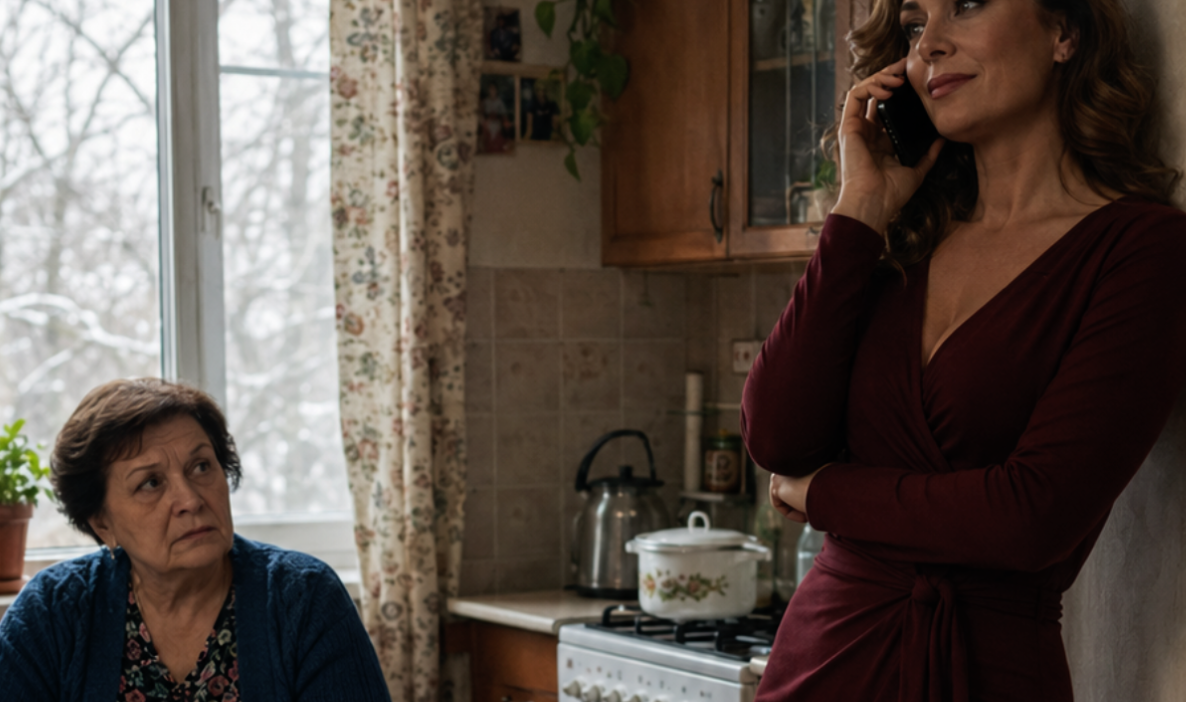
My mother-in-law sold her apartment, gave millions to her daughter, then came to me with a suitcase. I called my sister-in-law right in front of her. On speakerphone.
Olga entered the apartment building a little after six in the morning — and immediately stumbled over a foreign smell. The stairwell smelled of fried onions; the neighbors were having breakfast. After a twelve-hour shift, the smell hit her nose so hard she felt nauseous.
She opened the door with her key — and froze on the threshold.
There was someone else’s suitcase in the hallway. A big burgundy one, with a worn handle. Beside it stood a pair of slippers. Not her slippers.
“Olenechka, you’re home,” came a voice from the kitchen.
Her mother-in-law. Zinaida Pavlovna. In a robe. With a cup in her hand.
“Hello, Zinaida Pavlovna. What are you doing here?”
“Seryozha told you, didn’t he?”
“Seryozha told me nothing.”
Her mother-in-law pursed her lips and looked at Olga as if Olga had forgotten to learn her lesson.
“Well, you and he discussed everything. I live with you now. Where else am I supposed to go?”
Olga took off her jacket. Slowly. To give herself time to think.
Sleepy Mishka peeked out of the living room.
“Mom, why am I sleeping on the folding bed?”
“Later, sweetheart. Later.”
Olga took out her phone and called Sergey. Ringing. Again. He rejected the call. Ten minutes later, a message came: “Mom, I’m on the road. We’ll talk later. Don’t throw my mother out into the street.”
Olga sat down on the stool in the hallway — still in her uniform, still wearing her shoes. She sat there, staring at the burgundy suitcase.
“I need a separate room,” Zinaida Pavlovna explained at breakfast. “I sleep badly. And, Olenechka, I have an ulcer, so I need a special diet. Nothing fried, nothing spicy. Porridge, steamed vegetables.”
“I understand.”
“You’re a paramedic, you understand.”
“I understand.”
“I’ll stay in the child’s room. It’s quiet there.”
“And where will Misha sleep?”
“In the living room, of course. How much does a boy need? Seryozha slept in the hallway at his age, and nothing happened. He grew up into a man.”
Olga nodded and poured herself some tea. The tea was hot, and that was good: when your hands are busy holding a hot cup, they don’t want to do anything else.
Three days later, Olga understood the scale of the disaster.
Zinaida Pavlovna got up at six. She turned on the television. She watched morning health programs — louder than necessary for someone with normal hearing.
Her porridge had to be cooked fresh every morning. Yesterday’s wouldn’t do — “my stomach won’t accept it.”
She washed her laundry separately: “I can’t mix mine with everyone else’s. My skin is sensitive.”
Mishka moved around the apartment like a shadow. He had become quiet. He kept his schoolbooks in a neat little pile by the sofa in the living room.
“Mom, is Grandma staying for long?”
“I don’t know, sweetheart.”
“When will Dad come back?”
“Friday.”
“Will she live with us forever now?”
Olga said nothing. The honest answer was: I don’t know, and that frightens me.
On Friday evening, she sat on the bench outside the entrance. She wasn’t smoking — just sitting. Air. Silence. The things that no longer existed at home.
Tamara Leonidovna, the neighbor from the fifth floor, sat down beside her. A small woman with short hair and a gaze that saw straight through everything.
“So, Olya, the problem arrived at your place with a suitcase?”
“Is it that obvious?”
“It is, dear. Your face looks like my late boss’s when the financial police came for him.”
Olga smirked despite herself.
“Tamara Leonidovna, you used to be a lawyer, didn’t you?”
“I did. Thirty years in civil cases. Family, inheritance. All those joys.”
“May I ask you something?”
“Ask.”
Olga told her everything. Briefly, without tears — she was a paramedic; she knew how to be brief. The apartment in the small town that had been sold. The money was given to the daughter so she could expand her living space. The daughter’s three-room apartment — seventy-eight square meters. Sergey’s consent, which no one had asked Olga about. And the suitcase in her hallway.
Tamara Leonidovna listened. Nodded.
“My dear, I’ll warn you right away: going to court over this would be long and nerve-racking. The mother gave the money herself, there are no receipts, and a donation agreement with conditions doesn’t exist in Russia. But the point is simple: the mother sold her home for her daughter’s sake, the daughter didn’t provide her with housing, and now the mother has no place of her own. Even without a court, that has an ugly name. And it won’t be solved in a judge’s office, but in your sister-in-law’s kitchen.”
“What do you mean?”
“I mean you need to talk. Press her. People really don’t like it when their scheme is said out loud. While a scheme stays in someone’s head, it seems clever. Once it’s spoken aloud, it becomes pathetic.”
Olga looked at the neighbor and thought that this eighty-year-old woman, in sneakers and a cardigan, was worth more than half the law firms in the city.
“Thank you.”
“Don’t thank me yet. When you sort it out, bring me some cognac. I like Armenian.”
Sergey arrived on Saturday around lunchtime. Tired, with bags under his eyes. He hugged his son. Nodded to his mother. He hugged Olga last — somehow casually, almost in passing.
“Seryozha, we need to talk.”
“Let me eat first.”
“We need to talk.”
He looked at her and realized it was better not to argue.
The three of them sat down in the kitchen. Zinaida Pavlovna sat down too; she was certain this was a family council and that, as the eldest, she would not be left out.
Olga took out her phone and called her sister-in-law. She put the call on the speaker.
“Hello?”
“Lena, hello. It’s Olya.”
“Oh, Olya, hi. Did something happen?”
“Yes. Your mother has been living with us for two weeks now.”
“Well, that’s good. She was alone there, and you and Seryozha are nearby.”
“Lena, do I understand correctly that your mother sold her apartment and gave the money to you?”
A pause.
“Well, that’s a family matter.”
“Lena, I’m not asking whose matter it is. I’m saying this: your mother sold her only home, the money went to you so you could expand your apartment, and now your mother is living with us in a two-room apartment, where we have a mortgage and a ten-year-old child sleeping on a folding bed. Am I understanding the situation correctly?”
“Olya, why are you being so aggressive?”
“I’m not being aggressive. I’m clarifying. With the money you received, you take your mother in.”
The line went quiet. For a long time. Zinaida Pavlovna turned pale. Sergey stared at the table.
“Olya, I have a child, a husband, and renovations.”
“I have a child, a husband, a mortgage, and forty-two square meters. You have seventy-eight square meters and the money from your mother’s apartment.”
“This is family.”
“It’s family for me too. Seryozha is my husband. His mother is my mother-in-law. If it’s family, then it should be resolved as a family. With everyone involved.”
Her mother-in-law began to cry. Quietly. Into a handkerchief.
“Olya, what kind of way is that to talk to people?” Sergey finally spoke.
“Seryozha, be quiet. You didn’t talk to me — you made a decision. And I’m talking to your sister. Because there is no one else to talk to.”
That evening Sergey didn’t speak. He lay on the sofa in the living room, staring at the ceiling. Mishka quietly packed his schoolbag for the next day.
“Dad, are you home for a long?”
“For a week, son.”
“Should I put away the folding bed?”
“I don’t know yet.”
Olga washed the dishes. Listened. Said nothing.
Her mother-in-law sat in the child’s room behind a closed door. Her voice drifted out — she was calling someone. Her daughter, apparently.
Half an hour later, she came out. Her eyes were red.
“Olya, tomorrow I’ll probably go to Lena’s. For a while. To sort things out.”
“All right, Zinaida Pavlovna.”
“You’re harsh, of course.”
“I’m tired.”
Her mother-in-law wanted to say something else. She didn’t. She went back into the child’s room.
“You humiliated my mother,” Sergey said that night in the kitchen.
“I asked her daughter a question.”
“You called in front of her.”
“And you brought her here in front of me. Without a phone call, without a conversation, without, ‘Olya, let’s discuss this.’ You brought her and presented me with a fact. I can present facts too, Seryozha. I simply don’t want to yet.”
He said nothing.
“Seryozha, for twelve years I lived as if our family was one whole. But it turns out that when it comes to your mother and your sister, our family is you. And Mishka and I are just an attachment. That won’t work.”
“Olya.”
“Don’t ‘Olya’ me. I’m not throwing your mother out into the street. I’m saying she has a daughter, that daughter has seventy-eight square meters and her mother’s money. That’s mathematics, Seryozha. I’m not evil. I just know how to count.”
He sat with his head lowered. A big, exhausted truck driver who hadn’t slept for three days and whose wife had pressed him against the wall so firmly he had no way out.
“I promised my mother that you would take care of her.”
Olga looked at him. For a long time.
“Seryozha, you can only promise for yourself. I never promised you anything like that. You promised, so you take care of her. Take unpaid leave, sit with her, cook her porridge. I won’t say a word. But then you won’t be getting behind the wheel anytime soon.”
He stayed silent. He understood there was nothing to argue with.
Two days later, Zinaida Pavlovna left. With the same burgundy suitcase. Lena sent a vehicle. She didn’t come by herself — she sent some acquaintances with a small moving truck.
At the party, her mother-in-law didn’t hug Olga. She said dryly:
“Well, goodbye.”
“Take care of yourself, Zinaida Pavlovna.”
And that was it.
Mishka returned to his room. The folding bed was put away on the mezzanine. The apartment seemed to exhale.
Sergey sulked for a week. He walked around the apartment like a thundercloud, answering questions with single words. Olga didn’t touch him — she had shifts, she had her own things to do.
On Friday evening, he sat down beside her on the sofa.
“Olya.”
“What?”
“I was wrong.”
“I know.”
“I thought you would understand.”
“I understood. That’s why I did what I did.”
He was silent for a moment.
“Forgive me.”
“Seryozha, I’ll forgive you. Once. But I want you to hear me. Any decision about our apartment, our son, our money — only together. Not ‘I decided and you adapt.’ Together. If you ever decide for me again, I’ll decide without you. And you won’t like it.”
“What does that mean — I won’t like it?”
“Think about it. You have a whole week at home, so you have time.”
Sergey gave a short laugh. Not cheerful, but not angry either.
“You’ve become harsh.”
“I haven’t become anything. I was always like this. There just hadn’t been a reason before.”
On Sunday, Olga went out into the courtyard with a bag. Inside the bag was a bottle of Armenian cognac. Five stars.
Tamara Leonidovna was sitting on the same bench. With a newspaper.
“Well? Did you kick her out?”
“She left on her own.”
“That’s even better. No courts, no nerves.”
“This is for you. As promised.”
Tamara Leonidovna looked at the bottle and nodded approvingly.
“A good one. With this, it’s not shameful to have a conversation.”
“Thank you. If not for you, I probably would have handled all this differently. And it would have been worse.”
“My dear, the main thing in life is to call things by their proper names in time. A suitcase is a suitcase. A two-room apartment is a two-room apartment. And a mother’s money is a mother’s money. If someone gets confused, you need to help them stop being confused. Kindly. But firmly.”
Olga sat down beside her. Turned her face toward the sun.
“Did you forgive your husband?”
“I did.”
“And rightly so. Husbands are like big children. They don’t understand until you show them. Then you show them, and they get offended. Then it passes.”
“And my mother-in-law?”
Tamara Leonidovna shrugged.
“Your mother-in-law, my dear, is not your blood. And she never will be. That’s normal. You don’t have to love her — just respect her. From a distance. Preferably about three hundred kilometers.”
Olga laughed. For the first time in two weeks — truly laughed.
“Three hundred kilometers is exactly the distance to her town.”
“There you go.”
The bench was warm. The sun was setting behind the five-story building across the yard. From an open window on the second floor came the smell of fried potatoes — someone’s dinner was beginning.