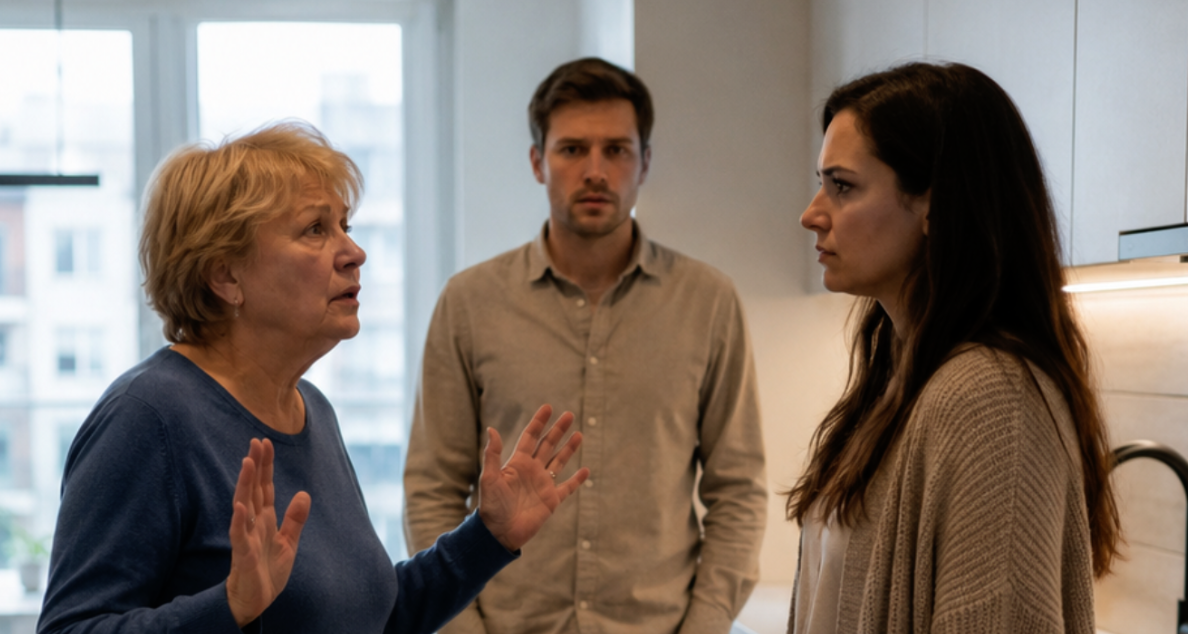
“So if your son doesn’t want to support you, I’m supposed to do it?!” the daughter-in-law asked in astonishment.
Anna lifted her eyes from her laptop screen and looked at the clock: half past seven in the evening. The workday had ended long ago, but the project had to be submitted tomorrow, so she had stayed late at the office. Her phone vibrated — a message from Maxim, her husband.
“Mom called again. She says she’s coming over tomorrow evening to talk. Something important.”
Anna sighed. Valentina Petrovna, her mother-in-law, had been visiting them more and more often lately, and every visit inevitably ended in a conversation about money. At first, there had been subtle hints, then direct requests, and in recent months, outright demands.
The next day, Anna deliberately came home early. She knew the conversation would not be easy and wanted to prepare herself mentally. Maxim was already home, sitting in the kitchen with a gloomy face.
“She’s already called three times,” he said without even lifting his head. “She keeps asking what time you’ll be home.”
“Max, we need to have a serious talk with her,” Anna sat down across from her husband. “This can’t go on forever.”
“I know,” he rubbed his face with his hands. “I’ve already tried to explain to her that we have expenses too: the mortgage, your master’s degree. But she says Marina Sergeyevna gets fifteen thousand from her daughter every month, and Lidia Ivanovna gets twenty.”
“And what do you tell her?”
“That we’ll help if something serious happens. Medicine, doctors — of course. But I’m not going to just hand over money for her whims.”
The doorbell rang exactly at seven. Valentina Petrovna entered solemnly, as always well dressed and neatly groomed. She had a bag of pastries in her hands.
“My dear children,” she kissed her son first, then her daughter-in-law, “how are you? Anechka, you’ve lost weight. Working too much?”
“Everything is fine, Valentina Petrovna,” Anna put the kettle on. “How are you?”
“Oh, what about me… My pension is pennies, everything is getting more expensive. Today I was visiting Marina Sergeyevna — she was showing off a new handbag for twelve thousand! She said her daughter gave it to her. And Lidia Ivanovna’s son is renovating her whole apartment — European-style renovation, just like in magazines.”
Maxim tensed. Anna saw him clench his fists.
“Mom, we’ve already talked about this,” he began carefully. “Every family has its own possibilities.”
“What possibilities?” Valentina Petrovna raised her voice. “You both have good salaries, especially Anna. They pay such money at her company! And what am I, a stranger? I gave birth to you, raised you, gave you my whole life, and now…”
“Mom, what does that have to do with this?” Maxim stood up from the table. “I already told you: if you need something important — medicine, a doctor, utility bills — we will always help. But I’m not going to just give you money for your wants.”
Valentina Petrovna fell silent, then slowly turned to Anna.
“Anechka,” her voice became soft, almost affectionate, “you’re a smart girl, educated. You understand that family is sacred. When I accepted you into the family, I thought you would become like a real daughter to me.”
Anna involuntarily tensed. She remembered exactly how that “acceptance into the family” had gone. Two years of constant criticism, remarks, and comparisons with other girls. Valentina Petrovna had kept her at a distance until she realized Maxim would marry her anyway.
“Valentina Petrovna…”
“Oh, why do you keep saying ‘Valentina Petrovna’ this and ‘Valentina Petrovna’ that!” her mother-in-law waved her hand. “I’m your mother now! And as a daughter, you should help me. You earn more than Maxim, don’t you? You must have extra money.”
“Mom, stop it,” Maxim stepped toward his mother. “Why are you dragging Anna into this?”
“What’s wrong with that?” Valentina Petrovna looked at him in surprise. “She’s my daughter now too. And she should take care of me. Everyone does it! Zina Petrovna told me her daughter-in-law gives her ten thousand every month, and no one objects.”
Anna slowly placed her cup on the table. She felt herself boiling inside.
“Valentina Petrovna,” she forced herself to speak calmly, “I understand that you want to live better. But we have plenty of expenses ourselves. The mortgage, my studies…”
“What studies?” her mother-in-law waved her off. “You already earn well enough! Studying is just indulgence. At your age, I was already raising Maxim and working three jobs!”
“Mom, enough!” Maxim raised his voice. “You have no right to tell Anna how to spend her money!”
“Why don’t I?” Valentina Petrovna stood up, hands on her hips. “She is my daughter-in-law now! And she is obliged to respect her elders! Or do you want me to starve to death?”
“No one is talking about starvation,” Anna also stood up. “Maxim said he would help with necessities. But what you’re asking for is not a necessity.”
“Not a necessity?” Valentina Petrovna’s voice became shrill. “Then what is a necessity? Walking around in old rags while all my friends have new things? Sitting at home while they go to the theater? Refusing a trip to a sanatorium?”
“Mom, are you sick?” Maxim became alert. “Did a doctor prescribe a sanatorium?”
“What does a doctor have to do with it!” Valentina Petrovna brushed him off. “Tamara Ivanovna is going to Kislovodsk, Galina Mikhailovna is going to Crimea. Am I worse than them?”
Anna looked at her mother-in-law for a long moment. Everything fell into place.
“So if your son doesn’t want to support you, I’m supposed to do it?!” her voice was quiet, but there was steel in it.
“What are you saying!” Valentina Petrovna threw up her hands. “What do you mean, ‘support’? We’re talking about helping parents!”
“Helping?” Anna took a step closer. “Valentina Petrovna, you receive a pension. You have a dacha that you rent out. You have savings you’ve been putting away your whole life. But that’s not enough for you because your friends brag about gifts from their children.”
“What’s wrong with that?” her mother-in-law lifted her chin. “Normal children help their parents! Or are you greedy?”
“We’re not greedy,” Maxim intervened. “We’re just not ready to pay for your whims. If you want to go to a sanatorium, save money. If you want a new handbag, buy it with your own money.”
“A handbag is a whim?” Valentina Petrovna was outraged. “And the theater is a whim? Looking decent is a whim?”
“No,” Anna sat back down on the chair, “but it is not our obligation. You are an adult, you have income. Live within your means.”
“How can I live within my means?” her mother-in-law began pacing around the kitchen. “Do you even know what a pension is? And rent? And groceries?”
“I do,” Anna answered calmly. “And I know that your pension allows you to live quite decently if you don’t try to compete with people whose children earn more.”
“Compete!” Valentina Petrovna stopped. “I’m not competing! I just want my children to love me!”
“Love is not measured in money,” Maxim said quietly.
“Easy for you to say!” his mother turned to him. “But how do I look in front of people? Everyone talks about how their children help them. What am I supposed to say?”
Suddenly, Anna laughed. She did not laugh for long, but sincerely.
“Then tell them the same thing!” she looked at her mother-in-law with cheerful eyes. “And live like everyone else — modestly and within your means!”
“What?!” Valentina Petrovna was taken aback.
“Tell your friends that we help you,” Anna shrugged. “Who’s going to check? But in reality, live on your own money. Then everyone will be satisfied.”
Her mother-in-law opened her mouth, then closed it. Then opened it again.
“You… you’re suggesting I lie?”
“I’m suggesting you do the same thing you’re demanding from us,” Anna stood up and began clearing the table. “Play a role. You want to play the role of a caring mother-in-law whose loving children provide her with everything she needs? Play it. But at your own expense.”
Maxim looked at his wife with admiration. Valentina Petrovna was silent, apparently digesting what she had heard.
“But that’s dishonest,” she finally muttered.
“And is it honest to demand money from your daughter-in-law for your whims?” Anna turned to her. “Is it honest to blackmail your son with stories about how much other children give their parents?”
“I’m not blackmailing anyone!” her mother-in-law flared up. “I just…”
“You just want to live beyond your means,” Anna finished for her. “Valentina Petrovna, I respect you as Maxim’s mother. But I am not your daughter. I have my own parents, and I help them when needed. Your son will help you — also when it is truly needed.”
“So you don’t love me,” Valentina Petrovna sat down and put on an offended expression. “That’s what I thought.”
“Mom, what does love have to do with this?” Maxim sat next to her. “We love you. But love is not an ATM.”
“Everyone has normal children, and I…” her mother-in-law took out a handkerchief and pressed it to her eyes.
“Everyone has different children,” Anna said. “And different parents too. Some really do need help from their children. And some are simply used to living at someone else’s expense.”
Valentina Petrovna sharply raised her head.
“How dare you!”
“And how dare you demand money from me?” Anna did not raise her voice, but she spoke firmly. “You understand that it’s wrong. Otherwise, you would have started with me, not Maxim.”
Her mother-in-law fell silent. Apparently, the logic was ironclad.
“Valentina Petrovna,” Anna sat opposite her, “let’s agree on this. If you really have problems — you get sick, something breaks in the apartment, you need medicine — we will help. Definitely. But we will not support you financially.”
“And what about caring for parents?” her mother-in-law asked weakly.
“Care is not only money,” Maxim said. “It is attention, time, help around the house if needed. We are ready to come visit you, help you, spend time together.”
“But Marina Sergeyevna said…”
“Let Marina Sergeyevna say whatever she wants,” Anna interrupted. “And you tell people the same thing about us. Just without our participation.”
Valentina Petrovna was silent for a long time, looking out the window.
“So there will be no money?” she finally asked.
“Not for your whims,” Maxim said firmly. “For necessities, yes.”
“And what counts as a necessity?”
“Something you truly cannot do without,” Anna answered. “Food, utilities, medicine, a change of clothes. But not a new handbag every month and not trips to a prestigious sanatorium.”
Her mother-in-law stood up and picked up her purse.
“Fine then,” she said with dignity. “I’ll manage without you.”
“Mom, where are you going?” Maxim got up. “Stay, let’s have dinner together.”
“No,” Valentina Petrovna headed toward the exit. “It’s time for me to go home. I need to think.”
When the door closed behind her, Anna and Maxim remained sitting in the kitchen in silence.
“Do you think she’ll understand?” Maxim asked.
“I don’t know,” Anna shrugged. “But now she knows what to expect from us.”
“Thank you for supporting me. It would have been hard for me alone.”
“We’re family,” Anna took his hand. “And in a family, there have to be boundaries. Including with parents.”
A week later, Valentina Petrovna called Maxim.
“Son,” her voice was unusually calm, “I’ve been thinking… Maybe you’re right. I talked to my neighbor, and she said her children aren’t exactly eager to give her money either. Maybe people just brag.”
“Maybe, Mom.”
“So I’ve decided: I’ll live on my pension. And if something happens, I’ll call.”
“That’s the right decision.”
“How is Anya?”
Maxim looked at his wife, who was preparing dinner.
“Anya is fine. Should I tell her anything?”
“Tell her… that I’ll think about what she said. Maybe she was right.”
When Maxim repeated the conversation to his wife, she only nodded.
“We’ll see,” she said. “But principles are not something you give up just for the sake of peace.”
“And if she starts again?”
“Then we’ll have the conversation again,” Anna smiled. “As many times as necessary.”
Valentina Petrovna never asked for money again. Sometimes, over the phone, she talked about her friends who bragged about gifts from their children, but now she added, “Although maybe they’re lying. Who knows.”
And when, six months later, she really did fall ill and ended up in the hospital, Maxim and Anna were by her side every day. They paid for medicine, brought food, sat with her in the ward. And Valentina Petrovna finally understood that care was not only about money.
“Thank you,” she said when she was being discharged. “For not abandoning me.”
“We were never going to abandon you,” Anna replied. “We just wanted everything to be fair.”
“Fair,” her mother-in-law repeated thoughtfully. “You know, maybe you were right back then. About what to tell my friends.”
“What do you mean?”
“Just that. I tell them you help me. But I live on my own money and don’t worry about it.” Valentina Petrovna winked slyly. “And you know what? It’s enough for me. Sometimes I even have some left over.”
Anna laughed.
“You see?”
“Living within my means turned out not to be so bad,” her mother-in-law admitted. “The main thing is not to compare yourself with others. Otherwise, you can drive yourself crazy.”
And for the first time in all the years she had known her, Anna thought that perhaps she and her mother-in-law might still manage to find common ground.