At the Age of Six, They Gave Me to My Grandmother and Forgot About Me. Thirty Years Later, They Arrived in a New Camry — to “Share the Apartment Like Family”
“Dashenka, sweetheart, open the door. We’re not strangers. We brought cake. Prague, your favorite.”
I looked at them through the peephole and thought: interesting, how did they know I liked Prague cake? I didn’t even try that cake until I was nineteen. My grandmother, who raised me, never bought it because it was too expensive. And they — my biological parents — had last seen me when I was six.
Thirty years ago.
I opened the door. Not because I was happy to see them. I did it because our neighbor, Aunt Zoya, was already peeking out of her apartment — a retired woman who loved other people’s drama. I didn’t want a show on the stairwell.
“Come in.”
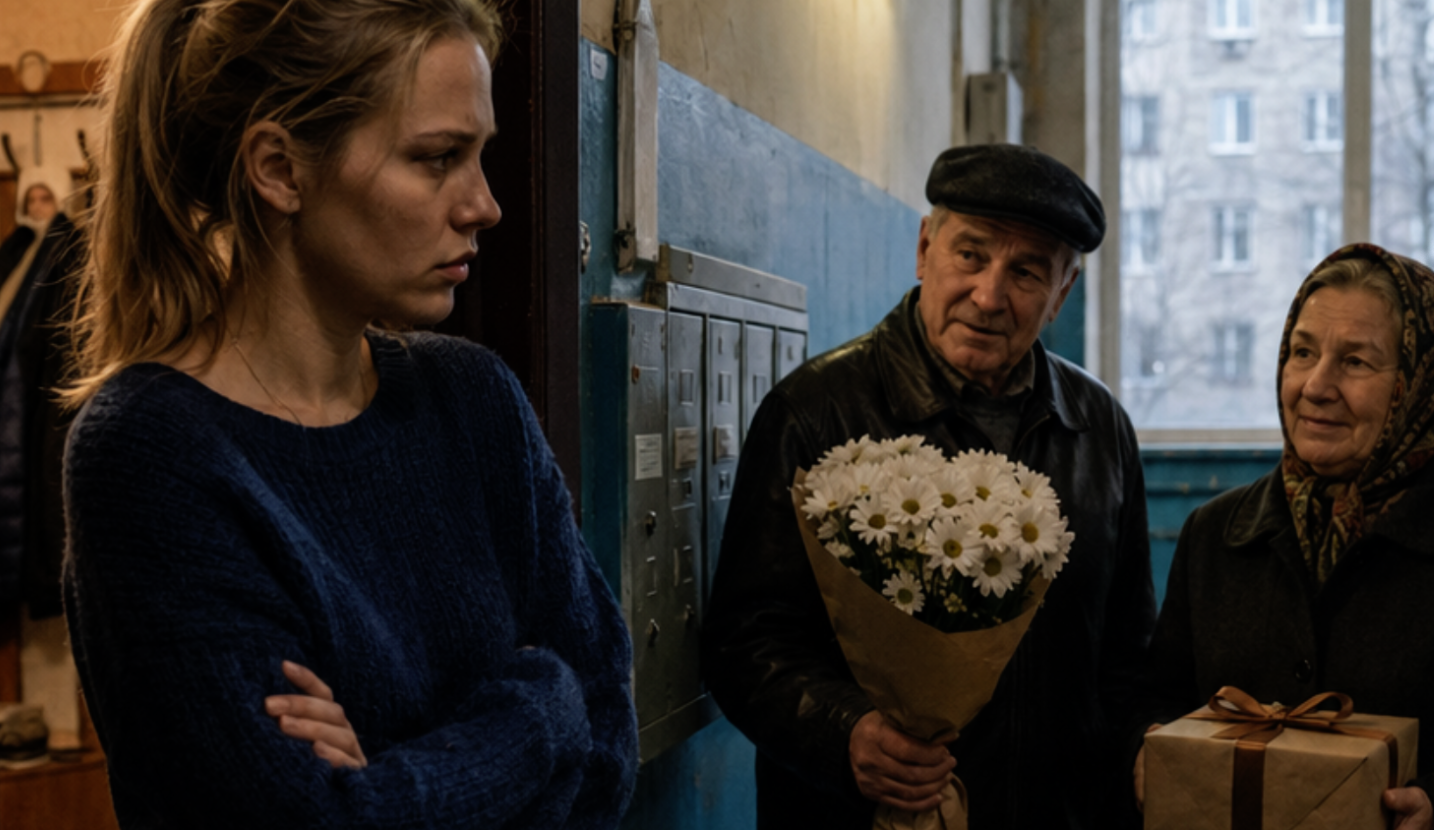
They entered. They fussed around nervously. My mother — Lyudmila, I don’t even remember her patronymic — rushed to hug me. I stepped back. She froze with her arms spread wide, like an offended supporting actress. My father — Viktor — stood awkwardly by the door, holding a bouquet of white carnations.
Carnations. Seriously. Those are usually taken to cemeteries.
Although maybe it was symbolic. They must have come to bury something.
“Dashulya, how are you?” my mother’s voice trembled on all the right notes. “We searched for you for so long…”
“Mom,” I said that word out loud for the first time in my life, and it sounded foreign, “you didn’t search for me. You knew where I was. With Grandma. In Ryazan. A five-story building on Tsiolkovsky Street, building seven, apartment twenty-eight. I lived there from the age of six until eighteen. Grandma knew your address too. And your phone number. She called you every year. On my birthday. You didn’t answer.”
My mother opened her mouth. I closed it. I looked at my father. He coughed into his fist.
“Dashulya, times were hard. The nineties. We gave you to Grandma temporarily…”
“Thirty years is ‘temporary’?”
“Dasha, come on, enough,” my mother fidgeted. “Let’s not dig up the past. What happened is over. We’re here now. We came.”
“I noticed,” I said. “The question is why.”
To understand the full beauty of the moment, you need some background.
My name is Daria. I’m thirty-six. I was born in Ryazan to young, reckless parents: my mother was nineteen, my father twenty-one. Mom worked as a shop assistant at a kiosk. Dad had no fixed occupation, as Grandma tactfully put it. I appeared by accident, and they told me that as soon as I learned to understand words.
“We didn’t plan you. You were a surprise.”
They didn’t like the surprise very much. Until the age of six, I somehow lived with them — or rather, they somehow lived with me. Grandma — my father’s mother — came every weekend and took me to her place so I could at least eat properly. When I was six, she simply arrived and said, “Vitya, Lyuda, I’m taking her. Not forever, just temporarily, until you get settled.”
They spent thirty years “getting settled.”
First they went to Moscow “to earn money.” Then to Krasnodar “to Aunt Sveta.” Then back to Moscow. Then somewhere else. They called once every year or two. They didn’t send postcards. Not a single penny of money. They didn’t come to my school graduation. They didn’t come to Grandma’s funeral when I was twenty-four. They didn’t come to my wedding when I was twenty-eight, even though I invited them — out of foolishness, out of one last hope that I still had a mother and father.
The wedding was modest. My groom, Seryozha, was a design engineer — normal, calm, without any quirks. Two years later, our daughter Polina was born. She is six now. Exactly the age I was when they gave me away.
Every time I look at Polina, I think: how? How could anyone forget this child for thirty years?
I don’t understand.
My apartment is a two-room place in Balashikha. Not a palace. Sixty-two square meters, eighth floor, eleven-meter kitchen. We bought it three years ago — Seryozha and I put in all our savings, plus we sold Grandma’s one-room apartment in Ryazan, which she had left to me. Grandma’s apartment became the down payment. The rest is a mortgage, which we are still paying.
This apartment is my grandmother. Literally. Her Ryazan walls turned into these Balashikha walls. I even brought her cabinet here — old, dark, with glass doors. It stands in the living room. Inside is her “Madonna” tea set, which she never once used. She saved it “for a special occasion.” That special occasion never came for her. But now it comes for me. On Sundays, Polina and I drink cocoa from that set.
I quickly found out how my parents got my address. From Vitalik, Grandma’s nephew, my second uncle. He lives in Ryazan; we talk on the phone about once a year. They found him through old classmates. They asked where “our little daughter” was. Vitalik, a kind soul, suspected nothing bad and told them. The address, the phone number, that I had a daughter, that we lived in Balashikha.
I called Vitalik afterward. Not angrily. I just said:
“Vitya, if anyone else comes looking — don’t give them anything. To anyone.”
He was confused. “Dasha, I thought…”
“I know what you thought. You thought well. I’m not angry. Just don’t give it out anymore.”
And now here they are in my kitchen. Sitting at my table. Drinking my tea. Eating their Prague cake — which, by the way, I don’t like. I like Bird’s Milk. But naturally, they couldn’t know that.
My mother started talking. For a long time. I listened and marveled at what an interesting life I apparently had — according to them.
“Dashenka, you have no idea how much we loved you. It was just the circumstances… Your father was cheated in business, we were left without money. Then Mom got sick, terribly sick, I couldn’t even work. Then your father was beaten up in the entrance of our building, he was bedridden for three months. Then we moved in with Aunt Sveta, but her husband drank, and we had to look for housing. And then you were already grown, and we were embarrassed to call — we thought you’d be offended…”
“I was offended,” I said. “At seven. When you didn’t come to my New Year’s school performance, even though you promised Grandma. Then at ten, when you didn’t come to my birthday. Then at fourteen, when I waited for you for three days in a row on March eighth, and you didn’t come. Then I stopped waiting. And I stopped being offended. You know, it’s exhausting.”
My father squirmed. My mother put on a pitiful face.
“Dashulya, let’s start with a clean slate. We’re your parents. That doesn’t disappear. Blood is blood.”
“Blood,” I repeated. “A good word. By blood, I had Grandma. She raised me. On two pensions — hers and the survivor’s pension for Grandpa. Remember, Grandpa died when Dad was fifteen? Well, Grandma raised Dad alone. And then she raised me too. She had an ulcer, diabetes, and one lung. And you dumped a granddaughter on that one old woman with one lung and went off to ‘get settled’ for thirty years. That’s blood too, Mom. Only for some reason, it never called you back to your child.”
My mother started crying. Beautifully. With sobs. I wasn’t moved. I have a daughter; I know what real children’s tears look like. These were adult tears. Directed tears.
“Why did you come?” I asked directly. “Without introductions.”
My father cleared his throat. Put down his cup.
“Dasha, we, well… basically… We wanted to talk. As a family. Human to human.”
“I’m listening.”
“Your mother and I are in a… difficult situation right now. We were renting an apartment in Podolsk, and the owners sold it. We have nowhere to go. And you… well, you understand… have a two-room apartment. A big one. And we thought maybe you could take us in… temporarily…”
I stayed silent. I looked at him. He couldn’t handle it and continued faster:
“Or, another option, the apartment could be exchanged. You, your husband, and your daughter could move into a one-room place. We’d take a room. Or a studio. We could even add a little money. We have a car, we could sell it…”
“A car,” I said. “A white Camry. I saw it from the window when you arrived. So that exists. But money for housing doesn’t. Interesting balance.”
“Dashulya, don’t be like that!” my mother cut in. “That car was your father’s lifelong dream!”
“I was someone’s dream too,” I said. “Grandma’s. She dreamed I would grow up to be a decent person. She succeeded. You had other dreams. And you fulfilled them. A white Camry. Congratulations.”
Then the circus began.
My mother cried louder. Said I was “heartless.” My father said I “had to understand how old and sick they were.” My mother remembered that she had “given birth to me after all, in pain, it was a C-section.” My father remembered that he “would have paid child support if Grandma had filed, but she didn’t, so that means she had enough.” My mother suggested that we “live together, and we would become real grandparents to little Polina.” My father said that “by law, parents have rights to their children’s housing.”
At that point, I stood up.
“Right. You have five minutes to get your things. Leave.”
“Dasha, what do you think you’re doing?” my mother shrieked.
“I’m allowing myself to kick strangers out of my apartment. Legally, I’ve known you for two hours. Before that, we had no relationship. I have no obligations to you. And as for the law — I read it too, so don’t scare me. An adult is not required to support parents if they avoided raising that child. And you avoided it. For thirty years. So no rights to housing that I bought with my own money and for which I pay a mortgage. You’re free to go.”
My father stood up. Crimson-faced. With an ugly expression.
“You’ll regret this.”
“Unlikely,” I said. “I already regretted everything I could. Thirty years’ worth, in advance.”
They left. They left the Prague cake on the table. I threw it down the garbage chute. Not out of principle — it had alcohol in it, and I have a child. And anyway, I don’t accept cakes from strangers.
Seryozha came home from work late. I told him everything. He listened silently, then hugged me and said:
“Dasha. You did the right thing. Grandma would be proud of you.”
I cried. For the first time all day. Not because I was hurt by my parents. But because Grandma was gone. Because she wouldn’t see this. Because her cabinet with the tea set was the only thing left of her. And because today, I had defended that cabinet.
Six months passed.
My parents called twice more. The first time, it was my mother. She cried and said Dad had “blood pressure problems, he needed peace, and they were still wandering from one rented corner to another.” I replied, “I sympathize. But that is not my problem.”
The second time, it was my father. He threatened to “take me to court.” I said, “Go ahead. I’ll file a counterclaim for moral damages for thirty years of absence. We’ll see who owes whom more.”
They stopped calling.
Polina is growing up. She is seven now. She knows that her mother “doesn’t have her own mom and dad,” and that she was raised by “Great-Grandma Tonya.” She doesn’t ask unnecessary questions. Children are wise. They understand what adults cannot say out loud.
And every Sunday, I take out Grandma’s “Madonna” tea set. I pour cocoa into the cups. And Polina and I drink — to Grandma. To the woman with one lung who took in someone else’s child and made her her own. Forever. Without conditions. Without “temporarily.”
That, I believe, is what parents are.
Not the ones who gave birth.
But the ones who stayed.