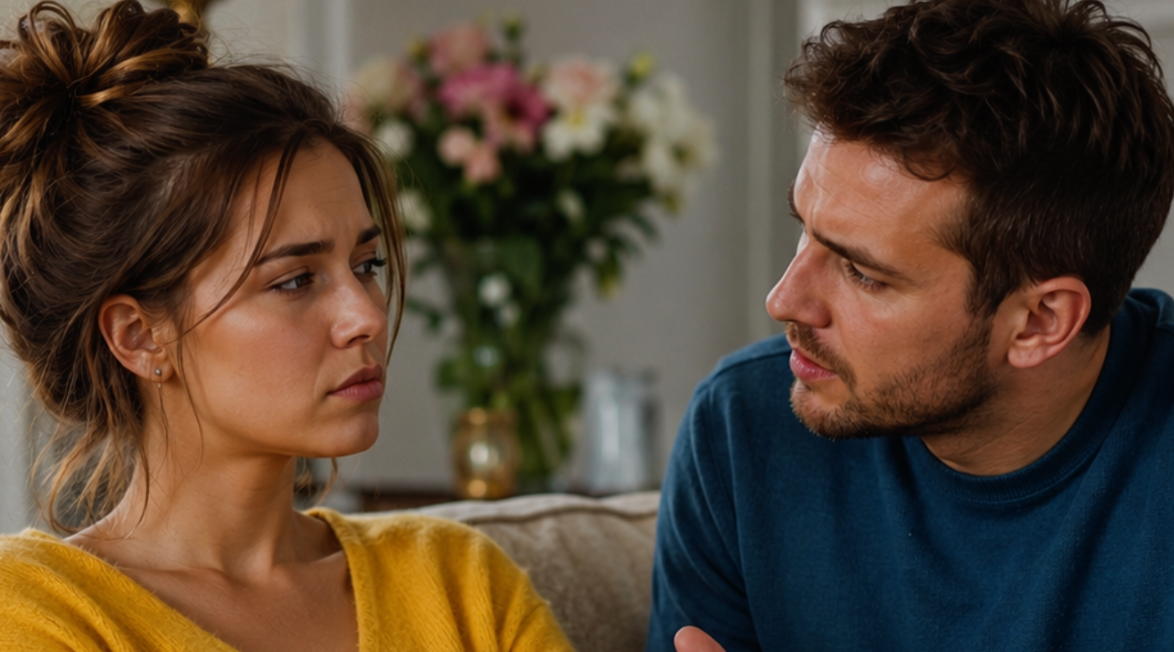
“You’ll move to the village to my parents’ place. You’ll take care of them,” her husband ordered.
Anton appeared in front of her right by the office doors, as if he had been standing there all day, waiting. Tatyana had only just stepped out onto the porch, adjusting the strap of her bag on her shoulder. The evening was warm; she had been thinking about tea with lemon and silence. Instead of silence, she got her husband with a stone face.
“Hi,” she said. “What brings you here? You don’t usually like meeting me after work.”
“Listen carefully,” Anton didn’t even greet her. “Tomorrow you write your resignation letter. You quit. And you go to my parents in the village. You’ll take care of them.”
“Of whom?” Tatyana tilted her head to the side, as if she hadn’t heard him.
“My parents. They’re getting weaker, you understand. They need someone in the house. It’s decided.”
She was silent for a moment, studying him as if a news ticker had suddenly lit up across his forehead. Decided. Not “let’s discuss it,” not “I’m asking you.” Decided, like a stamp on a document.
“Interesting,” Tatyana drawled. “And no one thought to ask me?”
“What is there to ask?” Anton jerked his shoulder. “You’re my wife. This is a family matter. In family matters, people don’t ask. They do.”
“Family,” she repeated with interest. “So my family now consists of a suitcase and a train schedule.”
“Don’t get smart,” he grimaced, as if tasting something sour. “You always start juggling words. I told you plainly. You’re going, period.”
Tatyana shifted her bag more comfortably. Inside, everything was boiling, but outwardly she kept her tone even, almost gentle. Patience was an expensive thing, and she didn’t want to spend it on the office steps.
“Antosh, let’s not do this in the street,” she said softly. “Come home and we’ll talk calmly. We’ll have tea. Have you even eaten?”
“I don’t have time for tea,” he was already looking at his phone, at his watch, somewhere past her. “I have things to do. I told you the main thing. You heard me. I’ll be home by evening.”
“And the details?” she smirked. “The address, for example. I’ve never even been to your parents’ place.”
“Later, later,” he waved her off and walked away without turning around, as if the matter had been closed forever.
Tatyana remained standing there, watching him go. It wasn’t even anger — it was surprise. How could a person who had lived under the same roof with her for more than one year decide that her life was a thing that could simply be moved from one shelf to another?
“Well, imagine that,” she said aloud to herself. “‘You’re going, period.’”
She sighed and went to the store. Bread, cheese, something for tea. Her head demanded simple, understandable actions where you chose the loaf yourself.
In the vegetable section she ran into Zoya. They worked in the same office, back to back, and knew about each other even the things they hadn’t wanted to know.
“Oh, look who it is!” Zoya was pushing a cart piled so high it looked as if she were preparing for a siege. “Tanya, save me. I’m about to lie down right here between the zucchini.”
“What happened?”
“What happened?” Zoya snorted. “Home happened. The washing machine has been leaking for three days, the kid brought a runny nose home from kindergarten, and my husband sits there wondering why dinner doesn’t cook itself. I’m like a squirrel in a wheel, except the wheel is square too.”
“You have my sympathy,” Tatyana smiled. “I have news too. Fresh, hot off the press.”
“Come on, then.”
“Anton met me outside the office. Ordered me to quit my job and go to the village. To take care of his parents.”
Zoya stopped the cart so abruptly that a jar of peas almost jumped out.
“Wait. Ordered you? Just like that?”
“Just like that. ‘You’re going, period.’”
“And what did you say to him?”
“I didn’t say anything,” Tatyana shrugged. “I stood there admiring how a person could erase my life with one sentence.”
“Okay, stop,” Zoya narrowed her eyes. “Do his parents have no one else? Are there other children?”
“Yes. He has a sister. Vera.”
“A sister,” Zoya stretched out the word with a face as if the secret of the universe had just been revealed to her. “So his parents have their own daughter. And for some reason the daughter-in-law is supposed to take care of them. Am I understanding the arrangement correctly?”
“Absolutely correctly.”
“Tanya, he hung someone else’s problem around your neck like a shopping bag!” Zoya threw up her hands. “They’re not even your parents. They’re his. And his sister’s. But somehow you’re the one responsible. Convenient arrangement.”
“Very convenient,” Tatyana agreed. “I thought the same thing: how sweet it is when love for one’s parents ends exactly where personal inconvenience begins.”
“Oh, you do know how to put it,” Zoya chuckled. “Listen, are you actually going?”
“Do I look like a suitcase without a handle to you?”
“No.”
“That’s what I thought,” Tatyana put a bag of lemons into her basket. “The only place I’m going is to get tea. And then I’m coming back.”
Home was quiet and pleasant right up until the phone rang. Her sister-in-law’s name appeared on the screen. Tatyana looked at it for a second, then answered anyway — curiosity won.
“Tanechka!” Vera’s voice flowed like honey, so sweet it made her teeth ache. “Oh, I’m so happy! Antosha told me everything! You are such a clever girl, pure gold!”
“Hello, Vera. And in what sense am I gold?”
“Well, how else! You’re going to our parents to help! I finally breathed freely, you can’t imagine. I have children, work, a house, I’m torn apart, literally into pieces.”
“Wait,” Tatyana interrupted softly. “Anton told you I was already going?”
“Of course he did! He said it was all decided, you’re resigning tomorrow and packing. Tanechka, you’re so responsible, unlike some people.”
“Vera,” she almost smiled. “I hate to upset you on such a bright evening. But I’m not going anywhere.”
There was a pause on the other end.
“How… how are you not going?” her sister-in-law’s voice instantly dried up. “Anton said…”
“My husband says many things. For example, last year he promised to put up a shelf. There’s still no shelf. Same here.”
“Tanechka, what are you doing!” Vera began speaking rapidly. “They’re parents! They need help! Who, if not you?”
“Indeed, who,” Tatyana said thoughtfully. “Their own daughter, for example. Has that occurred to anyone?”
“Me?! I have a family! I have children! I have the whole house on me!”
“And I, apparently, have no family, no home, and no business of my own. I’m convenient, Vera. A real gift.”
“You’re twisting everything!”
“I’m simply listening and repeating it back,” she answered calmly. “All right, I won’t keep you. Give my regards to your parents. From afar.”
She hung up and exhaled. A key turned in the door — Anton had arrived. He walked into the kitchen, flopped down on a chair, and pulled toward himself the plate she had left for herself.
“Is there food?” he grumbled, already poking at it with a fork.
“It’s already been served for you, as you can see.”
He ate greedily, quickly, dropping crumbs, without looking at her. Then he pushed the plate away, wiped his mouth with the back of his hand, and, to her amazement, got up and went into the bedroom. Tatyana heard the wardrobe doors creak.
“Anton?” she looked into the room. “What are you doing?”
“Helping,” he was briskly pulling out her sweaters and folding them into an open suitcase on the bed. “You have to pack. I’m a kind husband; I’m packing your things for you. Appreciate it.”
“Appreciate it,” Tatyana echoed, leaning against the doorframe. “I didn’t say anything about going.”
“What’s there to say?” he didn’t turn around, continuing to stuff sweaters inside. “It’s a done deal. I’ve already told everyone. I told my mother. I told Vera. It’s too late to back out now and let people down.”
“People,” she repeated quietly. “And letting me down, then, is normal.”
“Don’t start,” he finally turned around, holding her favorite scarf. “You always create drama. What’s the big deal? You’ll live there, take care of them. It’s not hard for you, and it helps people.”
“You know,” Tatyana crossed her arms, looking at the growing pile of things in the suitcase. “The more you pack, the more interesting this becomes to me.”
“See?” he brightened, interpreting everything in his own way. “Now she’s interested. I told you — you’d come to your senses.”
“You made something of yourself. So you’ll sign the apartment over to me,” her father demanded viciously.
Stories for the Soul by Elena Strizh
2 days ago
The doorbell rang. On the threshold stood Sergey — Anton’s friend, a calm man with a heavy, attentive gaze. He stepped inside, saw the open suitcase, and frowned.
“Where are you going?” he asked. “On vacation or something?”
“Wrong guess,” Anton said, stepping into the hallway and clapping his friend on the shoulder. “Tatyana is going to my parents. To the village. To take care of them.”
Sergey shifted his gaze to Tatyana. She stood calmly, with a faint smile.
“Is that true?” he asked her.
“That is Anton’s plan,” Tatyana replied. “As you can see, in this plan I’m only the suitcase. I gave no consent. Not in words, not with a nod, not with a blink.”
Sergey slowly turned to his friend.
“Anton. Let’s step aside.”
They went into the kitchen. Tatyana didn’t hide — she stood nearby; she was actually curious.
“What are you doing?” his friend began quietly. “They’re your parents. Yours and your sister’s. Why should your wife carry all of it on herself?”
“Who else?” Anton spread his hands. “Vera is busy, she has children. I work. Tatyana is the only free person.”
“Free,” Sergey shook his head. “She’s not free. She’s the one you’re dumping everything on. I’m telling you as someone who carried a family since childhood: you can’t do that. I raised my brother and sister. I know what care means. You don’t order care. You take it upon yourself.”
“Oh, here we go,” Anton grimaced. “Found ourselves a saint. You had your life, I have mine. I say she’s going, so she’s going.”
“They’re your parents, Anton,” Sergey repeated firmly. “Your blood. If you want to help, sit down and help yourself. Or split it with your sister. Don’t shift it onto someone who came from outside.”
“She’s my wife!” Anton raised his voice. “A wife isn’t outside! She’s family! Where I took her from, that’s where she should pull the load!”
“Where you took her from,” Tatyana said thoughtfully from the hallway. “Antosh, I’m not a horse to be harnessed. And I’m not a vacuum cleaner to stand in the corner until needed.”
“Shut up!” he barked. “We’ll figure it out without you.”
Sergey looked at him.
“You’re a fool, Anton,” he said simply. “And incurable.” Then, nodding to Tatyana, he left.
When the door closed, Tatyana went into the room and dialed her sister-in-law. Suddenly, she was truly interested in getting to the bottom of it.
“Vera, hello again. I have a question. Since everyone cares so much about your parents, tell me, what are you personally ready to do for them?”
“Me?” Vera became wary again. “I’ll send money. Regularly. That, by the way, is also care, and not a small amount.”
“Wonderful,” Tatyana perked up. “How much?”
“Three thousand,” Vera announced proudly. “Every month. Not everyone can do that, you know.”
Tatyana couldn’t hold back and laughed — brightly, sincerely.
“Three thousand,” she repeated through laughter. “Vera, are you serious? Three thousand a month in exchange for me dropping everything and moving into someone else’s house. A magnificent exchange. Truly royal generosity.”
“What’s so funny?!” Vera flared up. “Money doesn’t grow on trees!”
“Exactly,” Tatyana said after she stopped laughing. “My years don’t grow on trees either. Thank you, Vera, you’ve helped me a lot. Now I know the exact price of your care. Exactly three thousand.”
She hung up. Anton stood in the doorway, pleased with himself.
“Well,” he pointed at the suitcase. “Everything fit. Big suitcase, convenient. I did well.”
“You did well,” Tatyana nodded. Then suddenly she went to the storage room, pulled out two large bags, and began briskly putting the remaining things into them.
“Why so much?” Anton was surprised. “Are you moving forever or something?”
“What did you think?” she replied without turning around. “If I’m going, I might as well do it properly.”
And warmth spread through his chest: she had agreed. His wife had agreed. He knew it — firmness always wins. He watched her stuff the bags and mentally patted himself on the head.
In the morning Anton woke up in a wonderful mood. He stretched, walked around the apartment like the master of life, and kept glancing at the packed things by the door.
“Don’t forget,” he said, sipping coffee. “Mother is already waiting for you. She made up a bed for you, a separate one. She really tried. Call her and thank her or something.”
“I’ll call,” Tatyana nodded, and she really did dial her mother-in-law.
“Hello,” she said evenly. “This is Tatyana. Thank you for preparing the bed. That was very thoughtful of you.”
“Oh, my dear, don’t mention it,” the woman rejoiced. “I’ve already cleaned the room and cleared some space. Come, come. We really need help. Floors, the garden, various things around the house.”
“I understand,” Tatyana said. “Thank you again for the bed.”
“So when should I expect you?”
“Thank you for the bed,” Tatyana repeated with a smile and said goodbye.
Her mother-in-law was satisfied — she had been thanked, so that meant she was coming. Anton, who had heard the conversation, practically glowed.
“See how well everything is going,” he said. “Everyone is happy. I told you.”
“Everyone,” Tatyana agreed. “A real holiday.”
She called a taxi. Anton, feeling generous, carried the suitcase and bags downstairs himself. He groaned, but carried them with the look of a man doing a good deed. He loaded everything into the trunk and slammed it shut.
“Well,” he said, dusting off his hands. “Godspeed. Call when you get there.”
Tatyana got into the car, waved to him, and drove away. Anton stood by the entrance, watching the taxi go, unbearably proud of himself.
Only when the car disappeared around the corner did it hit him. The address. He hadn’t given her the address. Tatyana had never been to his parents’ place — his mother had always come to visit them herself.
“Oh, damn it,” he muttered and grabbed his phone.
He is called Tatyana. Long rings. Then again. Rings. Rejected. He quickly typed an SMS with the address and added: “Don’t get lost. Call when you arrive.” He sent it. Then stood there a little longer, calming himself: she would read the message, she would get there, everything would be fine. His wife had gone, after all. She had gotten into the taxi herself. Herself.
“Unblock my accounts!” her husband shouted, not yet knowing he was already her ex.
Family Whirlpool | Stories People Keep Silent About
2 days ago
The day passed in errands. By evening Anton had even forgotten his anxiety — he was sure everything was going according to plan. Then his mother called.
“Antosh,” her voice was confused. “Where is Tanechka? No one came. I waited all day, made the bed, and started a pie. She isn’t here.”
“What do you mean, she isn’t there?” Anton went cold. “She left in the morning. By taxi. I loaded the things myself.”
“No one is here, son. No taxi, no Tanechka. Maybe she got lost?”
“I’ll sort it out,” he snapped and hung up.
He began calling his wife. Once. Twice. Five times. Rings, then — switched off. Messages didn’t go through. He stood in the middle of the room, and slowly, heavily, it dawned on him: Tatyana had not gone anywhere. All her things, the suitcase, the bags — they had gone somewhere unknown, but not to his mother.
“Well, you little…” he exhaled. Anger rose inside him, dark and suffocating. “She tricked me. She tricked everyone.”
He paced around the apartment, dialing again and again, leaving voice messages in which he first demanded, then broke into shouting into the void. There was no answer. He slept badly that night.
In the morning he went to her office. He waited. Tatyana came out — calm, rested, as if there had been no drama the day before.
“Where were you?!” he pounced on her right by the steps. “Where are the things?! Mother waited all day! What have you done?!”
“Good morning, Anton,” Tatyana said imperturbably. “I didn’t go anywhere. And to be honest, I never intended to. From the very beginning.”
“What do you mean, you never intended to?!” he choked. “You got into the taxi! You packed your things!”
“You packed the things,” she corrected him. “With great enthusiasm, by the way. And the taxi took me and my bags somewhere else. Somewhere I’m not considered furniture.”
“You… you’re mocking me!” he sprayed words, his face blotchy. “I treated you decently! And you!”
“Decently is when people ask, Anton. Not when it’s ‘you’re going, period,’” she adjusted her bag. “By the way, don’t forget. On Friday the rent for the apartment has to be paid. I don’t live there anymore, so now that’s entirely your concern. Logical, isn’t it?”
“You will come home and go to my mother today!” he shouted, not hearing her. “I said you’re going! Stop showing off!”
Tatyana looked at him without a trace of a smile. Her voice became even and cold.
“Anton. Listen carefully. If you order me one more time — right here in front of you, without leaving these steps — I’ll open my phone and file for divorce online. In three taps. Want to test it?”
He fell silent. He opened his mouth — and found no words.
“I’m not threatening you,” she added calmly. “I’m simply stating the conditions. The way you like. Decided.”
And she walked away — light-footed, without turning around. She didn’t say when she would come back. Or whether she would come back at all.
Anton remained standing there. His anger drained away somewhere, and in its place came a sticky, unpleasant fear. He suddenly understood that she really had left — with the suitcase, with the bags that he himself, with his own hands, had packed for her. As if he had put her out the door. As if he had driven her away. And he loved her. He had not thought, had not believed, that she was capable of doing this — firmly, calmly, simply taking and leaving him.
The phone rang. Vera.
“Anton, so what’s going on with our parents?!” his sister rattled on. “When is Tatyana finally coming?”
“Never,” he barked. “She’s not going. If you want, sit down and go to Mother yourself.”
“How dare you speak to me in that tone?!” she flared up.
“And you can shove your three thousand deep into your wallet,” he snapped, and heard short beeps. Vera had hung up.
He sat down on the curb by the office steps. He didn’t go anywhere. He decided to wait until evening. To wait for Tatyana. And talk to her. Without “it’s decided.” Without “you’re going.” Just talk. If she still wanted to listen to him.
He sat there and thought that the firmness he had been so proud of had turned out to be ordinary stubbornness. And that he had mistaken the person beside him for a thing that could be moved around. But the thing had gotten up and left. On her own two feet. With his suitcase.