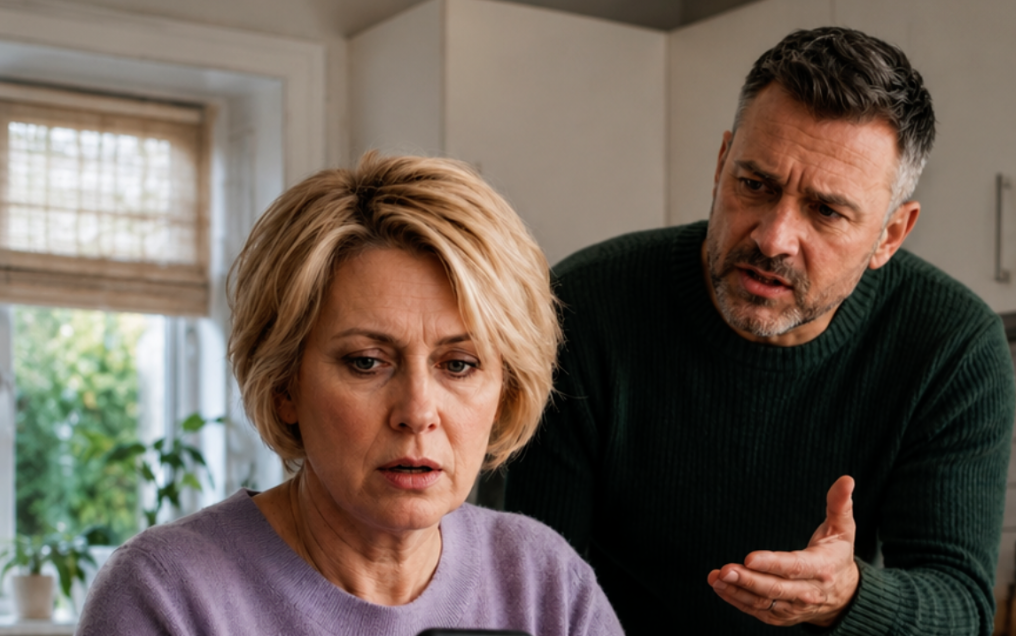
“You don’t have a serious salary,” my husband declared. I blocked my card and silently watched what would happen.
“From now on, we’re going to have an order, Nelly. I’ve calculated everything.”
Viktor said it in the same tone people usually use to announce that the light bulb in the building entrance has been replaced. No anger. No pressure. Even with a certain practical concern that immediately made me want to check exactly how he was about to carefully put me in my place.
Two bank cards were lying on the kitchen table. His dark one, and my light one with a peeling corner, because I carried it in my jacket pocket together with keys, receipts, and a lipstick I should have thrown away a long time ago.
Next to them lay his notebook.
Viktor loved that notebook more than some relatives love each other. Squared paper. An elastic band. On the first page, written in large letters: “Family Budget.” Underlined twice. In blue.
“What kind of order?” I asked.
The tea in my mug had already darkened and formed a thin film on top. I had come home from work forty minutes earlier, had managed to take off my boots, put the bag by the door, and slice some bread. Dinner was almost ready. Or rather, it had been ready for a while, but Viktor had been waiting for the right moment to open his kitchen parliament session.
“A normal kind,” he said. “An adult kind. In all serious families, the money is kept in one place.”
“As far as I know, we’re not exactly a kindergarten.”
“Nelly, don’t start.”
He said that “don’t start” often. A convenient phrase. A person hasn’t even said anything yet, and they’ve already been appointed the troublemaker.
I sat down across from him. The bag by the door quietly slumped onto its side, a pack of salt rolled out of it and bumped against the leg of a stool.
“Show me what you calculated.”
Viktor was pleased. He loved it when people asked him to show his calculations. That was when he became the chief engineer of our apartment, where I, apparently, was listed as service staff with the right to an advisory vote.
He opened the notebook.
“Look. Utilities, internet, groceries, the car, repairs, medicine, gifts, household expenses. Everything needs to be brought into one cash pool.”
“Into whose one?”
“A common one.”
“Where will this common cash pool be kept?”
Viktor pressed his lips together slightly. Not too much. Just enough to show that I had supposedly asked something irrelevant, although I had hit exactly where I needed to.
“With me, of course. I’m the one who manages the budget.”
“Of course,” I said. “Who would doubt it?”
He pretended not to hear.
“You get your money on your card. Then you pay here and there from that card, buy this and that. Afterward, it’s unclear where everything went. This way, everything will be visible.”
“Visible to whom?”
“To us.”
“Viktor, your ‘us’ usually sits with a pen in one hand and my card in the other.”
He looked up.
“That’s exactly why I’m saying: give me your card. Your salary isn’t serious, but it will still be useful in the common pot.”
The words settled evenly on the table. Almost beautifully. “Not serious.” As if my salary wore a short skirt and laughed during class.
I looked at my card. There wasn’t much money on it. But from that “not much,” very concrete things had been bought over the last few years: eggs when they suddenly ran out; laundry detergent; light bulbs; blood pressure pills for his mother; food for Barsik; a gift for his nephew; a taxi when Viktor left the car at the service center and I had to pick up an order after work on time.
My unserious salary had been surprisingly busy.
“And your card?” I asked.
“What about mine?”
“Will it go into the common pot too?”
Viktor leaned back in his chair. The chair creaked. Old, Viennese, still from my mother. Every time, he threatened to throw it away, but he always sat on that exact one because it was “familiar.”
“My card is for work.”
“What do you mean?”
“My main salary goes there. Bonuses. Payments. It’s more convenient for me to distribute everything myself.”
“And it’s less convenient for me to do that myself?”
“Nelly, you understand. Your income is small. You spend it on the house anyway.”
“So if I spend it on the house anyway, why do you need my card?”
He clicked his pen. Once. Then a second time. That sound always appeared when Viktor ran out of arguments but still had confidence left.
“So there won’t be chaos.”
For some reason, at the word “chaos,” I looked at his notebook. In the “home” column, there was the amount for winter tires. In the “repairs” column, there was a new dashcam. In the “vacation” column, there was a fishing trip with Seryoga, where they had spent two days sitting on the riverbank, eating canned stew, and taking pictures of a bucket with three tiny roaches as if they had returned from an expedition to Kamchatka.
Below, in small handwriting, it said: “Nelly: groceries.”
And that was all.
“We have an interesting kind of chaos,” I said. “Tires are home, fishing is vacation, and groceries are me.”
“Don’t nitpick.”
“I’m not nitpicking. I’m reading.”
He pulled the notebook toward himself.
“You’re always like this. Instead of discussing things normally, you start clinging to words.”
“You’re the one clinging to words. ‘Not serious,’ for example.”
Viktor waved his hand.
“Why are you so stuck on that? I didn’t mean it as an insult.”
Another convenient phrase. You say something unpleasant to a person, put “I didn’t mean it as an insult” on top, and that’s it, apparently you can go drink tea.
I stood up and turned off the stove. The potatoes in the pan had already begun to stick. The smell of fried onions hung over the kitchen, thick and homely. The kind of smell that usually reconciles people, if there is anything inside them that can still be reconciled.
“Sit down,” Viktor said. “We haven’t finished talking.”
“We’ve already said almost everything.”
“Nelly.”
I turned around.
“What?”
“Let’s not be theatrical. Bring me the card, I’ll link it to the common payments. It’ll be easier.”
“To which common payments?”
“Internet. Utilities. Stores. Pharmacy. Everything necessary.”
“And what is all of that being paid from now?”
He did not answer immediately.
I went to the table and picked up the notebook. Viktor jerked, but did not take it away. Apparently, he decided that I could read it anyway, since I still wouldn’t understand his higher accounting.
On the last page were the monthly totals. His handwriting had become smaller, like a doctor’s at the end of a shift.
“Utilities: Viktor.”
“Car: Viktor.”
“Loan: Viktor.”
“Home: Nelly.”
“Groceries: Nelly.”
“Small things: Nelly.”
“Small things,” I read aloud.
“Well, what else should I call it?” he said tiredly. “You buy something every day yourself. Napkins, cereal, milk, that thing, what’s it called, for the floor.”
“Cleaner.”
“Exactly. Floor cleaner. Are those serious expenses?”
I even chuckled. Not happily, no. Sometimes the body simply looks for a crack through which it can release steam before it boils over.
“Of course not. Our floor isn’t serious either. It washes itself out of respect for your main salary.”
Viktor frowned.
“Why are you being sarcastic?”
“So I don’t say something ruder.”
The next day, I deliberately did nothing. Not out of spite. I simply decided to see what the house would look like without my unserious money.
In the morning, we ran out of bread.
“Nelly, is there any bread?” Viktor shouted from the kitchen.
I was buttoning my blouse in front of the hallway mirror. The button on my sleeve refused to go through the loop, and I thought how strange it was: a person can learn over twenty-seven years to guess her husband’s mood by his footsteps, but still not learn to fasten her left sleeve without irritation.
“No.”
“What do you mean, no?”
“I mean no. There was bread yesterday. Today there isn’t.”
He came out with the empty bread box.
“You went to the store after work yesterday.”
“I did.”
“And?”
“I bought salt, cottage cheese, food for Barsik, and a light bulb for the bathroom. I didn’t buy bread.”
“Why?”
“I forgot.”
He looked at me as if I had forgotten not bread, but a child on a commuter train.
“Fine, I’ll stop by myself.”
“Of course.”
In the evening, he came home with bread, sausage, cheese, and some kind of cookies.
“Here,” he said, unloading the bag. “Nothing complicated.”
“I agree.”
“And the receipt was only eighteen hundred.”
I looked at him. He didn’t hear himself right away. Then he cleared his throat and went to take off his shoes.
Two days later, the detergent ran out.
“Nelly, where’s the new one?” Viktor asked from the bathroom.
“What new one?”
“The laundry detergent.”
“At the store.”
His head appeared from the bathroom.
“What do you mean?”
“Exactly what I said. The old one ran out, and I didn’t buy a new one.”
“Why?”
I was sitting in the kitchen peeling carrots. I still had to make soup, because I wasn’t planning to turn the house into a battlefield. I was interested in something else: whether Viktor would see what had stood in front of him for years on the shelf, in the cupboard, in the fridge, in the medicine cabinet, on the windowsill, under the sink.
“Because it’s a small thing,” I said. “And small things aren’t serious.”
He came into the kitchen holding the empty detergent bag with two fingers.
“Are you going to remember every word now?”
“Not every word. Only the good ones.”
“Nelly, enough already.”
“I haven’t even started.”
He sat down. Put the bag on the table, right next to the notebook. The empty bag looked more convincing than many conversations.
“Let’s talk normally,” he said. “I’m not your enemy.”
“Then who are you?”
“Your husband.”
“Then why do you want my card, but won’t give me yours?”
Viktor looked away toward the window. Outside the glass, the courtyard was darkening, and the kitchens in the neighboring building were lit. People were moving back and forth behind the windows, putting kettles on, opening fridges, arguing, making peace. Perhaps every kitchen had its own accounting system, only not everywhere was it called love.
“Because I manage money better,” he finally said.
“Better for whom?”
“For the family.”
“Who is the family?”
He exhaled irritably.
“Here we go again.”
“No. For the first time, this is ending.”
I stood up, wiped my hands on a towel, and picked up my phone.
“What are you doing?” Viktor asked.
“Putting things in order.”
He relaxed a little. He probably thought I had finally surrendered. That I would open the app now, transfer the remaining money to him, or let him link my card wherever he wanted.
I opened the banking app. Password, fingerprint, menu. My card appeared on the screen. That same light one with the peeling corner.
“Nelly, let’s not put on a show,” Viktor said, already more softly. “I’m doing this for us.”
I tapped “block.”
The phone asked whether I was sure.
A very interesting question. At least the bank asked.
“I’m sure,” I said.
“Sure about what?”
I confirmed. A short, dry message appeared on the screen, as if someone had politely closed a gate: “Card blocked.”
In the kitchen, the fridge suddenly became very audible.
“What did you do?” Viktor asked.
“I blocked the card.”
He blinked.
“Why?”
“So there won’t be chaos in the common pot.”
To say that he got angry would not be accurate. First, he got confused. His face took on the expression of a person who came to switch on the light and discovered that the switch was painted on the wall.
“Are you out of your mind?”
“No.”
“What about groceries? What about payments?”
“Common ones?”
“Well, yes!”
“But you have the main salary. A serious one.”
He stood up. Walked around the kitchen. Came back. The notebook lay in front of him, but now, for some reason, it didn’t help.
“Unblock it.”
“No.”
“Nelly, I’m serious.”
“So am I.”
“This is childish.”
“Maybe. But the card is already grown-up. It went into blocking all by itself.”
He wanted to say something, but the doorbell rang.
We both looked toward the hallway. The ringing came at the wrong time, like a neighbor’s drill on a Sunday morning.
Behind the door stood Raisa Pavlovna from the fifth floor. In a housecoat under a puffer jacket and with a utility bill in her hand. She always looked as if she had just stepped out for a minute, but that minute could easily last an hour.
“Nelly dear, could you take a look?” she asked. “There are miracles with the water bill again. I think they’ve charged me for a swimming pool. I haven’t swum in it, of course, but who knows, maybe in my sleep.”
I took the bill.
“Come in.”
“Oh, I’ll just stand at the door. You’re probably having dinner.”
Raisa Pavlovna peeked over my shoulder and saw Viktor with the notebook. Then the cards on the table. Then the empty detergent bag. Women our age can read a kitchen faster than any app.
“Oh, a meeting?” she said. “Then I’ll come back later.”
“No, Raisa Pavlovna, let’s take a look.”
I stepped out into the stairwell and pulled the door almost closed. It smelled of wet doormats and someone’s stewed cabbage. The elevator hummed between floors like an old cat.
We stood by the windowsill. I was going through her bill while I could hear Viktor walking around the kitchen behind the door. Steps one way. Steps back. A chair creaked. Then I heard his voice:
“Half the house was hanging on her card!”
He said it loudly. Not for us, of course. For himself. But the door was thin, and in such cases, the stairwell always works like a radio speaker.
Raisa Pavlovna lifted her eyes from the bill.
“On whose card?” she whispered.
“Mine,” I said.
She looked at me. Not with pity. More the way people look at a woman who has carried a heavy bag for a long time and has only now set it down on the ground.
“Well,” she said. “Half the house is no small thing.”
I gave her the bill back.
“Everything is correct. You just didn’t submit the readings last month. You need to send them in.”
“I’ll send them. And you, Nelly dear, should also send something. Where it needs to go.”
“I already have.”
Raisa Pavlovna went to the elevator, and I returned to the apartment.
Viktor was standing by the table. The notebook was open. My blocked card lay beside it. An ordinary piece of plastic. It decides nothing. Feeds no one. Buys no detergent. Pays no internet. Bears no responsibility for someone else’s confidence.
“Did the neighbor hear?” he asked.
“I think so.”
“Wonderful.”
“Don’t worry. She doesn’t mean any harm.”
“It’s not about her.”
“Then what is it about?”
He sat down. Slowly, as if the chair beneath him had suddenly become lower.
“You could have said it normally.”
“I did say it.”
“When?”
“When I asked why my card was common and yours was for work. When I read ‘small things.’ When I asked who the family was in your notebook.”
Viktor ran his hand over his face.
“I didn’t want to humiliate you.”
“But you did.”
He was silent.
I moved the pan away from the stove, took out two plates, and served the potatoes. Not because I had forgiven him or hadn’t forgiven him. Simply because the potatoes were not guilty of anything, and hungry conversations are always meaner than full ones.
We ate in silence.
Viktor looked several times at the notebook. Then at the card. Then at me. He was clearly waiting for me to say something big, feminine, and final. About respect. About the years. About how tired I was of being convenient.
But I didn’t.
Big words in our kitchen had long been used like curtains: they seemed to hang there, but the crack was still visible.
The next morning, the internet was cut off.
Or rather, not the entire internet — the automatic payment had not gone through. A notification flashed in the app, and Viktor came out of the room with his phone.
“Nelly, our internet wasn’t paid.”
“It happens.”
“Was it linked to your card?”
“Yes.”
“Why?”
“Because three years ago you said, ‘Pay it now, we’ll sort it out later.’”
He was silent for a moment.
“I forgot.”
“I remembered. And paid.”
An hour later, he found two more payments. Barsik’s food subscription. The intercom. Then he remembered the pharmacy for his mother, where my card was saved in the personal account because the last time he had not been able to receive the code; his “phone was lagging.”
By lunchtime, Viktor took out the notebook himself.
“Let’s rewrite it,” he said.
I was sitting by the window, sewing a button onto my coat. The button was large, dark, with a scratch in the middle. I had been meaning to replace all four so they would match, but every time I bought not buttons, but something necessary for the home.
“Rewrite what?”
“The expenses.”
“Why?”
“So it’s normal.”
“What does normal mean?”
He opened a blank page. For a long time, he held the pen over the first line.
“Well… my expenses separately. Yours separately. And common ones.”
“And the card?”
“Everyone keeps their own card.”
I looked up.
He was not smiling. He was not pretending this had been his idea from the very beginning. And he was not apologizing with beautiful words. Viktor had never been good at apologizing. Instead, he usually showed some kind of household activity: taking out the trash, fixing the faucet, buying bread without being reminded.
“And the common pot?” I asked.
“There will be an account. We both transfer money into it. We’ll agree on the amount.”
“Both of us?”
“Both.”
“Seriously?”
He nodded.
“Seriously.”
I pushed the needle into the fabric and pulled the thread. The button settled into place firmly, without tilting.
“All right,” I said. “Then let’s start with the fact that my salary is not unserious. It is mine.”
Viktor lowered his eyes to the notebook.
“Should I write that down?”
“Remember it.”
He nodded again.
That evening, I opened a new account. I didn’t give it a beautiful name. No “freedom,” no “new life,” no postcard sunset. I simply wrote: “Nelly.” Sometimes a name in its rightful place sounds better than any slogan.
I didn’t throw away the old card. I put it in the kitchen drawer, where we kept rubber bands for bags, batteries, a candle from last year’s cake, and a small screwdriver no one could ever find.
Viktor sat at the table, rewriting the notebook. Slowly. With an unfamiliar expression on his face.
“I bought detergent,” he suddenly said.
“I saw.”
“And bread.”
“I saw that too.”
“I put the receipt in the notebook.”
I looked at him and, for the first time in days, almost smiled.
“Just not in the ‘heroic deed’ column.”
He coughed.
“In the ‘home’ column.”
Outside the window, it was getting dark. Barsik rubbed against the bag of food, the fridge hummed, and soup was warming on the stove. Everything was almost like before.
Only my card was no longer lying on the table like a request for permission to be useful.
And Viktor’s notebook, for the first time, was closed not by his hand, but by mine.
Did this story about the card, the notebook, and the “unserious” salary touch a nerve?