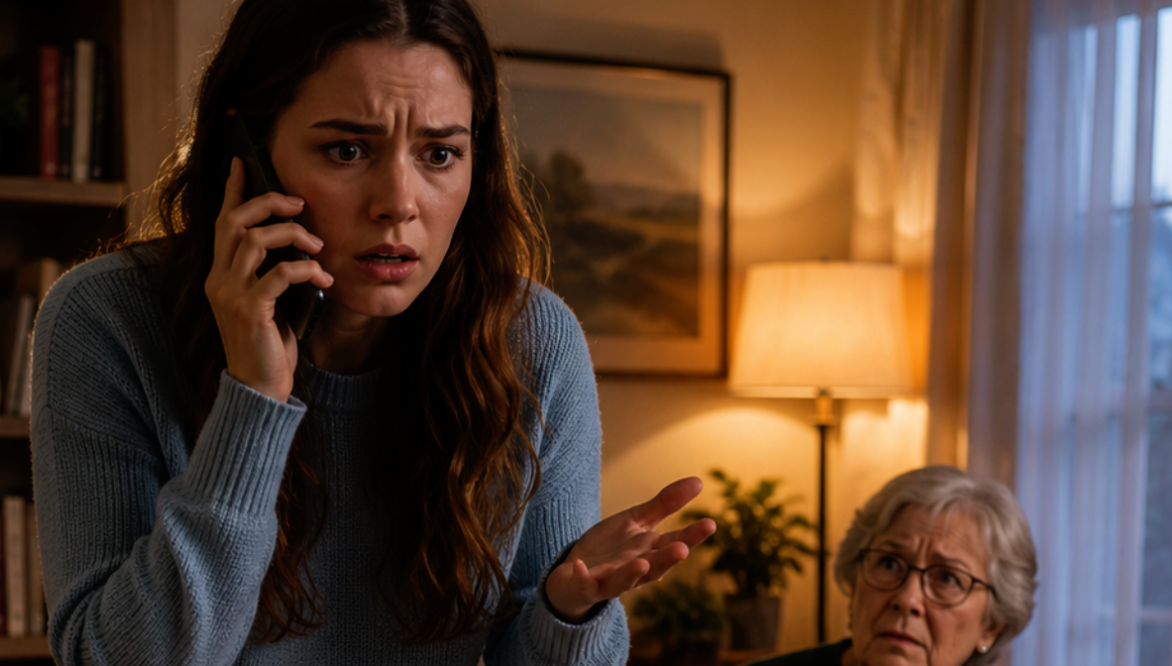
“Katya, my son’s new wife needs surgery. Sell your apartment and send us the money. We used to be family, after all,” her mother-in-law said over the phone.
Katya put the kettle on and, while it hummed, leaned her shoulder against the cool doorframe. The evening stretched lazily. Through the window came the voices of boys in the courtyard; someone was kicking a ball and arguing over whose turn it was to be the goalkeeper. Mint scented the windowsill from her mug, freshly washed kitchen towels were drying on the radiator nearby, and on the table lay a notebook full of math problems. Anton had slipped outside, promising to finish them before bed. The apartment—hers, small, with a narrow hallway and a balcony that fit a folding table and two chairs—had become a fortress over the past few years. The walls might be thin, but the silence was her own, and so was the order.
The phone vibrated, lighting up the dim kitchen. A familiar name appeared on the screen: “Valentina Petrovna.” Katya hesitated. Since she and Sergey had divorced, her former mother-in-law rarely called, but always with some kind of request: either “talk to Seryozha urgently, he won’t listen to me,” or “send a photo of Anton to kindergarten,” even though Anton had stopped going to kindergarten years ago. Katya sighed and swiped her finger across the screen.
“Katya, hello. Lera, Seryozha’s wife, has fallen seriously ill. The doctors say she needs surgery, and quickly. You understand. It’s a very large sum.”
“Valentina Petrovna, please tell me what you need from me,” she said calmly.
“Oh, how difficult you are. Fine, I’ll be brief. Katya, my son’s new wife needs surgery. Sell your apartment and send us the money. We used to be family, after all,” her mother-in-law said over the phone.
Katya automatically turned down the kettle and gripped the phone tighter. For a second, it seemed to her that she had misheard. Then she realized: she had heard far too clearly.
“Why are you silent?” her mother-in-law continued. “You have the apartment you kept after the divorce. Sell it. Live with your mother for now. And send us the money. We’re not strangers; we used to be family. Besides, you have a job, you’re holding up, but Lerochka won’t be able to work for a long time after the surgery. Help, Katya. It would be noble.”
The kettle switched itself off with a dull click. Katya sat down on a chair, holding the phone with her shoulder to free her hands. She took two cups from the cupboard: one for herself, the other out of habit, the way she had done for years when she and Sergey drank tea in the evenings and argued about whose mugs were more comfortable. The second cup now stood ready for guests, as rare as rain in July.
“Valentina Petrovna,” Katya said, weighing each word, “you called me and suggested that I sell my apartment to help your son and his wife. Is that correct?”
“I’m not asking some stranger!” her mother-in-law hurried to say. “Anton is our grandson, Seryozha is your ex-husband, we lived as one family for so many years. You yourself used to say that blood relatives are not strangers. Now it’s time to prove whether you meant it. You’re a kind woman; we could always rely on you. What’s an apartment to you? You and your mother can manage in cramped conditions. But we need the money like air.”
Katya poured boiling water into her cup and dropped a sprig of mint into it. She felt a familiar wave rising in her stomach—not anger and not fear, but a firm determination to say “no” in a way that would finally be heard.
“This apartment is my home,” she said. “And I will not sell it. I feel sorry for Lera, truly. If I can help with advice, I will. I can tell you where to look for a state quota, which doctors to write to, where to arrange payment in installments. But money—no. Especially not at the cost of my apartment.”
“Are you made of stone?” her mother-in-law flared up. “You never used to be like this. I remember how you exhausted yourself just to please everyone. And now what? Seryozha used to be your family. I’m a mother, and I’m asking for his sake. You’re an intelligent woman; you understand that an apartment can be earned again, but health cannot.”
“An apartment can be earned,” Katya agreed, “and that is exactly why I spent many years earning it. With Anton in my arms, and with your son, who at the time was ‘temporarily’ unemployed and then left the family altogether. I earned it month after month. And I do not owe it to anyone just because ‘we used to be family.’ We used to be. Now we are not.”
Her mother-in-law fell silent for a moment. There was a rustling on the line, as if she had left the room, pressed the phone to her shoulder, and begun opening a cupboard.
“I thought you were wiser,” she said, now more quietly. “My heart is not at peace. Poor Lerochka is crying, Seryozha doesn’t sleep at night. We’re not asking for charity. We’re asking as relatives. Sell the apartment, and later, as soon as we can, we’ll pay you back. I give you my word.”
Katya gave a faint smile because she had heard her former mother-in-law’s “word” many times before: when she had “given her word” not to interfere, then appeared at the door without calling; when she promised not to drag her son into things and still called in the middle of the night saying, “Katya, come over, he’s drunk.” And when they were separating, her mother-in-law’s “word” had sounded exactly the same—like a coin used to pay not a debt, but an old habit.
“Your word is your word,” Katya said gently. “I respect it. But it does not cancel out my ‘no.’”
“So you won’t even think about it?” The voice on the line became thinner, like a string stretched tighter than it could bear.
“I have already thought about it,” Katya replied. “And I will not sell the apartment.”
“Then keep it for yourself,” her mother-in-law snapped. “Only don’t come to me later asking for help when your Anton needs money for his education! Do you think I’ll help him? I won’t! I have another daughter-in-law now, another family!”
“You decided that long ago,” Katya said evenly, “even without my answer. Take care of yourself, Valentina Petrovna. And I wish Lera good health. Goodbye.”
She hung up, restraining her hand so she would not slam the phone onto the table. Anton came into the kitchen, slightly flushed from playing outside, with a blade of grass in his hair.
“Mom, can Timka come over for half an hour? He promised to show me a coin trick.”
Katya smiled and nodded toward the notebook.
“Half an hour—after you finish those five problems. And wash your hands.”
Anton sighed unhappily, but smiled back and ran to the bathroom. Katya picked up her cup of mint tea and went out onto the balcony. The evening was clear. A neighbor downstairs was spreading a rug over the railing, and the smell of dill and fresh cucumbers drifted through the courtyard. No one knew what conversation had just taken place in this small kitchen with its narrow balcony. And that was for the best.
She and Sergey had divorced two years ago. The divorce had not been loud, but it had been heavy—like a wardrobe that has to be dragged over a threshold, catching on the doorframes and leaving white scratches behind. First they silently stopped having dinner together. Then they stopped turning off the lights after each other. Then he began coming home so late that it was easier to stay silent about the reason. When he packed his things, Anton spent two days moving around the apartment more slowly than usual, as if walking through water. He spoke quietly and turned off the television so that “Dad wouldn’t be disturbed.” Then everything became seemingly even: activity schedules, Katya’s work, Saturday “Dad weekends” marked on the calendar. Her mother-in-law called often at first, then less and less. One day Katya learned from a neighbor that Sergey had remarried. She shrugged, mentally wished him happiness because she could not find the words, and went out to buy bread.
Katya had received the apartment after the divorce through an amicable agreement: she had paid Sergey half its value, taking out a loan and borrowing from her cousin. She saved for repairs for a year: replacing the wiring, putting up new wallpaper, painting the old doors. Anton would carry little jars of paint to her from the kitchen and ask if he could draw a rocket on the wall in his room. She allowed it—a small one, in the corner. Their things were here, their limping stool she had been promising to fix for a month, their warm baths in the evenings.
And now—this phone call. “Sell your apartment and send us the money.” Her mother-in-law’s words sounded like cold water from an outdoor pump, shocking not with heat, but with how unexpected the cold was. Katya knew that more calls would follow: from Sergey, from Lera herself perhaps, maybe even from mutual acquaintances. Everyone would have their own “why”: the “sympathetic” ones quiet, the “life teachers” loud. But Katya had her own “because”: because this was her home, her son’s home, their safety and peace. And yes, she felt compassion for someone who was ill. And yes, compassion did not mean she was obligated to take the roof from over her own child’s head.
The phone gave a short beep: a message. Katya picked it up. It was from Sergey.
“Kat, you said things to Mom. She’s in tears. Lera really is in the hospital. I don’t know what to do. Let’s talk calmly.”
She typed a reply: “We’ll talk. Tomorrow at six, at the café by the school.” Then she immediately erased “at the café.” She did not want phone calls at the café; she did not want her mother-in-law “accidentally” showing up. She wrote: “In the schoolyard. In front of the children, only about the children. About money—separately.”
“Mom, I’m done,” Anton said, showing her the notebook. “Can Timka come?”
“Yes,” Katya said, looking through the lines, checking a couple of tricky ones, and kissing the top of her son’s head. “Fifteen minutes, and then home.”
He darted out, and she went back onto the balcony. Sergey called.
“Hi,” he said cautiously. “Mom called you… too harshly. Don’t listen to her. But the situation really is difficult. Lera needs surgery. I’ll collect as much as I can. Could you… lend us something? We’ll pay it back.”
“Seryozha,” Katya replied quietly, “I can’t. Not because I’m full of anger. I can’t because I have a child to take care of. This apartment is everything we have. I’m ready to help gather documents. I know where to look for quotas, and there are people who help with paperwork. I can sit with Lera if needed. But selling the apartment—no. And lending a large sum—also no.”
“You’ve changed,” he said bitterly. “You used to do everything for the family.”
“I have a family,” Katya said. “Anton and me. And you have a family too. That is your responsibility.”
He was silent. Somewhere in the background, an elevator door beeped.
“All right,” he said. “I thought… Never mind. Sorry. I’ll figure it out myself.”
His “myself” sounded unfamiliar. Katya felt a warm wave rise and fall in her chest—not pity, but tired understanding: in this story, everyone would take their own steps. She placed the phone on the table and got to work: brewed a second cup of tea, took out an old folder labeled “apartment documents,” placed a clean sheet of paper beside it, and wrote: “funds, quotas, hospitals.” This was not some therapeutic note-taking exercise; these were possible steps for those who were willing to use them.
The next day, they met by the school. The yard was noisy, children rode scooters, and parents waited on benches. Sergey arrived hunched over, looking younger without his wife’s hand on his arm. Katya saw two lives in him: the old one, in which he brought her chebureki from the market and laughed, and the current one—with Lera, the hospital, and someone else’s misfortune.
“I’m not here to defend Mom,” he said first, sitting on the edge of the bench. “That’s just how she is. I’m… asking for help in any way. I’ll scrape the money together somehow, from friends, from loans. But maybe you know someone…”
“I do,” Katya nodded. “I put together a list. But, Seryozha, one thing. If you take out loans, think about how you’ll manage them. Right now, Lera comes first for you. And beside her is Anton. Don’t make it so all of you drown. Try for the quota first. Talk to the doctor about how long you can wait. Don’t rush into debt slavery if there are other options.”
He nodded, and for the first time, it did not look like he was doing it just for show.
“I’ll take Anton on Saturday,” he added. “We’ll go for a walk, spend time together. Nothing is canceled.”
“Good,” Katya said. “Just tell me in advance what time. He has practice.”
They spoke a little longer—dryly, but calmly. They parted without hugs and without new promises.
Two days later, her mother-in-law sent a long voice message about how “people become heartless,” about “ingratitude,” and about how her son was “a saint.” Katya did not reply. A week later, Sergey sent a new message: “We got the quota. Surgery is in a month. Thank you for the contacts.” Katya exhaled with relief—not because she had “helped,” but because someone else’s misfortune had not dragged her life into the millstones. At that moment, Anton was bringing paper frogs home from school and telling her about a new scooter trick.
Her mother-in-law called again. Several times Katya answered, and each time she heard the same thing: “You’re made of stone,” “You abandoned us long ago,” “I will never forget this.” Sometimes the line was silent—her mother-in-law would just breathe, then eventually click the call off. Then the calls became less frequent. The only line of communication left in their lives was about Anton: “I’ll come on Wednesday,” “I’ll pick him up on Saturday,” “I’ll take him to practice.” And that was the only thing truly worth preserving.
One evening, Katya ran into Lera in the courtyard. She was pale, wearing a headscarf, carrying a bag from the pharmacy. They stopped like two strangers. Lera was the first to lift her eyes.
“Are you Katya?” she asked quietly.
“Yes,” Katya answered. “How are you?”
“I’m alive,” Lera said. “Sergey told me you gave him contacts. Thank you. I…” She faltered, then found the words. “And also… forgive my mother-in-law. She breaks everyone, and me even more. I just want to live. Without other people’s money. Without other people’s orders.”
Katya nodded. There was no pretense in those words. She looked at the face of her ex-husband’s new wife—no anger, no rivalry, just another woman in pain, walking her own path.
“Get well,” Katya said. “And take care of yourself.”
Lera nodded and walked on, leaning on the bag as if it were a crutch. Katya watched her for a long time until she heard a familiar voice behind her.
“Mom, can Timka and I play until dark?”
“No,” she smiled. “Until dinner, then home. Just a second.”
She returned home and spread the contact cards on the table—the ones that had helped Sergey. She thought that everything had finally fallen into place: each person had their own life and their own responsibility. Her mother-in-law would still remember and reproach. Sergey would sometimes look for an easy way out. Lera would keep fighting. And Katya would live. She would teach her son to fold the corners of pages in his notebook, buy apples on discount, change lightbulbs when they burned out, and enjoy the balcony at sunset, which had come to her not through “other people’s justice,” but through her own choice and labor.
Her “no” that evening in the kitchen had not been made of stone. It had been alive, like the root of a tree holding the earth back from a landslide. If that root is not seen or respected, the house will slide away. Katya chose the house. And with that, she had said everything.