My Husband Promised My Car to His Mother While I Was Away on a Business Trip. I Came Back Early — and Caught Him Handing It Over
“Mother said to give it to her, so I gave it to her. What’s so hard to understand?”
Ilya said it as if they were talking about a carton of milk, not a car. Her car. The blue Mazda that Olya had spent two years paying off, denying herself vacations and new jackets.
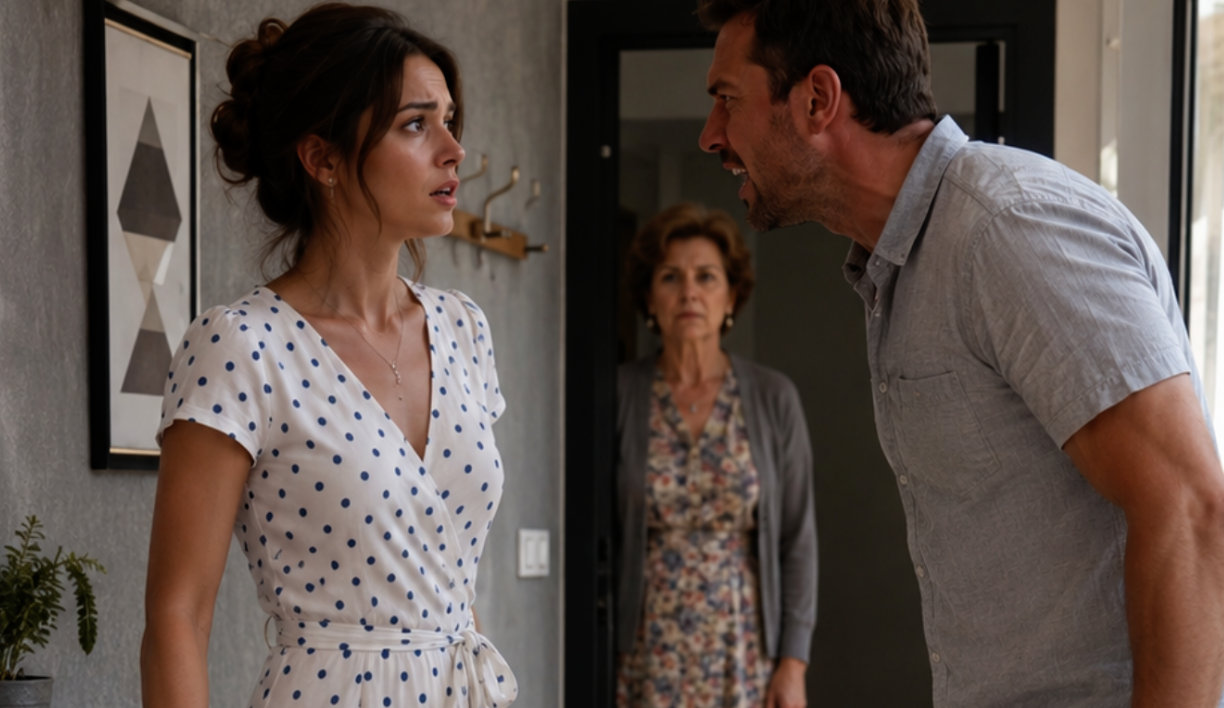
She stood in the doorway with a travel bag on her shoulder and a suitcase at her feet — straight from the train station, back earlier than planned because the conference had been moved. And instead of a quiet apartment, she saw her mother-in-law, Rimma Borisovna, sitting in the kitchen in a flowered robe like a queen on a throne, drinking Olya’s coffee from Olya’s mug. And Ilya stood beside her, looking at his mother as if he were waiting for approval.
“Wait,” Olya said slowly. “You gave her my car?”
“Temporarily. She needed to go to the doctor. A couple of times.”
At those words, Rimma Borisovna gave a theatrical sigh and pressed her hand to her chest.
“Olenka, I’m terribly ill. My legs barely work, my blood pressure keeps jumping. I thought you, of all people, would understand.”
“Ill” was the word that worked like a universal pass in Rimma Borisovna’s family. She was “ill” exactly when it benefited her. The rest of the time, she somehow managed to go to the market, argue with the neighbors, and drag heavy bags back from the dacha.
Olya put down her suitcase. Slowly, carefully, as if trying not to break something — inside herself.
“Ilya. Where are the keys?”
He hesitated. It was a bad pause. The kind of pause that can hold far too many unnecessary things.
“She took them yesterday. She said she’d return them today.”
“Yesterday?”
Olya took out her phone and checked the car’s location. She had installed a tracker a year ago, after Ilya had once “lent” her coffee machine to his mother and it came back three months later with a cracked casing. The tracker showed a street on the other side of the city. Not a hospital. A shopping mall.
She turned around and left. No explanations, no slamming doors — she simply left, called a taxi, and went there.
The Panorama shopping mall on a Saturday buzzed like a disturbed hive. Olya found her Mazda on the third level of the parking garage — neatly parked, with a fresh scratch on the bumper that had not been there before.
She stopped beside it and just looked at the scratch. Long, pale, as if someone had misjudged a turn and had not even thought to say anything.
Rimma Borisovna appeared about twenty minutes later, carrying two large bags from a clothing store. Behind her shuffled some friend of hers, just as plump and loud.
“Oh!” her mother-in-law faltered when she saw Olya. “You’re supposed to be on a business trip…”
“I came back,” Olya said shortly.
“Well, good, wonderful,” Rimma Borisovna had already pulled herself together and was smiling. “We just got a bit of fresh air. I told Ilyusha — the doctor prescribed movement and fresh air for me…”
“In a shopping mall?”
“Well, we stopped by on the way. What’s wrong with that?”
Her friend tactfully stepped aside and pretended to study the ceiling of the parking garage.
Olya held out her hand.
“The keys.”
One second. Another. Rimma Borisovna looked at her with that special expression Olya had known for five years — a mixture of hurt, righteous outrage, and calculation. Now she would try to pressure her with pity. Or accuse her. Or cry.
“Olya, why so rude…”
“I’m not being rude. I’m asking for my keys.”
The bags rustled. The keys were found in the depths of her purse, among receipts and crumpled napkins. Olya took them, opened the car, and inspected the interior. There was dirt on the front mat — reddish, clay-like, clearly not from asphalt. On the back seat lay someone else’s umbrella.
“Take the umbrella,” Olya said.
Rimma Borisovna kept saying something — about a daughter-in-law who did not know how to respect her elders, about Ilyusha, whom she had raised all by herself, about how young people were completely different nowadays. Olya did not listen. She adjusted the driver’s seat, placed her phone in the holder, and drove out of the parking garage.
Only at the traffic light did she feel her hands begin to tremble. Not from fear — from anger, which she had held inside so carefully for the last half hour.
Five years. For five years she had tried to be a good wife, a good daughter-in-law, polite and restrained. She had kept silent when Rimma Borisovna came over without calling and rearranged her things. She had kept silent when her mother-in-law fed Ilya “proper food,” hinting that Olya did not cook correctly. She had kept silent when the woman took money from the kitchen shelf — “I’ll borrow it for a week” — and never returned it.
But the car was different.
The car had cost money. Real money, earned and saved. And Ilya had handed it over without asking while Olya was eight hundred kilometers away.
She called her friend Zhenya.
“Can I stay at your place tonight?”
“Of course. What happened?”
“I’ll tell you when I get there.”
Zhenya lived ten minutes away, in a small one-room apartment on Ushinsky Street that always smelled of coffee and turpentine because Zhenya painted in oils at night. Olya arrived, parked the car in the courtyard, went up to the fourth floor, and only when Zhenya opened the door did she finally exhale — truly exhale, like a person who had not been breathing for a long time.
“Sit down,” Zhenya said, moving canvases off the sofa. “I’ll be right back.”
Olya sat and looked out the window at the city growing darker. Somewhere out there, in their apartment, Ilya was probably calling his mother — discussing how ugly everything had turned out. Or complaining. Or asking Rimma Borisovna to “talk to Olya.”
Three messages from him had already arrived on her phone. She did not open them.
Zhenya brought two glasses of something cold and non-alcoholic, sat beside her, and asked:
“Did you think it would come to this?”
Olya looked at her.
“Honestly? No. I thought he would change. Or that I would somehow adjust.”
“And?”
She turned the glass in her hands.
“And I’m tired of adjusting.”
Outside the window, the city glowed with lights. A warm June evening, open cafés, people on benches. And in her head, one thought kept circling — simple as a nail, and just as sharp.
Something had to change. And she already knew exactly what.
Ilya called at half past ten.
Olya looked at the screen — her husband’s name glowing in the dark — and let it ring out. Then a message came: “Where are you? Mom is upset. Call me back.”
Mom is upset. Not “I’m worried.” Not “I’m sorry.” Not “let’s talk.” Mom is upset.
Zhenya glanced at the screen and said nothing. She knew how to stay silent at the right moments — one of her greatest qualities.
Olya put the phone aside and went to bed. For the first time in a long while, she slept without feeling that she had to control something.
In the morning, she went home.
Ilya was sitting in the kitchen with the look of a man who had spent the entire night preparing for a difficult conversation and now had no idea how to begin. In front of him stood a mug of cold tea. He was not even drinking it — just holding it.
“Olya,” he began.
“Wait,” she said.
She went into the bathroom, washed her face, changed clothes. Then she came back to the kitchen, turned on the kettle, and only then sat down across from him.
“Go ahead.”
“Mom called last night. She was very hurt.”
Olya looked at him.
“Ilya. She took my car and drove to a shopping mall. She brought it back with a scratch and dirty mats. What exactly hurt her?”
He winced.
“Well, the way you spoke to her…”
“I asked for the keys.”
“She says you practically tore them out of her hands.”
So that was how it was. Olya mentally noted it — the version had already grown details. Soon there would be witnesses who had seen the daughter-in-law shove the poor woman in front of the entire parking garage.
“Ilya,” she said slowly and evenly. “You gave away my car without my permission. While I was in another city. This is not up for debate — it is a fact.”
“She’s my mother,” he said, and there was something so helpless, so childlike in his voice that Olya’s heart clenched for a second. Only for a second. “I couldn’t refuse her.”
“You can never refuse her. That’s the problem.”
He fell silent. He looked down into his mug.
Outside, in the courtyard, someone started a car. An ordinary Sunday morning, an ordinary city, ordinary life — only inside that kitchen, something was slowly and irreversibly shifting.
Rimma Borisovna arrived at three in the afternoon. Without calling, as usual — she simply rang the doorbell, and Ilya went to open it with such relief that it looked as if he had been waiting for rescuers.
She came in with a bag. She had brought pies, of course. Pies were her main weapon. After any scandal, pies appeared, and everyone was supposed to pretend that the pies meant peace and forgiveness in one bag.
“Olenka,” she said from the doorway, her voice soft, almost affectionate. “I wanted to talk.”
“Come in,” Olya said.
They sat in the living room. Ilya settled next to his mother — slightly closer to her than to his wife. Olya noticed this and, again, said nothing.
Rimma Borisovna started from afar. First, about her health. Blood pressure, knees, a neurologist who understood nothing. Then about loneliness. How hard it was for a woman of her age when her son was busy and her daughter-in-law was away on business trips. Then, very quietly, with a breathy sigh, she said she had never asked for anything.
Olya listened. She looked at her mother-in-law’s hands — well-groomed, with a neat manicure, no signs of illness or helplessness. She remembered the bags from the clothing store in the parking garage.
“I understand that it turned out awkward,” Rimma Borisovna said. “But Olenka, you’re a smart woman. You should understand — family is built on respect. I always told my husband, may he rest in peace, that respect is the most important thing. Ilyusha learned that from childhood.”
“Ilyusha learned that you cannot be refused,” Olya replied.
Rimma Borisovna blinked. Then she smiled — slowly, like a cat that had been disturbed but had no intention of leaving.
“Well, there you go again. I came to talk like a human being, and you…”
“And I am talking like a human being. You took my car. A car I bought myself. Without asking, without warning. And you brought it back with a scratch.”
“That scratch was there before me!” her mother-in-law’s voice instantly hardened. The mask fell off quickly, as always, when pity stopped working. “First prove that it was me!”
“Mom,” Ilya interrupted.
“No, wait!” Rimma Borisovna straightened up. “I want to say something. I raised this boy alone. Alone! I worked two jobs, denied myself everything. And now I come to my own son’s home and get interrogated?”
She knew how to do this — turn any conversation toward her own sacrifice. Any complaint became an attack on her maternal heroism. Any “you acted unfairly” became “you don’t appreciate what I did for you.”
Olya used to get lost in these turns. She would start justifying herself, softening her words, searching for compromise. Not today.
“Rimma Borisovna,” she said calmly. “The fact that you raised Ilya alone is your achievement, and I do not deny it. But it does not give you the right to manage my property.”
Her mother-in-law opened her mouth. Closed it. Opened it again.
“Do you hear how she’s speaking to me?” she said, turning to her son.
Ilya stared at the floor.
“Ilya,” Olya called him.
He raised his head.
“Do you want to say something?”
One second. Another. In that second, everything was being decided — Olya could feel it with her skin. Either he would say something real now, or he would once again hide behind his mother’s back, as he always had.
“Mom,” he finally said, his voice quiet, almost guilty, “maybe not now…”
Rimma Borisovna looked at him for a long moment. Then she stood up. Took the bag of pies — all of them, the whole bag — and headed for the door.
“I understand,” she said at the door. “I’m unwanted here. But you will remember this day, Olya. You’ll see.”
The door closed.
Ilya sat on the sofa and stared at the wall. Olya sat across from him. The apartment was quiet — a real, heavy silence in which each of them thought their own thoughts.
She looked at her husband and tried to understand: was this the end, or the beginning of something? She herself did not know the answer.
Ilya’s phone vibrated. A message from his mother — Olya did not see the text, but the way he reached for the screen made everything clear.
She stood up, took her jacket and car keys.
“Where are you going?” he asked.
“I need to think,” she answered.
And she left.
She drove without a destination — just through the city, along familiar streets that were almost empty on a Sunday evening. She turned on the radio and immediately turned it off again. Silence was better.
At the traffic light near the park, she stopped and suddenly realized she was driving to the office. Not home, not to Zhenya’s — to the office. As if her body itself knew where it needed to go.
She worked as a financial analyst in a small company on Ozyornaya Street. She always had the office keys with her — an old habit from the days when she stayed late and opened the building before security arrived. She went up to the second floor, sat at her desk, and turned on the monitor.
And just sat there.
Everything here was hers. Every folder, every spreadsheet, every report. Here, no one entered without knocking and no one took someone else’s things without asking.
She opened her personal folder and found a file she had not opened in three months. A spreadsheet with calculations — she had made it last autumn, one of those evenings when Ilya had once again gone to his mother’s and had not returned until midnight. She had calculated it just to occupy her mind. How much a one-room apartment in their district cost. What the down payment would be. What the monthly payment would be with her salary.
She looked at the numbers and thought: so this is why I calculated it.
She returned home late. Ilya was not asleep — he was sitting in the kitchen, and this time there was not a mug in front of him, but a phone, whose screen he quickly turned away as soon as she came in.
“Were you texting your mother?” Olya asked, not accusing him, simply clarifying.
“She’s worried.”
“About you?”
“About us.”
Olya poured herself water and drank the glass.
“Ilya, I want to tell you something. Not as a complaint — just as a fact.”
He looked at her cautiously.
“I’m tired of being the third person in our marriage. There should be two of us. But there are always three.”
“She’s my mother,” he said quietly. “I can’t erase her from my life.”
“No one is asking you to erase her. I’m asking you to choose me. Sometimes. At least sometimes.”
He was silent for a long time. Outside the window, a car passed, throwing a strip of light across the ceiling before disappearing.
“I don’t know how to do that,” he finally said. And that was perhaps the most honest thing he had said all day.
“I know,” Olya replied. “That’s exactly the problem.”
She went into the bedroom. Lay down. Looked at the ceiling and thought about the spreadsheet with the numbers. About the down payment. About the fact that she had savings — not huge, but she had them. And that she had never told anyone about those savings.
An interesting coincidence.
Something unexpected happened on Wednesday.
Olya was at work when an unfamiliar woman called her. Her voice was businesslike, slightly tired, like someone who made many calls a day.
“Olga Sergeyevna? My name is Darya, I’m from Kontur Real Estate Agency. You left a request for apartment selection in October last year.”
Olya froze.
“Yes,” she said carefully. “I did.”
“A very interesting option has appeared. If you’re still looking, it’s worth viewing.”
Olya had not left any request in October. She had only calculated things in a spreadsheet, looked at websites, but had not sent anything anywhere. Or had she? She no longer remembered that evening exactly — only that it had been late and she had been angry.
“When can I see it?” she asked.
“Tomorrow at six in the evening. Would that work for you?”
The apartment was on Ushinsky Street — five minutes from Zhenya’s place, as it turned out. Third floor, corner unit, with windows facing two sides. Small, but with a good layout — an entrance hall, a kitchen, one room, and everything neat, with nothing extra. The previous owners had renovated it two years ago and moved abroad.
Olya walked through the rooms and touched the walls. Wide windowsills — she could put flowers there. A bright kitchen. New tiles in the bathroom, gray and white.
“Do you like it?” Darya asked.
“Yes,” Olya said. And she herself was surprised by how simple it sounded.
She called the bank right from there, standing by the window overlooking the courtyard. The manager — young, speaking quickly — explained the terms. The down payment, the rate, the term. Olya listened and mentally ran through her spreadsheet. The numbers matched.
Almost.
“I need three days,” she told Darya.
For three days, she lived her usual life — cooked, went to work, talked to Ilya about household things and insignificant details. He seemed to have decided that everything had resolved itself. That was how it used to happen before — a scandal, a pause, and then life returned to its familiar course, like water flowing back into an old riverbed.
On the second day, Rimma Borisovna called.
“Olenka,” she said sweetly. A new tactic, apparently. “I wanted to apologize. Maybe I got a little heated back then.”
“All right,” Olya answered evenly.
“There we go. That’s what I’m saying — we need to live peacefully. I was thinking, maybe next week I could come over and help you clean? I noticed you haven’t washed behind the refrigerator in a long time.”
Olya closed her eyes for a second.
“Rimma Borisovna. Thank you. We can manage.”
“Oh, come on! I only want to help. And at the same time, I’ll bring Ilyusha’s winter clothes. I was sorting through them and thought he should have them. And also — do you have a drill? My neighbor asked for one, and I told him I’d borrow yours.”
There it was. Already the drill.
“We don’t have a drill,” Olya said. They did. A good one, almost new. “Goodbye, Rimma Borisovna.”
She put the phone away and returned to the documents lying quietly in front of her on the desk. The mortgage agreement. She had already signed the preliminary agreement with the agency. The bank had approved her application that morning — quickly, without unnecessary questions, because her credit history was clean, her income was stable, and she was doing it all herself, without anyone’s help.
That evening, she told Ilya.
Not as an ultimatum. She simply told him.
“I bought an apartment. I’m completing the paperwork this week.”
He looked at her for a long time. A very long time.
“You… what?”
“An apartment. On Ushinsky Street. A small one.”
“Are you leaving?”
Olya looked at him carefully. At this man she had loved — and perhaps still loved — but who had never learned to choose her.
“I’m giving both of us space to think. You — about what you want. Me — about the same thing.”
“Because of the car?” he asked, and there was such sincere incomprehension in his voice that her chest tightened.
“Not because of the car, Ilya.”
She did not explain further. Some things are either understood — or they are not. And no explanation can help with that.
She received the keys to the new apartment on Friday. Darya handed them to her in the small office of the agency, shook her hand, and said, “Congratulations.” Olya stepped outside, squeezed the keys in her fist, and stood there for a little while — just like that, in the warm June sun.
Then she got into her car. Her blue Mazda with the new scratch on the bumper, which she had already scheduled for repair.
And she drove to look at her new windows — from the outside. Just to see how they looked in the evening light.
They looked good.
A month passed.
Olya was living on Ushinsky Street. She woke up without an alarm clock, drank coffee by the wide windowsill, and looked out into the courtyard, where an old woman walked a red Pomeranian every morning. It was a small, insignificant ritual — but it was hers, and no one interfered with it.
Ilya called. At first, often — confused, sometimes offended, once almost in tears. Then less frequently. They met at a café on Central Street — calmly, without scandal, like two adults who were tired of fighting.
“Mom says you planned all of this on purpose,” he said, studying his cup.
“I know she says that.”
He was silent for a while.
“I miss you.”
“I miss you too,” Olya answered honestly.
It was true. She missed him — the Ilya she had seen in the first years, before Rimma Borisovna had finally settled into their marriage as a third full-fledged member. But missing someone and going back are two different things.
“You’re not coming back,” he said. Not a question — a statement.
“I don’t know,” she replied. “It doesn’t depend only on me.”
He nodded. Finished his coffee. At the exit, he turned around.
“I’ve started seeing a psychologist.”
Olya had not expected that. She looked at him — and saw something new in his face. Not confidence, no. Rather, the first timid sprout of something that might one day become confidence.
“Good,” she said quietly. “That’s good, Ilya.”
He left. She remained sitting for a little while, looking through the café window at the summer street.
According to rumors passed through Zhenya, Rimma Borisovna was telling everyone she knew that her daughter-in-law had abandoned her son because of a car. The version took root, grew details, and began living a life of its own. Olya did not deny it.
Some things do not need justification.
That evening, she returned home — to Ushinsky Street, to the wide windowsills and gray tiles in the bathroom. She placed a new plant in the kitchen — the first one in this apartment, a small ficus in a white pot.
She adjusted it. Took a step back.
Good.