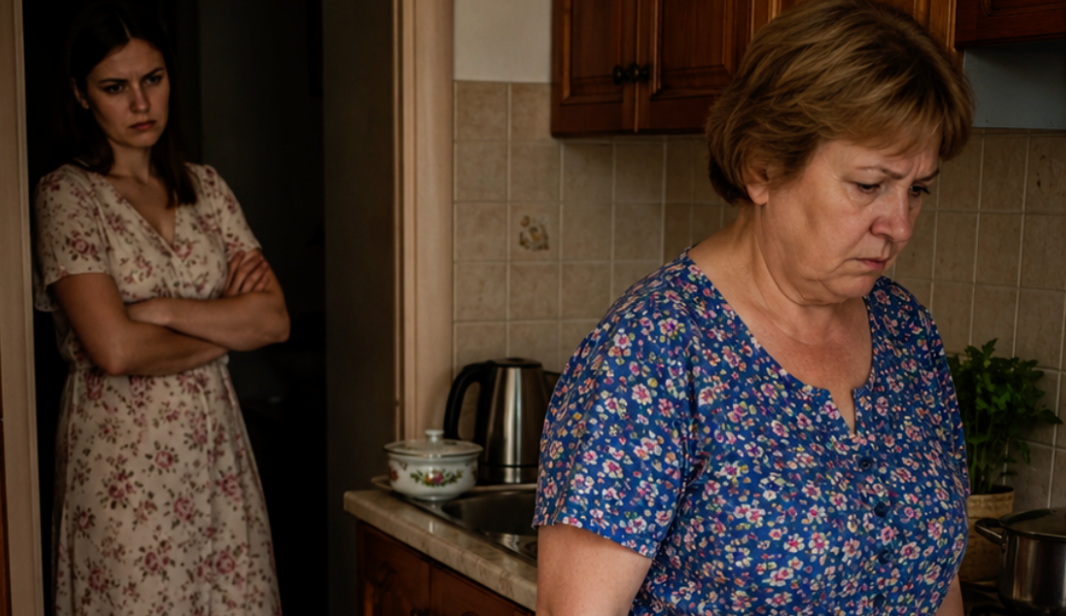
“At Your Age, It’s Shameful,” My Daughter Said. I Changed the Locks That Same Evening
“Did you forget that Danya has swimming lessons on Tuesdays?” Dasha’s voice struck me in the back as I poured boiling water into the teapot.
The water spilled over the rim and scalded my knuckles. Without saying a word, I placed the kettle back on its stand. Dasha stood in the hallway without taking off her shoes, staring at Pavel.
He was sitting at my kitchen table, in my apartment, calmly stirring his tea with a spoon. The clinking of metal against porcelain seemed deafening. Dasha had opened the door with her spare key, just as she had been doing for the past five years, ever since her father passed away.
For all those five years, I had lived according to another family’s schedule. I picked up my grandson, drove him to his activities, made cutlets for the entire week, and packed them into plastic containers.
I gave Dasha six hundred thousand rubles—all the savings I had put aside while my husband was still alive—so she could buy a good car.
“Mom, it’s for Danya. We need to drive him safely, and you’ll be riding with us too,” she had said.
So I gave her the money.
And now, three times that month, Dasha had called me on Friday evening, complaining about a migraine or an urgent report, at the exact moment Pavel and I were preparing to leave for the countryside. My weekends were canceled. I went to look after my grandson.
“Good evening, Dasha,” Pavel said calmly, placing his spoon on the saucer.
My daughter ignored him. She stepped into the kitchen, leaving dirty boot prints on the linoleum.
“Mom, I don’t understand. It’s six o’clock. My child is sitting in the lobby with his coach. I keep calling you, and you’re sitting here… drinking tea?”
She looked at the two cups and then at the half-eaten pie.
I wiped my burned hand with a kitchen towel. It was old, decorated with faded sunflowers. My eyes caught on the edge of a plastic container sitting on the counter.
Inside was freshly made borscht, cooling after I had cooked it that morning to take to their house for dinner. The lid was slightly open, and condensation had collected along the sides.
Pavel and I had met in April while waiting in line at the public services center. I had gone there to apply for a discount on my utility bills, while he was updating the documents for his garage.
His electronic queue ticket was not working, so I helped him speak to the administrator. Then we ran into each other again on the way out.
He was a widower. His wife had died of cancer seven years earlier. They had never had children.
That spring, we simply had coffee together at a bakery around the corner. After that, he began meeting me after work.
One Friday, I was returning from the Magnit supermarket with extremely heavy bags in both hands.
Dasha had asked me to buy groceries for the weekend because she and her husband were going out of town and leaving Danya with me. Cabbage for borscht, three kilograms of potatoes, meat, and milk.
My fingers had turned white and numb from the plastic handles cutting into them. When I reached the entrance to my building, I put the bags down on the dirty pavement so I could find my keys.
I lived on the fifth floor of an ordinary Khrushchev-era apartment block with no elevator.
“Allow me, Lena.”
Pavel appeared from around the corner so quietly that I flinched.
Without another word, he picked up both bags.
We climbed the stairs in silence. On the landing between the third and fourth floors, he stopped, breathing heavily, but he did not put the bags down.
That evening, he stayed for tea for the first time.
We talked until midnight. I told him about Danya, about how my back hurt after working in the garden at the country house, and about how afraid I was of winter coming.
He listened.
He simply listened without interrupting.
Dasha came to pick up her son on Sunday evening. She looked tired, with dark circles beneath her eyes.
“Mom, you really should go to bed early tonight,” she said as she zipped up her son’s jacket. “Your blood pressure has been unstable this week. I can tell just by looking at you. I’ll bathe Danya myself. Just pick him up from kindergarten tomorrow so I don’t have to fight through traffic before work. Get some rest tonight.”
It sounded so warm and caring, so much like family.
I nodded while swallowing a blood-pressure pill. At the time, I believed we were all parts of one mechanism. I believed my help was the concrete foundation holding her young family together.
I had convinced myself that at fifty-two, a woman should smell of homemade pies, wear comfortable shoes without heels, and never look in the mirror for more than thirty seconds.
I was afraid that admitting my loneliness would mean betraying my husband’s memory. I was afraid the women sitting outside the building would call me a foolish old woman trying to look young.
“I left my phone charging in the bedroom,” I said, looking at the dirty marks on the floor.
“So what? You don’t check the time at all?” Dasha’s voice rose into a shriek. “I’m racing here from work and risking losing my license because the coach is calling me! Meanwhile, my mother is sitting here with…”
She did not finish.
Pavel stood up from the table. He was a full head taller than Dasha, broad-shouldered and dressed in a simple gray shirt.
“I’ll pick up Ivan,” he said evenly. “My car is outside. Lena, give me the address.”
“You are not going anywhere near my son!” Dasha stepped forward, blocking the doorway. “Mom, have you lost your mind? Who are you trusting with my child? Some random man from the street?”
“He isn’t some random man, Dasha. This is Pavel.”
“I don’t care who he is!”
She threw her handbag onto the bench in the hallway. The bench creaked beneath it.
“I took out a loan for that car because I was counting on you to look after Danya! We had an agreement! I trusted you with my son, and now you’re here chasing romance!”
I looked at her reddened face.
Something inside me cracked.
An agreement?
I had given her all the money Vadim and I had saved to replace the windows and take a trip to a health resort. I had given it to her without asking for anything in return.
And now she was calling it an “agreement.”
Perhaps she was right. I was a grandmother. I had volunteered to help. I had trained them to believe I would always be available whenever they needed me.
I reached for the wooden box of tea bags and opened the lid. Slowly, I began sorting them—green tea with green tea, black tea with black tea.
The repetitive movement calmed me.
“You promised, Mom. Dad would turn in his grave if he saw you abandoning your family for the sake of having a man in the house,” Dasha said.
My hand froze above the box.
A green tea bag slipped from my fingers and fell onto the table.
She had not said it in anger. She had said it like a rehearsed argument, one she knew had always worked.
She was using her father as leverage.
“Choose.” Dasha folded her arms across her chest. The fabric of her expensive coat rustled. “Either you end this ridiculous circus at your age right now, get dressed, and come with me to pick up Danya, or I will never set foot in this place again. And you will never see your grandson. At your age, this is shameful, Mom.”
The air in the kitchen became as thick as jelly.
Pavel smelled of tobacco and expensive sandalwood soap. The scent mixed with the smell of my cooling borscht, creating a strange and unnatural contrast.
The refrigerator in the corner growled as it began another cooling cycle. Somewhere below the window, an old tram rattled heavily along the avenue, making the glass in the window frames tremble almost imperceptibly.
I stared at Dasha’s boot.
The metal zipper had come undone by a couple of centimeters, and the teeth had separated. I should tell her to fasten it, I thought. Otherwise, she might trip on the stairs and fall in the dark entrance hall.
The fingers of my right hand had gone numb from gripping the edge of the counter so tightly. The cold, slightly rough plastic pressed into my palm, leaving a red mark on my skin.
In the pocket of my house cardigan was a crumpled piece of paper—the receipt from Magnit that morning. I could feel its hard corners through the thin fabric.
I needed to buy laundry detergent while it was still on sale. The discount ended tomorrow.
The thought passed through my mind so clearly and so absurdly that I wanted to laugh.
I blinked.
The tram moved away. The refrigerator fell silent.
I loosened my grip.
“Close the door from the other side, Dasha,” I said.
“What?”
She recoiled as though I had slapped her across the face.
“You came into my home. You tracked dirt across the floor. You insulted me and my guest. Your child is sitting in the lobby. Go to your son, Dasha.”
“You… you’re choosing him?”
Her voice trembled, not from hurt, but from the realization that she was losing control.
“I’m choosing myself.”
I picked up my phone from the table and unlocked the screen.
“Go to your son.”
She stood there for a few more seconds, waiting for me to back down, waiting for my lifelong habit of pleasing everyone to take over.
Then she spun around, grabbed her handbag, and rushed out onto the stairwell. The door slammed so hard that my umbrella fell from the coat rack in the hallway.
Pavel silently picked it up and returned it to its place.
I stood by the table, staring at my phone screen. My hands were no longer shaking.
I opened the browser and typed, “Emergency locksmith home visit.”
Forty minutes later, a gloomy-looking man arrived carrying a toolbox. Pavel met him in the hallway and helped him remove the old lock cylinder.
I sat in the kitchen, listening to the screech of the drill.
Dasha did not call that evening.
She did not call the next day or even the following week.
I did not go looking for her.
I stopped buying weekend groceries for three people. I stopped rushing to help every time the phone rang.
Pavel and I went to the country house that very Saturday. We planted flowers and drank tea on the veranda, wrapped together in a single blanket.
Sometimes in the evenings, I stood by the window and looked down at the parking lot.
I missed Danya. I missed him so badly that the longing became a physical pain beneath my ribs.
But whenever I remembered the rustling of my daughter’s coat and the word “shameful” thrown at me like an accusation, my back straightened on its own.
I realized something terrible.
I was not angry with Dasha.
I was angry with myself for spending years purchasing the right to feel needed and paying for it with my own life.
On the cabinet in the hallway, beside the mirror, lay an old key with a little bear keychain.
It was Dasha’s spare key, the one she had left on the bench in her rush to leave.
It no longer opened anything.
I saw it every time I put on my coat.
The locks had been changed.
The apartment smelled of sandalwood and freshly brewed coffee.
There would be no more unexpected visits.