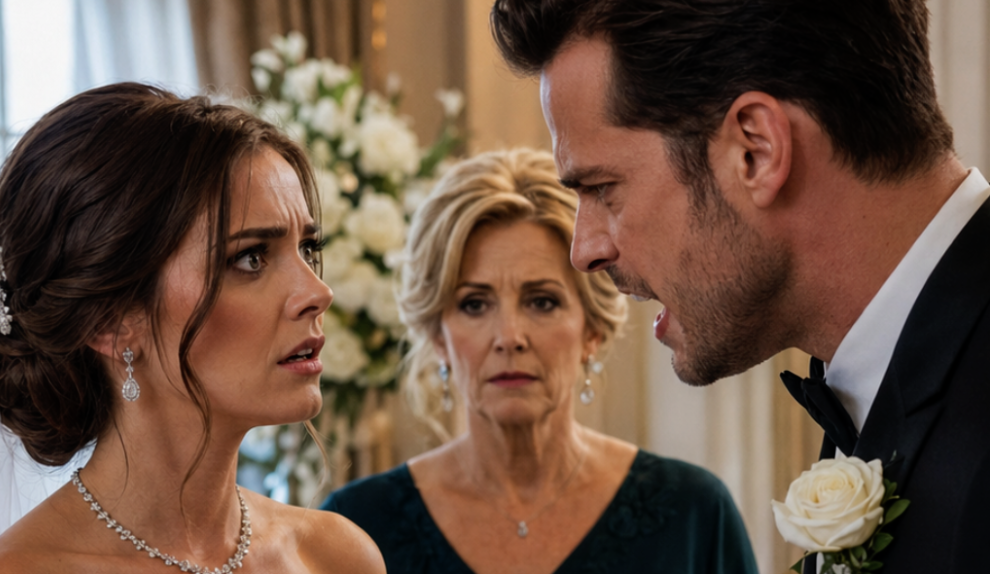
My Fiance Brought Me a “Prenuptial Agreement” to Sign, Certain I Wouldn’t Read It All. I Did—and Canceled the Wedding
He placed the pen beside the folder before I had even sat down at the table. It was blue, with a gold band, and unfamiliar—not something from our apartment.
“There’s nothing major in there,” Artyom said, sliding the folder across the table toward me. “Just a formality. Mom found a lawyer, so everything’s been done properly.”
Valentina Sergeyevna was sitting on the sofa by the window, scrolling through something on her phone. She wasn’t looking at the table.
She was making far too much of a point of not looking, to be honest.
I opened the folder. It smelled of printer ink and new plastic sleeves. Eight pages, small print, one-and-a-half line spacing.
“Eight pages of formality,” I said.
“Well, you know lawyers.” Artyom smiled. “They love padding things out. Don’t read too deeply into it. It’s all standard. The apartment, the car—just so everything’s fair if anything happens.”
He poured himself some tea. He didn’t pour any for me, even though the kettle was closer to him.
“The wedding’s in three weeks, Ksyusha,” he added more gently. “Let’s not waste time on paperwork. You don’t like boring documents anyway.”
That was the moment I began reading slowly.
Not because I was offended.
I read boring documents every day. I had worked at a publishing house for eight years, and for the last four I had specialized in contracts and legal proofreading. Around ten agreements passed through my hands every week: copyright agreements, licensing contracts, and all kinds of other documents.
I knew where people hid the important parts.
The important parts were always buried somewhere in the middle, where the reader’s eyes were already getting tired.
Artyom had forgotten that. Or perhaps he had never considered it important.
Once, he had asked what I did for a living, and I told him, “I edit texts at a publishing house.”
He nodded and said, “Oh, commas.”
And that was how it remained ever since.
Commas.
Clause 1: The apartment on Smolnaya Street was his premarital property and would remain his in the event of divorce. Fair enough. He had bought the apartment before meeting me.
Clause 2: The car belonged to him. Also purchased before me.
I reached Clause 3 and stopped.
“Are you actually reading it?” Artyom looked into his cup and stirred his tea with a spoon. “You’re taking a while. There’s honestly nothing unusual there.”
“Mm-hmm,” I said.
Clause 3 was titled “Arrangement of the Shared Household.”
A beautiful title.
It stated that during the marriage, the management of the household, cleaning, cooking, and organization of the domestic routine would be assigned to the wife.
It also stated that “the wife’s performance of the aforementioned duties shall not give rise to property claims and shall not be subject to monetary valuation during the division of assets.”
I read it twice.
Not because I had failed to understand it the first time. I understood it immediately.
I reread it to make sure those words were truly on the page and I had not imagined them.
“Artyom,” I said, looking up. “Did you read Clause 3?”
“Which one is that?” He didn’t look away from his phone. “The household one? That’s just so it’s clear who does what around the house. Mom says it’s useful to agree on these things in advance so you don’t start fighting later.”
Valentina Sergeyevna turned a page on her phone from the sofa.
Not a sound.
“Who does what,” I repeated. “And according to this clause, what do you do?”
“Well, I bring in the money.” He finally looked at me. “It’s logical. I earn, you take care of the home. Traditional roles.”
I returned to the folder.
Clause 4.
Clause 5.
I was reading quickly now because I knew what I was looking for.
I memorized Clause 6 word for word, even though I saw it only once.
“In the event of the birth of a child, the wife shall assume primary responsibility for childcare until the child reaches the age of three. During this period, the wife shall not claim compensation for lost income or professional opportunities.”
I closed the folder and placed my palm on top of it.
“Artyom.”
“Hmm?”
“This says that if we have a child, I stay home with the baby for three years, and if I lose my job, income, and career experience because of it, that’s my problem. Correct?”
He sighed.
It was the kind of sigh people give when they have to explain something obvious to someone slow-witted.
“Ksyusha, how else would it work? You’d go on maternity leave anyway. Everyone does. I didn’t invent it. That’s just how life works. The lawyer says it’s better to put everything in writing so there are no surprises.”
“Whose lawyer is this?”
There was a pause.
A brief one, but I heard it.
“An acquaintance of Mom’s,” Artyom said. “Why?”
Valentina Sergeyevna finally put her phone aside. She folded her hands in her lap and looked at me calmly and kindly, the way someone looks at a little girl taking too long to solve a simple exercise.
“Ksyushenka,” she said. “Don’t work yourself up. This isn’t directed against you. It’s so everything between you is fair and done properly, like a real family. That’s how it has always been in our family. The man provides, and the woman takes care of the home. I raised Artyomushka on my own. I know what I’m talking about.”
“Had you seen this agreement before today?” I asked.
She smiled faintly.
“I helped draft it. Otherwise, would you really have understood all those legal clauses yourself? You’re our comma expert.”
There it was.
The comma expert.
I remained seated with my hand resting on the closed folder.
Artyom finished his tea, stood up, and placed the cup in the sink. He didn’t wash it. He simply left it there.
Then he turned around.
“So, are we signing it? The pen’s right there. I have a meeting at seven, so let’s not drag this out.”
I thought I would feel angry.
I didn’t.
Instead, I felt as though someone had handed me a manuscript pretending it was one book, while an entirely different book was hidden inside. And the author was looking at me, waiting for me to stamp “approved for publication,” confident that I would be too lazy to read it.
I opened the folder again, this time to the last page.
“Artyom, did you read the whole agreement yourself? From beginning to end?”
“I told you, it’s standard.”
“That isn’t an answer.”
He was silent for a moment.
“I looked through it. The important parts. Mom and the lawyer checked everything, so why would I need to go into the details?”
“So you didn’t read it.”
“Ksyusha, why are you getting so worked up?” He sat down again, now wearing a different expression. “I thought you’d just sign it and that would be it. You’re usually… Well, you don’t like arguing. That’s what I like about you. Things are peaceful with you.”
“Peaceful,” I repeated.
Peaceful meant convenient.
He wasn’t even trying to hide it.
He had been certain he could place eight pages in front of me, that I would flip through them for appearance’s sake, notice the words “apartment” and “car,” decide that everything looked fair, and sign with the blue pen with the gold band.
Because I was the comma expert.
Because things were peaceful with me.
Because I didn’t like boring documents.
For four years, I had been reading documents like these to make sure people did not accidentally sign something they should never sign.
And he had placed exactly that kind of document in front of me, assuming I would be one of those people.
“Valentina Sergeyevna,” I said. “May I ask you something? In Clause 6, the part about not claiming compensation for lost income—was that your wording or the lawyer’s?”
“What difference does it make, dear?”
“A significant one. A lawyer writes what the law permits. But the phrase ‘shall not claim professional opportunities’ isn’t about the law. It’s about making me give up my career in advance and ensuring that afterward, I wouldn’t dare mention that I once had one. A lawyer wouldn’t add that independently. Someone asked for it to be included.”
She stopped smiling.
“What are you implying?”
“Nothing. I’m reading. Out loud. Just as you wanted—honestly and openly.”
Artyom looked from me to his mother.
For the first time that evening, he looked as though he was actually reading the agreement he himself had brought.
“Clause 8,” I continued, turning the folder toward him. “Here. Read it yourself.”
He took the folder and bent over it. His lips moved as he read.
Clause 8 stated that if the marriage was dissolved at the wife’s initiative, she was required to leave the shared residence within one month, with no right to compensation for any money invested in renovations or furnishings.
Incidentally, those renovations and furnishings were intended for the new apartment we had been planning to purchase together with a mortgage.
I had already saved the money for the down payment from my salary.
My comma-expert salary.
“This isn’t…” Artyom looked up. “This must be part of a template. Something left over from…”
“Left over from what, Artyom? A previous bride?”
Silence.
Valentina Sergeyevna rose from the sofa.
“All right,” she said. “That’s enough hysteria. The agreement is perfectly normal. All respectable people have one like this. You’re creating a scandal over nothing. Artyom, tell her.”
Artyom said nothing.
He sat there, staring at the eighth page in silence.
And that silence was worse than the entire agreement.
At least the agreement had been written by someone else’s lawyer.
But he was the one remaining silent.
The man who was supposed to stand beside me in three weeks and say, “I do.”
He could have said, “Mom, stop. This really is too much. Let’s remove it.”
One sentence.
He didn’t say it.
He chose not to argue.
With his mother.
It was easier to remain peaceful with me.
I closed the folder and pushed the blue pen into the middle of the table, toward him.
“I’m not signing it,” I said.
“Ksyusha, let’s talk tomorrow with clear heads,” Artyom said quickly. “You’re tired, I understand…”
“I’m not tired. I finished reading.”
“And what exactly did you read?” Valentina Sergeyevna interrupted. “They’re ordinary papers. You were simply looking for something to complain about. If you don’t want to get married, just say so. Why put on this performance?”
“I do want to,” I said.
And I surprised myself because it already sounded like the past tense.
“I wanted to. Until page six.”
I stood up and took my jacket from the back of the chair.
The hallway was dark, and it took me a moment to find the light switch.
Behind me, Artyom was saying something about sleeping on it, about how his mother had not meant it that way, and about how we were all adults.
Adults.
An adult man had brought his fiancée a document in which she was assigned the role of a servant without a voice, and he had been so certain she wouldn’t finish reading it that he hadn’t even read it himself.
I turned around in the doorway.
“Artyom, did you honestly think I wouldn’t read it?”
He hesitated.
“I thought you… Well… Usually, with things like this…”
“I ignore them. Go on, say it.”
He didn’t.
From the living room, Valentina Sergeyevna shouted that I would regret this, that men like her Artyom were hard to find, and that at my age I could not afford to be so selective.
At my age, I was thirty-one.
I closed the door.
And on the staircase, I realized that for the first time in six months, I could breathe normally.
I canceled the wedding the next day.
I called the restaurant. We lost the deposit, but so be it.
I sent every guest the same brief message: the wedding would not take place, and I asked them not to request details.
I left the ring in its box on Artyom’s windowsill. I went there while he was out and gave the key to his neighbor.
Artyom called me.
First he tried to persuade me.
Then he accused me.
Then he tried to persuade me again.
He sent me a long voice message in which he said he had torn up the agreement, that I had misunderstood everything, and that his mother was “her own person, while we were our own family.”
I listened to half of it.
His remorse lasted until the halfway point.
After that, he began talking about how much money he had spent on the wedding and how awkward this would make him look in front of his relatives.
Looking awkward.
That was what truly devastated him.
Not the fact that I had left.
The fact that he would now have to explain to his aunts and uncles why the bride had run away three weeks before the wedding.
When I told my mother, she remained silent on the phone for a long time.
“Maybe,” she said carefully, “you could have simply crossed out those clauses? Rewritten the agreement properly and stayed? Paper is just paper. What matters is how people live.”
I thought about that.
I honestly did.
The clauses could indeed have been crossed out.
A lawyer could have rewritten the whole thing in an hour.
But you can cross out lines.
You cannot cross out the fact that he brought me that agreement, certain I would swallow it without question.
You cannot cross out the fact that he remained silent when his mother reduced my entire career to “commas.”
The agreement had merely written out loud what both of them thought about me.
I could have deleted the clauses and married the people who had invented them.
“Mom,” I said, “he didn’t write the wrong things in those clauses. He described me exactly as he saw me. It just turned out I wasn’t that woman.”
She was silent again.
“Well, it’s your decision,” she said. “You know best. Just don’t regret it later.”
I don’t regret it.
Mostly.
Sometimes, late at night, I catch myself remembering the good things.
He knew how to make coffee exactly the way I liked it.
He remembered that I didn’t eat cilantro.
He took me to the seaside for my thirtieth birthday and didn’t complain when I slept through most of the journey.
Then I remember the blue pen with the gold band that he had placed on the table in advance.
He must have bought it specially or borrowed it from the lawyer. We didn’t own a pen like that.
He had planned everything.
He had thought about the pen.
He had not thought about the fact that I knew how to read.
Now, whenever an author brings an agreement to work and says, “It’s standard, you don’t need to read it closely,” I always read it closely.
And I always find Clause 6.
There is one in almost every agreement.
Most people simply never reach it.
I always do now. Valentina Sergeyevna wrote to me a month later.
One message.
No greeting.
“You ruined the boy’s life over a formality. I hope you’re ashamed of yourself.”
I read it twice.
Not because I didn’t understand it the first time.
I understood it immediately.
I wasn’t ashamed.
But I still had one question.
I even typed it out to send to her, then deleted it before pressing send.
The question was simple:
If it truly was only a formality, why did you work so hard to make sure I wouldn’t read it?