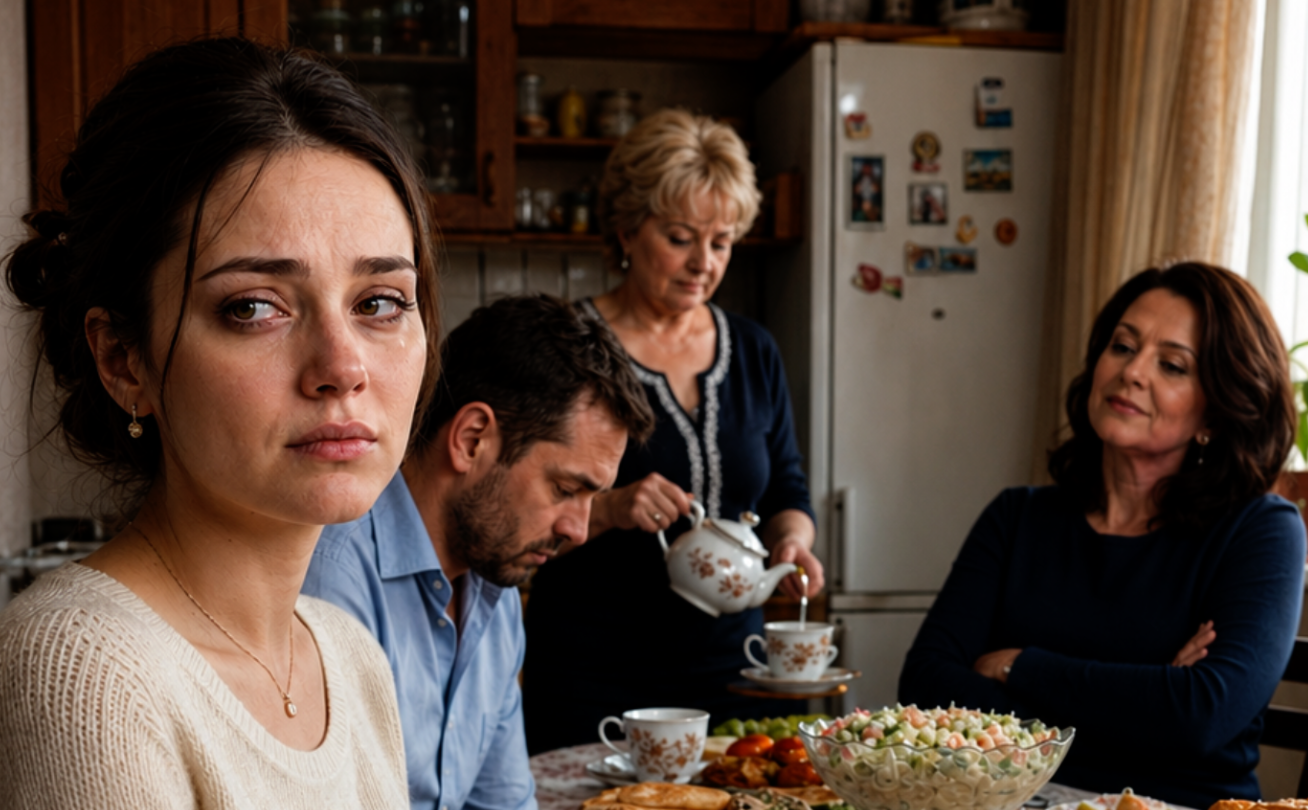
Her Husband Stayed Silent Every Time His Sister Humiliated His Wife. One Day, That Silence Cost Him Too Much
Regina first heard that word in her mother-in-law’s kitchen, when Polina was eight months old.
Her husband’s sister, Zhanna, was sitting by the window, peeling a tangerine and talking to a friend on the phone. She was not whispering. She was speaking at full volume.
“What kind of wife is she? She’s a freeloader hiding behind her child. Vitka only keeps her around out of pity because Polinka is still little. Otherwise, he would have dealt with her a long time ago.”
Regina stood in the hallway with a baby bottle in her hand. Polina was breathing softly against her shoulder. Her mother-in-law, Tamara Nikolaevna, was washing dishes three meters away from Zhanna and did not turn around.
No one turned around.
Regina walked past the kitchen, went upstairs, and sat on the bed. Polina fell asleep. Regina never warmed the bottle.
She did not cry. She simply sat there, listening to Zhanna laughing downstairs.
Viktor came home from work at nine. Regina said nothing. Not because she was afraid of an argument. She knew exactly how it would go.
Viktor would say, “Zhanka is an idiot. Don’t pay attention to her.”
Tamara Nikolaevna would say, “That isn’t what she meant.”
And a week later, it would happen again.
Before going on maternity leave, Regina had worked as an accountant for a construction company. Her salary had been forty-six thousand rubles. It was not a fortune, but it had been her own money.
The apartment where they lived belonged to Tamara Nikolaevna. It was a two-room Khrushchev-era apartment on Leningradskaya Street. From spring until November, her mother-in-law lived at her country house. In winter, she moved in with either them or Zhanna.
Viktor paid the utility bills and considered that they were living there for free.
Regina saw it differently.
Over two years, she had replaced the pipes, bought a washing machine, put new wallpaper in the child’s room, and installed plastic windows in the living room. She had paid for everything with her own savings.
The receipts were stored in a shoebox on the upper shelf.
She was not planning to prove anything to anyone. She simply had a habit of keeping records.
But she remembered the word “freeloader.”
The second time Zhanna used it, Viktor was present.
It was Polina’s first birthday. They were all sitting around the table: Tamara Nikolaevna, Zhanna and her husband Eduard, Viktor, and Regina.
Polina was poking at a piece of cake in her high chair.
Zhanna gave her an engraved silver spoon and said:
“At least the child will have something of her own. Her mother doesn’t have a roof or a penny to her name.”
Eduard snorted.
Tamara Nikolaevna said nothing.
Viktor looked at Regina and then lowered his eyes.
Regina took the spoon, said thank you, and put it in a drawer.
That evening, after the guests had left, she asked Viktor:
“Did you hear what your sister said?”
“I heard her. Zhanka just runs her mouth. Don’t take it seriously.”
“I’m not taking it seriously. But you could have said something to her.”
“And what was I supposed to say? She would get offended, Mom would take her side, and the whole circus would begin. Do you really need that?”
Regina understood two things.
First, Viktor would not argue with his sister for her sake.
Second, she could not leave immediately because she had nowhere to go.
She did not own an apartment. It was possible to rent a place on an accountant’s salary while raising a child, but only barely. And she had not yet returned to work.
So Regina began calculating.
Over the next year and a half, she did three things.
First, she returned to work when Polina was eighteen months old. She arranged with the head of a daycare center for Polina to attend for a shortened day. Regina dropped her off in the morning and picked her up at four.
Second, she saved money.
Not her entire salary, of course. But every month she transferred fifteen thousand rubles into a separate savings account in her name at another bank.
Viktor knew only about Regina’s salary card at Sberbank.
He knew nothing about the savings account.
Third, she collected documents.
Receipts for the pipes, windows, washing machine, and wallpaper. The contract with the installer who had fitted the windows. Utility bills she had paid during the months Viktor had forgotten.
Everything remained in the same shoebox on the upper shelf.
She was not preparing for war.
She was preparing for the day someone might tell her to leave, so she would have somewhere to go.
During that time, Zhanna called her a freeloader four more times.
Regina counted.
Once in front of Tamara Nikolaevna’s neighbor.
Once in front of Polina’s daycare teacher, when Zhanna came to pick Polina up instead of Regina.
Once over the phone, deliberately speaking loudly enough for Regina to hear.
And once in front of Polina herself.
The girl was two and a half years old.
Zhanna crouched in front of her and said:
“You’re such a beautiful girl. Thank God you don’t take after your mother.”
Polina did not understand.
But Regina understood everything.
The turning point came in March, when Polina was three.
Tamara Nikolaevna announced that she wanted to sell the apartment on Leningradskaya Street. She had been offered a good price: three million two hundred thousand rubles.
She planned to move permanently to the country house, insulate it, and live there all year round.
“You and Vitya will have to find a place of your own,” she said over dinner.
There was no anger in her voice. She stated it as a simple fact.
Viktor turned pale.
“Mom, we live here. Polinka’s daycare is right across the street.”
“I know. But it is my apartment, Vitya. I paid for it for thirty years.”
Regina remained silent.
Inside, she felt calm and clear.
The next day, she called a lawyer.
Not because she wanted to sue anyone. She wanted a consultation.
She asked whether she could claim compensation for the renovations if the apartment belonged to someone else but she had paid for the improvements.
The lawyer told her that if she had receipts, contracts, and proof of payment, she could attempt to recover the money through court as unjust enrichment.
There was no guarantee, but there was a possibility.
Regina thanked him and ended the call.
She had no intention of suing Tamara Nikolaevna.
But now she knew that the receipts in the shoebox were more than just the result of an old habit.
Zhanna learned about the apartment sale before Regina did.
And she reacted in her usual way.
She called Viktor and said:
“Mom is selling the apartment. She’ll divide the money between us. Just make sure your wife doesn’t interfere with her demands. She hasn’t invested a single kopeck in that apartment.”
Viktor repeated the conversation to Regina.
Perhaps he expected her to remain silent, as usual.
“Not a single kopeck?” Regina asked.
“Well, that’s what Zhanka thinks.”
“And what do you think?”
Viktor was silent for a moment.
“I think we’re a family, and we’ll work it out.”
Regina nodded.
That evening, she took the shoebox down from the upper shelf.
She added up the receipts.
The total amount she had invested over three years was four hundred twenty-eight thousand rubles.
The pipes. The windows. The washing machine. The wallpaper. Minor repairs in the bathroom. A replacement faucet. A new lock on the front door.
She photographed every receipt and uploaded the images to cloud storage.
Two weeks later, Tamara Nikolaevna found a buyer.
The sale was scheduled for April.
Regina and Viktor needed to unregister from the apartment.
Regina went to the government services center alone.
She removed herself from the registration and registered Polina with her.
Then she found a one-room apartment on Yuzhnaya Street for eighteen thousand rubles a month. She paid the first and final months’ rent.
She moved their belongings in two days while Viktor was at work.
He came home to an empty apartment.
He called her.
“Regina, where are you?”
“On Yuzhnaya Street. Polina and I have moved.”
“What do you mean you’ve moved? Why?”
“Because your mother is selling the apartment. We had to leave anyway.”
“But we could have rented something together!”
“We could have. But I decided that first, I need to understand whether I still want to be with you.”
Viktor fell silent.
It was the first silence that cost him dearly.
Zhanna heard about the move from Tamara Nikolaevna.
And she could not resist.
She sent Viktor a message.
He showed it to Regina later, when he came to the apartment on Yuzhnaya Street carrying a bag of groceries and wearing a guilty expression.
The message read:
“Well, the freeloader finally left on her own. I told you so. She’ll take Polinka and dump you. Tell Mom not to divide the money three ways. There are only two of us.”
Regina read it and handed the phone back.
“Did you answer her?”
“Not yet.”
“Don’t bother.”
She did not explain.
She already knew what she was going to do.
Tamara Nikolaevna sold the apartment at the end of April for three million two hundred thousand rubles.
The money was transferred to her bank account.
In May, she invited Viktor and Zhanna to the country house to discuss how she would divide the money.
Regina was not invited.
Viktor told her about the meeting afterward.
Tamara Nikolaevna wanted to keep one million six hundred thousand rubles to insulate the country house.
The remaining amount would be divided equally: eight hundred thousand for Viktor and eight hundred thousand for Zhanna.
Zhanna said:
“Just make sure Vitya doesn’t give his wife a single kopeck. That is our family’s money, and she is an outsider.”
Viktor remained silent.
Again, he remained silent.
Regina filed for divorce in June.
Viktor did not believe it.
He came to the apartment on Yuzhnaya Street and stood in the doorway.
“Because of Zhanka? Because of one word?”
“It isn’t because of the word, Vitya. It’s because you stayed silent every time she said it. It’s because you said nothing when she called me an outsider in front of your mother. And it’s because not once did you say, ‘This is my wife, the mother of my child, and she invested almost half a million rubles in your apartment.’”
Viktor sat down on a stool.
“What half a million?”
“Four hundred twenty-eight thousand. The pipes. The windows. The washing machine. The wallpaper. The bathroom. The lock. The faucet. I have receipts for everything.”
He stared at her as though he were seeing her for the first time.
“You kept all of that?”
“I’m an accountant, Vitya. I keep everything.”
The divorce hearing was scheduled for September.
There were no disputes over property because they owned almost nothing together.
The apartment belonged to someone else. They had no car. They had not taken out any joint loans.
Polina would remain with her mother, and Viktor did not object.
But Regina filed a separate lawsuit against Tamara Nikolaevna.
It was not a property division claim.
It was a claim for the recovery of unjust enrichment: four hundred twenty-eight thousand rubles invested in someone else’s property, supported by receipts, contracts, and payment records.
The lawyer warned her that the court might reduce the amount.
It might reject part of the claim.
But her documents were strong.
When Tamara Nikolaevna learned about the lawsuit, she called Viktor.
“Is she serious? She filed a lawsuit against me?”
“Mom, she spent three years renovating your apartment with her own money. You knew that.”
“I never asked her to!”
“But you didn’t refuse the improvements. And Zhanka didn’t complain when hot water started flowing through the new pipes.”
It was the first time Viktor had not remained silent.
But it was already too late.
The court hearing took place in October.
Regina arrived with her lawyer.
Tamara Nikolaevna came with Zhanna.
Zhanna sat in the courtroom with her back straight and her lips pressed tightly together.
As the judge read through the case materials, Zhanna leaned toward her mother and whispered something.
Tamara Nikolaevna moved away from her.
The judge examined the receipts.
The window installation contract.
The payment records.
The photographs of the apartment before and after the renovations, which Regina had found on her phone.
Zhanna could not restrain herself.
“Your Honor, she lived in that apartment for free. The renovations were payment for living there.”
The judge looked at her.
“Are you the owner of the apartment?”
“No, but—”
“Then your opinion is irrelevant to the substance of this dispute.”
Zhanna fell silent.
For the first time Regina could remember.
The court partially granted the claim.
Regina was awarded three hundred ten thousand rubles.
The judge excluded the minor bathroom repairs and the faucet because those improvements were not supported by separate contracts.
But the pipes, windows, washing machine, and wallpaper were accepted.
Tamara Nikolaevna was ordered to pay three hundred ten thousand rubles within three months.
But the story did not end in the courtroom.
It ended at the civil registry office.
In November, Regina and Viktor went to collect their divorce certificates.
The procedure was simple: approach the window, show their passports, sign the documents, and receive the certificates.
Viktor stood beside her.
Silent.
His hands were in the pockets of his jacket.
Regina signed first.
Her signature was steady and calm.
She took her copy of the divorce certificate.
Viktor signed and took his.
They walked out onto the front steps.
It was a cold November day, and the leaves had already fallen.
Regina put the certificate in her handbag.
“Give Zhanna a message,” she said. “The freeloader has officially checked out.”
Viktor did not answer.
He only nodded.
He remained standing on the steps of the registry office while Regina walked to the bus stop, climbed into a minibus, and left.
For the first two weeks, Polina asked about her father every evening.
Then she asked every other day.
Then once a week.
Regina always gave her the same answer:
“Daddy loves you. You will still see each other.”
Viktor picked Polina up on Saturdays and brought her home by six.
He transferred child support to Regina’s bank card on the twenty-fifth of every month.
Tamara Nikolaevna paid one hundred fifty thousand rubles in December.
She transferred the remaining one hundred sixty thousand in February, just before the deadline.
Zhanna never called.
Not to apologize.
Not to argue.
She simply disappeared.
Regina did not miss her.
In March, exactly one year after Tamara Nikolaevna announced that she was selling the apartment, Regina made the down payment on a one-room apartment in a newly constructed building.
Three hundred ten thousand rubles came from the court settlement.
Two hundred seventy thousand came from her savings account.
She took out a fifteen-year mortgage.
The apartment was on the fourth floor, with a south-facing balcony.
Polina ran through the empty rooms, shouting:
“Mommy, there’s an echo in here!”
Regina stood by the window.
She held the purchase agreement in her hand.
It was in her name.
Only her name.
She thought that she needed to buy a washing machine.
And this time, she would not have to keep the receipt.
For anyone reading this who lives in someone else’s apartment and invests their own money in renovations, here is what you need to know.
Keep your receipts.
Not because you are expecting a battle, but because life is unpredictable, and a three-thousand-ruble receipt for a faucet may one day become part of your evidence.
Take photographs of the apartment before and after the renovations.
Keep copies in cloud storage.
When you pay for something by bank transfer, specify exactly what the payment is for: “Payment for window installation under contract,” rather than simply writing “transfer.”
And when someone calls you a freeloader, there is no need to argue.
You need to calculate.