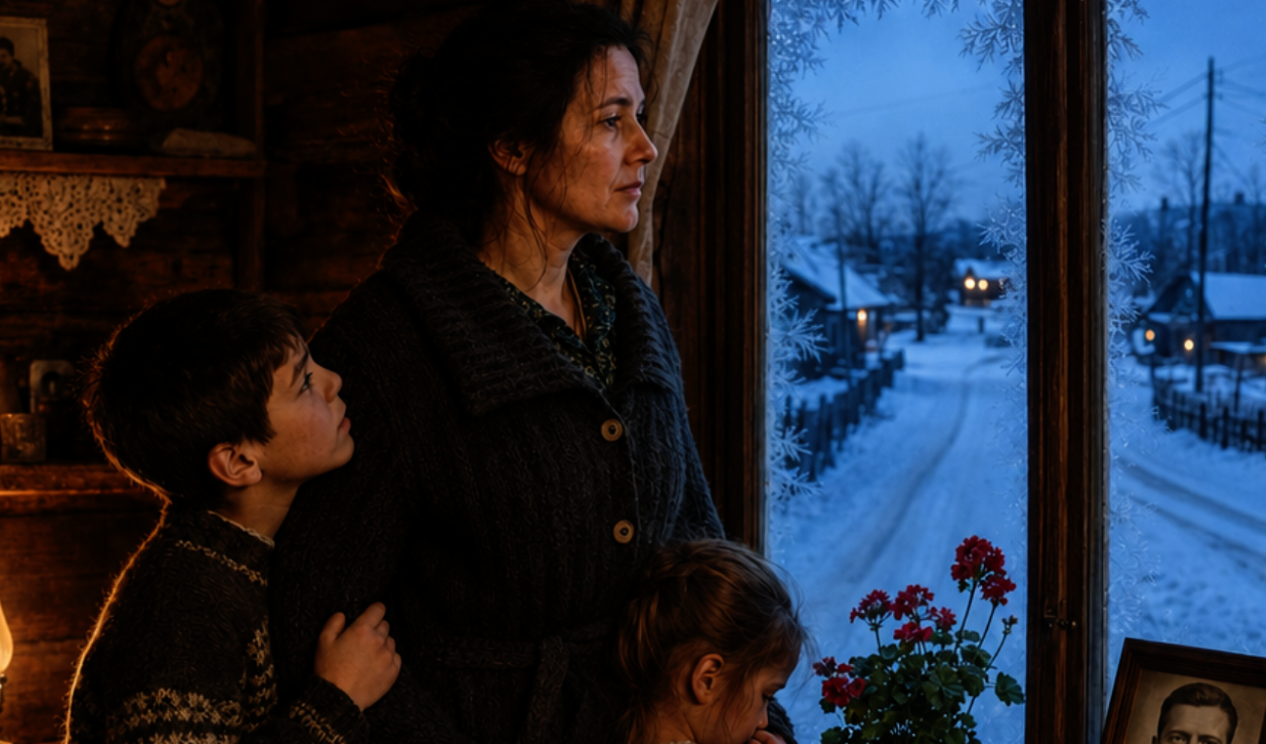
Her Husband Went Missing in 1994, and She Waited for Him Her Entire Life. He Had Lost His Memory and Was Living with Another Woman
Nikolai was thirty-four that year.
He was a strong, hardworking man, with hands like iron clamps. He had held on at the collective farm until the very end, but when it finally collapsed, he began traveling to the city to trade. At first, he sold potatoes from his own garden. Later, he moved on to consumer goods: Chinese jackets, sneakers, cassette tapes.
For the first time, there was real money in the house. His wife, Zinaida, was delighted. After many difficult years, they could finally afford to put meat on the table on ordinary days, not only on holidays. Their two children, Vitya and Alyona, no longer had to go to school wearing hand-me-downs.
Nikolai would leave for a week or two at a time and return exhausted but carrying money. He always brought presents as well. A scarf for his wife. Chocolates for the children. Everything exactly as it should be.
On that November day in 1994, he said:
“Zina, I’ll be gone for three days. I’m going to the neighboring region. They say shoes are cheap there. I’ll buy a shipment, and we’ll sell them here. Provided everything works out.”
“Maybe you shouldn’t go?” she said. “The roads are bad. They’re predicting snow. And things aren’t exactly safe these days.”
“We’ll manage. It’s not the first time.”
He kissed her on the cheek, ruffled Vitya’s hair, and hugged Alyona. Then he walked out through the gate and boarded an old bus heading to the district center.
The bus coughed out a cloud of bluish smoke and disappeared around the bend.
She never saw him again.
Nikolai did not return after three days, a week, or even a month. Zinaida went to the police.
“Wait,” they told her. “Maybe he’s gone off on a drinking spree. He’ll come back.”
And so she waited.
Every night, she listened for footsteps outside the window. Whenever the gate creaked, she jumped to her feet.
But it was only the wind.
Or a neighbor.
Or some stranger passing by.
A year went by.
The police could only shrug.
“We’ll put him on the missing-persons list. But you understand what times we’re living in. Thousands of people disappear. We can’t find them all.”
She understood.
In 1994, people disappeared without a trace. They vanished as if swallowed by deep water, as if pulled into a black hole. They left home, and that was it. No letters. No news. No grave.
Only emptiness.
And the horrifying, unbearable uncertainty.
Was he alive or dead? Had someone killed him for his merchandise? Had he gone to prison? Had he lost his memory? Had he abandoned his family and left for another woman?
Nobody knew.
Neither did she.
And that uncertainty was worse than any truth. Worse even than receiving a death notice. At least after a death notice, you could mourn.
But how could she mourn now?
Whom was she supposed to grieve for?
A living man?
A dead one?
The children grew up.
Vitya, the elder child, began working at fourteen to help his mother. Alyona, the younger one, did well at school, but she was quiet and withdrawn.
She barely remembered her father. She had been only four when he disappeared. All that remained in her memory was a vague feeling of warmth.
And a smell.
Gasoline, tobacco, and bread.
But their mother remembered everything.
She kept his belongings.
There was the checked shirt he had worn when he left on his final journey. It had been washed over and over again, yet she had never thrown it away.
She kept his old Soviet passport.
She also kept a photograph of the two of them together. They were young and laughing, and he had his arm around her shoulders.
The photograph stood on her dressing table. Every evening, Zinaida looked at it.
She no longer cried. She had no tears left.
She simply looked.
“Where are you, Kolya?” she whispered into the darkness. “Where are you?”
The years passed.
Vitya grew up, enrolled in a technical college, and trained as an electrician. Then he moved to the city.
Alyona got married and had a daughter.
Zinaida remained alone in the old house. Her children repeatedly invited her to live with them, but she refused.
“What if he comes back?” she would say. “Who will be here to welcome him?”
The children sighed.
They had buried their father in their hearts long ago. There was no grave and no cross, but they had buried him nonetheless.
Their mother had not.
She was still waiting.
Every evening.
Every night.
For twenty-six years.
In 2020, Vitya, now a thirty-five-year-old man, was browsing the internet.
He had his own office in the city and his own electrical installation company. It was a serious, successful business.
But sometimes, out of an old habit, he would type his father’s name into a search engine.
“Nikolai Sergeyevich Skvortsov.”
Every time, he found nothing.
This time, however, he tried searching differently. He opened a social media platform and began looking through the profiles of people with the same name. There were dozens of them.
Then he suddenly froze.
One of the profiles contained a photograph from a wedding. Guests were sitting around a table.
At the edge of the group sat an elderly man.
His hair was gray. His face looked rough and weathered.
But his eyes…
And the shape of his shoulders…
And the way he tilted his head slightly to one side…
Vitya enlarged the photograph.
“It can’t be,” he said aloud.
He looked again.
And again.
Then he downloaded the photograph and sent it to his sister.
“Alyona, look at this. Isn’t that him?”
Alyona called him five minutes later. Her voice was trembling.
“Vitya… I think that’s Dad.”
The two of them went together.
They did not tell their mother. They decided to investigate first and make sure. If they were mistaken, there was no reason to upset her.
Zinaida’s heart was no longer strong. She had already suffered two heart attacks, and her blood pressure was unstable. Any unnecessary shock could kill her.
They drove for a long time.
Eight hours by car.
The neighboring region.
A remote settlement hidden among dense forests.
They knew the address. Vitya had found it through acquaintances, the police, and every other source he could use.
The house stood at the edge of the settlement.
It was an ordinary house with a small front garden and an apple tree in the yard.
The gate was open.
A woman in her sixties sat on a bench on the porch. She was plump and had a kind face.
A man was sitting beside her.
Gray-haired.
Stooped.
He was staring into the distance.
Vitya opened the gate.
The man turned his head and looked at the newcomers.
He said nothing.
He simply stared at them politely and distantly, the way one looks at complete strangers.
It was his father.
Vitya understood immediately.
His heart gave a violent thud and seemed to drop into his stomach.
“Dad?” he said hoarsely.
The man frowned.
“Who are you?”
The woman on the bench stood up. Her expression changed. She looked frightened and tense.
“Who are you looking for?”
“This is our father,” Alyona said. “Nikolai Skvortsov. He went missing in 1994. We’re his children.”
The woman turned pale.
“His name is Vasily. Vasily Petrovich. He’s my husband. We’ve lived together for twenty-five years.”
Vitya stood there staring at his father.
His father stared back.
There was nothing in his eyes.
No recognition.
No fear.
No joy.
No guilt.
Only emptiness.
He truly did not remember them.
“Come inside,” the woman said. “I’ll tell you everything, since things have turned out this way.”
Her name was Valentina.
She had found him in January 1995 on a road not far from that very settlement.
He was walking through the freezing cold in light clothing. He had no hat and no documents. His head had been badly injured.
When she called out to him, he stopped, looked at her, and collapsed.
She dragged him back to her house.
He weighed almost nothing, just skin and bones.
She called the local medical assistant.
“Traumatic brain injury,” he said. “An old one. Two or perhaps three weeks old. Do you know who he is?”
She did not.
She nursed him back to health.
For three months, he lay in bed, unable to get up. She fed him with a spoon, changed his bedding, and read books to him.
He did not speak.
Sometimes, he cried out in his sleep, shouting something unintelligible.
But when he woke up, he remembered nothing.
Not his name.
Not his home.
Not his wife.
Not his children.
“I named him Vasily,” Valentina said. “After my father. He didn’t object. We started living together. I never had children of my own. I… fell in love with him, to tell you the truth. And he loved me too, in his own way. As best he could.”
Vitya sat at the table with his fists clenched.
Alyona said nothing. She stared out of the window.
“You should have reported him to the police,” Vitya said.
“I did. He wasn’t a criminal. They said that if he couldn’t remember anything, we should simply live our lives. You remember what those years were like. In 1995, nobody had time for things like that. We were all just trying to survive.”
The door opened, and the man everyone called Vasily entered the room.
He sat at the table and looked at Vitya and Alyona.
“Please don’t be angry with me,” he said. “I truly don’t remember. I don’t remember anything.”
He ran a hand over his head, indicating an old scar on his temple beneath his gray hair.
“The doctors say it’s amnesia. Complete amnesia. Everything that happened before 1995 has been erased. Cut away like it was sliced out with a knife.”
Vitya looked at him.
At his father.
At this stranger who spoke calmly, almost indifferently.
He did not know what to feel.
Anger?
Pity?
Pain?
All of it at once.
“Do you remember that you had a family?” Vitya asked. “A wife and children? Do you understand that she waited for you for twenty-six years?”
The old man shook his head.
“I don’t know who she was waiting for. I’m sorry. I’m deeply sorry. But I’m not that man. Or rather, I am myself. I am Vasily. I don’t know that Nikolai. I can’t take responsibility for him. I can’t return to her because I don’t know her.”
Vitya stood up and went out onto the porch.
His eyes were burning.
Alyona left to go home.
Vitya said, “I’ll stay for one more day.”
He did not know why.
Perhaps he hoped his father would suddenly remember something. Perhaps he would start talking, call Vitya by name, or ask how Zina was doing.
But none of that happened.
Vitya spent the whole day sitting in the yard. He looked at the apple tree, the old doghouse, and the firewood stacked beside the shed.
Vasily was chopping wood.
His hands were still the same, like iron clamps.
His movements were familiar.
Vitya watched him and saw his father as he had been in childhood, chopping wood while little Vitya carried the logs into the house.
That evening, Vitya approached him and showed him a photograph on his phone.
“Do you recognize them?”
The photograph showed a young Zinaida wearing the very scarf Nikolai had once brought her. She stood smiling beside Nikolai and their children.
The old man stared at the screen for a long time.
Then he suddenly raised his hand to his eyes.
“I don’t remember,” he said. “But…”
He hesitated.
“Something… here…”
He pressed his palm against his chest.
“It feels heavy. As though I’m guilty of something, but I don’t know what.”
Then he began to cry.
An old man sat on a chopping block beside the woodpile and wept while looking at a photograph that did not awaken a single memory.
Only pain.
Only that strange, inexplicable pain somewhere beneath his breastbone.
Vitya stood beside him.
He was crying too.
Silently.
Without wiping away his tears.
Vitya returned home late that night.
His mother was not asleep. She was sitting in the kitchen, looking toward the door.
“Did you find him?” she asked.
The sound of her voice made it clear that she already knew.
“We found him, Mom.”
“Is he alive?”
“He’s alive.”
She exhaled and closed her eyes.
She remained like that for a long time.
Then she asked:
“Where is he?”
“In the neighboring region. He’s been living with another woman for twenty-five years.”
“Did he… did he leave us willingly?”
“No, Mom. He doesn’t remember anything. He lost his memory. Someone attacked him, robbed him, and left him on the road. That woman found him and nursed him back to health. He’s a different person now. He has another name. Vasily.”
Zinaida opened her eyes.
She stood up and walked over to the stove. For some reason, she adjusted the kettle.
Then she turned around.
“Is he happy?”
Vitya had not expected that question.
He thought she would ask, “Why didn’t he come home?” or “Why didn’t he search for us?”
Instead, she asked, “Is he happy?”
“I don’t know, Mom. He seems… peaceful. He works. He lives.”
“Then thank God,” she said. “Thank God.”
She sat down on a stool and folded her hands in her lap.
She stared at a single point in front of her.
She had stared at that point for twenty-six years.
For twenty-six years, she had searched for an answer.
And now she finally had one.
But the answer was worse than uncertainty.
Worse than death.
Death was an ending.
But Nikolai was alive.
He was alive and healthy, living with another woman.
He did not remember Zinaida.
And he never would.
“Mom,” Vitya said, “I can bring him here. Do you want me to? Maybe if he sees you…”
“No,” she said. “He isn’t guilty. I’m not guilty. And that woman isn’t guilty either. That’s simply how life turned out. It must already be difficult for him to live with a hole where his memory should be. Why should I open another hole inside him?”
She stood up and walked over to the dressing table.
She picked up the photograph, the one showing the two of them together.
For a long time, she looked at it.
“You know, Vitya,” she said, “at least now I know. I know he’s alive. I know he didn’t abandon us. He didn’t drink himself to death, disappear into some ditch, or end up in prison. Something terrible happened to him, but he survived. And he found someone who saved him. That… that’s good. For me, it’s good now.”
She put the photograph back.
But not on the dressing table.
She placed it on a shelf beside other old belongings.
It was as though she had closed a door.
She did not slam it.
She simply pulled it gently shut.
A month later, Vitya returned to the settlement.
He sat in his car outside the house for a long time.
He did not know why he had come.
Perhaps he wanted to say goodbye.
Perhaps he wanted to see his father one more time.
Perhaps he wanted to understand something.
He got out of the car and walked toward the gate.
The yard was empty.
The apple tree stood bare.
Firewood lay beside the shed.
Valentina came out onto the porch.
“You came back.”
“I came back.”
“Come inside.”
The house was warm.
Tea and pies were waiting on the table.
Vasily was sitting by the window reading a newspaper.
He raised his head and looked at Vitya.
Then, suddenly, he smiled.
“Hello, son.”
Vitya froze.
“You… you remember me?”
“No,” he answered. “I don’t remember. But now I know that you’re my son. Valya told me. She told me everything. About my wife, my daughter, and how all of you searched for me.”
He stood up, walked over to Vitya, and placed his hands on his shoulders.
“I don’t remember you as a child. I don’t remember watching you grow up. I don’t remember your mother. But I know that I wronged all of you, even though I don’t remember how. And I want…”
He hesitated.
“If it’s possible… if you’ll allow me… I’d like to see you sometimes. Just to see you. At least to know that you exist.”
“I’ll come,” Vitya said. “I have photographs at home. Mom’s photographs. Pictures of all of us from when you were young. I’ll bring them.”
“Bring them,” he said. “Valya can show them to me. I won’t remember, but my heart will feel lighter.”
Vitya embraced him.
For the first time in twenty-six years.
The old man was thin, light, and fragile.
And he smelled of smoke, bread, and gasoline.
Just like he had back then.
Just like he had in Vitya’s childhood.
Zinaida is still alive.
She has grown old, of course. Her heart sometimes gives her trouble, but she keeps going.
Sometimes, when no one is watching, she takes the photograph down from the shelf.
She looks at it.
She does not cry.
Sometimes she even smiles.
Now she knows that he is alive.
And that is enough.
She never saw him again.
She did not go to visit him.
She did not want to.
“Why should I?” she told Vitya. “Let him live peacefully, without me. He doesn’t remember me, but I remember him. That is enough for both of us.”
In the evenings, she lights the stove, drinks tea, and looks through the window at the snow.
And sometimes, when the gate creaks, she still flinches.
Out of habit.
An old habit, twenty-six years in the making.
But now she knows that it is only the wind.
The wind and the snow.
And no one else.