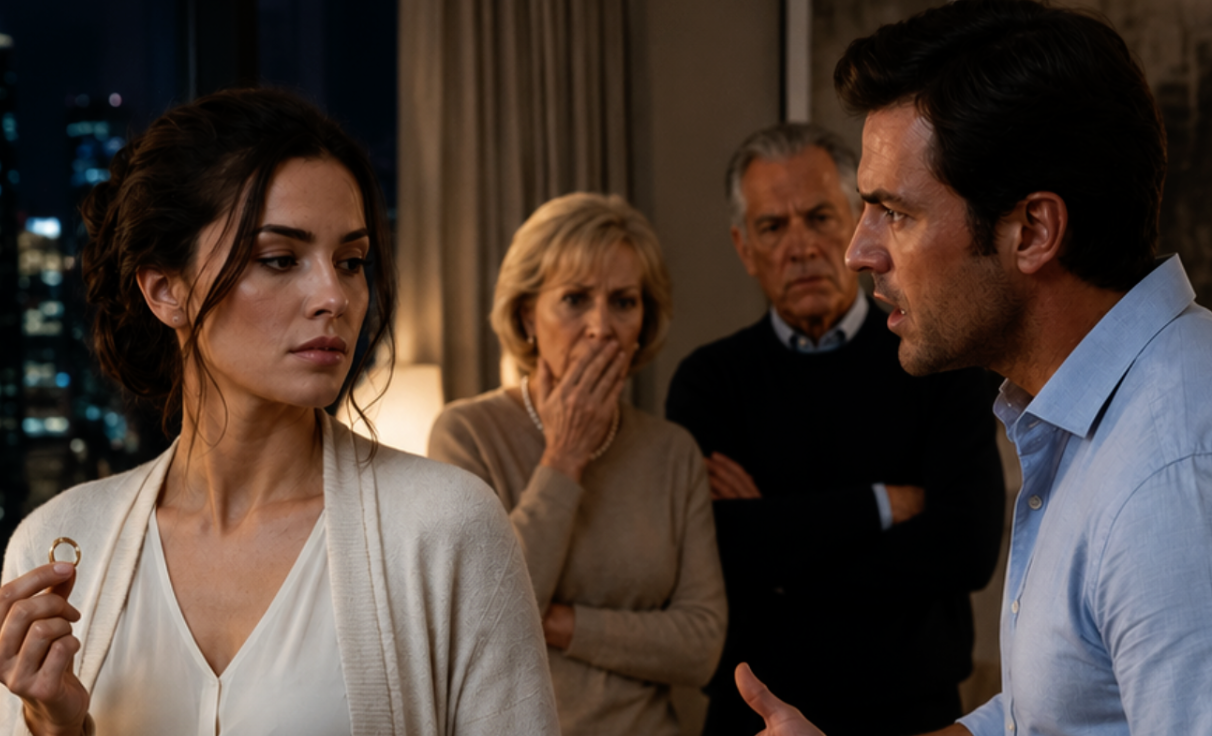
“Was the apartment yours before marriage? After the wedding, everything belongs to both of us,” the groom said. The wedding never happened.
“And when exactly did you decide that Andrey would be living in my apartment?”
Alla placed a bowl of roasted peppers on the table, still warm from the oven, and only then realized she had spoken the question aloud.
The kitchen was stuffy. Late August in Samara was always like this—the air thick and heavy, damp warmth drifting in from the river, while the old building near the embankment seemed to trap it inside, refusing to let it escape.
A yellow lamp with a frosted shade glowed above the table. Beneath it lay the wedding invitations, tied together with a thin beige ribbon. Alla had not had time to put them away in the other room.
Valentina Igorevna smiled so gently that an outsider might never have noticed that she had already made the decision for everyone.
“Alla dear, not at your place—at your shared home. There are only three weeks left until the wedding. You’ll live together and settle in. Andrey is going through a difficult time right now. It’s hard for him to be alone. And you have two rooms here. It’s spacious, comfortable, and close to his work.”
Andrey sat sideways at the table, as though the conversation had nothing to do with him. His windbreaker hung over the back of his chair. He twirled a teaspoon between his fingers and kept glancing toward the door of the smaller room, where Alla stored folders of work estimates, boxes containing her father’s books, and a folding desk she used for work.
Sergey, without lifting his eyes, cut the apple cake into neat, even slices. One might have thought they were discussing the menu rather than someone’s home.
“It won’t be for long,” Andrey added. “I just need some time to breathe. I won’t be a burden.”
Alla looked at Sergey. She did not need anyone else’s opinion. She needed only one answer—his.
“Sergey?”
He raised his head and smirked slightly, as though she were making an issue out of something insignificant.
“Alla, why are you getting so worked up? Was the apartment yours before marriage? After the wedding, everything belongs to both of us.”
He said it calmly. Without pressure.
So calmly that this evenness hurt more than any harsh tone, shouting, or insult could have.
Alla did not immediately understand what inside her had turned cold. It was not her hands or her back. Something inside her had become empty, like an apartment from which all the furniture had suddenly been removed, leaving you standing in the middle of the bare floor, unable to understand when anyone had found the time to do it.
She had renovated these rooms herself. It had not been an extravagant designer renovation intended for beautiful photographs. It had been a practical, adult renovation—the kind people saved money for and refused, on principle, to take out loans to complete.
She had replaced the wiring, searched for tiles that would match the old windowsills, and argued with the contractors over every electrical outlet.
She had not sold any of the old furniture. She had even kept her father’s heavy, dark wooden cabinet in the larger room, merely polishing it and replacing the handles.
This apartment had not fallen into her hands like a gift from heaven. It was a piece of her life that had remained after her father’s death.
And Sergey knew that.
“What exactly do you mean by ‘belongs to both of us’?” she asked.
Valentina Igorevna placed her palm on the tablecloth. Her fingernails were short, covered in clear polish, and she wore a ring with a green stone.
“No one is going to divide the walls, Alla dear. People get married so they can live like a proper family. Andrey will stay for a while, get back on his feet, and move on. You’re a sensible girl.”
“And the decisions have already been made? Without me?”
Sergey leaned back in his chair.
“Don’t be dramatic. Mom, stop looking at her like that. Alla is simply tired.”
Alla did not answer.
She watched Andrey narrow his eyes at the smaller room as though he were already imagining himself living there. She watched Valentina Igorevna nod toward the wardrobe in the hallway and casually remark that some of Alla’s belongings could be moved into the storage room.
Sergey did not object to a single word.
He simply ate his apple cake and behaved as though the conversation was difficult for only one reason—Alla, for some inexplicable reason, was being stubborn.
After they left, she stood by the window in the larger room for a long time.
Below, beyond the dark trees in the courtyard, scattered lights glowed along the embankment. Dust, heated stone, and the damp smell of the Volga drifted through the open window.
On the small table beside the sofa sat a bag containing her wedding shoes. They were cream-colored, with a thin strap.
She had deliberately left them out instead of putting them in the wardrobe because she liked looking at them and getting used to the idea that this would soon be her life.
Not the dress.
Not the restaurant.
Not the photographs.
Her life.
And that evening, for the first time, Alla realized that none of this was really about the wedding.
It was about the apartment.
The next morning, Sergey sent her a message.
“Don’t sulk. Andrey really is going through a rough patch. We’ll get through it. We’ll discuss everything.”
Ten minutes later, another message arrived.
“And stop treating the apartment like some kind of sacred shrine.”
Alla read it twice and placed her phone facedown.
At work, the numbers in the estimate blurred in front of her eyes. She corrected one line, returned to the previous one, and forgot what she had already calculated.
Liza noticed before lunchtime.
“You’re as pale as a sheet of paper. What happened?”
Alla did not like discussing her personal life at the office. But Liza had a rare gift: she never forced her way into someone’s private affairs. She simply sat beside you and spoke as though she were holding up a mirror—not a distorted one and not a flattering one.
Alla told her briefly about the dinner, the second room, the claim that everything would soon be shared, and the way Valentina Igorevna had already rearranged the furniture during the conversation without even leaving her seat.
Liza did not remain silent for long.
“The worst part isn’t that his brother has nowhere to live,” she said. “The worst part is that they didn’t include you in the decision. They simply informed you.”
“Maybe I really am being possessive. He’s having a hard time. There’s the divorce and the debt.”
“There are many ways to help someone. The question is why everyone already has a plan except the owner of the apartment. Sit down with Sergey this evening and ask him four questions without getting emotional. Who will live there? Who will pay? Who will make the decisions? Who will have keys? Don’t let him answer with vague generalities. Ask one question at a time.”
“He’ll say I care more about walls than people.”
“Then care about the walls. They’re your walls.”
Alla smiled weakly.
Liza’s words did not reassure her, but they gave shape to what had previously been nothing more than a heavy, sticky feeling.
That evening, she took out the hard-covered blue notebook in which she usually recorded renovation expenses and wrote down the four questions.
Then she added a fifth: official residence registration.
And a sixth: how long would Andrey stay?
The notebook lay on the cabinet beside the mirror when Sergey arrived. He was in a good mood and carried a bag of grapes and a cake in a transparent box.
“Peace?” he asked from the doorway.
“Can we talk?”
“Again? Alla, how long are we going to keep chewing over the same thing?”
He placed the cake on the kitchen table, approached her, and kissed her cheek. He smelled of expensive deodorant and the interior of his car.
Alla stepped half a pace away.
“I want to understand the specific arrangement. Who will be living here, for how long, who will pay, and who will receive keys?”
Sergey sighed as though she had demanded a financial report covering the previous five years.
“We’ll be living here. And Andrey will stay at first. A month or two at most.”
“At first after what?”
“After the wedding, of course.”
“Why after the wedding?”
“Because it would be strange before then. We aren’t officially married yet.”
He said it so simply that Alla wanted to ask whether he could hear himself.
Before the wedding, it would be strange. After the wedding, it would suddenly be acceptable.
Not because an extra room would appear.
Not because Alla’s opinion would change.
Only because they would receive a stamp at the registry office, and in his mind, something that belonged to someone else would become available to him.
“Who will pay the utilities?”
“We’ll work that out as we go.”
Alla lowered her eyes to the notebook. Liza had told her not to abandon the conversation after the first evasive answer.
“Who will have keys?”
“I definitely will. That isn’t even a question.”
“And who else?”
Sergey shrugged.
“Mom may need to stop by occasionally. She has experience handling a household. And Andrey should probably have a set so he doesn’t have to keep bothering us.”
Alla looked up at him.
“Have you already made duplicates?”
He hesitated for less than a second.
It was enough.
“I made one set for myself. So what?”
She walked into the hallway and opened the drawer in the cabinet where she kept utility bills and intercom key fobs.
Her own set of keys was where it belonged.
But beneath it, at the bottom of the drawer, lay two newly cut, shiny keys with blue plastic caps. They were exactly the kind made at the small kiosk near the tram stop.
They had not been there that morning.
Alla did not shout or gasp.
She simply picked up the keys, placed them in her palm, and returned to the kitchen.
“What are these?”
Sergey looked at them and frowned.
“You’re digging through drawers as though you’re investigating a crime.”
“I opened my own drawer in my own apartment. What are these?”
“One is a spare for you, and the other is mine. Stop making a scene.”
“Why do I need another spare when I already have a spare set?”
He looked away.
At that moment, everything became clear.
He had not expected her to catch him doing something small. He had expected the duplicate keys to quietly become part of their new life, as though they had always belonged there.
Perhaps the keys were the most honest expression of their plan: made quietly, in advance, without discussion.
“You simply don’t trust me,” Sergey said through clenched teeth. “That’s the real problem.”
“No. The problem isn’t trust. The problem is that you’re already making decisions about something that doesn’t belong to you.”
He was no longer smiling.
“Don’t speak like that. In three weeks, this will be our home.”
Alla slowly placed the keys in the pocket of her robe.
And suddenly, she understood something strange.
She was not frightened by the idea that Andrey might stay for a month.
She was frightened by the ease with which Sergey had said “ours” when he had not asked for her opinion about a single decision.
The next day, Valentina Igorevna called her.
“Alla dear, Sergey is terribly upset. You should smooth things over. Men experience housing differently. What matters to them is that their loved ones always have somewhere to go.”
“Their loved ones?”
“Well, of course. Andrey isn’t a stranger.”
“Not to you.”
“That’s not what this is about. The poor boy is going through a difficult time.”
The “boy” was twenty-nine.
Alla almost laughed, but restrained herself.
“Having a difficult time doesn’t give him the right to enter my home without my consent.”
There was a brief pause on the other end of the line. Then Valentina Igorevna’s voice became even softer.
“I never thought you were such a hard woman. No one would guess it from looking at you.”
That hurt Alla more than a direct accusation would have.
Not greedy.
Not cold.
Hard.
As though, until that moment, they had expected only one thing from her: pleasant obedience.
The kind in which a woman smiles while others decide where she will sleep, who will enter her home, and how many doors she is required to open.
Two days later, Andrey himself appeared outside her apartment.
There was a small measuring tape in the pocket of his jeans, and he carried a bag of peaches.
“Don’t get worked up,” he said, standing on the landing. “I’ll only be five minutes. I just want to see whether my sofa will fit in the smaller room. I’m not your enemy.”
Alla stared at him, unable to decide what was more absurd: the peaches as a gesture of peaceful intentions or the sentence about his sofa, spoken as though her consent were already lying in his pocket beside the measuring tape.
“Did you seriously come here to measure the room?”
“Why delay it? I need to make plans too.”
“Make them somewhere else.”
He remained silent for a moment and then sighed, sounding almost offended.
“This is exactly why people stop speaking to one another.”
“Because of what?”
“Because of pettiness. We’re all adults. You need to take things more easily.”
Alla closed the door—not sharply, but carefully, so she would not give him another reason to claim she was hysterical.
Only after she was back inside the apartment did she realize that her palms were ice-cold.
The peaches were lying in a bowl in the kitchen. Andrey had managed to push the bag into her hands before she could think to refuse it.
Alla placed them on the table and stared at their warm, velvety skin for a long time.
It was remarkable how often pressure arrived not in a crude form, but accompanied by fruit, whispered words, and suggestions that one should “take things more easily.”
Sergey arrived late that evening.
The argument began before he had even left the hallway.
“You threw Andrey out?”
“I didn’t let him come inside to measure my room.”
“Alla, this has gone too far.”
“No. Coming to my door with a measuring tape is what went too far.”
“He came peacefully. He even brought peaches.”
“I don’t sell my consent for peaches.”
Sergey rolled his eyes and walked into the larger room. He could no longer hide his irritation.
“How long is this going to continue? Yes, my brother needs time to recover. What’s so terrible about that? You’re acting as though you’re going to war. We’ll live together, help one another, and offer support. That’s what a normal life looks like.”
“A normal life doesn’t begin with duplicate keys and people measuring rooms without permission.”
“You’re obsessed with the keys.”
“Because a key represents the right to enter. And all of you have already entered. So far, only with your words.”
He sat on the edge of the sofa and rubbed his face with his hands.
“I never expected you to be so… difficult to live with.”
That was when Alla almost broke.
Not because his words were accurate, but because her wedding dress hung in a garment bag in the room, new napkins for the wedding dinner lay in the cabinet, and a guest seating plan was attached to the refrigerator with a magnet.
There were fewer than three weeks left before the restaurant reception.
The engagement ring felt familiarly cold against her finger. They had chosen it together. She had already arranged time off for a dress fitting. She had already called her aunt and made an appointment with the hairdresser.
This whole dense, exhausting, expensive world held her by the elbows and whispered: Don’t destroy everything. Don’t humiliate yourself. Don’t force yourself to start over.
For the first time, Alla wondered whether it might be easier to agree to one month.
She could establish conditions, grit her teeth, and wait for it to end.
Perhaps it truly was not worth destroying a wedding over a single room.
But the thought did not have time to become comforting.
Another followed almost immediately—quiet, sober, and unmistakably clear.
The problem was not the month.
The problem was that the month had already been arranged without her.
The length of the stay, the keys, the furniture, and the right to enter had all been decided.
They required her participation in only one part of their plan: she must not interfere.
The following day, Alla went to the restaurant to see Ruslan Viktorovich.
She claimed she wanted to clarify the menu, but in reality she wanted to find out whether she could recover at least part of the deposit if the wedding was canceled.
She felt ashamed even to say it aloud.
Ruslan Viktorovich sat in his small office beside the reception hall. The air smelled of polished wood, cold mineral water, and something lemony.
He remembered her from their previous meeting and immediately took out the contract.
“What are we changing? The fish? The seating arrangement?”
Alla removed the bag from her shoulder and suddenly realized that she could not begin speaking.
She had to stare at the edge of the desk, the stacked folders, and the neatly aligned pens.
“The wedding may not happen,” she said.
Ruslan Viktorovich did not pretend to be surprised. He merely nodded slowly, as though he had heard far more unusual things.
“Then it isn’t the menu you need to review.”
“I understand.”
“Under the contract, part of the payment is nonrefundable. But not all of it. The date hasn’t been taken by anyone else yet. I can return more than I’m legally required to.”
Alla raised her eyes.
“Really?”
“I’m not interested in taking the last of someone’s nerves along with their money. Make your decision calmly.”
He spoke plainly, without excessive sympathy.
And because of that, there was more respect in his tone than in a dozen gentle attempts at persuasion from Valentina Igorevna.
Ruslan Viktorovich printed the documents, calculated the amount, and pushed a sheet of paper toward her.
“Sign it when you’ve made your decision. I’ll hold the reservation until the end of the week. After that, I’ll release the date.”
Alla left the restaurant and stood beneath its faded sign for a long time, squinting at the bright sky.
Heat shimmered above the asphalt. Cars moved slowly toward the embankment. Someone nearby was selling corn, and its sweet smell suddenly seemed extraordinarily ordinary and almost comforting.
The world had not collapsed.
No one would die if the wedding did not happen.
Yes, money would be lost. It was painful, embarrassing, and bitter.
But that was the price of leaving.
Not the price of her entire life.
That evening, Liza came over after work with grapes and cheese.
They sat in the kitchen without music. Alla barely ate.
“Have you made your decision?” Liza asked.
“I keep going in circles. On one hand, Sergey isn’t a stranger. We’ve been together for almost two years. And Andrey really is in trouble. On the other hand, I can’t escape the feeling that they’re pushing me out of my own place. Gently and politely—but they’re pushing me.”
“Because that is exactly what they’re doing.”
“What if I regret it later? What if I lose someone because I reacted too harshly?”
Liza picked up the notebook containing Alla’s questions.
“Look. If you’re afraid of losing him, ask one question. After that, everything will be easier.”
“What question?”
“If the apartment is yours, why are the decisions already theirs?”
Alla turned toward the window.
The glass reflected the kitchen—the lamp, the white refrigerator, and the bowl of peaches she had still not eaten.
Suddenly, she felt some of her exhaustion disappear.
Not all of it, but the sticky, helpless part that made her want to delay the decision dissolved.
The following day, Sergey came to the apartment by himself.
He brought no cake, no grapes, and no conciliatory gestures.
He entered like a man who was exhausted by someone else’s stubbornness.
“I want to put an end to this circus,” he said. “We’re adults.”
Alla nodded.
“All right.”
They sat down in the larger room.
Between them stood a low table on which the folder containing the restaurant contract was lying.
Sergey noticed it immediately.
“You’ve already been there?”
“Yes.”
“Wonderful. So you decided to confront me with a fait accompli?”
Alla almost smiled.
It was strange to hear that particular accusation from him.
“You were the ones who confronted me with a decision that had already been made.”
“Who are ‘you people’? There’s that tone again.”
“You, your mother, and your brother.”
Sergey stood abruptly, walked to the window, and then returned.
“Listen, I’m tired of this language. I’m not some corporate raider. Andrey isn’t a criminal. Mom isn’t a monster. My brother needs somewhere to stay. My mother wanted to help him, and so did I. You turned the whole thing into some kind of territorial dispute.”
“Because you’re already dividing the territory. Without me.”
“We aren’t dividing anything! You’ve become obsessed with documents, keys, and square meters, as though they matter more than people.”
Alla stood as well. She did not approach him closely. Two steps remained between them.
“Then answer one question. If the apartment is mine, why are the decisions already yours?”
He stared at her as though she had deliberately chosen words he could not argue against.
Then he smirked, but without his former confidence.
“Because married people are supposed to trust each other.”
“That isn’t an answer.”
“That is the answer. Either you enter a shared life with me, or you remain alone with your walls and pieces of paper.”
Alla remained silent.
She waited for something else—perhaps an explanation, or at least an attempt to see her as a person rather than an obstacle.
But Sergey did not choose conversation.
He chose the last familiar weapon available to him: her fear of loneliness.
It was apparently the fear on which his entire plan had been built.
“I understand,” she said.
Then she removed the ring.
She did not do it abruptly, and her hands did not tremble.
She ran her thumb across the smooth metal as though confirming that it was an ordinary object rather than a sign of destiny, and placed it on the table beside the restaurant folder.
Sergey did not immediately understand what had happened.
“What are you doing?”
“Stopping this.”
“Because of one room?”
“No. Because you have already moved into this apartment in your imagination. You decided that I would simply make room for you.”
He stared at the ring as though it should somehow restore his control over the conversation.
Then he looked at her.
“You’ll regret this.”
Alla did not answer.
She walked to the door and opened it.
Sergey remained standing in the middle of the room for several more seconds.
The cabinet, the sofa, the dark blue rug, her father’s books on the shelf, and the garment bag containing the wedding dress hanging from the wardrobe door probably seemed like an absurd background for such an ending.
He clearly had not believed that she would go through with it.
“I thought you were smarter than this,” he said as he entered the hallway.
“And I thought you were kinder.”
He left without slamming the door.
That was somehow worse than if he had slammed it.
It was the careful, cold departure of a man who had not yet accepted the situation, but had merely decided he would return later and apply more pressure.
Alla turned the lock once, then a second time.
She rested her forehead against the door and remained there for about a minute.
Her phone immediately lit up with an incoming call.
Valentina Igorevna.
Then another call.
Sergey.
Then Valentina Igorevna again.
Alla silenced the phone and went into the kitchen.
The peaches had grown soft over the past few days. One had already begun to darken on one side.
She picked up the bag and emptied the fruit into the trash.
Not because the peaches were responsible for anything.
She simply no longer wanted to see other people’s gestures of peace in her home when those gestures had been used to conceal pressure.
The next morning, she returned to the restaurant and signed the papers.
Ruslan Viktorovich returned part of her deposit in cash, placing the money inside a thick white envelope.
“Do you think you’ll regret it?” he asked as she put the envelope into her bag.
Alla thought for a moment and answered honestly.
“The dress, perhaps. The decision, no.”
He nodded as though that were the only answer that made sense.
She returned home, took down the garment bag containing the dress, and placed it on the top shelf of the wardrobe.
She did not throw it away or stage any symbolic scene.
She simply stood on a stool and placed it where people kept things they did not need today.
On the table in the larger room, she laid out the ownership documents for the apartment, the spare set of keys, and the envelope from the restaurant.
Everything that had become tangled in her mind during the previous few days was now arranged in one place: her home, her money, and her nerves.
What remained to her after the wedding that never happened.
By evening, the heat had subsided.
Through the open window came the distant noise of the embankment, someone’s laughter, the sound of a motorcycle, and then the horn of a riverboat.
The old building seemed to breathe again, no longer so heavily.
Alla sat down at the folding desk in the smaller room—the room Andrey had already replaced with his sofa in his imagination—and opened her laptop.
An unfinished estimate glowed on the screen.
Ordinary work.
An ordinary life.
No music, no wedding toasts, and no one else’s keys in her drawer.
Her phone continued flashing with missed calls.
She did not touch it.
The ring lay on the windowsill. Sergey had never taken it with him.
A small circle of metal that had represented her future only yesterday now looked like an ordinary object left behind by a man who had decided far too early that the door was already open.
Alla picked up the key to her apartment and closed her hand around it.
Cold, familiar, and real.
Then she stood and went to check the locks once more—not because she was afraid, but because she wanted to hear for herself that precise, peaceful click.