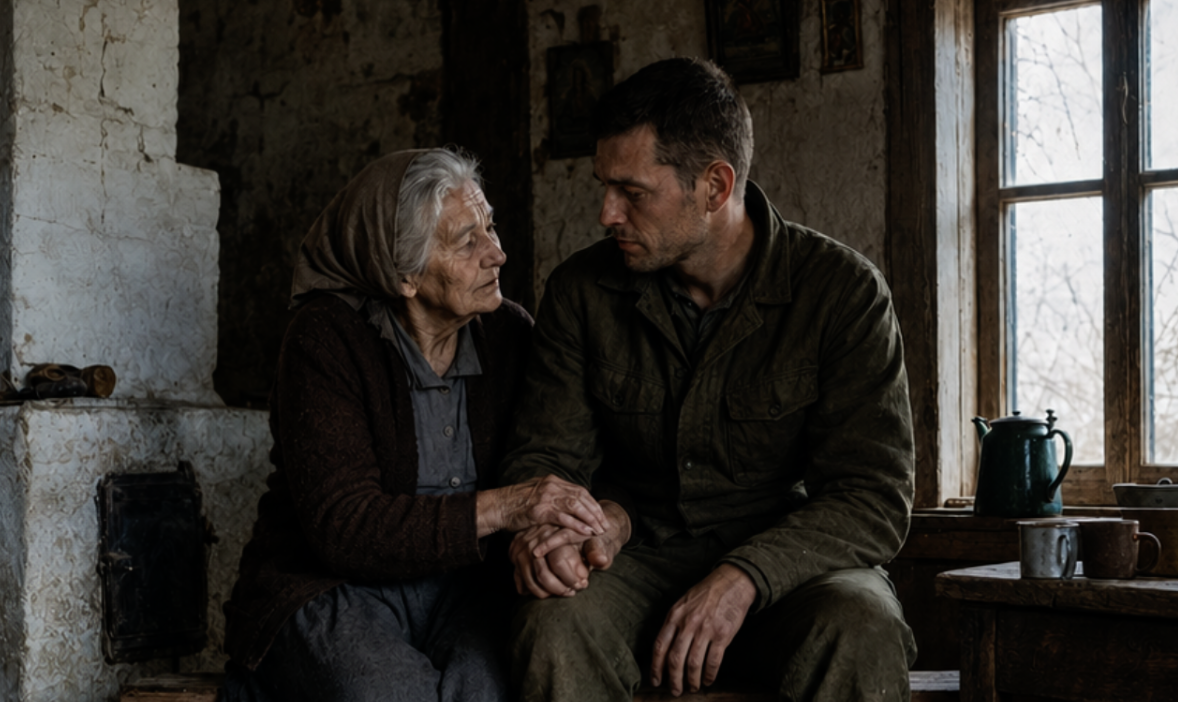
His Parents Divorced When He Was Three and Disappeared in Opposite Directions. The Boy Grew Up and Found Them Both in Remote Villages
Yegor was three years old when they divorced.
Of course, he did not remember it clearly. All that remained in his memory were vague fragments: shouting in the kitchen, the sound of breaking dishes, his mother packing her belongings into an old suitcase, and a stranger’s hand leading him into another room. That was all. After that came darkness. As though a door had slammed shut.
He was taken in by Granny Nyura, his mother’s mother. She lived in a village on the bank of a taiga river in the Komi Republic. The house was old and leaning to one side, but it had a stove. A cow. A vegetable garden. Potatoes.
His mother sent her first letter a month later. Then another three months after that. Then a New Year’s postcard. Afterward, there was silence. His father never wrote at all.
Granny Nyura did not judge them. She was one of those old women who understood everything but said nothing. Only sometimes, when she looked at Yegor, she would sigh.
“You’re exactly like her. You have your mother’s eyes. But your character comes from your father.”
“What kind of character?” Yegor would ask.
“Be quiet,” Granny Nyura would reply. “You’ll find out when you grow up.”
And Yegor grew up. He grew up alone. Without brothers, without sisters, without a gang of neighborhood boys. The village was small, with barely a dozen houses, and almost everyone there was elderly. There were no children his age.
He went to school five kilometers away in a neighboring settlement. In the mornings, he walked through the forest. In the evenings, he walked back. In winter, he traveled on skis. In autumn, he struggled through the mud. He studied reasonably well, although he was never outstanding. His teachers said he was capable but withdrawn. He sat at the back of the classroom, remained silent, and stared out of the window.
“What are you thinking about, Yegor?” they would ask.
“Nothing.”
But he was thinking. He was constantly thinking about the same things.
Where was his father? Where was his mother? Why had they left? Why had neither of them ever come to visit, written to him, or called? Why did they not need him?
Those questions grew together with him. When he was ten, he still hoped that the door would suddenly open and his mother would appear on the threshold—beautiful, wearing a beautiful dress and carrying presents. Or his father would arrive—big and strong, with a mustache like all normal fathers.
At thirteen, he stopped waiting.
At sixteen, he stopped forgiving.
At eighteen, he finished school and moved to the city. He enrolled in a technical college and trained as an electrician. Then he found a job. He rented an apartment. He lived alone. He visited his grandmother rarely, perhaps twice a year. When Granny Nyura died, the house was sold, and the final thread connecting him to his past was severed.
Yegor was twenty-five. He had a job, a battered old car, a couple of friends, and an emptiness inside him that was as cold as a March wind in the taiga.
That was when he made his decision.
He would find them.
He would find both of them, if only to look them in the eyes. If only to ask them why.
And so he began searching.
It was not easy.
Granny Nyura had never spoken about his parents in detail. All he knew was that after the divorce, his mother, Nadezhda, had gone somewhere—perhaps south, perhaps north. South? North? Who could say? His father, Viktor, had been born in Komi, but no one knew where he had gone. Perhaps he had remained somewhere in the republic. Perhaps he had left to work in the oil fields. Perhaps he had drunk himself to death and disappeared. Who could tell now?
Yegor began with the archives. He found the old documents that had remained among his grandmother’s possessions: the divorce certificate, a yellowed document from the village council, and several old photographs in which his mother and father, young and laughing, held a baby in their arms.
That baby was him.
From the documents, he moved on to the internet. Social networks, telephone databases, missing-person websites. He spent his evenings staring at faces on a screen.
Nadezhda Sosnina.
Viktor Sosnin.
Not a single match.
Then he began making telephone calls. He called personnel departments, village councils, and district administrations. He introduced himself as a journalist, lying that he was writing an article about family labor dynasties. Some people refused to help. Others promised to call him back.
They never did.
He searched for two years without finding anything.
Then chance intervened.
Yegor was sent on a business trip to replace the electrical wiring in an old school in a remote district center in northern Komi. The job was simple: three days of work, two nights in the local hotel, and then back home.
But an elderly woman worked as a hall attendant at the school. Her name was Aunt Klava. She sat by the entrance, knitted socks, and looked at everyone as though she knew everything about them.
“Your surname sounds familiar,” she told Yegor on the second day. “Sosnin. Some Sosnins used to live around here a long time ago. Viktor and Nadya. They wouldn’t happen to be your relatives, would they?”
Yegor’s breath caught in his throat.
“They are,” he said. “Did you know them?”
“Of course I did. We were from the same village. They married very young. He was a tractor driver, and she was a milkmaid. They were a good couple. Then something broke between them. They divorced and went their separate ways. She went in one direction, and he went in the other. So you’re their son?”
“Their son.”
“Well, imagine that.” Aunt Klava put down her knitting. “All grown up. I remember when you were only this little.”
She held her palm low above the floor.
“Do you know where they are now?” Yegor asked. “Do you know anything about them?”
Aunt Klava remained silent for a moment. She glanced around as though checking whether anyone might be listening. Then she spoke quietly.
“I know where both of them are.”
“Where?”
“Here. Not far away. In two villages on opposite sides of the river.”
Yegor could not believe her.
“Two villages? Close to each other?”
“Close. Ten versts apart. Perhaps less. Nadya lives in the village on the left bank. Viktor lives on the right. They’re both alive. And they’re both alone. But listen…” She hesitated. “They don’t know about each other. They haven’t seen each other once since the divorce. They never asked. They never showed any interest. That’s how they live—on opposite banks.”
Yegor said nothing. His mind could not comprehend it.
Twenty-two years.
His mother and father had been living in neighboring villages, only ten versts apart. A person could walk that distance in two hours. A person could cross the river in twenty minutes. Yet during all those years, there had been nothing. Not a single telephone call. Not a single meeting. Not even an accidental “hello” in the district center.
“And me?” he asked quietly. “Did they ever… even once…”
Aunt Klava looked away.
“I don’t know, Yegor. I don’t speak to them. I only hear rumors. Viktor has gone completely wild. He lives like a hermit and doesn’t talk to anyone. Nadya goes to church. She’s trying to pray away her sins. God only knows what sins they are.”
She told him the names of the villages, the names of the village council chairmen, and even suggested which local people he could ask for directions.
Yegor wrote everything down in an old, worn notebook that had once belonged to his grandmother. That evening, he lay in his hotel room, staring at the ceiling and thinking.
Whom should he visit first?
Where should he begin?
He decided to start with his mother. For some reason, it seemed more appropriate.
He found her the following day.
The village on the left bank greeted him with silence. There were several crooked houses, a closed community center, and an old chapel whose roof had collapsed. The few people he passed were mostly elderly women wearing dark headscarves.
His mother’s house stood on the outskirts, the last house before the forest. It was a darkened log house with the veranda windows boarded up. The only sign of life was smoke rising from the chimney.
Yegor knocked.
He waited.
Then he knocked again.
The door opened. A woman stood on the threshold. She was short and thin, wearing an old coat over a house dress. Her gray hair had been carelessly gathered into a bun. Her face was wrinkled and tired, with sunken eyes.
But those eyes were his own.
Gray, with a faint hint of green.
“Who are you looking for?” she asked.
“Does Nadezhda Sosnina live here?”
“She does. Who are you?”
He was silent for a moment.
Then he said:
“I’m Yegor. Your son.”
She did not cry out.
She did not burst into tears.
She did not throw her arms around him.
She simply stood there and stared at him for a very long time. Then she stepped aside, holding the door open.
“Come in,” she said. “Since you’ve come.”
The house was poor. There was an old stove, a table, two chairs, and an iron bed behind a printed cotton curtain. The walls were covered with faded floral wallpaper. The room smelled of dried herbs and loneliness.
“Sit down,” she said. “Would you like some tea?”
“Yes.”
She put the kettle on. Then she took out two mugs, one of which had a broken handle. She sat opposite him.
And remained silent.
Yegor looked at her.
Here she was—his mother.
The same woman he had imagined as young and beautiful when he was a child. The same woman he had waited for in the evenings while staring down the road. The same woman who had never come to visit him.
“Why?” he asked. “There is only one thing I want to understand. Why did both of you—you and Father—leave me and forget about me?”
She was silent for a long time. Then she began to speak, her voice dull and strained, as though every word had to be forced out.
“I didn’t forget you, Yegor. I remembered you every day. Do you think it was easy? I wrote letters. During the first few years, I wrote every week. Your grandmother never answered. Later, I found out that she hadn’t given the letters to you. She said there was no reason to wound your soul. She said the boy should forget everything and live in peace. I wanted to come. I wanted to come many times. But then…” She faltered. “Then I became ashamed. I was ashamed to look you in the eyes.”
She fell silent.
Then she began to cry.
She cried quietly, without sobbing. Tears simply ran down her wrinkled cheeks and fell onto the table.
“I was a bad mother, Yegor. I know that myself. I don’t deserve to have you searching for me.”
He sat there without knowing what to do.
All the anger he had accumulated over the years suddenly disappeared somewhere. Only exhaustion remained. And a strange, unexpected pity—not for himself, but for her. For this old woman who had lived alone in a remote village for twenty-two years, consumed from within by guilt.
“All right,” he said. “It’s all right, Mom. Let’s drink our tea.”
She raised her wet, reddened eyes.
And suddenly she smiled—a trembling, timid smile.
“You look like your father,” she said. “Very much like him. Here.”
She touched her forehead with her fingers.
“Your eyebrows. And your mouth. You have his mouth.”
“But the eyes are yours,” he said.
“Yes. The eyes are mine.”
They drank their tea. His mother questioned him carefully, afraid that one careless word might frighten him away.
Where did he live?
Where did he work?
Was he married?
Did he have children?
He answered briefly. He did not lie, but he did not reveal everything either. He still was not sure whether he had forgiven her. Perhaps he had not.
But at least he had heard her explanation.
At least he understood.
Then he asked:
“Do you know that Father lives only ten versts from here? On the right bank?”
She flinched and put down her mug.
“No. I didn’t know.”
“What would you have done if you had known?”
She remained silent for a long time.
“Nothing would have changed,” she finally said. “That train left a long time ago. Back when you were three.”
Yegor did not answer.
They finished their tea, and he stood up.
“I’m going to visit Father tomorrow,” he said. “After that, I might come here again. Unless you object.”
“Come,” she said. “I’m always here now.”
He left.
She remained standing on the threshold, watching him walk away, just as she had once watched the bus carrying her away from her three-year-old son.
Yegor went to see his father the next day.
The right bank was higher and steeper. The village was even smaller and poorer. The road was covered with potholes. The houses were low and seemed to have sunk into the ground.
He found his father by the river.
The man was sitting on an overturned boat, staring at the water. He was a tall, stooped old man wearing an old quilted jacket and heavy work boots. His gray hair stuck out in every direction, and his face was covered with stubble. Beside him stood an empty bucket, while a fishing rod lay forgotten on the sand.
“Viktor Sosnin?” Yegor asked as he approached.
The old man did not turn around.
“Suppose I am. What do you want?”
“I’m Yegor. Your son.”
The old man slowly—very slowly—turned his head.
He looked at Yegor for a long time and with great concentration, the way someone might examine an unfamiliar object while trying to understand where it had come from.
“Yegor,” he repeated. “Imagine that.”
Then he fell silent.
Yegor sat down beside him on the overturned boat. He took out a packet of cookies. He had bought them at the village shop because he had not known what else to bring.
He offered them to his father.
The old man took the packet, turned it over in his hands, and set it aside.
“So you found me,” his father said. “And I thought you had forgotten.”
“I didn’t forget. I remembered the entire time.”
“Yes. Yes, of course. I remembered too. But what good did it do? Memory is like a fish. You think you’ve caught it, but a moment later it slips away, and it’s gone.”
He paused.
“Is your mother alive?”
“She is.”
“Where is she?”
“On the left bank. Ten versts away.”
His father gave a humorless, bitter smile.
“Ten versts. It might as well be a thousand. I haven’t seen her since 1992. Not since the divorce. Back then, she said, ‘That’s it, Vitya. It’s over.’ And it was over.”
“What happened?” Yegor asked. “Why did you divorce?”
His father picked up a piece of wood from the sand and turned it between his fingers.
“We were young. Stupid. I drank. She wouldn’t forgive me. I was jealous. She didn’t understand me. I wanted one thing, and she wanted another. You cried at night, and we screamed at each other. She kept saying she would leave. Then she left. Six months later, I left too. I abandoned you with your grandmother. I thought it would be better that way. I thought you would grow up and work it out for yourself.”
He twisted the piece of wood between his fingers and threw it into the river.
“Have you worked it out?”
“I’m working on it,” Yegor said.
His father nodded.
Then he fell silent again.
The river flowed past them—calm, wide, and indifferent. The forest darkened on the opposite bank. Somewhere there, ten versts away, his mother sat inside her house and was probably thinking about the same things.
They knew nothing about each other.
For twenty-two years, they had known nothing.
And now, even after finding out, nothing would change.
“Listen,” his father suddenly said. “Don’t hold a grudge against me. I understand that you have every right to. But don’t hold on to it. Anger is like that piece of wood. You throw it into the river and let it float away. But if you keep it clenched in your hand, it becomes a splinter. The wound festers. Do you understand?”
“I understand,” Yegor said. “I’ll try.”
They sat on the boat and stared at the water.
His father did not say anything else.
Yegor remained silent too.
But there was something important in that silence. Something that had been missing all those years.
Then Yegor stood up.
“I should go. I still have things to do.”
“Go,” his father said. “Come again, if you feel like it. I’m always here.”
He remained sitting there alone on the empty riverbank—old and gray-haired, with an empty bucket and a forgotten fishing rod.
He watched not his son, but the piece of wood floating down the river, turning slowly in the current.
Yegor returned a month later.
He came for the weekend.
He visited his mother first. They sat together and talked. She showed him old photographs—the same ones in which she and his father were young. She told him how they had met at a dance in the village club, while music played on an old record player.
She told him how his father had walked her home and carried her shoes because they had rubbed her foot raw.
She told him how they had married without rings or a wedding dress. They had simply registered their marriage and sat down to drink tea.
“He was a good man,” she said. “Until he started drinking. Once he started drinking, he became someone else. Then I became someone else too. We forgot how to talk to each other. Do you understand?”
“I understand,” Yegor said.
Then he visited his father.
The old man met him on the same riverbank, as though he had never left. But this time he was clean-shaven and wearing a clean shirt. He had even turned the boat over, cleaned it, and begun sealing its seams with tar.
“Are you repairing the boat?” Yegor asked.
“Yes,” his father replied. “It’s very old. The wood has dried out. But if I seal the cracks, it might still be useful.”
“Where are you planning to sail?”
“Where would I sail? Maybe to the other bank.”
He glanced sideways at Yegor.
“To see your mother.”
Yegor said nothing.
He did not ask whether his father would truly cross the river or not.
He had already understood the most important thing: those two would never be together again. Too much water had flowed beneath the bridge. Too many things had accumulated between them during those twenty-two years.
But something had already changed.
Something had already begun to move.
As Yegor drove away, leaving behind two villages on opposite banks, he thought about what a strange thing life was.
Ten versts was a distance that a person could walk in two hours.
But sometimes, to cross that distance, one had to live an entire lifetime.
And sometimes, even an entire lifetime was not enough.
He reached the highway.
The gray ribbon of road stretched ahead. The taiga darkened on his right, while the river glittered on his left.
On the opposite bank, in a small village, his mother lived.
On this bank, his father remained.
And he, Yegor, was the bridge.
The only bridge between them.
That was a responsibility too.
Perhaps it was the most important responsibility of his life.
He pressed the accelerator.
In the rearview mirror, the two villages appeared for a moment—one on the opposite bank and one on this side.
Then they disappeared.
Ahead of him was the road.
Long.
Bright.
And entirely his own.