My Mother-in-Law Waited for My Salary and Demanded to See the Amount. But My Answer Quickly Cured Her of the Desire to Count Other People’s Money
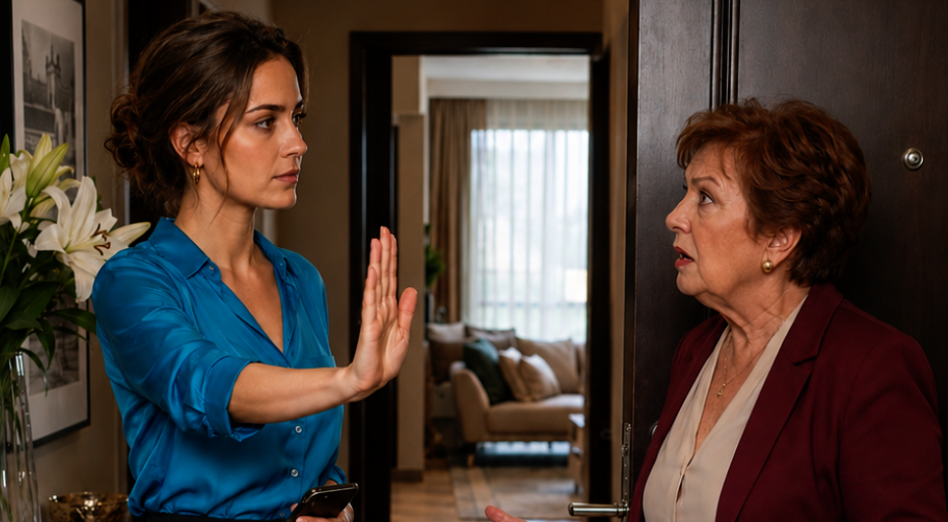
“Open your banking app. I need to see the exact amount!” Irina Semyonovna ordered.
She was sitting sideways beside the refrigerator, deliberately holding out her arm to prevent me from opening the door.
It was the evening of a scorching July Thursday. I had just returned from work after riding through half of the heat-melted city in a suffocating subway car. All I wanted was a glass of ice-cold water and some blessed silence.
Instead, an unscheduled branch of the tax office had opened in my kitchen.
Senya had let his mother in an hour earlier when he stopped by the apartment from his workshop. She had claimed that she was bringing us fresh strawberry jam and would leave immediately. But instead of jars of jam, I found myself facing an aggressive interrogation.
A thick green squared notebook lay in front of my mother-in-law. The word “BUDGET” had been carefully written across its cover in black marker.
“Good evening, Irina Semyonovna,” I sighed, gently moving her elbow aside so I could reach the life-saving pitcher. “And what happens if I refuse? Will you call in the riot police, or will you start torturing me immediately? Just so you know, our iron is new and has a steam function. You’ll need the instructions. You won’t be able to operate it that easily.”
“This is no time for jokes, Tamara!”
My mother-in-law adjusted her glasses and looked at me as though I had stolen a crystal chandelier from the Hermitage Museum in broad daylight.
“I am your husband’s mother. I have every moral right to know how much money is settling in your pockets while my son breaks his back in his workshop. I have reliable information that you received a bonus today!”
A week earlier, I had carelessly mentioned in her presence that we had been promised a substantial bonus after successfully completing a major construction project. Now the punishment for my loose tongue was sitting on my own kitchen stool.
She narrowed her eyes, eagerly waiting for me to start making excuses, fidgeting, blushing or frantically hiding my phone in my pocket.
But I work as a construction-materials testing engineer. My daily job is to crush concrete cubes under a hundred-ton press until they crack and collapse.
After dealing with concrete, human manipulation seems like nothing more than children fussing around in a sandbox.
“Your information is certainly accurate,” I said, pouring myself some water and taking a long, deeply satisfying drink. “But I still don’t understand why my personal bonus has suddenly become the subject of your internal audit.”
“Because!” Irina Semyonovna declared, slapping her plump palm against the green notebook. “You are close family! In a normal family, the money must be visible to the older and wiser relatives.”
She triumphantly raised her chin.
“My friend Lyuba’s son Valerik is divorced. He lives with his mother and gives her every last kopeck of his salary! Then she decides how much to set aside for utilities, how much to spend on groceries and whether Valerik deserves money for new socks. Now that is genuine respect!”
My mother-in-law shook her head reproachfully.
“But you have turned my Arsyusha into some powerless dependent! You deliberately earn more than he does just to humiliate him!”
The scale of this reinforced-concrete logic genuinely amazed me.
My mother-in-law sincerely believed that my career growth was not the result of ten years of hard studying and work, but an elaborate act of sabotage against the masculine dignity of her beloved son, planned many years in advance.
In her unique worldview, the ideal daughter-in-law was supposed to earn exactly three rubles less than her husband, walk around the house with her eyes lowered and cheerfully surrender any excess income to the “maternal rescue fund.”
The lock clicked in the hallway, and Arseny appeared in the doorway.
My husband restored antique furniture, transforming battered Soviet tables, cabinets and metal workbenches into expensive designer pieces.
He walked in, wiping ingrained dust from his hands, and immediately assessed the scene: his stern mother with her green notebook, me holding a glass of water and the thick, almost tangible tension in the air.
“Oh, the traveling inspection committee is here,” Senya said with a smirk, wrapping an arm around my shoulders as usual. “Mom, are you doing your accounting routine again? We agreed that this subject was closed.”
“Arseny!” my mother-in-law cried tragically, clasping her hands together as her voice instantly changed to one of suffering. “I’m trying to save your marriage! She doesn’t respect you at all!”
She pointed a finger at me.
“I saw her getting out of a taxi today! Riding around in taxis like some grand lady while you spend all day covered in sawdust and paint! Demand to see her payslip immediately! She received a bonus. She probably earns more than you do, and you tolerate this outrageous arrogance like some kept man!”
I looked at my husband with professional interest. This was precisely the kind of fragile moment that caused many marriages to break apart with a loud crack.
But my husband was made from excellent, durable material.
Senya gently but firmly moved his mother’s chair aside, walked over to the refrigerator, took out a container of meat patties and turned to Irina Semyonovna.
“Mom, my wife’s income is a source of personal pride for me, not a family disgrace. If Toma earns more than I do, it means I was smart enough to choose an intelligent and successful woman.”
He placed the container on the counter.
“I would be a dependent if I were like your beloved role model Valerik—living with my mother at the age of forty, enjoying free room and board and asking her for cigarette money. This subject is permanently closed.”
My mother-in-law tried to say something, but her jaws merely opened and closed soundlessly because she could not find the right words. Her face rapidly turned the deep color of an overripe eggplant.
Her brilliant plan to turn husband and wife against each other over money had collapsed into the abyss.
But Irina Semyonovna was not the kind of person who surrendered humbly after her first tactical defeat. She grabbed her green notebook from the table, pressed it against her enormous chest like a knight’s shield and forced out:
“Well, well. We’ll see how cheerful you are when she abandons you for some millionaire!”
Then she marched out proudly with her back straight, slamming the front door so hard that the metal shoehorn hanging by the entrance gave a miserable clang and fell to the floor.
I thought that was the end of the story.
How wrong I was.
That had only been a light warm-up before the main battle.
We went to the country house that weekend.
We decided not to cancel the visit. Before the argument, we had firmly promised to bring my mother-in-law new boards for her shed and repair her malfunctioning water pump.
July was mercilessly melting the asphalt. The air smelled of sun-heated grass, and we hoped to finish the repairs quickly and hide beneath the dense shade of the old apple trees.
My mother-in-law greeted us at the gate with suspicious sweetness.
A generous meal had already been laid out on the veranda. Fresh young potatoes from the garden steamed appetizingly beneath chopped dill. Crisp lightly salted cucumbers gave off a sharp aroma of garlic, while hot cabbage pies glowed golden brown.
But I knew the golden rule: a free pie from Irina Semyonovna always came with a long lecture about the enormous debt we owed her for giving us life.
Predictably, Aunt Lyuba was sitting at the table—the mother of the exemplary forty-year-old Valerik.
She and Irina Semyonovna had been friends for almost forty years and had long considered each other family. She was a woman with a stiff chemical perm and the severe, judgmental gaze of a professional martyr.
We had already had the questionable pleasure of sponsoring their joint vacation in Kislovodsk, so her presence promised nothing good.
“Oh, Tomochka, you’ve become so thin! There’s nothing left of you but your eyes,” Lyuba began sympathetically, quickly pushing a plate toward me. “Still working all the time? Still building that career of yours? Meanwhile, real feminine happiness is passing you by.”
She theatrically rested her cheek against her hand.
“Irochka and I had such a wonderful vacation in Kislovodsk last year. We breathed the fresh air while you stayed in the city, wasting away over your concrete.”
“My feminine happiness is sitting directly across from me right now, enthusiastically eating potatoes,” I replied, nodding at Arseny.
“For now,” my mother-in-law sighed dramatically. “Until all that money blinds you. Lyubochka, why don’t you tell us how your Valerik brought you his salary yesterday?”
And so began a cheap one-woman performance.
With breathless admiration, Aunt Lyuba described how her adult son had placed thirty thousand rubles on the lace doily covering her dresser, kissed her hand and humbly asked her to give him one thousand rubles for gasoline.
“That is what proper upbringing looks like!” Irina Semyonovna concluded triumphantly, casting victorious glances in my direction. “Family means putting everything into one common pot. The wisest and most experienced person should decide how it is distributed—not someone who rides around in taxis every day.”
I carefully placed my fork on the napkin. The crisp, lightly salted cucumber had suddenly lost all its flavor.
“Irina Semyonovna,” I asked gently, almost tenderly, “could you please name the exact amount of money a woman needs to earn before she acquires the moral right to humiliate her own son?”
I tilted my head slightly.
“Senya and I would simply like to know your current rates.”
The table instantly fell into such dense silence that we could clearly hear a bewildered wasp buzzing near the veranda window.
My mother-in-law rapidly turned crimson, matching the color of the country-style borscht.
“How dare you speak to me like that?” she shrieked, pressing both hands dramatically against her chest. “I sacrificed my entire life for him! I am his mother!”
“You are a mother, not a joint-stock company expecting dividends,” I replied calmly.
It is amazing how quickly someone else’s salary becomes “our shared savings” as soon as relatives discover that it is slightly above the regional average.
“Arseny and I will manage our own budget.”
“Oh, is that so?” Irina Semyonovna jumped to her feet, nearly overturning the bowl of potatoes. “Since you are so grown-up and independent, and since his own mother has no authority over you, let’s speak like adults!”
She planted her hands on her hips.
“Since you received such a luxurious bonus, Tamara, it is time for you to take care of us! I urgently need my balcony renovated, a new polycarbonate greenhouse and a seaside vacation. I have calculated everything!”
With the grand gesture of a magician, she pulled the cursed green notebook from the deep pocket of her apron.
“You owe us two hundred and fifty thousand rubles. To begin with. We are family! Surely helping an elderly mother isn’t difficult for you!”
I stared directly at her.
At that moment, Irina Semyonovna reminded me remarkably of a hungry seagull on a southern promenade. You know the kind—an unbelievably large and shameless bird that first looks pleadingly into your eyes, and then, without blinking, screeches and tears an entire juicy meat pastry out of your hands.
Senya slowly put down his fork and wiped his hands with a paper towel.
“Mom, I’ll build you the greenhouse myself next weekend. We have already brought the materials. We insulated and enclosed your balcony only three years ago, and it is in perfect condition. We also paid for all your dental implants in December.”
“That was last year!” my mother-in-law protested sincerely, entirely undisturbed by these reinforced-concrete facts. “Tamara has a bonus now! Why should that money lie uselessly on her bank card when her mother has so many needs?”
The sacred duty to one’s relatives is an amazing invisible currency. For some reason, I am always the one expected to pay with it, while everyone else shamelessly pockets the change.
“Irina Semyonovna,” I said, slowly rising from the table. “My bonus will pay for our long-awaited vacation. And do you know why? Because I earned it honestly.”
I picked up my handbag from the chair.
“Charity obtained through aggressive coercion is called extortion under the Criminal Code. Thank you very much for the delicious pies. Senya, start the car.”
We drove away from the country house accompanied by Aunt Lyuba’s outraged lamentations about how “young people today have completely lost their shame and become unbearably insolent.”
On Monday, my mother-in-law decided to change her tactics.
Since she had failed to overpower me in front of witnesses on neutral territory, she decided to strike at my weakest point—my workplace.
She called the laboratory in the middle of my shift.
I switched the phone to speaker mode, placed it on the control panel and remained behind the thick protective screen. The testing press hummed steadily, increasing the enormous pressure on a concrete cube millimeter by millimeter.
“Tamara,” my mother-in-law’s voice said through the speaker, stern, official and cold. “I demand that we meet this evening. At my house.”
She paused impressively.
“I consulted an experienced lawyer over the weekend. As Arseny’s mother, I am legally entitled to financial support and part of my son’s income. Since you have a shared family budget, I am entitled to part of your bonus as well!”
I mentally applauded her “lawyer.” Free consultations on internet forums can work genuine miracles.
Article 87 of the Russian Family Code does indeed require able-bodied adult children to support parents who are disabled and in financial need.
However, the key legal phrase is “in financial need.”
The amount of such support is always determined by a court based on the minimum cost of living—not on the sudden desire of an energetic pensioner to replace her greenhouse, renovate her balcony and enjoy an all-inclusive resort vacation.
Moreover, a daughter-in-law’s income has absolutely nothing to do with it.
“Irina Semyonovna, do you know what my job involves?” I asked calmly, without taking my eyes off the fluctuating numbers on the sensors.
“What does your job have to do with anything? I am talking about the law!” the voice on the phone protested.
“It is directly connected. Every concrete sample has a maximum compressive strength. Do you know what happens when the pressure exceeds the acceptable limit?”
“What kind of nonsense are you talking about? Are you even listening to me?”
Inside the chamber, the concrete collapsed with a dry, deafening crack, breaking into heavy pieces within the steel protective casing.
“It breaks,” I said gently and very clearly toward the phone. “And its stone fragments can painfully strike the person who kept pressing the button too hard. Do not push me beyond my breaking point, Irina Semyonovna.”
Then I ended the call without waiting for her reply.
That evening, Senya and I sat down to dinner at home. The mood was frankly miserable. My husband could see that his mother’s outrageous behavior had literally left me shaking.
“Toma, please forgive her. She has completely lost her mind lately because of Lyuba and her perfect Valerik.”
Senya rubbed his tired eyes.
“Let me speak to her firmly tomorrow. I’ll cut off all contact for a month and block her number. She can cool down and think about her behavior.”
I looked at my husband. He was ready to defend me without compromise, and that was the most important thing.
But hiding from problems like an ostrich is not my style.
If someone desperately wants to play at accounting, honesty and total financial auditing, then that person should be given exactly what they have been demanding.
But according to my strict rules.
“No, Senya,” I said with a vengeful smile. “A month of silence will solve nothing. She’ll decide that her ‘lawyers’ frightened us. She wants exact figures? She is loudly demanding that we recognize her as the chief financial officer of our family?”
“Yes…” my husband answered cautiously, putting down his fork. “What are you planning? You have the look of someone drawing blueprints for a nuclear reactor.”
“We have a large dinner planned on Friday to celebrate Uncle Kolya and Aunt Nina’s wedding anniversary, don’t we?”
“Yes. The whole family will be there. Mom too, of course.”
“Excellent. That is where we will conduct a complete, total and absolutely transparent audit.”
I decisively pushed my plate aside.
“We’ll download the bank statements from our apps, find the electronic receipts in our email and collect the contracts for every major expense going back to 2021.”
At first, Senya resisted, muttering that it was “an awkward piece of madness” and that “family problems shouldn’t be aired in public.”
But when we calculated the total amount for the first year alone, his eyebrows rose almost to his hairline.
After that, he joined the process with the enthusiasm of a detective investigating a major case.
On Friday evening, we arrived at the Golden Ear restaurant.
The entire family had gathered around the long table, which was generously covered with food. There were the guests of honor, Uncle Kolya—Irina Semyonovna’s older brother—and his friendly wife, Aunt Nina; several noisy cousins; the ever-present Aunt Lyuba; and, of course, my mother-in-law herself.
Irina Semyonovna had strategically seated herself beside her brother.
She sat with extraordinary importance, her back straight like a trade-union chairwoman distributing scarce vacation vouchers. Beside her plate—you will not believe this—lay the same battered green notebook.
She was clearly preparing to fight one final, demonstrative battle against me in front of an audience.
The table was overflowing with food: rich meat solyanka in clay pots, juicy chicken rolls, layered salads and transparent trembling aspic. The guests ate enthusiastically, clinked crystal glasses and competed to offer congratulations to the celebrating couple.
When the waiters served the main course, Irina Semyonovna decisively tapped her fork against her glass.
“Ira, can we please manage without your accounting today? It’s a celebration. People are trying to relax,” Uncle Kolya said with a grimace, sensing trouble.
But my mother-in-law could not be stopped. She had stepped onto the path of open confrontation.
“My dear family!” she began in a formal, ceremonial voice. “We have gathered today for a very happy occasion. But family ties are not only about joyful celebrations and delicious food. They also require mutual assistance—and absolute honesty!”
At the other end of the table, Aunt Lyuba nodded vigorously, her tiny curls bouncing threateningly in rhythm with her friend’s words.
“Unfortunately,” my mother-in-law continued, casting me a sorrowful look filled with universal suffering, “not everyone in our large family understands the meaning of honesty. Certain people secretly conceal their income, hide large bonuses and categorically refuse to help their mother, using blatant rudeness as an excuse.”
An awkward, heavy silence instantly descended over the table.
Uncle Kolya started coughing and nearly choked on a piece of chicken roll. Aunt Nina nervously pressed a napkin to her lips.
“Therefore, today, in front of all of you, I demand that justice be established!”
Irina Semyonovna dramatically opened her green notebook and stared directly at me with the eyes of a prosecutor.
“Tamara! I know that your bonus has already arrived. In front of everyone here, I demand that you name the exact amount! We must distribute it fairly. After all, we are close relatives. Everything should be shared!”
My mother-in-law was advancing into my personal space slowly and inevitably, like a fat, hairy caterpillar crawling toward a juicy cabbage leaf, entirely convinced that the leaf had been planted exclusively for its personal enjoyment.
Everyone at the table stared at me.
Senya tensed, clenched his jaw and prepared to jump to his feet, but I gently placed my hand on his knee.
“Irina Semyonovna,” I said, rising smoothly from my chair and putting my paper napkin aside. I gave her the most radiant and sincere smile I could manage. “You are absolutely right.”
My mother-in-law froze in surprise.
She had clearly expected a scandal, shouting, hysterics or a shameful retreat. Instead, I had suddenly agreed with her.
Aunt Lyuba’s mouth fell open in amazement, and she forgot to finish chewing her aspic.
“Honesty and complete transparency are the foundations of strong relationships,” I continued, removing a large folder from my bag.
It was red.
Thick.
Packed tightly with printed documents.
“If everything is now officially shared, and we are introducing a universal auditing system, then we should begin by balancing the accounts. Otherwise, the situation would be rather unfair.”
I clicked open the rings and opened the folder.
“Here is the detailed financial report for the past five and a half years. Item one: the complete replacement of the roof at your country house. Materials and payment for the construction crew. Paid entirely by bank transfer from my salary card. Total: one hundred and fifty thousand rubles.”
I removed a copy of the construction contract and receipt and placed them directly on the tablecloth in front of my mother-in-law.
She blinked rapidly.
“Well… But that was… You offered to do that yourselves…” she began, rapidly losing her prosecutorial confidence.
“Family means putting everything into one common pot!” I brightly reminded her, repeating her favorite words. “Moving on. Item two: your last anniversary celebration at the Usadba restaurant. A luxurious banquet for thirty guests.”
I pulled out the next document.
“Arseny paid for it using his credit card. We then spent six painful months paying it off using my vacation fund. Total: eighty-five thousand rubles. Here is the detailed statement from the bank.”
The second white sheet landed on top of the first.
Uncle Kolya leaned forward with enormous interest, completely forgetting about his main course.
“Item three,” I continued, now genuinely enjoying myself. “The new two-compartment refrigerator for your kitchen, purchased to replace the one that burned out. Forty thousand rubles.”
The sheets landed on the table one after another.
“Item four: the dental implants and treatment you received in December. Ninety-two thousand rubles. Here are the statements from the dental clinic bearing your name. And item five: the wonderful summer vacation package to the Kislovodsk health resort for you and Aunt Lyuba…”
“Wait!” Aunt Lyuba suddenly shrieked, her voice cutting through the hum of the air conditioner. “I gave Ira thirty-five thousand rubles for Kislovodsk! In cash! To pay for my own vacation!”
I looked innocently at my shrinking mother-in-law.
“Is that so? Irina Semyonovna tearfully told us that Lyubov was experiencing temporary financial difficulties. We paid for both vacation packages in full. Seventy thousand rubles. The travel agency receipt is included.”
A thunderous paralysis settled over the table.
Aunt Lyuba slowly turned her entire body toward Irina Semyonovna.
In a single second, the face of exemplary Valerik’s mother became predatory and merciless.
“Ira… Are you telling me that you took money from the children and quietly put my hard-earned cash into your own pocket?”
“Lyuba, calm down! It was simply a ridiculous misunderstanding!” my mother-in-law said anxiously as ugly burgundy patches spread across her face.
The green notebook had suddenly become a very inconvenient object with nowhere to hide.
“I spent that money on groceries afterward… for the country house! You all go there to eat barbecue!”
“I visit your country house twice a year at most!” Lyuba screamed across the entire restaurant. “Return my money immediately, you fraud!”
I tapped my fingernail quietly but firmly against the table, drawing everyone’s attention back to me.
“Ladies, please don’t argue in public. I haven’t finished my report. Item six: the replacement of every wooden window in your apartment with modern plastic windows. One hundred and ten thousand rubles.”
I paused theatrically.
“And now let us calculate the final total. Irina Semyonovna, according to your golden rule about the ‘common pot,’ Arseny and I have contributed exactly five hundred and forty-seven thousand rubles to your personal fund without compensation. And that does not include regular small purchases, expensive blood-pressure medication or bags of groceries.”
I closed the red folder with a sharp click.
My mother-in-law sat pressed firmly against the back of the restaurant chair. Her magnificent posture had disappeared like ice cream melting in the heat. Her frightened eyes darted between me and the enraged Aunt Lyuba.
“You… You had no right… Those were gifts!” Irina Semyonovna squeaked miserably, almost in tears.
“Exactly. They were gifts,” I said, smiling even more broadly. “And we are not asking you to return them. But those gifts do not give you the right to shamelessly control all our future income.”
I placed the folder back inside my bag.
“Over the past five and a half years, we have already spent five hundred and forty-seven thousand rubles on your needs. Therefore, the emergency financial-assistance fund is closed. Permanently. My bonus, like all our future salaries, will be spent on us.”
Arseny rose from his seat.
He was calm, but there was steel in his eyes.
“Mom, gifts truly do not require an audit. But since you pulled out your green notebook in front of everyone and decided to count other people’s money while hiding behind lofty words, we are moving to strictly commercial relations. The Bank of Son and Daughter-in-Law will no longer issue loans of trust.”
He casually picked up his mother’s green notebook from the table.
He turned it over in his strong hands and opened it to the first page, where the words “Arsyusha and Toma’s Income” had been scrawled in crooked handwriting.
Then he smirked and dropped it directly into an empty bowl stained with greasy solyanka broth.
“The account is closed. Happy anniversary, Uncle Kolya and Aunt Nina. We wish you every happiness. Please forgive us for this unscheduled performance.”
We turned around and calmly walked toward the exit.
Behind us, Aunt Lyuba was shouting furiously, “Return my thirty-five thousand, you shameless woman! I’ll tell Valerik everything! He’ll deal with you!”
Irina Semyonovna’s miserable, disjointed excuses followed as she desperately tried to convince her grim-faced brother that everyone had completely misunderstood her.
We stepped onto the restaurant porch.
The July night brought long-awaited, life-saving coolness. The city hummed with traffic, yellow streetlights sparkled, and breathing suddenly felt amazingly easy and free.
Senya wrapped an arm tightly around my shoulders and suddenly burst into genuine laughter.
“Listen, you came up with that devious plan involving the receipts back at the country house, didn’t you? Admit it.”
“Just an ordinary engineering approach, darling,” I said, happily leaning against his reliable shoulder. “When someone puts too much pressure on you, sometimes all you need to do is return the force to the person who created it.”
Two months have passed since that memorable dinner.
Irina Semyonovna has never called us about money again. In fact, she tries not to mention financial matters at all.
At the slightest hint of a conversation about expenses, Senya gently narrows his eyes and asks:
“Mom, shall we open Toma’s red folder and refresh our memories with the figures?”
Aunt Lyuba had a spectacular falling-out with her. She demanded the return of her hard-earned money with such a tremendous scandal that my mother-in-law tearfully had to open her treasured “untouchable emergency savings.”
As it turned out, the perfect Valerik only gave his mother the official minimum wage he earned from a part-time position at a garage business.
He carefully kept the money he earned repairing other people’s cars in those same garages on a separate secret bank card. Trusting Lyubochka knew absolutely nothing about it—until she decided to inspect his income using my mother-in-law’s method.
The resulting scandal was impressive.
And the green notebook?
Uncle Kolya laughingly told us that he had seen it at his sister’s country house.
She now uses it to swat flies on the veranda.
A perfect, one-hundred-percent appropriate use for an instrument of financial blackmail.
After all, nobody has abolished the law of return: if you spend long enough enthusiastically counting other people’s money, you will eventually find yourself without your own.
And shamelessness is not merely something you can fight.
It is something you must fight.
Especially when you have a thick red folder filled with documents ready and waiting.