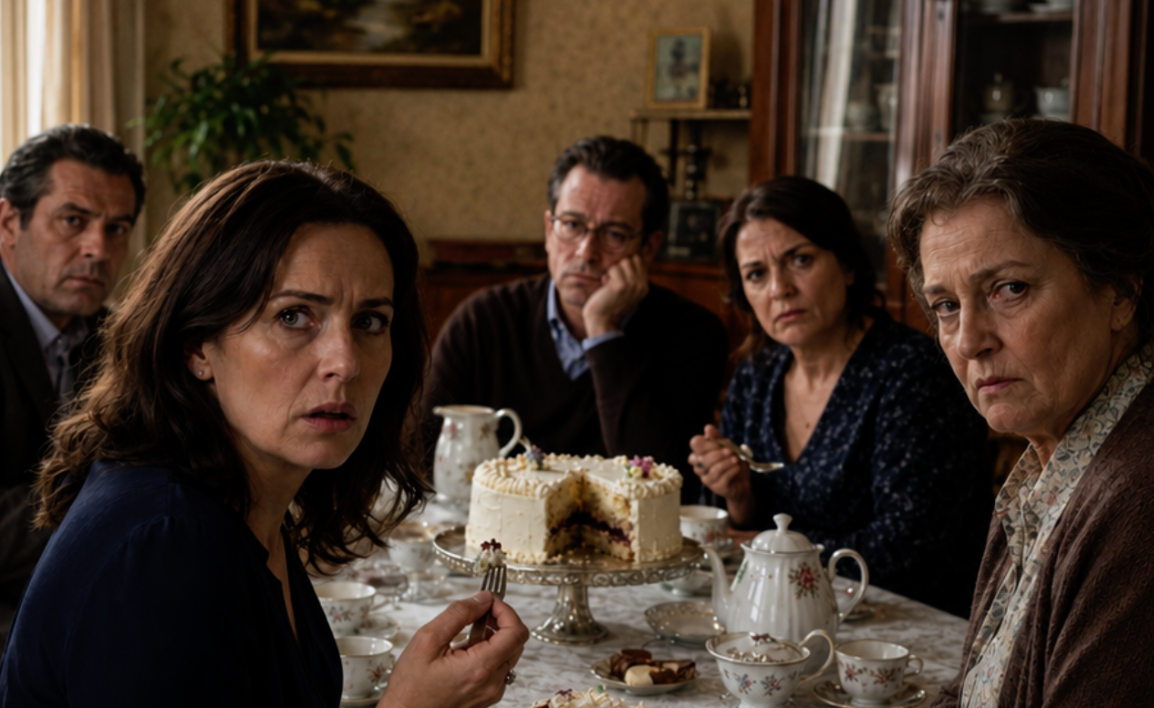
“Mom, don’t eat that cake… I saw Grandma put something in it,” my son whispered softly. The spoon froze in my hand.
“Mom, don’t eat that cake… I saw Grandma put something in it,” my son whispered softly. The spoon froze in my hand.
Dima tugged at the sleeve of the festive blouse I had picked up from the delivery point only yesterday. His fingers were cold and slightly damp with nervousness. Slowly, I lowered my hand. The polished metal clinked against the rim of the Czech crystal bowl. The bowl, filled with Olivier salad, stood in the very center of the table like a symbol of family prosperity. Beside it towered a huge cake decorated with buttercream roses, which Elena Nikolaevna had brought in a large cardboard box tied with string.
The living room was stuffy. It smelled of roasted pork, my mother-in-law’s heavy perfume, and mandarins that Ilya had bought from the neighborhood store during some crazy pre-holiday sale for 140 rubles per kilogram. My husband laughed loudly at yet another joke from his father. My parents sat a little farther away, smiling politely but clearly feeling out of place.
“Snezhanochka, why did you stop?” Elena Nikolaevna’s voice cut through the general noise like the ring of a freshly sharpened knife. “Everyone’s waiting. You know the tradition—the birthday girl has to taste the first piece. I spent three hours at the stove soaking those sponge layers. Especially for your thirty-sixth birthday.”
I looked at my mother-in-law. She sat perfectly straight, her well-groomed hands folded in her lap. A delicate gold bracelet gleamed on her wrist. Behind the lenses of her fashionable glasses, her eyes remained perfectly round, motionless, and attentive.
“Ilya, pass Mom the cake server,” I said quietly, without taking my eyes off Elena Nikolaevna.
Still smiling, my husband reached toward the dessert plate. On a hook near the stove in the kitchen hung a fresh white terry towel with a blue border. I had hung it there myself an hour before the guests arrived. It looked so clean, proper, domestic. Just as proper as this evening I had worked so hard to save from any possible argument.
“Dima, what are you whispering in your mother’s ear over there?” Ilya playfully flicked our son on the nose. “Come on, Snezh, cut the cake. My dad’s already on his third shot without anything hot to eat.”
“Wait, Ilya.” I gently but firmly moved his hand away from the cake. “Dima, repeat what you just told me. Out loud.”
My son shrank into himself, glanced at his grandmother, and shoved his hands into his trouser pockets. The table instantly fell silent. My father stopped chewing. My mother adjusted the collar of her sweater. Elena Nikolaevna didn’t move at all, although her fingers tightened slightly around the fabric of her skirt.
“Dima, I’m waiting,” I repeated, feeling a heavy, cold emptiness beginning to spread inside me. It was the same exhaustion that had been accumulating for the past several years while I tried to be an accommodating daughter-in-law, a good wife, and the perfect homemaker.
“I just… I was thirsty,” the boy stammered, staring at the floor. “I went into the kitchen. Grandma was standing by the sink. She had this little dark bottle in her hands. She dripped something from it right onto the top layer of the cake, where the writing is. Then she hid the bottle.”
Ilya frowned, looking from his son to his mother.
“Mom, what’s this about? Did you put something on the cake?”
“What nonsense,” my mother-in-law said with a short, dry shrug, putting on an expression of genuine bewilderment. “The child simply got confused. I was sprinkling syrup over the sponge so it wouldn’t be dry. Snezhana, are you really going to ruin the celebration because of a child’s imagination? We have guests sitting here, you know.”
Silently, I put down my spoon. The celebration that had cost me two weeks of preparation, late nights at the computer finishing my quarterly report, and seven thousand rubles at the supermarket had finally stopped being an ordinary family evening. We had been living in this two-room apartment for six years. A prefab building on the outskirts of the city, in an ordinary residential district. When we took out the mortgage, Elena Nikolaevna had brought us three hundred thousand rubles in a white envelope.
“This is from your father and me toward the down payment,” she had said grandly, sitting down on our old sofa. “So you won’t have to be ashamed in front of people for going to the bank and borrowing money with nothing to your name.”
Those three hundred thousand became our bondage.
My mother-in-law believed she had purchased a lifetime membership that entitled her to control our lives. She could show up at two in the afternoon on a Wednesday, unlock the door with her own key—Ilya himself had given her a duplicate—and start rearranging the pots in our kitchen cupboards.
“Your frying pans are covered in grease, Snezhana,” she would say, touching the cast-iron bottom with one finger in disgust. “A good homemaker scrubs them with baking soda after every use. And why has your laundry been sitting in the bathroom for three days? Ilya complained to me that he has no clean shirts left.”
I kept quiet.
I swallowed it because I felt indebted to her. My accountant’s salary went toward the monthly mortgage payment and utilities, which climbed past eight thousand rubles in winter. Ilya earned less, his Lada Granta constantly needed repairs, and we were always short of money. Starting a conflict with my mother-in-law meant provoking a heavy, prolonged family scandal involving every relative down to the third cousin.
Food had always been the most dangerous battlefield.
I had been diagnosed with a nut allergy as a child, especially to almonds. One tiny piece, one drop of concentrated extract, and I would develop angioedema. I always carried an epinephrine auto-injector and prednisone in my purse.
Elena Nikolaevna knew this.
But her old Soviet mentality refused to accept what she considered such “urban whims.”
“There were no allergies in our day,” she liked to say at every holiday table. “We ate everything out of the same pot, and nobody suffocated. People invent illnesses out of idleness, and then the husbands go hungry because their wives are too lazy to bake a proper pie with nut filling.”
Three years earlier, at my father-in-law’s anniversary celebration, she had already tried something similar.
She served homemade rolls with tea, insisting they contained nothing but poppy seeds. I took one bite and immediately felt my tongue beginning to go numb. Only my mother’s quick reaction saved me—she immediately pulled the medication from my purse.
Back then, Elena Nikolaevna cried for a long time, lamenting that the poppy-seed filling had been store-bought, already prepared in a jar, and that she simply hadn’t read the fine print on the back.
Ilya had put an arm around his mother’s shoulders and said:
“Snezh, come on. Mom didn’t mean any harm. She just didn’t notice. Stop working yourself up.”
And I gave in.
I forgave her because it was easier for everyone that way.
I didn’t even take away her keys to our apartment.
Before this birthday, I made another mistake.
Because I was insanely overloaded at work, I didn’t have time to prepare the entire table myself. My mother-in-law volunteered to help.
“I’ll do everything myself, Snezhanochka,” she cooed sweetly over the phone three days before the celebration. “You rest and finish your reports. I’ll bake the cake myself—my signature homemade one. Men love my baking. You just buy the groceries.”
I agreed.
I was simply too tired to argue.
I transferred four thousand rubles to her for the ingredients and breathed a sigh of relief that at least one problem had been taken off my shoulders.
I ignored the way she took over my kitchen all morning while I rushed to the hairdresser and left Dima with a friend for a couple of hours. The white terry towel with the blue border that I had hung up clean had already been stained with something yellow and greasy.
I noticed it when I came back.
But I said nothing.
Again. I stood up from the table. My knees felt weak, but my mind was burning with a strange, frightening clarity.
“Snezhana, where are you going?” Ilya tried to grab my arm, but I pulled away. “Where are you going? Let’s just put the cake away if Dima thinks he saw something. We’ve got a box of chocolates.”
“I’ll be right back,” I said in a flat voice that sounded like someone else’s. “I want to bring clean plates.”
The kitchen greeted me with the perfect order Elena Nikolaevna always left behind as a way of emphasizing my own supposed untidiness.
The sink was empty. The stove gleamed. On the windowsill sat an empty egg carton and the wrapper from a 180-ruble block of butter.
Dima quietly came in behind me and closed the wooden door.
“Mom, I really saw it,” he whispered, sniffling. “She was standing right here with her back to the door. She took a little brown bottle out of her bag. She dripped it onto the cake, right where it says ‘Happy Birthday’ in frosting. Then she lowered her hand down there, where the trash bin is.”
I walked over to the sink.
Underneath it, behind a plastic cabinet door, stood a gray trash bin. I bent down.
At the very bottom, beneath potato peelings and onion skins, lay that same white terry towel with the blue border.
For some reason, my mother-in-law had thrown it away, tightly wrapped into a bundle.
I pulled it out.
It was heavy.
Something inside made a muffled clinking sound.
When I unfolded the fabric, a small dark-glass pharmacy bottle dropped into my palm.
The label had been carefully peeled off, but around the neck remained a distinctive, sharp, sickly-sweet smell.
Bitter almonds.
Concentrated confectionery essence.
One drop of that substance was enough to trigger a severe bronchial spasm in me.
My hands weren’t shaking.
My body reacted differently: my ears began to ring, and my temples tightened as though an iron band had been placed around my head.
I looked into the small mirror hanging above the kitchen table.
A pale woman with dark circles beneath her eyes stared back at me.
I barely recognized her.
Who was this woman who tolerated other people’s abuse in her own home, a home she herself was paying for?
“Mom?” Dima looked anxiously into my face.
“Everything’s all right, sweetheart. Go back into the room. Sit with Grandpa.”
I carefully slipped the bottle into my blouse pocket. It was small enough to fit easily—an ordinary ten-milliliter glass vial.
I left the white towel with the blue border on the kitchen table.
It was no longer a symbol of cleanliness.
It was evidence.
When I returned to the living room, Elena Nikolaevna was pouring tea into cups.
She did it with such a calm, peaceful expression that you might have thought nothing had happened.
“There’s our Snezhanochka,” she said sweetly, looking up at me. “Ilya, cut your wife a piece. Enough of these ridiculous scenes. Dima imagined it. The boy must have gotten overheated sitting in front of the television.” I walked up to the table, took the cake server from my husband’s hand, and drove it hard into the middle of the buttercream flower, right where the inscription was.
The frosting parted, exposing the moist, soaked cake layer underneath.
“Snezh, what are you doing?” Ilya jumped up from his chair. “This is too much! Mom worked so hard, and you…”
“Ilya, be quiet.”
I didn’t raise my voice, but my husband suddenly stopped talking and sat back down.
My parents froze.
My father slowly moved his shot glass aside.
I took the dark glass bottle from my pocket and placed it on the tablecloth directly in front of my mother-in-law’s cup.
The glass made a dry, distinct knock against the wooden table through the thin fabric.
“I found this in the trash, Elena Nikolaevna,” I said, looking directly into her eyes. “Wrapped in my towel. Why did you do this?”
My mother-in-law looked at the bottle.
For a second, her face twitched and her lips tightened into a thin line. But she immediately switched to her tried-and-tested survival strategy.
Tears instantly appeared in her eyes.
She pulled a paper tissue from her cardigan pocket and pressed it to the corners of her eyes.
“Dear God, what have I done to deserve this?” she sobbed, looking toward the ceiling. “My whole life, I’ve done everything for them! I drag myself around with the last of my strength, give them my tiny pension, brought them three hundred thousand rubles for the apartment so they wouldn’t have to live in cramped conditions! And now they’re treating me like some criminal! Humiliating me in front of the in-laws! Ilya, look what your wife is doing! She wants to drive me into an early grave!”
“Mom, please don’t cry.” Ilya darted toward her, trying to put his arms around her shoulders. “Snezhana, why are you doing this? It was just a drop of flavoring—what’s the big deal? Mom just wanted it to smell nice! Baking is supposed to have an aroma!”
Feeling her son’s support, my mother-in-law instantly changed from tearful victimhood to a muffled, oppressive attack.
She put away the tissue and looked at me with icy reproach.
“Snezhana, you’re always creating drama out of nothing. I was only trying to do what was best. I’ve spent my whole life doing everything for you, and you see malicious intentions everywhere.” Her voice grew stronger, hard and schoolteacher-like. “Besides, Ilya likes the smell of almonds. I baked this cake primarily for my son! Have you ever thought about your husband? Everything is always about your selfish demands!”
“They’re not demands, Elena Nikolaevna. I have a potentially fatal allergy. And you know that perfectly well.”
“What allergy?” my mother-in-law suddenly leaned forward, and the mask of friendliness finally slipped completely from her face, revealing what had been underneath all these years. “You invented your convenient little illness! I thought you were making up that nut allergy so you’d have an excuse not to eat my food! Ilya likes it! I wanted to prove that nothing would happen to you from one tiny drop of essence! That you’re just putting on an act in front of me, trying to show your authority! You would have eaten the piece, and nothing would have happened! Stop acting like some spoiled lady!”
The room became so silent that we could hear the cheap wall clock ticking in the hallway.
My father slowly rose from his chair. His face had turned dark red.
“All right,” he said, looking at my father-in-law. “I think we’ll go. Masha, gather your things. Dima, come to Grandpa.”
“Dad, wait.”
I turned to my parents.
“Don’t leave. This is my home. And my birthday.”
I looked at Ilya.
My husband was sitting with his head drawn down between his shoulders.
He wasn’t looking at me.
He was staring at the buttercream roses on the ruined cake.
Once again, he had chosen not to get involved.
Once again, he had chosen the side of his mother, who had just admitted that she had deliberately tried to poison me to test her stupid theory.
“Elena Nikolaevna.”
I walked to the living-room door and opened it wide.
“Get out of my apartment. And take your cake with you.”
My mother-in-law gasped with indignation.
She tried to cry again, but the tears wouldn’t come this time.
She looked at her son, expecting him to defend her, but Ilya remained silent, staring at the tablecloth.
“Fine!” she spat, standing up and grabbing her handbag. “Ilya, you stay with this lunatic if you have no pride! We’ll see how you manage without my help! Tomorrow I’m going straight to the government services center and demanding my share of this apartment back for those three hundred thousand! You’ll end up with nothing!”
She stormed into the hallway, the heels of the house slippers she always kept at our place clattering loudly against the floor.
My father-in-law, who had remained silent all evening, quietly stood up, nodded to my father, and followed his wife.
A minute later, the front door slammed shut. The guests left remarkably quickly, in awkward, heavy silence.
My parents went home, taking Dima with them for the weekend.
Before leaving, my mother hugged me tightly around the shoulders and whispered:
“Stay strong, sweetheart. If anything happens, call us immediately.”
The apartment became empty and strangely spacious.
The ruined cake sat forlornly on the table.
The smell of almonds now seemed suffocating, chemical, poisonous.
Ilya sat on the sofa in the living room, staring at the television screen, where scenes from some old entertainment show flickered with the sound turned off.
His face held an expression of deep, childish resentment.
“Why did you have to treat my mother like that?” he asked quietly without turning his head when I came in to collect the dirty dishes. “We could have resolved everything without humiliating her like that. So she made a mistake. She’s old. She said something stupid. Now her blood pressure will shoot up, and I’ll have to bring her medicine.”
I stopped beside the table, holding the crystal salad bowl in my hands.
“She didn’t make a mistake, Ilya. She did it deliberately. She wanted to prove that I was lying. She didn’t care that I could die right in front of our son.”
“You wouldn’t have died,” he muttered, changing channels. “You always make everything complicated. You turned a tiny thing into a huge problem and ruined the celebration for everyone.”
I didn’t answer.
I realized there was nothing left to argue about.
It was that strange feeling when there is no anger or hurt left inside you—only a light, transparent emptiness.
I simply carried the dishes to the sink.
I didn’t have the strength to wash them that night.
I went into the bedroom, took my things out of the wardrobe, and moved them into the small children’s room.
Dima was staying with his grandparents that night anyway.
Ilya watched me from the hallway with genuine, foolish confusion in his eyes.
“Snezh, are you serious? You’re moving into another room because of a cake? Come on, stop this nonsense and sleep in the bedroom.”
“I’ll sleep here,” I said.
I went into the children’s room and closed the door behind me.
My hand automatically reached for the small latch.
There was a soft metallic click.
The door that I had always left open all these years so that I could hear every sound in the house was now locked from the inside.
It wasn’t an act of rage.
It wasn’t an attempt to punish my husband.
It was simply a boundary.
My own personal boundary—the first one I had established in many years—and I was no longer going to let anyone cross it.
I lay down on Dima’s narrow bed, pulled the blanket over myself, and stared into the darkness.
From the kitchen, the sickly-sweet smell of almond essence still faintly lingered.
Tomorrow morning, the first thing I would do was throw that cake into the trash container in the courtyard, submit a request through the government services portal to have the locks changed, and start looking for a lawyer to deal with the division of our mortgaged two-room apartment.
But for now, the room was filled with an unfamiliar, dense silence.
And for the first time in a very long while, I wasn’t afraid of that emptiness.