My Mother-in-Law Gave My House to Her Daughter. She Didn’t Know That the Address in the Documents Was Completely Different
“Artyom Gennadyevich, have some salad, don’t be shy,” Galina Timofeyevna said, pushing the crystal salad bowl closer to the guest. “I made the Olivier salad myself this morning, the way we like it in our family.”
“Thank you, Galina Timofeyevna,” the notary replied with a nod, carefully tucking his napkin into place.
Larisa sat at the edge of the table. Igor, her husband, was staring at the television, where the news played silently. Veronika, her sister-in-law, sat opposite them, nervously adjusting her hair.
“It is a celebration, after all,” the mother-in-law said, looking around the room. “It’s Veronika’s birthday. Thirty-nine years old. A grown woman.”
“Mom, please don’t start,” Veronika said, lowering her eyes.
“What do you mean, don’t start?” her mother’s voice grew louder. “You don’t even have a place of your own, just a rented apartment in some residential district.”
“And the utility bills there are outrageous,” Igor added without taking his eyes off the screen.
“Exactly!” his mother exclaimed triumphantly, raising a finger.
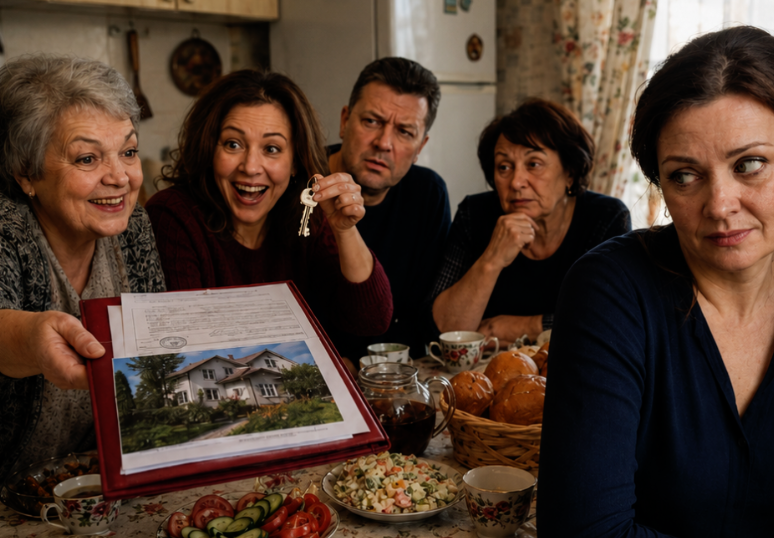
Larisa looked at the table. Between a platter of sliced meats and a pitcher stood a red plastic folder. An ordinary office folder. Every now and then, Galina Timofeyevna patted it with her palm.
“We’re family,” her mother-in-law said, looking at Larisa. “We should help one another.”
“Of course,” Larisa replied evenly.
She knew that tone. It was the tone Galina Timofeyevna usually used when giving orders.
“I worked at the Bureau of Technical Inventory my entire life,” her mother-in-law said, turning toward the notary. “I know every document in this city. Every letter of the law.”
“The law changes, Galina Timofeyevna,” Artyom Gennadyevich gently pointed out.
“Order doesn’t change,” she snapped. “There is only one proper order. The elders decide, and the younger ones listen.”
She patted the red folder again.
“Veronika has been completely alone since the divorce,” the mother-in-law continued as she poured fruit drink. “Her child support is practically nothing. What arrives on her Mir card is enough to make you cry.”
“Three thousand,” Veronika said quietly.
“There!” her mother exclaimed, slapping the table with her palm. “And she has to live somewhere. She can’t spend her entire life moving from one rental to another.”
Larisa picked up a napkin and wiped her fingers.
“Veronika has a good job,” Larisa said calmly. “She’s an administrator.”
“You call that a job?” her mother-in-law snorted. “You’re a cadastral engineer. You have stability. You own property.”
“Yes.” Larisa looked straight into her eyes. “I am the owner.”
Galina Timofeyevna smiled. It was a wide smile, but it didn’t reach her eyes.
“Family should share, Larisochka.”
The red folder lay on the table. Larisa stared at it and felt a familiar cold spring tightening inside her.
She had seen that folder a week earlier.
In her own hallway.
The Accumulation of Other People’s Keys
“Give me a spare set,” Galina Timofeyevna had said a month earlier while standing in Larisa’s hallway.
“What for?” Larisa asked, holding her bag and already late for work.
“The pipes in that settlement leak all the time,” her mother-in-law replied quickly and confidently. “Emergency services never come. And your house there just stands empty.”
“Everything is shut off.”
“What if a pipe bursts?” Galina Timofeyevna folded her arms across her chest. “I’ll just keep an eye on the place. I’ll check it once a week.”
Larisa was exhausted that day. She was working on a complicated project, preparing documents for submission to Rosreestr, and she hadn’t been sleeping enough.
“Here,” she said, taking a set of keys from the hook.
“That’s my smart girl,” her mother-in-law said, instantly sweeping the keys into her pocket.
It had been a mistake.
Larisa knew it the moment she did it.
But she hadn’t had the strength to argue. She had handed over the keys to her country house simply to buy herself a little peace and quiet.
A week later, the phone calls began.
“Larisa, why has the polycarbonate roof in the greenhouse collapsed?” her mother-in-law demanded over the phone.
“Snow piled up on it during winter.”
“Then you should have cleared it!” Galina Timofeyevna said indignantly. “I hired the neighbor and transferred five hundred rubles to her by phone number. She cleaned up the mess.”
“I didn’t ask you to.”
“And who is supposed to ask me? I’m the mother. I take care of the family.”
Then there was the issue with the bills.
“I took the waste collection bill out of the mailbox,” her mother-in-law announced when she arrived without an invitation. “There’s a debt. Three hundred rubles a month.”
“I pay through the app,” Larisa replied, trying to keep her breathing steady. “Once every three months.”
“You should pay every month!” Galina Timofeyevna put the bill on the table. “I paid it myself. The line at the MFC was insane, but I stood there and waited.”
“Why did you go to the MFC over a garbage bill?”
“So everything would be in order!”
Larisa had remained silent then.
Igor sat in the kitchen reading the news.
“Mom, don’t you have anything better to do?” he muttered.
“I have plenty to do!” Galina Timofeyevna turned toward her son. “Your house is rotting away without anyone living there, Larisa. A house needs to breathe, and you spend all your time at work. Land should serve the family, not sit there covered in weeds.”
Surprisingly, that statement sounded almost reasonable.
Larisa really did visit the property rarely.
Three years earlier, she had inherited it after her father’s death. The house was sturdy, and the plot was large—ten sotkas of land.
“I’ll go there in the summer,” Larisa said.
“In the summer!” her mother-in-law exclaimed, throwing up her hands. “By summer it’ll be too late. Veronika and I will go there this weekend. We’ll open the place for the season.”
“It’s my house, Galina Timofeyevna.”
“We’re family.” Her mother-in-law smiled.
Again, the smile was empty.
“No one is taking your house away from you. We’ll just dust the place.”
Larisa didn’t go to check on them.
Another mistake.
Two weeks earlier, Veronika had called her in the evening.
“Larisa, where do you keep the bed linen there?” her sister-in-law asked, sounding slightly guilty.
“What bed linen?”
“In the bedroom. Mom and I came out here. It’s cold, so we turned on the heater.”
“It’s in the dresser,” Larisa replied, feeling cold spread through her body.
“Thanks. Mom is sorting through the things in the wardrobe.”
“What things?”
“Your father’s.”
Larisa ended the call.
She got dressed in five minutes, called a taxi, and drove out of town. The taxi cost six hundred rubles.
When she opened the door with her own key, Galina Timofeyevna was standing in the middle of the room holding a garbage bag.
“What are you doing?” Larisa asked.
She didn’t shout. Her voice was quiet.
“Throwing away junk,” her mother-in-law replied without so much as flinching. “You can barely breathe in here.”
“Those are my father’s things.”
“He’s dead, Larisa. The living need space.”
“Put the bag down.”
Galina Timofeyevna looked at her.
Her gaze was assessing.
Cold.
“You’re selfish, Larisa.”
“Put the bag down.”
Her mother-in-law dropped the black plastic bag onto the floor.
“Veronika doesn’t have a place of her own or even a decent husband,” Galina Timofeyevna suddenly said quietly. “I’m her mother. I have to make sure my daughter has something while I’m still alive. You have it easy—you have a profession. She has to wander from one rented apartment to another.”
There was genuine, heavy pain in those words.
The pain of an aging mother worried about her troubled daughter.
Larisa heard it.
And because she heard it, she didn’t throw them out that evening.
She allowed them to spend the night.
Larisa returned to the city on the morning commuter train.
That was her third mistake.
The Paper Trail
Several days passed.
Larisa came home from work earlier than usual.
The hallway smelled of someone else’s perfume.
“Igor?” she called.
Silence.
Her husband was at work.
Larisa walked into the kitchen.
A red plastic folder lay on the table.
She had never seen it in her apartment before. The folder was thick and tied with white strings—the type commonly used in old archives.
Larisa stepped closer.
The strings had been untied.
Inside was an old technical passport from the Bureau of Technical Inventory.
Her passport.
The same one her father had obtained back in the 1990s.
“Where did this come from?” Larisa said aloud to the empty apartment.
She began going through the papers.
An extract from the house register.
A copy of her father’s death certificate.
An old cadastral plan drawn by hand.
All of those documents had been stored in the bottom drawer of the desk in her study.
The lock on the front door clicked.
Larisa didn’t move away from the table.
Galina Timofeyevna entered the kitchen carrying a bag from Pyaterochka.
“Oh.”
Her mother-in-law froze.
“You’re home early.”
“What is this?” Larisa asked, pointing toward the folder.
“Documents,” Galina Timofeyevna replied, quickly putting the shopping bag on a chair. “I was making sure everything was in order.”
“You went through my desk?”
“I was looking for the electricity bills!” her mother-in-law immediately went on the offensive. “It’s impossible to find anything in your house!”
“Give me the keys to the apartment.”
“Larisa, you’re forgetting yourself.”
“The keys.”
Galina Timofeyevna pursed her lips.
Slowly, she took the keyring from her purse and threw it onto the table.
The metal clinked against the plastic red folder.
“I was only trying to help,” her mother-in-law hissed through clenched teeth.
Then she turned around and left.
The front door slammed shut.
Larisa remained standing over the folder.
She gathered the old documents and returned them to the drawer.
Her mother-in-law had left the red folder behind.
That evening, Larisa opened her work laptop.
As a cadastral engineer, she had access to the relevant databases. She entered the old cadastral number from the documents that had been lying on the table.
The system displayed:
Property removed from the register. Boundaries annulled.
Larisa exhaled.
Three years earlier, she herself had carried out the land surveying process.
She had changed the boundaries of the plot by combining it with a neighboring abandoned piece of land that she had purchased from the local administration.
The old address, “Plot 42,” had ceased to exist.
A new one had appeared:
7 Lesnaya Street.
The old BTI documents had become nothing more than waste paper.
Larisa closed her laptop.
She didn’t know why Galina Timofeyevna had needed the old technical passport.
But she did know one thing.
Her mother-in-law never did anything without a reason.
“Mom called,” Igor said over dinner. “She’s upset. She says you threw her out.”
“She was going through my documents.”
“Well, she’s an old woman. She worries about inheritance.”
“It isn’t her inheritance.”
“We’re family,” her husband sighed.
His mother’s words coming out of her son’s mouth.
Larisa silently washed a plate.
The sponge squeaked against the porcelain.
She remembered how Galina Timofeyevna had always boasted about her connections at Rosreestr.
“I can get any document arranged through my old friends, without any of those government service websites,” she liked to say.
Larisa dried her hands on a towel.
Then she looked at the empty red folder that she still hadn’t thrown away. And now that same red folder was lying on the festive table.
Between the Olivier salad and the cold cuts.
“Veronika,” Galina Timofeyevna said as she stood up.
She raised a glass of fruit drink.
“You’ve suffered so much. But your mother isn’t going to leave you with nothing.”
Silence fell over the table.
Igor stopped chewing.
Artyom Gennadyevich, the notary, politely put down his fork.
“I thought about this for a long time,” the mother-in-law continued, her voice trembling with solemnity. “A family must stay together. And property should serve the person who needs it most.”
She placed her hand on the red folder.
“Today, I’m giving you a house.”
Veronika gasped.
She covered her mouth with her hand.
“Mom… Are you serious?”
“Absolutely.”
Her mother untied the white strings.
“Here are the documents. The deed of gift.”
She removed a thick white sheet of paper and handed it to her daughter.
Larisa remained motionless.
Inside her, everything was completely silent.
“But how?” Igor muttered. “That’s Larisa’s house.”
“It belongs to our family!” Galina Timofeyevna snapped. “I arranged everything through my old connections. I still have contacts at the BTI and the registration office. I was the one who originally registered that plot myself! I have the right!”
“You’re not the owner, Mom,” Igor said quietly.
“I’m the mother! And I know how the law works!” her mother-in-law exclaimed, looking triumphantly at Larisa. “You’ll have to forgive me, Larisochka. But you don’t need that house. And this girl has nowhere to live.”
With trembling hands, Veronika took the paper.
There were tears in her eyes.
“My mother-in-law gave my house to her daughter,” Larisa said evenly, almost syllable by syllable.
“I did,” Galina Timofeyevna replied proudly, lifting her chin.
“May I see it?” Larisa held out her hand.
Veronika looked uncertainly at her mother.
“Give it to her,” Galina Timofeyevna allowed. “Let her see for herself. Everything is official. There’s even a stamp.”
Larisa took the document.
It really was a deed of gift.
Printed on a good-quality printer.
Under Donor was the name:
Galina Timofeyevna Osipova.
Under Recipient:
Veronika Andreyevna Osipova.
Larisa lowered her gaze.
She reached the section titled Subject of the Agreement.
She read in complete silence.
Only the television continued playing with the sound turned off.
“The cadastral number listed here is 50:12:0000000:42,” Larisa said, raising her eyes. “And the address is Plot Forty-Two.”
“That’s correct,” her mother-in-law said with a nod.
“She didn’t know that the address in the documents was completely different,” Larisa said.
But she wasn’t speaking to her mother-in-law.
She was speaking to the notary.
Artyom Gennadyevich narrowed his eyes.
“May I?”
He gently took the paper from Larisa’s hands.
He quickly read through the document, then removed a pair of glasses from the inside pocket of his jacket and put them on.
“Galina Timofeyevna,” the notary said in a dry, professional tone, “which document did you use when preparing this agreement?”
“The technical passport! The real one, with a blue stamp!”
“That cadastral number was annulled three years ago,” Larisa said, looking directly at her mother-in-law. “The house and land underwent a procedure to merge the plots and clarify the boundaries. The address is now 7 Lesnaya Street. A different number. Different coordinates.”
Galina Timofeyevna froze.
Her confident smile slowly disappeared from her face.
The scheme had failed at the very first step.
Her confidence was replaced by confusion.
“What nonsense are you talking about?” she blurted out.
“You executed a gift agreement for a property that doesn’t exist,” the notary said, putting the document on the table. “Legally, this agreement is nothing more than a piece of paper. You cannot give away something that does not exist in the registry. And more importantly, you cannot give away property that does not belong to you.”
“But I arranged everything!” Galina Timofeyevna’s voice cracked. “Ninochka from the archive confirmed everything for me!”
“Ninochka from the archive checked an old database that hasn’t been updated since the 2000s,” Larisa said as she stood up from the table. “She gave you an extract for a phantom property.”
Veronika looked from her mother to the document.
“Mom?” she asked quietly. “You were trying to give me someone else’s house using fake documents?”
“They’re not fake!” Galina Timofeyevna shouted. “There’s a stamp!”
She grabbed the agreement.
Her hands were trembling.
She reread the lines as though she could make them become real through sheer force of will.
Her confusion turned into silence.
Galina Timofeyevna said nothing.
She stared at the red folder as though it had betrayed her.
“Why did you do this?” Igor asked.
He looked as though someone had struck him.
“Because she’s an outsider!” his mother finally said, looking up at Larisa.
There was no anger in her eyes.
Only the desperation of someone who had lost control.
“She’s an outsider, while you are mine. I wanted us to have something of our own.”
“You already have something of your own,” Larisa replied. “Your apartment.”
She walked over to the chair and picked up her handbag.
“The celebration is over,” Larisa said, turning toward Igor. “Are you coming?”
Igor remained seated, clutching the edge of the table with both hands.
He looked at his mother.
Then at his wife.
“I’ll come later,” he said dully.
Larisa nodded.
That was an answer too.
“Larisa, wait,” Artyom Gennadyevich said, standing up as well. “I’ll give you a ride. I’m going in the same direction.” The drive back to the city took an hour.
Artyom Gennadyevich drove carefully, without turning on the radio.
“I came there simply as an acquaintance,” he suddenly said. “And somehow ended up in the middle of a bad play.”
“I’m sorry,” Larisa said, staring through the dark window.
“You have nothing to apologize for. You handled yourself impeccably.”
Larisa didn’t answer.
Impeccably?
She had allowed her mother-in-law to take the keys.
Allowed her to rummage through her papers.
Allowed her to believe that Larisa’s silence meant weakness.
Larisa entered her empty apartment.
She didn’t turn on the lights.
The hallway was quiet.
The television wasn’t humming.
The floorboards weren’t creaking beneath Igor’s heavy footsteps.
Larisa walked into the kitchen.
The table was clean.
She opened the Gosuslugi app on her phone and requested a fresh extract from the Unified State Register of Real Estate.
Ten minutes later, a PDF arrived.
She opened it.
Owner: Barysheva Larisa Nikolayevna.
Restrictions: None registered.
Her name.
Only hers.
Larisa placed the phone on the table.
On the exact spot where someone else’s red folder had once been.
Now the space was empty.
And for the first time in a long while, that emptiness felt right.
Would she ever be able to trust people who called themselves family again?