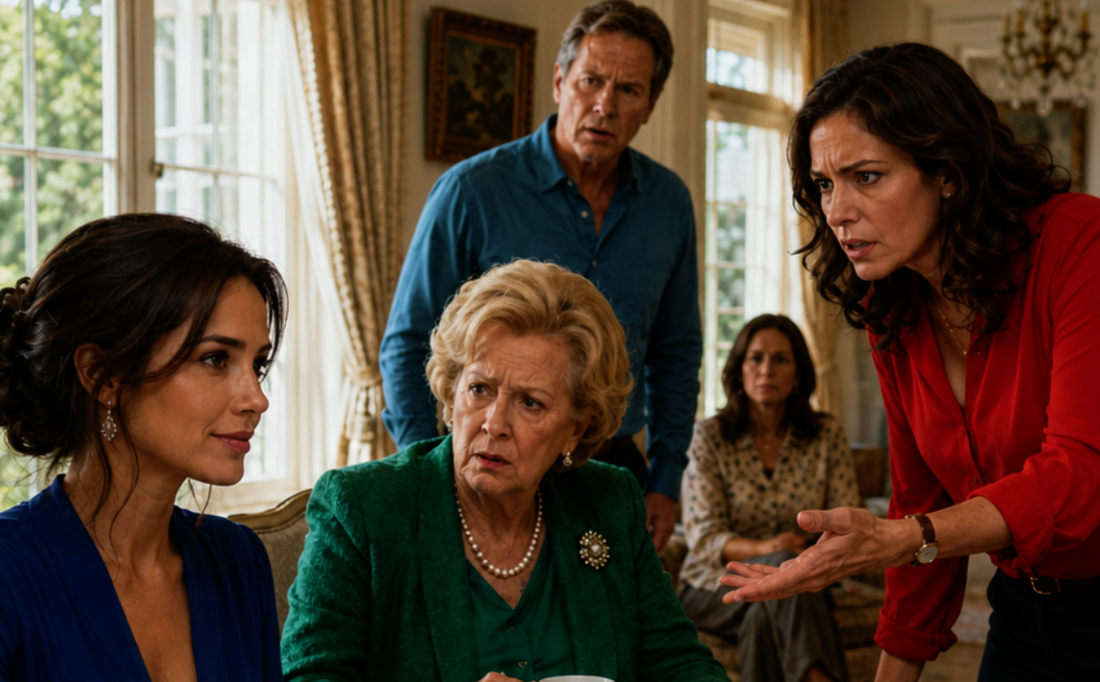
“Give Mom Everything Back — the Debts Are Written Down,” My Sister-in-Law Announced in Front of Everyone. But I Opened the First Page.
“Now then, my dear relatives, let’s talk about something that’s been bothering me. About conscience,” Larisa’s ringing voice, trembling slightly with theatrical emotion, cut through the cozy hum of the family gathering.
She sharply pushed away the unfinished piece of apple charlotte in front of her and stood up. The chair scraped against the old parquet floor, polished carefully with wax. A painful silence fell over my mother-in-law’s small but surprisingly bright apartment.
I calmly set down my dessert spoon. At fifty-five, I had long since learned not to react to my sister-in-law’s theatrical outbursts. As the manager of a large pharmaceutical warehouse, I dealt with dozens of conflicts every day and had seen people panic, become exhausted, and lose their composure. My nerves had developed a healthy layer of armor long ago.
But now, looking at Larisa’s crimson face, I felt a vague uneasiness.
“What are you starting now, Lara?” my husband asked hoarsely.
Pavel was a large, solid man with the hardworking hands of an elevator repair mechanic. Instinctively, he shifted closer to me, as though shielding me with his shoulder. His fingers tightened tensely around the edge of the tablecloth.
“Oh no, Pasha, I’m not starting anything. I’m ending this circus!” Larisa’s eyes flashed triumphantly as she shoved a hand into her oversized designer handbag, which she had not even bothered to leave in the hallway.
She pulled out a notebook.
It was old, with a blue imitation-leather cover, the kind sold at newsstands forty years ago.
Tamara Sergeyevna, the hostess of the apartment, sat at the head of the table in her severe woolen dress. Suddenly, she turned pale. Her thin hands, covered with age spots, began to tremble.
“Larisa, put that back,” the seventy-nine-year-old woman said quietly, but her voice carried the same metallic note once remembered by the patrons of the district library where Tamara Sergeyevna had worked her entire life. “Were you going through my dresser?”
“I was looking for the blood pressure monitor, Mom!” her daughter shot back without the slightest embarrassment. “And I found this. Proof of how everyone here has been deceived!”
The room suddenly felt stuffy. Outside, a fine autumn rain tapped against the metal window ledge, and that monotonous sound now seemed deafening.
At the corner of the table, Vera Sergeyevna, the hostess’s younger sister who had come from the countryside, pursed her lips disapprovingly. Larisa herself had insisted that she attend, promising an “important family meeting.”
The aunt was a straightforward woman who could not tolerate intrigue. She narrowed her eyes at her niece.
Beside her sat Larisa’s thirty-year-old son, Alexei, a calm and decent young man. Irritated, he rubbed the bridge of his nose, already anticipating yet another scandal caused by his mother.
“Take a look, Aunt Vera! Lyosha!” Larisa waved the notebook over the table. “All this time, we’ve been thinking our Galya is some kind of saint. Completely selfless! Fluttering around her mother-in-law, taking care of her. But apparently our little saint has been taking money from Mom for years!”
“Larisa, shut up immediately,” Pavel said, trying to rise, but I gently placed a hand on his knee to stop him.
“Give Mom everything back! The debts are all written down!” my sister-in-law announced dramatically in front of everyone and slammed the notebook onto the table. “I demand that this so-called ‘debt’ be repaid. What did you think? That Mom was so senile she wouldn’t record anything? She wrote it all down! We’ll simply deduct these amounts from your and Pasha’s share of the inheritance. Mom’s apartment has been left equally to you two anyway. So now we’ll calculate everything!”
She opened the notebook somewhere in the middle and began reading, pronouncing every word sharply.
“‘March seventeenth. Galya — large amount.’ ‘April fifth. Galya — repairs.’ ‘August twelfth. Galya — sanatorium.’”
Larisa looked triumphantly around at the relatives.
“And your name is everywhere, Galya! Along with the amounts. Hundreds of thousands of rubles over all these years! Mom recorded how much you borrowed from her! Have you completely lost your conscience? Robbing your own elderly mother-in-law, a pensioner, while she’s sick?”
I remained silent.
Everything inside me tightened, but not from shame. It was from a piercing, painful pity.
I looked at Tamara Sergeyevna, whose eyes were now filling with helpless tears.
I remembered those expenses perfectly.
That month, the medications prescribed by her cardiologist could not be obtained through the subsidized prescription program because there were supply problems at the clinic. I found them at a pharmacy and paid for them myself because treatment could not be postponed. With an elderly heart, every missed day could be dangerous.
The refrigerator really had broken down in April. It leaked and ruined half the food inside. I called the repairman myself and paid to have the compressor replaced while my husband was at work.
And the sanatorium…
After pneumonia, Tamara Sergeyevna had struggled to breathe. She needed fresh pine air. I managed to obtain a subsidized voucher through the trade union, but I paid a considerable part of the remaining cost out of my own savings.
And every time my mother-in-law tried to push crumpled banknotes from her pension into my hand, I gently but firmly pushed them back.
“Tamara Sergeyevna, you’re insulting me. We’re family. Buy yourself some fruit instead.”
I had never reported any of this to Larisa.
And now my sister-in-law had turned my care upside down, trying to portray me as a thief.
“Well?” Larisa sneered venomously, staring at me. “Nothing to say?”
“You’re reading from the middle, Larisa,” I said calmly, without raising my voice. “I’ll open the first page.”
I reached across the table, took the blue notebook from under my stunned sister-in-law’s hands, flipped all the way to the beginning, and held up the yellowed sheet so everyone could see the words written there.
“Tamara Sergeyevna, please read it yourself,” I gently asked my mother-in-law.
The elderly woman put on her glasses.
Her voice trembled, but with each word it regained the strength of the librarian she had once been.
She read the single sentence written on the page:
“Debts I will no longer be able to repay.”
Vera Sergeyevna gasped.
Pavel lowered his head and swallowed heavily.
“What?” Larisa blinked in confusion, her triumphant smile beginning to disappear. “What debts?”
“Two years ago, after my minor stroke, I started forgetting things,” Tamara Sergeyevna said, removing her glasses as tears rolled down her wrinkled cheeks. “At first, little things. Where I put my keys. Whether I had turned off the stove. Then I became frightened, Lara. Terrified, with that animal fear of old age. I was afraid that one day my mind would fade and I would forget who had been beside me during my darkest days. I would forget whose hands lifted me out of bed.”
She looked at me.
There was so much boundless gratitude in her gaze that my own breath caught.
“I wasn’t giving money to Galya,” my mother-in-law continued, her voice growing stronger. “Galya was paying for me. I was writing down everything I owed her. She bought expensive medicine for me when I couldn’t get it by prescription. She brought groceries. She paid for repairs. I tried to reimburse her, but she refused. So I started this notebook.”
She placed a trembling hand on the blue cover.
“I wrote down every time she helped me. Not because I wanted the debt deducted from the inheritance. I wrote it so that if my mind ever failed me, I could open this notebook and read who had truly supported me.”
Her eyes hardened as she looked at Larisa.
“This is my memory, Larisa. My confession. And you dragged it through the mud.”
The room became so quiet that the ticking of the old wall clock could be heard.
I quickly wiped away a tear as my husband squeezed my hand tightly beneath the table.
Vera Sergeyevna exhaled loudly.
“Oh, Larisa…” She shook her head. “What a fool you are. Imagine using that against her! You should be on your knees thanking your mother that her daughter-in-law takes care of her while you live however you please!”
Red blotches appeared across Larisa’s face.
Her perfect hairstyle suddenly looked ridiculous, and the expensive perfume around her seemed suffocating.
But she was not accustomed to giving up.
“Oh, come on!” she shrieked, immediately switching back to attack. “That’s all sentimental nonsense! Pasha and I are her actual children! And I help Mom too, by the way! I arranged her pension card! I do her shopping! You wouldn’t manage anything without me!”
That was when Pavel finally lost patience.
He slowly rose.
In his work, he often dealt with worn, rotting elevator cables and knew one thing very well: if a cable begins to tear, sometimes you have to cut it before everything collapses.
“You help her, you say?” my husband asked in a deceptively quiet voice. “Mom gave you her bank card so you could pay her utilities because it’s difficult for her to walk to the bank. And so you could order groceries. Right?”
“Right!” my sister-in-law snapped defiantly.
Tamara Sergeyevna suddenly straightened.
The sorrow on her face was replaced by bitter determination.
She pushed the blue notebook aside and opened a drawer in the table.
“Since today appears to be accounting day,” she said icily, “let’s finish the calculations.”
She pulled out a thick white envelope bearing the bank’s logo.
“Last Tuesday, I asked Pasha to take me to the branch. I wanted to check my savings for my funeral and your father’s headstone, so you wouldn’t have to spend money later. The bank employee printed a statement for me.”
Larisa seemed to collapse inward.
Her eyes widened, and her hands clutched the strap of her handbag.
“Mom, don’t…” she muttered in a changed voice. “This is family business. Why do this in front of everyone?”
“In front of everyone!” Vera Sergeyevna cut in, slamming her dry palm against the table. “You started this trial yourself, so now you answer for it! Read it, Toma!”
Tamara Sergeyevna removed several sheets from the envelope.
“All right. My pension and my funeral savings,” she began, running a finger along the lines. “April. Purchase at a cosmetics store — fourteen thousand rubles. Larisa, sweetheart, perhaps you can explain why an old woman with arthritis needs expensive serum and French perfume?”
Larisa remained silent, shrinking into herself.
“May,” her mother continued mercilessly. “Beauty salon. Hair coloring, spa treatment. Almost ten thousand. I barely left the apartment except to go to the clinic, and Galya trims my nails with ordinary clippers.”
She moved her finger lower.
“July. Travel agency. Almost my entire monthly pension. Was that one of those ‘essential medications’ you told me about? A weekend trip?”
“Mom, that was my money!” Larisa screamed hysterically. “I just… I didn’t deposit my cash onto my own card, so I paid with yours! I was going to repay it!”
“You were planning to repay it for six months?” Pavel looked at his sister with disgust. “You took tens of thousands from our mother’s card, Lara. You lived at the expense of a pensioner who saves money on cottage cheese. And now you have the nerve to accuse my wife?”
Alexei, who had remained pale and silent until then, suddenly leaned forward.
“Wait, Grandma,” the young man said, his voice trembling. “Look at September. Just before the cold weather. Is there a transfer to an auto parts store?”
Tamara Sergeyevna scanned the lines.
“Yes, Lyoshenka. September eighth. Tires. Thirty-one thousand.”
Alexei slowly turned toward his mother.
There was such contempt in his eyes that Larisa shrank even further.
“You told me those tires were your birthday present to me,” he said quietly, articulating every word. “You said, ‘Son, I saved up my bonus so you could drive safely.’”
His face hardened.
“You bought them with Grandma’s funeral money?”
“Lyosha, sweetheart, what difference does it make?” Larisa fussed, reaching for her son’s hand. “It’s all family money! Grandma would have given it to you anyway! It’s inheritance. It belongs to us eventually!”
Alexei pulled his hand away in disgust.
He took out his smartphone, opened his banking app, and typed quickly for several seconds.
In the silent room, Tamara Sergeyevna’s phone made a short notification sound.
“I transferred thirty-five thousand to you, Grandma. With interest,” Alexei said as he stood up from the table. “Forgive me. I didn’t know.”
He looked down at his mother.
“I’m ashamed of you, Mom.”
“Lyosha! Where are you going?!” Larisa shouted as he turned and walked into the hallway.
The front door slammed shut.
Larisa was left alone beneath the crossfire of everyone’s condemning stares.
Her plan to publicly humiliate me had turned into a catastrophe.
She had wanted to portray me as a calculating bitch so she could justify her own stealing and secure her claim to the apartment.
Instead, she had trapped herself.
Vera Sergeyevna slowly stood, supporting herself with both hands on the table.
“You know something, niece?” she said heavily. “Our family has lived through poverty and hard times. But we never had rats.”
She stared at Larisa.
“You didn’t just steal your mother’s money. You stole her peace of mind. Get out of here.”
“This is my apartment too! Half of it is mine!” Larisa shrieked, clinging to her final argument.
“As long as I’m alive, this is my apartment,” Tamara Sergeyevna said, and her voice sounded like a verdict.
She placed the bank card on the table and covered it with her palm.
“Tomorrow, I am going to the notary. I will rewrite my will. The apartment will go to Pasha and Alexei.”
Larisa froze.
“You, Larisa, have already received your inheritance. And I am blocking this card today.”
Larisa gasped.
She grabbed her handbag, nearly knocking over a cup of cold tea.
“You’ll regret this! All of you!” she hissed. “You’ve all turned against me! Fine. We’ll see!”
“Get out!” Pavel roared so loudly that the dishes in the cabinet rattled.
He stepped toward his sister.
Larisa squeaked in fright and rushed into the hallway like a bullet.
A deafening silence hung over the room, broken only by the sound of rain.
Tamara Sergeyevna sank heavily into her chair.
The artificial strength left her body, leaving behind only the immense exhaustion of an elderly person who had been betrayed.
She covered her face with her hands, and a muffled, painful sob escaped through her thin fingers.
I was beside her instantly.
I wrapped my arms around my mother-in-law’s thin, trembling shoulders and pulled her close.
“There, there, my dear,” I murmured softly. “It’s over now. We’re here. Pasha’s here. I’m here.”
I looked up at my husband.
“Pasha, bring the blood pressure monitor. Tamara Sergeyevna, breathe calmly. We’ll check your pressure and give you the medicine your doctor prescribed. No sudden movements.”
Pavel, his eyebrows drawn together grimly, hurried into the other room to fetch the device.
Vera Sergeyevna sighed heavily and wiped her eyes with the corner of the tablecloth.
“You’re a golden woman, Galya,” she murmured. “Forgive us old fools.”
When Tamara Sergeyevna had calmed down a little and the monitor showed acceptable readings, I carefully picked up the blue notebook from the table.
I closed it and gently placed my hand over the old imitation-leather cover.
“You don’t owe me anything, Tamara Sergeyevna,” I said firmly, looking directly into her eyes. “Just don’t give your bank card to anyone again.”
Then I pushed the notebook toward her.
“And keep this. Not because of the debts. Keep it for the memories.”
Pavel silently turned on the kettle.
Vera Sergeyevna began slicing the now-cold apple charlotte.
And Tamara Sergeyevna pulled the blue notebook closer to herself.
Now she knew for certain that the most important part of her memory would never be lost.