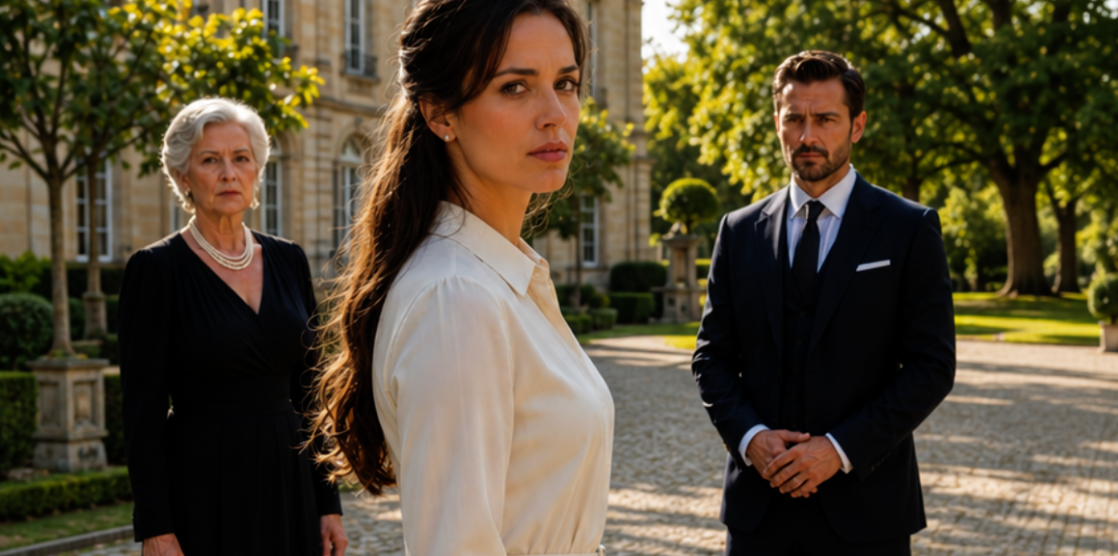
The Groom’s Parents Demanded That I Sign a Prenuptial Agreement on the Eve of the Wedding, but They Didn’t Expect My Response
“Annushka, sit down and make yourself comfortable. We need to discuss something,” Elena Viktorovna said, pointing to the armchair opposite her before pulling a thick folder of documents out of her handbag.
I felt everything inside me tighten. Maxim was sitting next to his parents, avoiding my eyes. One week before the wedding? Seriously?
“What is this?” I asked, although judging by my future mother-in-law’s expression, I could already guess.
“It’s a prenuptial agreement, dear. Viktor Petrovich and I think it’s better to settle everything in advance so there won’t be any misunderstandings later.”
Viktor Petrovich nodded, adjusting his glasses.
“You see, Anna, we have a family business. We need to protect it. It’s only reasonable.”
I took the documents. There were many pages, the print was tiny, and everything was written in legal language. I skimmed the first few clauses and felt the blood drain from my face.
“Maxim, did you know about this?” I turned toward my fiancé.
He finally looked at me.
“Mom told me yesterday. I thought it was just a formality.”
“A formality?” I looked back at the agreement. “It says here that in the event of a divorce, I’m entitled to nothing. Not even property that we buy together during the marriage.”
“Well, that makes sense,” Elena Viktorovna interrupted. “It’s our money. Maxim works for our company.”
“And if we have children?”
“Child support is fixed. It’s a perfectly respectable amount.”
I looked at the figure. It was less than my current salary.
“I need some time to think,” I said, standing up and pressing the folder to my chest.
“There isn’t much time,” Viktor Petrovich remarked. “The wedding is in a week. The notary is expecting us tomorrow.”
Maxim walked me to my car in silence. Only after I sat behind the wheel did he lean toward the window.
“Anya, don’t be dramatic. We’re not planning to get divorced.”
“Then why do we need a contract?”
“My parents are just protecting themselves. You understand how much they’ve accumulated over the years.”
I started the engine.
“I understand. The question is whether you understand what’s happening.”
At home, Mom had already set the table. Irina and Oleg had come over for dinner. It was the perfect moment for a family council.
“What happened?” Mom immediately noticed my mood. “You’re so pale.”
I put the agreement on the table. All three of them leaned over the documents.
“Wow,” Oleg drawled. “These people are serious. Even gifts from your husband have to be returned if you divorce.”
“Mom, what do you think?” I asked.
Svetlana sighed.
“You see, Annushka, their family really is wealthy. Maybe they’re simply being cautious.”
“Being cautious?” Irina exclaimed. “Mom, do you understand what this means? They don’t trust Anya from the very beginning. What kind of foundation is that for a family?”
“But she loves him,” Mom said quietly.
“Love is love, but you still need to keep a cool head,” Irina said firmly. “Anya, you remember how they behaved when you and Maxim first started dating, don’t you? They were always making remarks about how you weren’t from their social circle.”
I remembered. A year and a half earlier, when Maxim first brought me to his parents’ house, Elena Viktorovna spent the entire evening talking about girls from “good families” whom he had known at university. Viktor Petrovich asked where my parents worked, and when he learned that Mom was an accountant and my father had died five years earlier, his expression visibly changed.
“They always thought Maxim could find a better match,” I said. “Remember, Irina, how Elena Viktorovna kept talking at your wedding about her friends’ daughter? How clever she was, how she graduated with honors, and how her father was a major businessman.”
“I remember,” my sister nodded. “Even then she wasn’t exactly hiding the fact that she didn’t like you.”
Oleg shook his head.
“And what does Maxim say?”
“That it’s a formality. That his parents are just protecting themselves.”
“Anya,” Mom took my hand, “maybe you really should sign it? For the sake of your family’s happiness? You’re not planning to divorce anyway.”
Irina jumped to her feet.
“Mom, what are you saying? If they aren’t planning to divorce, why do they need the contract? It’s distrust from the very beginning.”
The next day, I went to see Natalia Borisovna, our corporate lawyer. We had worked together many times on business matters, and I knew she wouldn’t just shrug her shoulders and give me vague advice.
“Wow, this is quite a document,” she whistled after studying the agreement. “Anna, this isn’t a prenuptial agreement. It’s a surrender agreement. Look here: even if your husband cheats and you file for divorce, you still walk away with nothing. The child support is ridiculous. And this clause is especially interesting.”
She showed me a page I hadn’t read very carefully the day before.
“It says that if you receive an inheritance or an expensive gift from relatives during the marriage, it will also remain with your husband’s family after the divorce. Supposedly as compensation for emotional damages.”
“Is that even legal?”
“Unfortunately, yes. If you sign it, you’ll be bound by these conditions.”
I stared at the ceiling. Natalia Borisovna poured me some tea.
“Anya, I’ve known you for a long time. You’re a smart woman. Tell me honestly: do you really want to live with a man who allows his parents to treat you this way?”
“I thought everything would change after the wedding. That he would take my side more often.”
“And whose side is he on now?”
Good question.
That evening, Maxim called.
“How are things with the agreement? We need to go to the notary tomorrow morning.”
“Maxim, what if we add some additional clauses? Mutual conditions.”
“What kind of conditions?”
“For example, if you cheat on me, you pay a penalty. Or if your parents put psychological pressure on me during the marriage, I’m entitled to compensation.”
“Anya, why complicate things? It’s just a piece of paper.”
“If it’s just a piece of paper, why can’t you add my conditions to it?”
He was silent for a moment.
“You understand my parents will never accept that.”
“I understand. The question is, what matters more to you—their opinion or our relationship?”
“Don’t make me choose, Anya.”
“I’m not. They made us choose when they brought us this contract one week before the wedding.”
After that conversation, I didn’t sleep all night. In the morning, I came to work and honestly told my boss I needed the day off. I had to think everything through.
But I didn’t have to think for long.
At lunchtime, Irina sent me a message: “Turn on the local news.”
I did.
There was a report about successful local businesses, featuring Maxim’s company. Viktor Petrovich was being interviewed about expansion plans. At the end, the journalist asked about his son’s personal life.
“Maxim is doing very well,” Viktor Petrovich smiled. “He’s getting married soon. His fiancée is a good girl, although we still don’t know whether she’ll fit into our family. But we’ll see.”
Whether I would “fit in.”
Like a kitten from an animal shelter.
I turned off the television and realized I had made my decision.
I called Elena Viktorovna.
“Good afternoon. May I come over? I’d like to discuss the agreement.”
“Of course, dear. We’re home.”
I drove there carrying two folders. One contained their agreement. The other contained a document I had prepared the previous evening with Natalia Borisovna’s help.
Elena Viktorovna met me in the hallway.
“Well? Are we signing?”
“Yes. But on one condition.”
We went into the living room. Viktor Petrovich was sitting in his favorite armchair reading a newspaper. Maxim stood by the window.
“I’ll sign your agreement,” I said, “but only if you sign mine.”
And I placed the second folder on the table.
Elena Viktorovna frowned.
“What is this?”
“Counter-conditions. If our marriage lasts less than a year because of Maxim’s infidelity or psychological pressure from you, you will pay me compensation equal to one year of your company’s income.”
The room fell silent.
Viktor Petrovich lowered his newspaper.
“That’s outrageous.”
“And,” I continued, “if we have children, my share of the family property increases proportionally to the number of children. One more thing: if Maxim makes important decisions concerning our family without my consent, I have the right to end the marriage and receive compensation.”
Elena Viktorovna turned pale.
“Have you completely lost your mind?”
“I’m simply using your own logic,” I replied calmly. “If you’re confident in your son and believe he’ll be a good husband, then my conditions shouldn’t frighten you. But if you doubt his faithfulness or his ability to build a strong family, then why are you arranging his marriage at all?”
Maxim turned away from the window.
“Anya, this is absurd. Those amounts…”
“Absurd?” I looked at him. “But demanding that your future wife give up all her rights is perfectly normal?”
Viktor Petrovich stood up.
“We can’t sign this. It could ruin us.”
“It would ruin you only if your son turns out to be a bad husband. You don’t think he is one, do you?”
Elena Viktorovna shook her head sharply.
“That’s enough! We are not signing any additional conditions.”
“Then I won’t sign your agreement either,” I said, standing up and taking both folders.
Maxim stepped toward me.
“Wait. Maybe we can find a compromise?”
“What compromise, Maxim? Two weeks ago, you told me you loved me. Now you’re agreeing that I should give up every right I have just to marry you. Where exactly is the love in that?”
“But my parents are insisting…”
“Exactly. Your parents. And where is your opinion? Where is your position?”
He looked at his mother, then at his father, and finally at me.
“Maybe we should postpone the wedding? Until we resolve everything?”
I felt something inside me finally break.
Postpone it.
Not cancel it—postpone it.
So that the same thing could happen again later.
“Not postpone it, Maxim. Cancel it.”
I removed the ring from my finger and placed it on the table.
“Apparently, we really aren’t meant to be together.”
Elena Viktorovna jumped up.
“What are you doing? You’re destroying your happiness over a few pieces of paper?”
“I’m not destroying anything. I’ve simply opened my eyes and realized there was no happiness here to begin with. Your son wanted to get married, and you wanted to control the process. I was just the convenient option.”
Maxim remained silent.
He didn’t even try to stop me.
“Goodbye,” I said and walked toward the door.
Only when I got into my car did I allow myself to cry.
But the tears weren’t from grief.
They were from relief.
It felt as though an enormous weight had been lifted from my shoulders.
At home, I gathered the family together and told them everything.
Mom was upset at first.
“Maybe you rushed things? Perhaps you could have reached an agreement…”
But Irina interrupted her.
“Mom, you don’t understand. They never saw Anya as an equal. To them, she was like a servant who was supposed to be grateful they had allowed her into their family.”
Oleg nodded.
“You did the right thing, Anya. Better now than a year after the wedding.”
The next few days were spent canceling all the wedding arrangements. Fortunately, most of the contracts could be terminated without major financial losses. I decided to keep the dress. Maybe I’d need it someday.
Maxim called several times. He asked to meet and talk.
But there was nothing left to discuss.
He had made his choice in favor of his parents.
I had made mine in favor of self-respect.
A month later, Irina sent me a link to the latest local news. In the society section, there was a short article saying that “young entrepreneur Maxim Petrov has been seen spending time with the daughter of a well-known local furniture manufacturer.”
There was a photograph attached: Maxim standing beside a young woman at some event.
“He recovered quickly,” Irina wrote.
“Not surprising,” I replied. “His parents probably found a replacement immediately.”
But I wasn’t angry.
I even felt a little sorry for Maxim.
Spending your entire life walking along a path your parents have laid out for you, never making independent decisions—that is also a kind of prison.
Three months later, I received a promotion at work.
Irina called me.
“Congratulations! See how everything worked out? If you had married him, you’d probably be sitting at home having children while your career disappeared.”
“Not necessarily,” I laughed. “According to the contract, I wasn’t even allowed to work without my husband’s permission. So yes, everything turned out for the best.”
Recently, I ran into an acquaintance who works at their company. She told me that Maxim had become engaged to the furniture manufacturer’s daughter. Their wedding would be in the spring.
“Did she sign a prenuptial agreement?” I asked out of curiosity.
“What prenup? Her father gave them an ultimatum: either his daughter receives a share in the business, or there will be no wedding. So now they have a new business partner.”
So much for “just a formality.”
The truth was that I simply wasn’t in the right league.
I didn’t have the right status, the right connections, or parents with the right social standing.
Yesterday, Mom asked me:
“Do you regret it?”
“Regret what?”
“Not signing the agreement back then. Maybe everything would have turned out differently.”
I shook my head.
“Mom, if someone doesn’t see you as an equal from the very beginning, no signature is going to change that. They would have spent my whole life reminding me that I should be grateful they accepted me into their family. And I’m not going to spend my life apologizing for who I am.”
Sometimes the best answer is simply no.
No to humiliation.
No to inequality.
No to living according to someone else’s terms.
I made the right choice.
And I don’t regret a thing.