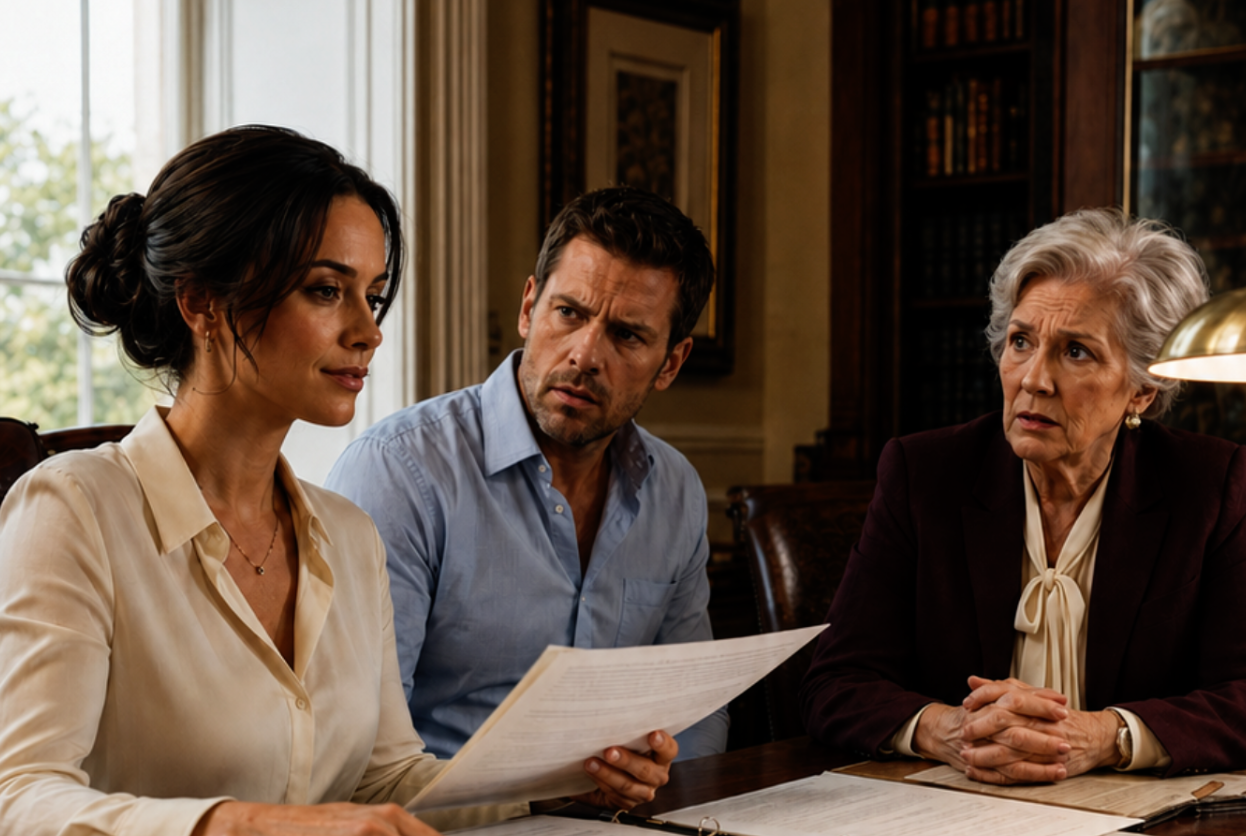
“We’re transferring your aunt’s atelier to Mom. I’ve already signed everything,” my husband said, forgetting about our prenuptial agreement
“We’re transferring your aunt’s atelier to Mom. I’ve already signed everything,” Sasha said calmly as he spread butter on a slice of bread.
Vera stood by the stove with a small saucepan in her hand. The milk was rising, about to boil over, but she couldn’t move.
“What did you sign?”
“A preliminary agreement.” Her husband didn’t even look up. “The notary appointment is Thursday at ten. You’ll come, sign, and that’ll be it.”
The saucepan finally hissed. Milk spilled onto the burner, filling the kitchen with the smell of something scorched.
Vera removed it from the heat, placed it on a trivet, and very slowly wiped her hands on a towel. Inside, she felt hollow and echoing, like an apartment building entrance at night.
Six years earlier, when Aunt Zoya died, Vera inherited her two-room apartment in an old building on Sadovaya Street. It wasn’t a palace. The parquet floors creaked, the ceilings were high, and the windows overlooked a courtyard lined with linden trees.
Vera turned the apartment into an atelier. She stripped the wallpaper herself, chose the lamps herself, and worked fourteen-hour days for three years until “Thread” became the kind of place people traveled across the entire city to visit.
And now her husband was talking about it with a sandwich in his hand.
“Sasha,” she said, though her voice sounded unfamiliar even to herself. “The atelier is registered in my name. It’s an inheritance. You have no right to sign anything.”
“Oh, don’t start.” He sighed in that particular tone that always made her jaw tighten. “Mom has thought everything through. Oksana has nowhere to live. She has two boys and keeps moving from one rental to another. We’ll sell the property and buy her a one-room apartment. Family is supposed to help each other.”
“Family,” Vera repeated.
“Exactly. And you can do your sewing somewhere else. Rent a basement or something. It’ll be cheaper.”
The lock clicked in the hallway.
Vera knew that sound by heart. Only one woman in that house opened the door that way—sharply, possessively, as though announcing: I’m coming in, make room.
Her mother-in-law.
Nina Arkadyevna entered the kitchen wearing a robe and holding her phone. The apartment belonged to her—a three-room place on the fifth floor where Vera and Sasha had lived throughout all six years of their marriage.
“Why waste money on rent when there’s plenty of space here?” she had said back then.
Vera had agreed.
She still hadn’t forgiven herself for it.
“Oh, what smells burnt?” Nina Arkadyevna sniffed the air. “Verochka, did you let the milk boil over again? Honestly, where do your hands grow from?”
“Mom, I already told her,” Sasha said.
“About Thursday?” Nina Arkadyevna immediately brightened and sat down at the table. “Good. That’s settled, then. Verochka, don’t worry, it’ll all be quick. Elvira Ivanovna is a trusted notary. I’ve been going to her for ages.”
Vera sat opposite her.
Slowly.
The way a person sits when the floor beneath their feet no longer feels stable.
“Nina Arkadyevna. The atelier belongs to me. I inherited it from my aunt. It was mine before the marriage.”
“So what?” Her mother-in-law smiled sweetly. “Verochka, you’re acting like a child. In a family, there is no ‘mine’ and ‘yours.’ There is only ‘ours.’ I’ve kept you in my home for six years, haven’t I? And I’ve never held it over your head.”
Kept you.
Not “you’ve lived in my home.”
Kept you.
“I pay the utilities, buy groceries, and paid for the renovations in the kitchen and bathroom,” Vera said quietly.
“Oh, so now you’re counting!” her mother-in-law exclaimed, throwing up her hands and turning toward her son. “Sasha, did you hear that? She’s presenting me with a bill now. There’s gratitude for you.”
Sasha said nothing.
He always stayed silent during moments like these—sitting there, poking at his food with a fork, waiting for the storm above the table to pass.
Vera looked at her husband and suddenly understood one very simple thing.
He knew.
He hadn’t found out today.
He hadn’t found out yesterday.
He had known for a long time.
All those months when her mother-in-law had suddenly started asking about the property’s cadastral value. When Oksana had casually wondered, “How much could you get for the place if you ever sold it?” When Sasha had asked for Vera’s passport “for insurance” and returned it the next day.
This wasn’t an argument.
It was a planned operation.
“Sasha,” Vera called. “Look at me.”
He raised his eyes.
Guilty, like a boy caught with someone else’s coins in his pocket.
“How long have you been discussing this?”
“Well… since winter,” he muttered.
Since winter.
Half a year.
For half a year she had cooked borscht for him, ironed his shirts, driven his mother to the clinic.
And all that time, behind her back, they had been dividing up her atelier.
“Verochka, why exactly are you sulking?” her mother-in-law said, leaning back in her chair. “You’re thirty-four. No children, nothing to show for yourself. Just your little scraps of fabric. At least Oksana raised two children. What have you done? You’re a freeloader, that’s what you are. Living in someone else’s apartment with enough arrogance for three generals.”
The kitchen became completely silent.
Vera felt something click inside her chest.
It hadn’t broken.
Quite the opposite—it had finally fallen into place.
Like a lock that had jammed for years and suddenly turned smoothly.
“A freeloader,” Vera repeated calmly. “All right. I’ll remember that word.”
“Mom, why would you say something like that?” Sasha said weakly.
“What else am I supposed to say?!” his mother raised her voice. “I’m telling the truth! My son never got anywhere in life because of her! He’s spent his whole life slaving away at her atelier!”
Vera almost laughed.
Sasha had visited her atelier exactly four times.
Twice to collect money.
She stood up.
“So Thursday at ten?”
“At ten,” her mother-in-law said happily. “That’s my sensible girl. I knew you’d come around.”
“I’ll be there,” Vera said. “I definitely will.”
She left the kitchen, closed the bedroom door behind her, and sat on the edge of the bed.
Her hands were shaking.
But her mind was cold and clear.
Because there was one thing her mother-in-law didn’t know.
And Sasha, apparently, had forgotten too.
Vera took out her phone.
“Marina, hi. Are you awake? I need you to bring the entire file on the property to the atelier tomorrow. Yes, all of it. And the lease agreement too. No, not over the phone. I’ll explain tomorrow.”
Then she found another number.
“Igor Lvovich, good evening. Sorry for calling so late. Do you remember the agreement you prepared for me six years ago? It looks like I finally need it.”
She didn’t sleep that night.
She lay staring at the ceiling, listening to her mother-in-law loudly discussing with Oksana over the phone what wallpaper they would put in the new one-room apartment.
And she remembered Aunt Zoya.
Her aunt had been a seamstress by the grace of God. Tiny and thin, always wearing a pincushion around her wrist.
She had taught Vera everything: how to set a sleeve, how to feel fabric with her fingertips, how to distinguish careful work from rushed work.
And she had always said one thing Vera hadn’t understood at the time.
“Verunya, remember this. People who try to take what belongs to you always hide behind the word ‘family.’ A real family doesn’t ask you to give things up. A real family asks how it can help. Once you understand the difference, you’ll know exactly who you’re dealing with.”
At twenty, Vera had thought it was just an old woman grumbling.
Now it sounded like survival instructions.
The next morning Vera went to the atelier earlier than usual.
Marina was already waiting for her with a cardboard box of documents and two cups of coffee.
“Tell me everything,” she said, sitting on the cutting table.
Vera did.
From beginning to end.
The agreement. The notary. The word “freeloader.”
Marina listened silently, and when Vera finished, she slowly put down her coffee.
“Vera… do they even know that you and I have an LLC? And that the property is under a long-term lease?”
“Apparently not.”
“What about the prenup?”
Vera smiled.
For the first time in twenty-four hours.
“Sasha signed it a week before the wedding. He barely even read it. Igor Lvovich told me back then, ‘Vera, you’re a woman with property. Protect yourself.’ I insisted. Sasha got offended, shouted for two days, then signed it and forgot.”
“Does your mother-in-law know?”
“Nina Arkadyevna was at a health resort at the time. Nobody told her. And Sasha…” Vera shrugged. “Sasha tends to forget things he doesn’t like.”
Marina slowly exhaled.
“Vera, you do realize Thursday at the notary’s office is going to be a circus?”
“I do.”
“And you’re still going?”
“I am,” Vera said. “I need them to hear it in front of witnesses. Once. And for good.”
She worked through Wednesday as though in a fog.
She was finishing a wedding dress for a quiet girl named Katya, who came to fittings with her mother and apologized in a whisper every time, saying, “We’re keeping you too long.”
And Vera kept thinking: so some people really do have mothers who don’t make them feel the need to pull their heads into their shoulders.
That evening Sasha tried to make peace.
He brought her ice cream, turned on one of her TV shows, and sat beside her.
“Sveta, come on, don’t be angry,” he said, then froze. “Vera, I mean.”
Vera wasn’t even surprised.
He was always mixing her up—with Oksana, with some Sveta from his past, with anyone at all.
“Sasha, tell me honestly. Did you ever once think that this would hurt me?”
“Well… yes.” He scratched the back of his head. “But Mom said you’d make some noise and then calm down. You always calm down.”
And there it was.
The entire answer.
For six years, that had been her defining characteristic in this family:
She’ll make some noise and calm down.
“Go to sleep,” Vera said. “We have to get up early tomorrow.”
On Thursday she arrived at the notary’s office ten minutes before ten.
They were already there.
All three of them.
Her mother-in-law in a burgundy blazer, Oksana in new boots, Sasha with a folder tucked under his arm, looking important like a schoolboy at an academic competition.
“There you are,” Nina Arkadyevna said approvingly. “Sit down, daughter-in-law. We’ll get everything taken care of quickly.”
Vera sat down.
She placed her bag on her lap.
Elvira Ivanovna, a tired-looking woman in her fifties, laid the documents out on the table.
“So. Vera Dmitrievna, you are the owner of the commercial property located at 14 Sadovaya Street?”
“Yes.”
“The preliminary agreement expressing intent to transfer the property was signed by your husband on your behalf. Do you confirm that he had the authority to do so?”
Vera raised her head.
“No.”
Her mother-in-law jerked.
“What do you mean, no? Verochka, what are you doing?”
“I never gave my husband any authority,” Vera said calmly. “No power of attorney. No verbal permission. And the agreement he signed contains a copy of my signature. I would like to know where that copy came from.”
Sasha turned pale.
“Verunya, I… I just transferred it from an old contract…”
“Transferred it,” Vera repeated. “Elvira Ivanovna, did you hear that?”
The notary removed her glasses and looked at Sasha very carefully.
“Young man, do you understand what you just admitted?”
“But she’s his wife!” the mother-in-law interrupted. “What difference does it make who signed? They’re one family!”
“It makes a very significant difference,” Elvira Ivanovna replied dryly.
Vera opened her bag.
“I brought some documents. Since we’re all here, let’s settle everything completely.”
She pulled out the first folder.
“Our prenuptial agreement. Signed one week before the marriage was officially registered and notarized. Clause four: property received by either spouse as a gift or inheritance, as well as income from each spouse’s entrepreneurial activities, remains that spouse’s separate property. Alexander Igorevich’s signature is right here.”
Silence.
Her mother-in-law slowly turned toward her son.
“Sasha. What prenuptial agreement?”
“Mom, I…” Sasha blinked. “I don’t remember. She told me to sign it, so I signed…”
“You signed it?!” Nina Arkadyevna grabbed the edge of the table. “You idiot! You signed a document against your own mother?!”
“Not against your mother,” Vera corrected her. “Against taking property that belongs to someone else.”
She placed a second folder on the table.
“Next. The apartment was converted into commercial premises. And starting last year, it was leased on a long-term basis to the limited liability company ‘Thread’ for fifteen years. The agreement is registered and the encumbrance appears in the official registry. Marina Goncharova is the second shareholder in the company. So even if, by some miracle, you obtained ownership of the property, you would obtain it together with a fifteen-year lease. At a rental rate that I set myself.”
Oksana spoke for the first time.
“That… that isn’t fair.”
Vera looked at her sister-in-law.
Calmly.
Without anger.
“Oksana, unfair is when relatives spend six months secretly dividing up something a person built with her own hands. The fact that I protected myself from my own family is probably sad. But it’s fair.”
Red blotches began appearing on her mother-in-law’s face.
“You scheming little snake! You planned all this in advance! You tricked all of us!”
“I didn’t plan anything, Nina Arkadyevna. I simply listened to Aunt Zoya once.”
“Who does your Aunt Zoya think she was?!”
“A woman who left me more than just an apartment,” Vera said. “She also left me enough sense to use my head.”
The notary cleared her throat.
“Ladies and gentlemen. There will be no transaction. Vera Dmitrievna does not consent, and no authority was granted. And you, Alexander Igorevich, should consult an attorney. Your actions involving your wife’s signature are an entirely separate matter.”
Sasha sat there gray-faced, clutching his folder.
His mother jumped to her feet.
“We’re not going to let this go! I have connections!”
“You will,” Vera said as she stood. “Because there’s nothing for you to hold on to.”
She zipped up her bag and looked at her husband.
“Sasha. I’m collecting my things today. I filed the petition yesterday.”
“What petition?” he whispered.
“For divorce.”
Her mother-in-law burst into ugly, spiteful laughter.
“And where are you going to go, you freeloader? You have nothing!”
Vera stopped in the doorway.
“I have an atelier, my hands, and my name. You wouldn’t understand the value of any of those things.”
She moved her belongings out in two hours.
There were ridiculously few things for six years of married life.
Three bags of clothes, a box of books, Aunt Zoya’s sewing machine, and an old photograph of her aunt standing beside a window with pins around her wrist.
Everything else in that apartment belonged to someone else.
Even the kitchen towels had once been described by her mother-in-law as “mine, by the way.”
Vera spent her first night at the atelier.
She made up the small sofa used by clients, covered herself with her coat, and slept more deeply than she had in the previous three years.
In the morning, sunlight streaming through the tall windows woke her, along with the rustling of the linden trees outside.
And she realized that, for the first time in a long while, she didn’t have to justify to anyone the simple fact that she had woken up.
Sasha called every day.
At first he demanded things.
Then he became offended.
Then he started complaining.
His mother wasn’t speaking to him. Oksana blamed him for “ruining everything.” And according to him, none of it was really his fault because he had only wanted what was best.
“Vera, I never thought it would turn out like this,” he said over the phone. “Maybe I was actually against it. Mom was just pressuring me.”
“Sasha,” Vera finally told him one day. “You’re thirty-eight years old. ‘Mom pressured me’ is not an excuse. It’s a diagnosis of our relationship.”
“So you’re not going to forgive me?”
Vera was silent for a long time.
“It isn’t about forgiveness. I don’t hate you. I just don’t want to be someone other people make decisions for anymore.”
A month later, the marriage was dissolved.
There was almost nothing to divide—only the car, which Vera let him keep, and a television she didn’t need.
Her mother-in-law sent one final long message.
It was about Vera’s ingratitude, about how she had ruined Nina Arkadyevna’s son’s life, and about how “women like you always end up alone.”
Vera read it and didn’t reply.
Not out of pride.
She simply wasn’t interested anymore.
In autumn she rented a small studio apartment two blocks away from the atelier.
She bought a white table, a lamp, and three pots of violets.
On her first evening there, she sat on the floor among the boxes and cried.
For a long time.
Ugly, gasping sobs.
She cried out everything: six years in someone else’s kitchen, six years of “you understand, don’t you?”, six years of feeling like a guest in her own life.
Then she washed her face, made some tea, and ordered herself a pizza.
A whole one.
Without anyone asking, “Did you save a piece for Mom?”
Orders kept coming.
Marina handled promotion.
Vera handled the work.
By winter, “Thread” had a two-month waiting list.
By spring, they hired two seamstresses.
That summer Vera went to the seaside alone for ten days for the first time in her life, and spent half the trip simply lying in her hotel room staring at the ceiling, getting used to the idea that no one was going to call her with some new complaint.
A year later, she made the down payment on her own apartment.
Small.
Thirty-eight square meters.
Fourth floor.
A window overlooking a schoolyard.
The day they handed her the keys, she stood in the empty room for a long time and simply breathed.
That autumn, Oksana called.
“Vera, don’t hang up. I’m calling because I want to.”
“I’m listening.”
Her former sister-in-law was silent for a moment.
“I wanted to say I was wrong. Back then I thought, so what? Why should you mind? You have something, after all. But now I’m moving into my fourth rental apartment, and I understand something. What belongs to someone else doesn’t keep you warm. It burns.”
“How is Nina Arkadyevna?” Vera asked.
“Mom and Sasha are tearing each other apart now. She blames him, and he blames her. They live together and fight every day.” Oksana gave a bitter little laugh. “You know, sometimes I think it’s good that you left when you did. At least you got out.”
Vera ended the call and walked over to the window.
Children were kicking a ball around in the courtyard.
The air smelled of wet leaves and somebody’s pancakes.
She thought about how the word “family” used to sound like an obligation to her.
Like a debt that could never be fully repaid.
But now she understood.
Family isn’t made up of the people who demand the most loudly.
Family was Marina, who had once driven across the city at four in the morning to help finish an order.
Family was Aunt Zoya, who six years earlier had placed not only an atelier into Vera’s hands, but also the ability to say “no.”
Family was quiet Katya, who returned a year after her wedding with a cake and said, “You didn’t rush me back then, and for the first time in my life I felt beautiful.”
Vera took the old photograph down from the shelf.
Aunt Zoya stood beside a window, tiny and thin, with pins around her wrist.
On the back, written in her aunt’s small handwriting, were the words:
“Verunya, sew straight and live honestly.”
“I’m trying, Aunt Zoya,” Vera said aloud. “I swear I’m trying.”
Outside, the streetlights were coming on.
Her apartment smelled of fresh coffee and new fabric.
And this was her life.
Entirely hers.
Without a single чужая signature on it.