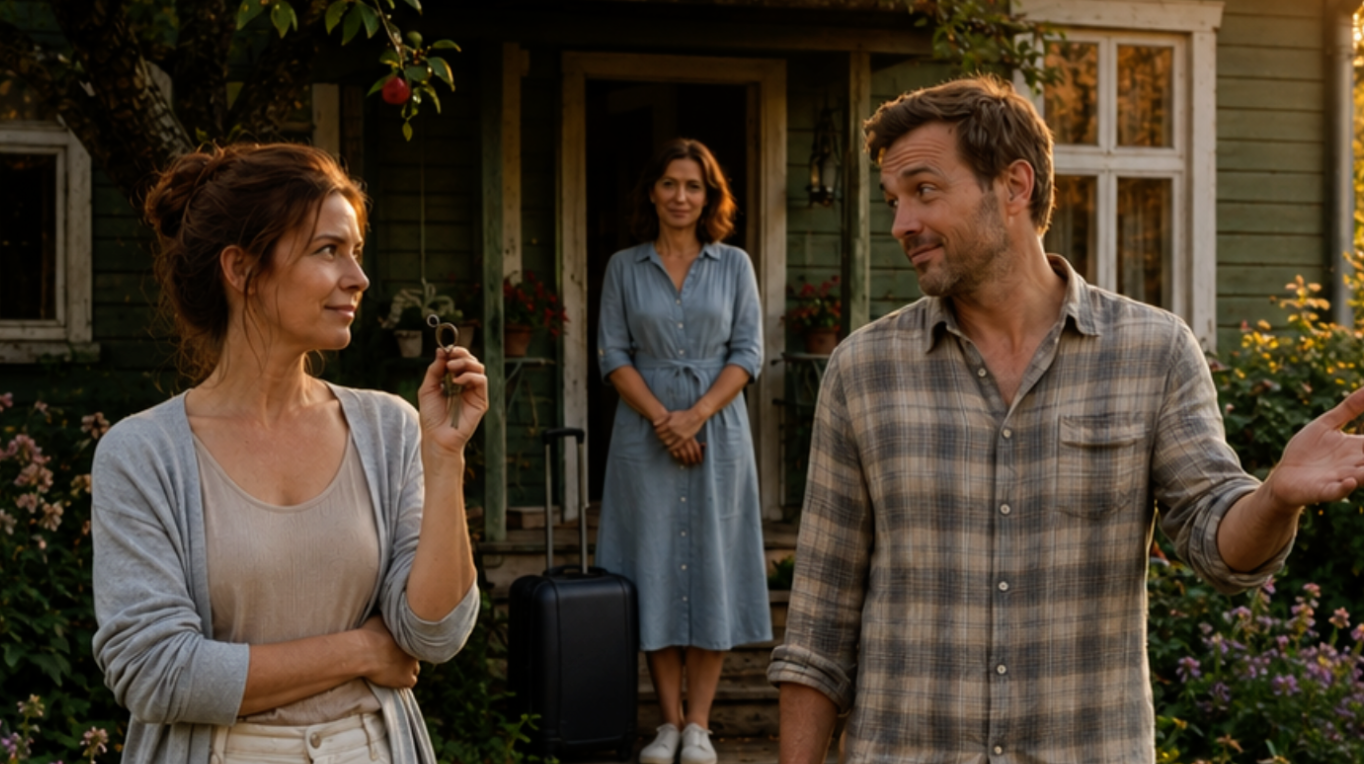
“I’m giving the dacha to my sister. She needs it more, and we don’t use it anyway,” Anton stated, his voice carrying the casual finality of a man who had never weeded a garden bed in his life.
I did not answer. Instead, I sat in the heavy silence of our kitchen and watched his hands. His soft fingers reached toward the ceramic bowl, selected a walnut, and squeezed it until the shell fractured. Carelessly, he poured the jagged fragments into his palm, glanced around for the trash bin, and dropped them right back into the bowl alongside the unbroken nuts.
The dacha. It was a modest six hundred square meters of earth beyond the city. It held the apple trees my grandfather had planted with his own weathered hands, their roots anchoring our family’s history into the soil. At the center stood a crooked, prefabricated house with a rusted potbelly stove that I lit every September. For twenty years, that plot had been the silent witness to my sweat and my labor.
Anton, conversely, had graced the dacha with his presence rarely. The somber afternoon we buried my grandfather, he stood near the rusty gate, leaning lazily on a shovel while engrossed in his phone screen.
“She needs it more,” Anton repeated, annoyed. “She has a mortgage, two noisy kids, and Valera hasn’t held a job in months. For us, that dacha is nothing but another useless tax bill.”
I remained silent, watching his jaw muscles tighten. This was his predictable routine: calmness always gave way to simmering irritation and harsh accusations.
“Are you even listening to me?” he demanded.
“I am,” I replied.
He paced the kitchen, poured a glass of water, and slammed the empty glass directly into the sink—where he knew I hated dirty dishes. “I am not asking for your permission,” he sneered, crossing his arms over his chest. “I am informing you. My father legally transferred the deed into my name two years ago.”
“Your father transferred the paperwork,” I said, my voice level. “But my grandfather planted those apple trees. My hands painted that fence.”
“What difference does it make? The documents bear my name.”
I picked the fragmented walnut shells out of the bowl. I carried the bowl to the windowsill, setting it next to a plastic cactus I had bought at a gas station. Anton called it a useless dust collector, but I never threw it away. “All right,” I said quietly.
Anton froze, thrown off balance. He had been bracing for a massive scandal, expecting me to weep and list the hours I poured into that soil.
“All right?” he repeated suspiciously.
“All right. Give it to your sister.”
“Great,” he exhaled, smirking. He tried to embrace me, but I smoothly stepped aside, pretending to fetch a towel. He dropped his arms and retreated to the living room.
That night, Anton fell asleep instantly, snoring softly. I felt nothing but a startling, crystalline clarity, as though someone had opened a window in a suffocating room. I slipped into the silent kitchen and texted Marina, a realtor: “I need to know how much a dacha forty kilometers outside the city is worth. Six hundred square meters, prefabricated house. I need to sell it quickly.”
The next morning, I boiled two eggs for Anton. “I’m going to the dacha this weekend to clean it,” I lied smoothly.
I drove to the countryside on Friday evening. The little house smelled of old wood, settled dust, and forgotten memories. On Saturday, Marina arrived in a crossover, assessing the property with calculating eyes. “The market is hot,” she noted. “I can get you three million rubles, but your husband must provide a notarized power of attorney.”
On Monday, I drove to a notary office. Alina, an old college acquaintance, drafted a general power of attorney for the sale of the property, leaving only the signature line blank. I took the document home, my heart beating with a calm rhythm.
Anton was waiting in the hallway, furious. “Seryoga’s wife saw you leaving a notary office! What are you scheming?”
I walked into the living room and sat on the sofa. “The dacha,” I said smoothly. “I spoke to a realtor. It’s worth over three million rubles. Why give it away when we could sell it and keep the cash for ourselves?”
Anton froze. The greedy gears ground in his head. Three million rubles. His angry expression dissolved into a hungry stare. “Do you need documents from me?” he asked eagerly.
“Just this power of attorney,” I said, pulling it from my bag. He grabbed the paper, didn’t read a single clause, and hastily scribbled his signature at the bottom of the page.
A week later, a older couple purchased the dacha. The transaction was flawless. Three million two hundred thousand rubles were wired to my accounts. I transferred half of that money into a hidden account in my name. The remaining half I routed to our joint account.
When Anton saw the banking notification, he rushed into the kitchen, his eyes wide. “You sold it!” he laughed, a manic sound, trying to pull me into a tight embrace. “Over a million and a half! We can finally buy that new Kia SUV I’ve been looking at!”
I stood rigid in his arms, looking him dead in the eye. “No,” I said, stepping back.
“What do you mean, no?”
“We are not touching a single ruble of that money for a car. It is going into a deposit account for the children’s future. So that when they are older, they won’t ask us why we threw away their great-grandfather’s legacy for a piece of metal.”
His face contorted in furious rage. He realized, far too late, the trap he had eagerly signed himself into. He had legally signed away his rights. I turned my back to his sputtering protests and stared at the plastic cactus on the windowsill.
That night, long after Anton had fallen into a fitful sleep, I slipped out of the apartment and drove down the dark highway to the dacha. The new buyers hadn’t moved in yet. I walked up the dirt path, sitting on the wooden steps under the apple blossoms. I pulled the heavy iron key from my coat pocket and left it gently on the wooden step. I turned around and walked away without looking back. Behind me lay twenty years of thankless labor. Ahead of me was the long road back to the city, the apartment on Leninsky, and a future that finally belonged to me.