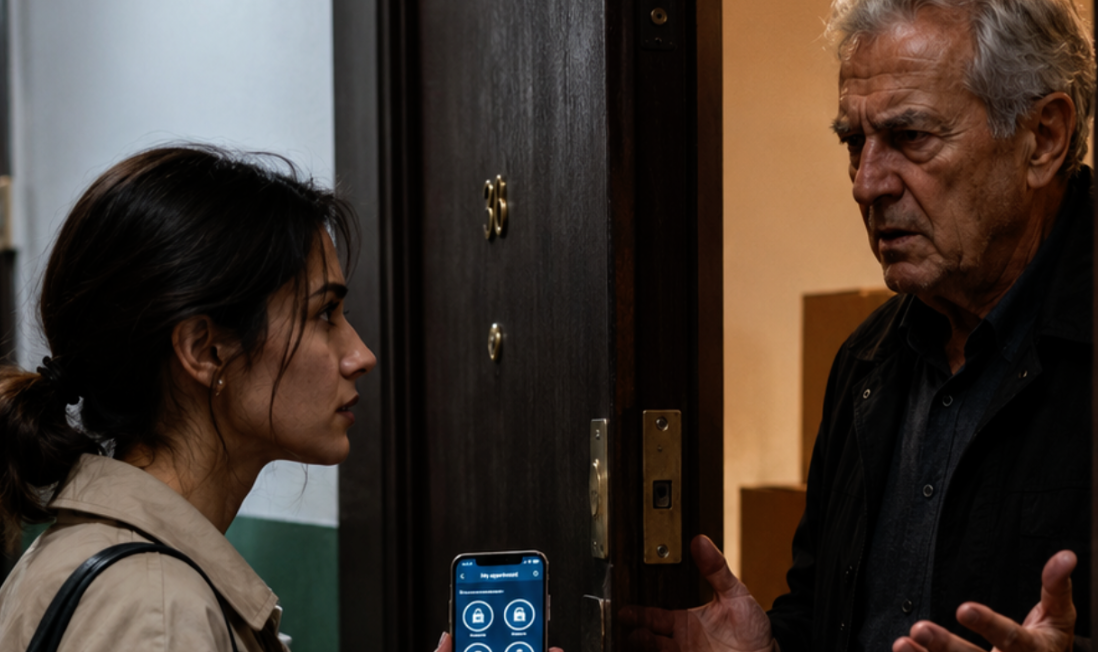
“We Changed the Locks. The Apartment Belongs to Your Brother Now,” My Father Declared, Forgetting About the Smart Home
— Yes, we changed the locks. The apartment belongs to Denis now. Let the girl go wherever she wants—to her fiancé.
My father’s voice was loud, carrying that familiar booming confidence of a man accustomed to giving orders on the factory floor and never doubting that he was right.
I was standing on the landing outside my own apartment.
A heavy laptop bag pulled painfully on my right shoulder. The wheels of my travel suitcase had barely cooled after the train ride.
Behind the door, upholstered in pale faux leather, a radio was playing. Someone was clattering dishes around in my kitchen.
The smartphone in my jacket pocket vibrated briefly.
It was a notification from a server application—a hidden utility I had written myself. The app collected logs from every sensor in my home automation system. Normally, it beeped when the humidity in the bathroom rose above the acceptable level or when the router started losing data packets.
Now it was methodically reporting that the lights were on in the apartment, the television was running, and hot-water consumption had exceeded the normal daily usage of one person.
I work as a systems administrator.
The last five years of my life had consisted of endless server racks, kilometers of twisted-pair cable, sleepless nights when databases went down, and brutally strict budgeting.
I had been paying a crushing mortgage on this two-bedroom concrete box in a new apartment building.
Forty-five thousand rubles every month.
No missed payments.
No excuses.
To save enough for the down payment, I had spent two years eating discounted pasta and wearing the same pair of winter boots.
My parents had always regarded my profession as something unserious.
“She sits at a computer,” was how my mother described my job to the neighbors.
— What if she calls the police? — came a muffled female voice from behind the door.
It was Sveta, the fiancée of my twenty-year-old younger brother.
— What police? — my father scoffed. — We’re her family. I said the matter is settled. Kostya will pick her up—he has a car. He can take her things. Denis needs the apartment more.
I pulled a keyring from my bag.
The metal felt familiarly cold against my fingers.
One of the keys was long and perforated—the key to the lower mechanical lock.
I inserted it into the keyhole.
It went only halfway in before hitting something unfamiliar.
The cylinder had been replaced.
Fresh scratches around the metal plate showed that the locksmith had worked in a hurry and had not cared much about appearances.
Slowly, I pulled the key back out.
The phone in my pocket vibrated again.
The motion sensor in the hallway had detected two people moving around.
I had given my mother a spare key myself a year earlier.
At the time, she had complained about her health. She said she was afraid she might fall while home alone and begged me to make a duplicate “just in case.”
For a long time, I refused because I knew their habit of showing up without warning.
Eventually, I gave in.
I wanted to be a good daughter.
I wanted to prove that I trusted them.
That had been my mistake.
I had opened the door to people who did not understand where the hallway ended and my boundaries began.
I tightened my fingers around the plastic handle of my suitcase.
A week at an information technology exhibition in a neighboring city had exhausted me completely.
All I wanted was a hot shower and my own bed with the orthopedic mattress I had bought with part of my annual bonus.
— Misha, the main thing is to tell her right away not to start screaming in the hallway, — my mother’s voice came from very close by. Apparently, she had walked into the entryway. — The neighbors will hear. It’ll be embarrassing.
I raised my hand and knocked twice against the steel door with my knuckles.
The sound was deep and heavy.
The radio in the kitchen instantly fell silent.
A thick pause settled behind the door.
This had been building slowly.
It always happens slowly in families where boundaries are considered something shameful and the word “no” is treated like betrayal.
The first warning sign had come a month earlier, on my birthday.
We were sitting in my kitchen.
I had only just finished renovating the apartment. I had put up wallpaper, installed smart outlets, and configured voice controls.
My mother wandered from room to room, touching the curtains and running her finger along the windowsills.
— You made it nice, — she said without looking at me. — Spacious. Denis could use a place like this. He and Sveta keep moving from one rented apartment to another. Their landlord raised the rent again.
I said nothing.
I simply put the kettle on the stove.
My brother sat at the table, picking at his salad with a fork and silently nodding.
He was in his third year of university, studying in a paid program that my father financed.
Denis claimed he had no time to work because his academic workload was too demanding.
Then the little inspections began.
My mother might call in the evening and ask:
— Are you staying at Kostya’s this weekend?
— Probably. Why?
— Your father and I could come over and put some seedlings on your balcony. We don’t get enough sunlight at our place.
I explained that the balcony was full of boxes and that it wasn’t convenient for me.
My mother would become offended and hang up.
Then my father would send long messages about how I did not appreciate family ties.
Two weeks earlier, they invited me to a family dinner.
Kostya couldn’t come because he was on duty at the hospital.
I went alone.
My parents, Denis, and Sveta were already sitting at the table.
Sveta looked at me with mild apprehension.
— Vera, — my father began as soon as we started eating the main course. — We need to have a serious conversation.
I put my fork down on the edge of my plate.
— You’re marrying Konstantin this fall. He inherited that apartment from his grandmother, the three-bedroom one downtown. You’ll live there.
— We haven’t decided yet, — I answered evenly. — It needs a complete renovation. For now, we were planning to stay at my place.
My father waved his hand as if brushing away an annoying fly.
— What renovation? It has walls. You can live there. That’s not the point. Denis and Sveta have nowhere to live. Your mother and I have been thinking… Let them move into your apartment. You’ll be living together anyway. Why should the apartment sit empty?
I looked at my brother.
He studied the pattern on the tablecloth with extraordinary concentration.
— The apartment won’t be empty. I live there. And I’m paying the mortgage on it.
My mother threw up her hands.
— Family members are supposed to help each other! Nobody survives alone these days. Times are difficult. You and Kostya both work and make good money. Denis is a student. Sveta only earns commission at a nail salon. How are they supposed to get started in life?
— By getting jobs, — I said, standing up from the table.
My father leaned his fists heavily against the tabletop.
— He’s twenty years old! The boy doesn’t have a penny to his name! We just want both of our children to have a decent start. You already have everything—a profession, an apartment, a reliable man. Are you really going to refuse your own brother a roof over his head? It’s only temporary, until he gets on his feet.
I left without finishing dinner.
For the next two weeks, they did not speak to me.
I assumed the conflict was over.
I thought they had understood my refusal.
Meanwhile, I was preparing for a work trip to the exhibition, booking tickets and finishing a presentation about fault-tolerant server systems.
On the day I left, my brother sent me a short message:
“What time is your train?”
I replied:
“6:40 p.m. I’ll be back next Thursday.”
There were no more messages.
And now, staring at the scratched keyhole, I understood exactly why he had wanted to know the precise schedule of my absence.
They had not argued with me.
They had simply waited until my train pulled away from the platform, called a locksmith to force open the door, showed him my spare key as proof that they had access to the apartment, and replaced the lock cylinder.
The interior latch clicked.
The door opened as far as the security chain allowed.
My mother’s face appeared in the narrow gap.
When she saw me, she did not look frightened.
On the contrary, her lips tightened into a thin line and her expression became hard, almost businesslike.
— You’re back, — she stated without attempting to remove the chain.
— Open the door, — I said calmly.
— Wait.
My mother turned around.
— Misha! Denis! Vera’s here.
The chain rattled, and the door opened wider.
My father stood in the doorway.
He was wearing sweatpants and my favorite conference-logo T-shirt.
Denis hovered behind his shoulder.
Sveta had wisely hidden in the kitchen.
— Hello, daughter, — my father said in the tone of a man who believed he had complete control of the situation. — You’re early. We thought you’d arrive this evening.
— My key doesn’t work.
I raised the keyring to his eye level.
— Yes, we changed the locks.
My father folded his arms across his chest.
— The apartment belongs to Denis now. I tried calling you, but you didn’t answer.
I had, in fact, put my phone on silent on the train so I could sleep.
— This apartment is my property, — I said evenly, without raising my voice. — I’m the one paying the bank for it.
— A girl doesn’t need her own apartment, — my mother cut in sharply, stepping forward. — You’ll move in with your fiancé. A young man needs somewhere to bring his future wife. They’re starting a family. We packed your things. The boxes are in the hallway. Kostya can come in his car and take them.
Denis smirked from behind her shoulder.
— Vera, come on, don’t start, — my brother drawled. — You’ve got loads of money, and we can barely afford to live. Take a couple of sweaters and stop making a scene in the hallway. You can pick up the rest later.
The door to the neighboring apartment creaked quietly.
Marina, the neighbor I occasionally met near the elevator, appeared in the doorway.
She saw my father, then looked at me, nervously adjusted her robe, and silently closed her door again, locking it.
Nobody intended to defend me.
— You called a locksmith and broke into my apartment, — I said, looking directly into my father’s eyes. — You packed my belongings into boxes.
— We’re not strangers! — my father shouted. — I’m your father! I have the right to decide who in this family needs help more. You’re selfish! You only think about yourself. We raised you, educated you, and now you’re begrudging your own brother one room? That’s it. This conversation is over. Come back tomorrow for your things.
He stepped backward and reached for the door handle, preparing to slam it in my face.
I didn’t scream.
I didn’t hit the doorframe with my bag.
I simply shook my head tiredly and stepped backward onto the landing.
— Fine, — I said.
My father froze for a second.
He had expected hysterics, tears, threats to call the police.
My calm reaction confused him.
— That’s my good girl, — he said condescendingly. — You’ll stay with Kostya. Nothing terrible will happen to you.
The door slammed shut.
The new lock clanged.
I remained standing in the dim stairwell.
The air smelled of damp plaster and someone else’s borscht.
I pulled out my smartphone.
I unlocked it with my fingerprint.
These digital dinosaurs, convinced that power was determined by possession of a metal key and the loudest voice, had absolutely no idea where they were.
My apartment was not simply a concrete box.
It was my laboratory.
A testing ground for automation systems.
All the electrical wiring, water supply, and climate control were connected to my personal server, hidden inside an inconspicuous ventilation enclosure.
Green indicators glowed on the app screen.
Network stable.
Power normal.
I opened the administrator tab.
Then I found a script I had written long ago called “Full Quarantine.”
It was designed for emergencies such as burst pipes or fires when I was away from home.
I looked at the closed door.
I remembered five years of saving.
I remembered the pasta.
I remembered Denis’s condescending smirk.
And my T-shirt on my father.
My finger touched the screen.
The system requested biometric confirmation.
I placed my thumb on the scanner.
A green message appeared:
“Script activated.”
A dull click sounded from inside the apartment.
Then another.
First, the system remotely cut power to every electrical outlet and lighting circuit.
Built-in relays in the breaker panel simply opened the circuits.
Next, servo motors installed on the bathroom pipes quietly whirred as they shut off the hot and cold water.
Finally, a concealed electronic deadbolt in the upper corner of the door engaged—a mechanism only the installer and I knew existed.
A thick steel bolt locked the door firmly from the inside, completely independent of the mechanical lock cylinder.
My mother shouted indignantly from behind the door.
— Misha, the power’s gone out!
I turned around, picked up my suitcase, and walked toward the elevator.
The smartphone in my pocket vibrated again.
The system had sent confirmation that the apartment had entered autonomous mode.
I called a taxi to a hotel.
I spent the next forty-eight hours in a hotel room.
I drank bad coffee from paper cups, worked on my laptop, and methodically reviewed the logs coming from my server.
My brother, his fiancée, and my parents were trapped inside an apartment that was completely dark, cold, and without running water.
At first, they tried to get out.
Twenty minutes after I left, the door sensor registered repeated attempts to open it from the inside.
They turned the mechanical lock and yanked at the handle, but the steel deadbolt held firmly.
Breaking down the door from the inside was practically impossible in a new apartment building with reinforced metal doorframes.
The window could not be opened either.
The apartment was on the first floor, so I had installed reinforced double-glazed windows without handles. They could only tilt open through a remote control.
The remote was in my bag.
According to the sound-meter logs, real panic began by the end of the first day.
The radiators became cold because the smart thermostats had shut off the heat.
There was no electricity.
No water.
The toilet wouldn’t flush.
The refrigerator began leaking.
Because of the concrete structure and foil-backed insulation, mobile reception inside the apartment was terrible, and I had cut power to the home router before anything else.
On the second day, they were apparently terrified enough to finally manage to call emergency services.
The notification from the building management company arrived in my email on Wednesday morning.
Emergency responders had been dispatched following a report of “people trapped inside who were feeling unwell.”
To force open my reinforced door with its concealed electronic deadbolt engaged, they had to use hydraulic cutters and an angle grinder.
They practically ripped the entire doorframe out of the wall.
When the rescuers finally got inside and led my pale, sweaty, filthy relatives out into the light, the questions began.
A police officer who had arrived with the emergency crew demanded documents proving their right to be inside the apartment.
None of them were officially registered there.
There was no rental agreement.
And the owner—me—was nowhere to be found.
They were handed an enormous bill for the unnecessary emergency response and the illegal entry into the apartment.
The building management company also filed a report regarding damage to communal property because part of the stairwell wall had collapsed during the forced entry.
The fine was assigned to my father because he was the one insisting to the police that he “had the right to decide what happened with his daughter’s apartment.”
I returned home at noon on Thursday.
The landing was silent.
The mangled metal door had been propped against the wall.
Nearby stood cardboard boxes filled with my belongings—the things they had managed to pack before the power was cut.
Beside them lay a black garbage bag, apparently containing Denis’s possessions.
They had moved out in disgrace an hour earlier.
Marina, my neighbor, later told me that my father had shouted through the entire building, promising to sue me, while Sveta cried and smeared what was left of her makeup across her face.
My mother had tried calling me, but I had blocked her number while I was still in the taxi.
I stepped over my brother’s bag and entered the apartment.
It smelled of dampness and dirty laundry.
Empty mineral-water bottles were scattered across the floor.
I took out my smartphone.
I pressed my finger to the scanner.
I turned the electricity and water back on.
The system responded instantly.
The pipes filled with a low hum, and the hallway lights came to life.
I did not clean up after them myself.
Using the app, I remotely ordered a professional cleaning service and hired workers to install a new door.
By Saturday evening, the apartment was mine again.
The new door was heavier than the old one.
The air smelled of cleaning chemicals and citrus air freshener.
I sat at the kitchen table with my smartphone lying in front of me.
There was no sense of triumph.
Only a dense, cold emptiness inside my chest, as though a huge piece of my past had been cut out of my life together with the destroyed doorframe.
I opened my banking app.
I found my brother’s number in the contacts list.
In the amount field, I entered 5,000.
That was exactly how much he had paid the locksmith to break into my apartment.
I attached the receipt for replacing the lock cylinder and added a message:
“For the illegal break-in.”
Then I pressed “Send.”
I did not feel ashamed.
But I did not feel happy about having been stronger than them, either.
I had simply protected my territory in the only way available to me.
Family ties had turned out to be thinner than the twisted-pair cables running through my walls.
I stood up, walked to the front door, and turned the interior lock.
The hidden electronic deadbolt slid into place with a quiet click.
I ran my palm over the cold metal.
Now the boundary was sealed completely.
And only I would decide when it opened again.
Was that smart home truly the only protection I had from the very people who were supposed to protect me by default?