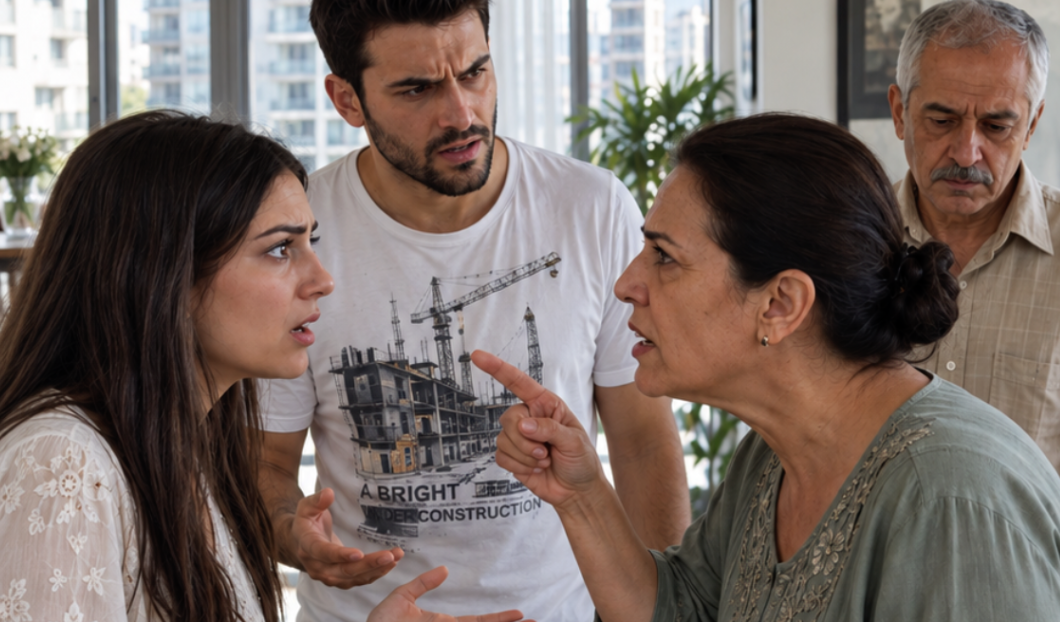
“We’re moving in with you permanently. We’re already selling our apartment,” my mother-in-law announced as casually as if she were discussing the weather.
I stood frozen in the doorway of her apartment, holding a box of cream puffs I had brought for Sunday tea.
Around me, everything was chaos.
Cardboard boxes were stacked against the walls, furniture had been moved, and her neighbor was dragging a heavy oak chair down the hallway.
“Take the chairs too, Lyuba,” Tamara Vasilyevna called cheerfully. “Nikolai and I won’t need them anymore. We’re starting a new life, and we’re traveling light.”
I stared at her.
“Where exactly are you going?”
She looked genuinely surprised.
“Vitya didn’t tell you?”
My stomach tightened.
“Tell me what?”
“We’re selling the apartment and moving into your house. Permanently. Your place is huge. One hundred and thirty square meters! Why should your father-in-law and I keep climbing five flights of stairs when we can live comfortably with our son?”
For several seconds, I couldn’t speak.
My husband had apparently made a life-changing decision without even mentioning it to me.
And judging by the packed boxes, this wasn’t some vague family discussion.
Everything had already been arranged.
Tamara Vasilyevna continued enthusiastically.
They would sell their two-bedroom apartment for about four and a half million rubles. They would give the money to Vitya so we could pay off the remaining mortgage on our house.
Then they would move into our downstairs guest room.
Except it wasn’t really a guest room.
It was my office.
I worked remotely several days a week. The room contained my desk, two monitors, shelves full of documents, and everything I needed for work.
But according to my mother-in-law, I could apparently move somewhere else.
She was already planning the furniture.
Nikolai Ivanovich would take care of the yard.
She would cook.
They would help with our nine-year-old son, Dima.
To her, it sounded like the perfect arrangement.
To me, it sounded like my home was being taken away one room at a time.
I drove home in silence.
When I arrived, Vitya was outside washing the car.
He smiled when he saw me.
“Hey. You’re back early.”
I walked toward him.
“When were you planning to tell me your parents were moving into our house?”
His expression immediately changed.
“Mom told you?”
“She didn’t just tell me. She has already packed half the apartment.”
He sighed.
“Anya, I was going to explain everything.”
“When? After they arrived with suitcases?”
He tried to stay calm.
“Look at the situation logically. Dad struggles with the stairs. Mom’s blood pressure is unstable. We have a large house and plenty of room. They sell the apartment, give us the money, and we pay off the mortgage.”
He started calculating.
We still owed two million rubles.
Without the mortgage payment, we would free up around forty thousand rubles every month.
We could finish the attic renovation.
His parents could stay downstairs.
We could eventually move upstairs.
Dima would always have grandparents nearby.
Dinner would be ready when we came home.
“It makes perfect sense,” he said.
“For you,” I replied.
I explained what he was refusing to see.
His mother did not need full-time care.
She needed control.
My office would disappear.
She would take over my kitchen.
His father would take over the yard.
My privacy would disappear with them.
“You’re exaggerating,” Vitya said.
“They’re normal people. We’ll establish rules.”
“Rules only work when people respect boundaries.”
He frowned.
I reminded him that his mother had already listed her apartment for sale without asking whether I agreed to let her live in my house.
That was not a good sign.
Then he used the argument I had expected.
“They’re my parents. I’m their son. I’m supposed to take care of them.”
“And I’m your wife.”
He looked irritated.
“If you refuse to live with them, then maybe you’re only thinking about your own comfort.”
I didn’t answer.
A few days later, his parents arrived to “measure the windows.”
Tamara Vasilyevna walked straight into my office with a measuring tape.
“This desk has to go,” she announced. “It takes up too much space.”
I stared at her.
“That’s my work desk.”
“You have a laptop. You can work in the kitchen.”
Then she pointed toward the wall.
“Our bed will go here.”
Our bed.
Not “if we move in.”
Not “if Anya agrees.”
She was already speaking as though the room belonged to her.
Outside, Nikolai Ivanovich inspected my garden.
I had spent three years caring for the lawn, roses, and shrubs.
He returned with his own plans.
“In spring, we’ll plow this whole area,” he said. “The lawn is useless. We’ll plant potatoes, carrots, onions. Maybe build two greenhouses.”
I looked at Vitya.
He looked uncomfortable, but instead of stopping them, he only said weakly:
“Dad, maybe not potatoes.”
That was when I understood something important.
If they moved in, my husband would never truly stand between me and them.
He would always hesitate.
Always soften their demands.
Always ask me to compromise.
The next day, I called a lawyer.
I explained everything.
His response was immediate.
If Vitya’s parents sold their only home and gave the money to us, the legal and financial consequences could become very complicated.
If they later registered at our address and had nowhere else to live, removing them during a serious conflict might become difficult.
But the bigger problem was obvious.
They would be giving up their only escape route.
Once their apartment was sold, they would have nowhere to return to.
That meant one bad family decision could trap all of us together permanently.
I finally understood that this wasn’t just an argument about privacy.
It was a financial trap.
That Friday, I sat down with Vitya.
“I’ve found a solution.”
He looked relieved.
“If your parents sell their apartment for four and a half million, they can buy a very good one-bedroom apartment nearby. Ground floor. New building. Ten minutes from us. Shops, a clinic, a park.”
His smile disappeared.
“That defeats the purpose.”
“What purpose?”
“The money. If they buy another apartment, we can’t pay off our mortgage.”
There it was.
Finally.
The truth.
This wasn’t only about helping his parents.
He wanted their apartment money.
I looked at him.
“So they sell their home, give us everything, and in exchange they receive permanent access to ours?”
“That’s not how it is.”
“It’s exactly how it is.”
He became angry.
“You don’t care about my family.”
“Your family is me and Dima.”
He looked away.
“I already promised Mom.”
“Then you made a promise you had no right to make.”
The following morning, Vitya’s sister Marina called me.
She was furious.
According to her, Tamara Vasilyevna had cried all night.
Her blood pressure was dangerously high.
They had packed everything.
And I was supposedly humiliating them by offering them a small apartment.
I asked Marina a simple question.
“If living with their children is so important, why don’t they move in with you?”
She immediately changed tone.
She had two teenagers.
Her apartment wasn’t large enough.
There was no room.
“But Vitya has a huge house,” she insisted. “He’s their only son.”
Of course.
Everyone believed my house was the obvious solution because they wouldn’t be the ones sacrificing their privacy.
That Monday, I took the day off work and ordered an official valuation of our house.
When the appraiser arrived, Vitya panicked.
“Are you selling the house behind my back?”
“No,” I said. “I’m calculating what happens if you continue making decisions behind mine.”
I showed him the numbers.
Our house was worth approximately twelve million rubles.
We still owed the bank two million.
That left ten million.
But four million of the original down payment had come directly from my parents.
They had sold their country house and given me the money specifically for our purchase.
I had every bank record proving it.
“If we divorce and divide the property,” I explained, “those personal funds can matter.”
Then I showed him the rough calculation.
If the property were divided, he might leave with around three million rubles.
His parents would have four and a half million from their apartment.
Together, the three of them would have roughly seven and a half million.
“You can buy a house outside the city,” I told him. “And the three of you can live together exactly as you planned.”
His face went pale.
“And you?”
“I take Dima and my share and buy an apartment closer to his school.”
He stared at me.
“You’d destroy our family over this?”
“No.”
I shook my head.
“You would destroy it by deciding my opinion doesn’t matter.”
For the first time, he stopped arguing.
I explained the real danger.
If his parents sold their home and invested everything into ours, they would be financially dependent on us.
If living together failed, there would be nowhere for them to go.
He would be trapped between his wife and parents forever.
And eventually, he would lose one side.
Probably me.
The next evening, Vitya came home late.
He looked exhausted.
“The sale is canceled,” he said.
I turned toward him.
“What happened?”
“I told them about your apartment idea.”
“And?”
“Mom exploded.”
He laughed bitterly.
“She called me weak. Said you had turned me against my family. Said she didn’t want some pathetic one-bedroom apartment. She wanted to live here.”
He paused.
“Dad told me to cancel everything. He said they’d stay where they were.”
Then Vitya looked at me.
“You know what’s strange?”
“What?”
“She never asked how we would pay the mortgage without their money.”
He lowered his eyes.
“She only cared that you wouldn’t let her control the house.”
I said nothing.
“You were right,” he whispered.
I hugged him.
“We’ll manage the mortgage ourselves.”
Six months later, we still lived in the same house.
My office was still my office.
My roses were still growing.
The lawn had not been turned into a potato field.
Vitya visited his parents every Saturday and helped them when they needed something.
Tamara Vasilyevna barely spoke to me for months, but eventually the open hostility faded into cold politeness.
And every Saturday evening, when Vitya returned from his parents’ apartment, I saw the same thing happen.
He would step through our front door.
The house would be quiet.
The smell of coffee would drift from the kitchen.
The glow of my computer monitor would come from the office.
And his shoulders would relax.
We never discussed the property calculations again.
We didn’t need to.
Something had permanently changed between us.
Vitya finally understood that important family decisions could not be made behind my back.
And I learned something too.
Sometimes protecting a marriage does not mean agreeing, compromising, or keeping the peace at any cost.
Sometimes the only way to save your family is to make it completely clear that you are prepared to walk away from it.