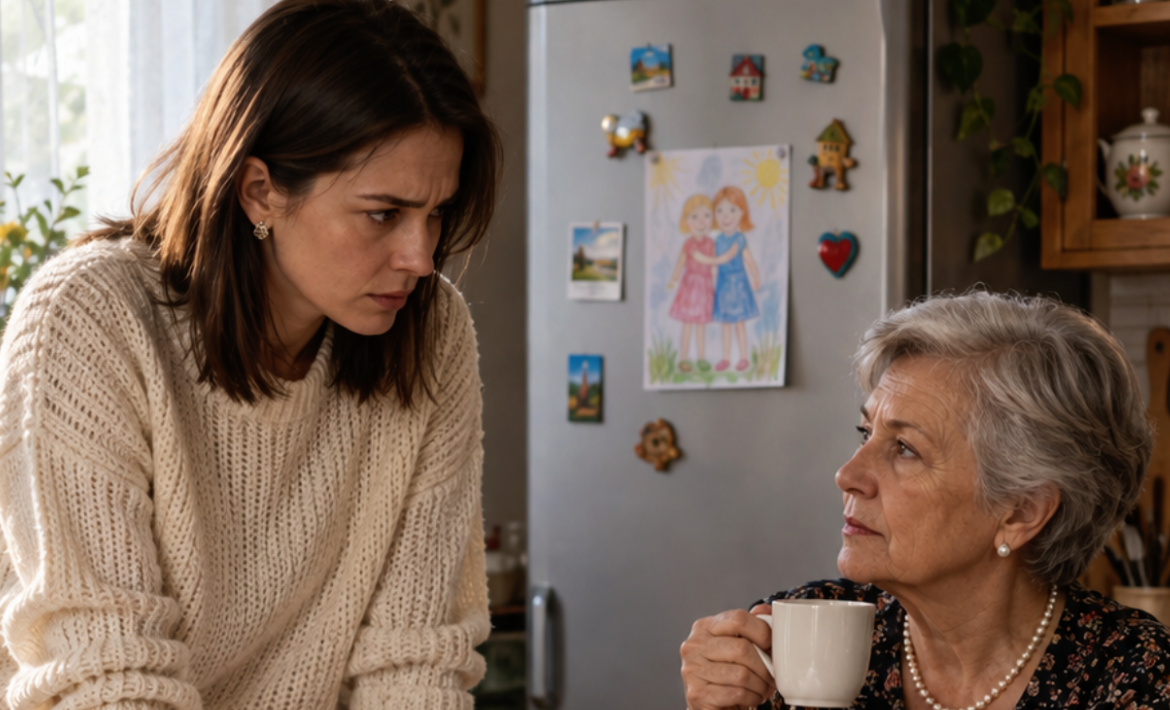
“Sign here, Anna Mikhailovna. After that, the apartment will be transferred to your mother-in-law,” the notary said without even looking up from the documents.
Anna froze, the pen still in her hand. The office smelled of old paper and peppermint candies. A cold November drizzle fell outside the window, while inside her, an entire world was collapsing.
Valentina Petrovna sat beside her with pursed lips, staring straight ahead with that air of noble patience Anna had learned to recognize perfectly during six years of marriage. It was a mask—the mask of a woman who “always wanted what was best.”
“Wait.” Anna put down the pen. “I don’t understand. This apartment belonged to my parents. What does my mother-in-law have to do with it?”
“Oh, Anya, why are you making a fuss again?” Valentina Petrovna turned toward her, her voice becoming as sweet as the fruit compote she prepared every summer while wearing that cloying smile. “We discussed everything yesterday. Sergei explained it to you.”
Sergei. Her husband. Her Seryozha, who had suddenly been “too busy at work” to come with them that morning and who had spent a long time staring silently at his phone the previous evening.
Anna felt her hands turn cold.
“No,” she said quietly. “We didn’t discuss anything. Sergei told me that some documents connected to his father’s will needed to be completed. I agreed to come.”
The notary cleared his throat, glancing from one woman to the other. Meanwhile, her mother-in-law was already taking a handkerchief from her purse, preparing to dab at dry eyes.
“My dear girl,” she began lamenting, “why are you behaving this way? I do everything for you. You’re young and inexperienced, while I’ve lived a whole lifetime. It would be better to register the apartment in my name. It would be safer that way. Taxes, inheritance—anything could happen.”
“What exactly do you mean by ‘anything’?” Anna tried to keep her voice steady, but it betrayed her with a tremor.
Her mother-in-law shook her head reproachfully.
“There you go. I open my whole heart to you, and you immediately become hostile. A typical daughter-in-law. Ungrateful.”
The word “ungrateful” sounded like a verdict. Anna had heard it in various forms for six years. “Ungrateful,” “incompetent,” “unreasonable.” Every time her mother-in-law said one of those words, she sighed softly, as though she were bearing a heavy cross.
Anna stood up and slowly returned the documents to the notary’s folder.
“I’m not signing anything today.”
“Anna!” her mother-in-law cried, jumping to her feet. “What do you think you’re doing?”
“I’m going home. And I’m going to speak to my husband.”
A damp, biting wind greeted her outside. As Anna walked toward her car, she felt everything inside her trembling—not from the cold, but from the realization.
Sergei had known.
He had known and sent her there alone because he did not have the courage to look her in the eye.
The apartment in question had come to Anna from her parents. Her mother had left her the modest two-room apartment in a quiet neighborhood as her only inheritance. It was small, but deeply precious to her.
Anna had grown up there. The old piano on which her mother had taught her to play “Moonlight Sonata” still stood inside. The old refrigerator still hummed behind the wall, and whenever Anna heard that sound, she remembered her mother’s voice:
“Well, sweetheart, would you like some tea?”
Her parents had been gone for three years now. They could no longer protect their gift.
Only Anna could do that.
When she arrived home, Sergei was sitting in the kitchen with a cup of tea, scrolling through his phone. He looked far too relaxed for someone who had supposedly been overwhelmed with work.
“You’re home?” He looked up at her and attempted a smile. “How did everything go?”
Anna placed her bag on a chair.
“You knew.”
The smile vanished from his face.
“Anya, come on…”
“You knew that your mother wanted me to transfer my apartment into her name. You knew, and you sent me there alone so you wouldn’t have to get involved, didn’t you?”
Sergei sighed in the way men sometimes sigh when they find it inconvenient to discuss money with women—with mild condescension.
“Mom is simply worried. We have that outstanding loan now, and anything could happen. If the apartment were in her name, then…”
“What difference does it make whose name it is in if the loan belongs neither to me nor to her?”
He hesitated.
“Well… if some kind of problem came up…”
“What problem, Seryozha?” Anna moved closer. “Tell me plainly. What kind of problem?”
He remained silent for a long time. Then he said quietly:
“I had to take out another loan. A small one. For Mom. She needed money to renovate the country house. She asked me, and I couldn’t refuse. And as security, I… well… verbally promised them our apartment.”
Anna sat down. She simply dropped into the chair because her legs had suddenly stopped supporting her.
“You pledged my apartment as collateral.”
“Our apartment,” he corrected her. “We’re husband and wife.”
“No, Seryozha. My mother left this apartment to me.”
The next part of the original text is damaged, but the argument ends with Anna asking whether she is now a stranger to him.
“Yes,” she said. “Starting today, I am.”
She left, quietly closing the door behind her.
Aunt Lyuda’s home was warm and smelled of apple pie. It was an old house on the outskirts of town where Anna had spent every summer as a child. Everything was different there—simple, free of tension, with no hidden meaning beneath every word.
“Tell me everything,” Aunt Lyuda said, seating her on the sofa, wrapping a blanket around her and placing a mug of tea in her hands.
Anna told her everything from the very beginning.
She told her how she had married Sergei six years earlier and how her mother-in-law had immediately begun “helping.” How Anna gradually realized that Valentina Petrovna was not helping at all—she was controlling them. How Sergei had never defended her, always finding an excuse for his mother’s behavior. How Sonya had been born and her mother-in-law had begun “raising” the girl according to her own rules. How Anna sometimes cried in the bathroom at night with the water running so no one could hear her.
Finally, she told her about that day. About the notary. About the apartment.
Aunt Lyuda listened in silence. Then she stood up, retrieved an old folder from a cabinet and placed it on the table.
“Anyuta, when your mother—my sister—was already ill, she gave this to me. Just in case.”
“What is it?”
“Copies of every document concerning the apartment. And there’s one more document that your mother drew up two months before she died. It’s a deed of gift. The apartment wasn’t merely inherited—it was specifically given to you as a gift, with a special condition.”
Anna opened the folder. Her fingers were trembling.
Among copies of various certificates lay the deed of gift. Its terms were written plainly in black and white:
“The apartment is transferred as a gift to Anna Mikhailovna with the following restriction: should any attempt be made to alienate the property—through sale, gift, or collateral—within twenty years of the date of execution, the gift shall return to the estate and pass to the alternate heir, Lyudmila Mikhailovna.”
Anna looked up at her aunt.
“So that means…”
“It means that if you ever decide—or are forced—to sell or transfer the apartment, it will automatically pass to me. I’ll return it to you once everything has settled down. Your mother thought of everything, Anyuta. She didn’t trust your Seryozha. Forgive me for not telling you sooner. I hoped perhaps it would never come to this.”
Anna rested her head on her aunt’s shoulder and cried for the first time that day. Not from sorrow, but from relief—from the realization that her mother was still protecting her, even from beyond the grave.
“Thank you, Mom,” she whispered.
The following morning, Anna returned home. She was alone, carried no bags and felt calm. Copies of the documents were in her handbag. The originals remained with her aunt in a secure safe.
Sergei opened the door looking disheveled. Apparently, he had spent the night on the sofa.
“Anya, finally. Mom was so upset yesterday that her blood pressure shot up. Come inside. Let’s talk.”
“Is your mother here?”
“No, she went home.”
“Good.”
They went into the kitchen. Anna sat opposite her husband and placed the folder in front of him.
“What is this?”
“Open it.”
Sergei opened the folder and read slowly. Anna watched his expression change from confusion to surprise, from surprise to bewilderment and from bewilderment to panic.
“So… the apartment can’t be transferred?”
“It can. But if it is, it will pass to my aunt. You’ll be left without the property you gave as your ‘verbal guarantee.’ Your mother will also get nothing. And I’ll remain with an aunt who loves me.”
“Anna…” He ran a hand over his face. “Why didn’t you tell me this before?”
“Because you never asked. You simply decided that my apartment was ‘our’ apartment. My mother-in-law decided it was her apartment. Somehow, I got lost amid all the decisions the two of you were making.”
Sergei remained silent for a long time. Then he said quietly:
“I was a fool.”
“Yes.”
“Did Mom really intend simply to transfer it into her name?”
“Your mother wanted to keep you under her control for the rest of your life, Seryozha. She also wanted me to be blamed for every misfortune. Do you think she truly needs that country house? What she needs is power—over you, over us and over Sonya.”
Sergei remained silent for a long time. Finally, he asked:
“What am I supposed to do now?”
Anna exhaled.
“Seryozha, I’ll give you one chance. One. Do you hear me? One chance. That isn’t a threat. It’s a fact.”
He looked up at her.
“First, you will speak to your mother yourself, without me. You’ll tell her she isn’t getting any apartment—neither mine nor anything belonging to us. You’ll also tell her that she is no longer welcome in our home unless I invite her. And you will take back her keys.”
“But…”
“No ‘buts.’ Second, you will repay that loan yourself. How you do it is your problem. Sell your car, find an additional job—do whatever you need to do. That loan has nothing to do with me.”
“Anna, that’s…”
“Third, we’re going to a marriage counselor. I want to save our family, but not at the expense of my own life. If you hide behind your mother again, I’ll file for divorce. And you won’t see Sonya or me nearly as often as you would like. That isn’t blackmail. It is a boundary.”
Sergei sat there, pale. Apparently, for the first time in all those years, he truly heard his wife—not as a mother, a companion, or someone who existed to serve him, but as a human being with conditions of her own.
“I… I agree.”
“Don’t agree with me. Speak to your mother. And don’t come back until you have.”
He left that same evening.
Anna remained alone in her apartment. She opened the old piano and ran her fingers over the keys. Somewhere inside her, beneath the familiar exhaustion, a new feeling suddenly appeared.
Peace.
Real peace, not something forced or artificial.
For the first time in six years, she truly felt at home in her own home.
Sergei’s conversation with his mother was long and loud. Anna learned about it from Valentina Petrovna’s neighbors, one of whom, as it turned out, had long been friends with an acquaintance of Aunt Lyuda.
Her mother-in-law screamed that she had been “deceived,” that her “daughter-in-law had turned her son against her,” and that “now she would tell everyone what an ungrateful woman he had married.”
According to the neighbors, Sergei raised his voice at his mother for the first time in his life. He said that if she ever called his wife “barren” again, he would never want to see her.
Valentina Petrovna refused to speak to her son for a week. Then she called him herself and suggested they “have some tea.”
Sergei replied, “Mom, only if you respect Anna. Otherwise, no.”
His mother sighed at length into the phone, but eventually agreed.
She and Sergei came to see Anna together two weeks later.
Valentina Petrovna was unusually quiet. She did not attempt to take charge in the kitchen. She did not criticize Sonya’s drawing on the refrigerator. Only once, while Anna was pouring the tea, did she speak.
“Anya… I feel ashamed. I suppose I was wrong.”
“About what exactly, Valentina Petrovna?”
Her mother-in-law hesitated. Anna had no intention of helping her. She would have to say it herself.
“I was wrong to interfere in something that was none of my business. The apartment. And… everything else.”
“I accept that.”
“Do you forgive me?”
Anna looked at the woman who had made her life unbearable for six years. For the first time, she did so without anger or resentment.
“I don’t forgive you, Valentina Petrovna. Not yet. But I’m prepared to try again—under new conditions.”
“What conditions?”
“You visit only when you are invited. You don’t discuss me with the neighbors. You don’t interfere with the way we raise Sonya. And you will never—do you hear me?—never use the word ‘barren’ in my presence again.”
Her mother-in-law lowered her head.
“All right.”
“Then let’s have some tea.”
A year passed.
Anna and Sergei attended marriage counseling for six months. It was difficult. Sometimes they argued after their sessions. Sometimes they did not speak to each other for an entire day.
Gradually, however, Sergei learned how to be a husband instead of merely a son. He learned to say no to his mother. He learned to say yes to his wife.
He repaid the loan. He sold his car and began using public transportation. He never reproached Anna for it—not even once.
Valentina Petrovna visited them once a month. She always brought gifts for Sonya and always behaved with restraint. Once she even brought Anna a jar of apricot jam from her garden. She did not say anything about it; she simply placed it on the table.
Perhaps that was her way of apologizing.
The apartment remained Anna’s. She kept the deed of gift with its special restriction.
One day, after all their reconciliations, Sergei said to her:
“Anya, your mother saved me.”
“From what?”
“From myself.”
Sonya was now seven. She played the same piano Anna had played as a child. She smeared jam on the keys, and no one scolded her. Grandma Valya, as Sonya called her, came over on Saturdays and taught her how to make pancakes.
Sometimes Anna caught herself thinking that she was a different kind of daughter-in-law now—not the woman who remained silent, nor the woman who hid her tears, but a woman who knew her own worth.
Whenever one of her new acquaintances complained about her mother-in-law, Anna did not offer advice.
She simply said:
“Your home is your home. No one has the right to decide how you should live in it.”