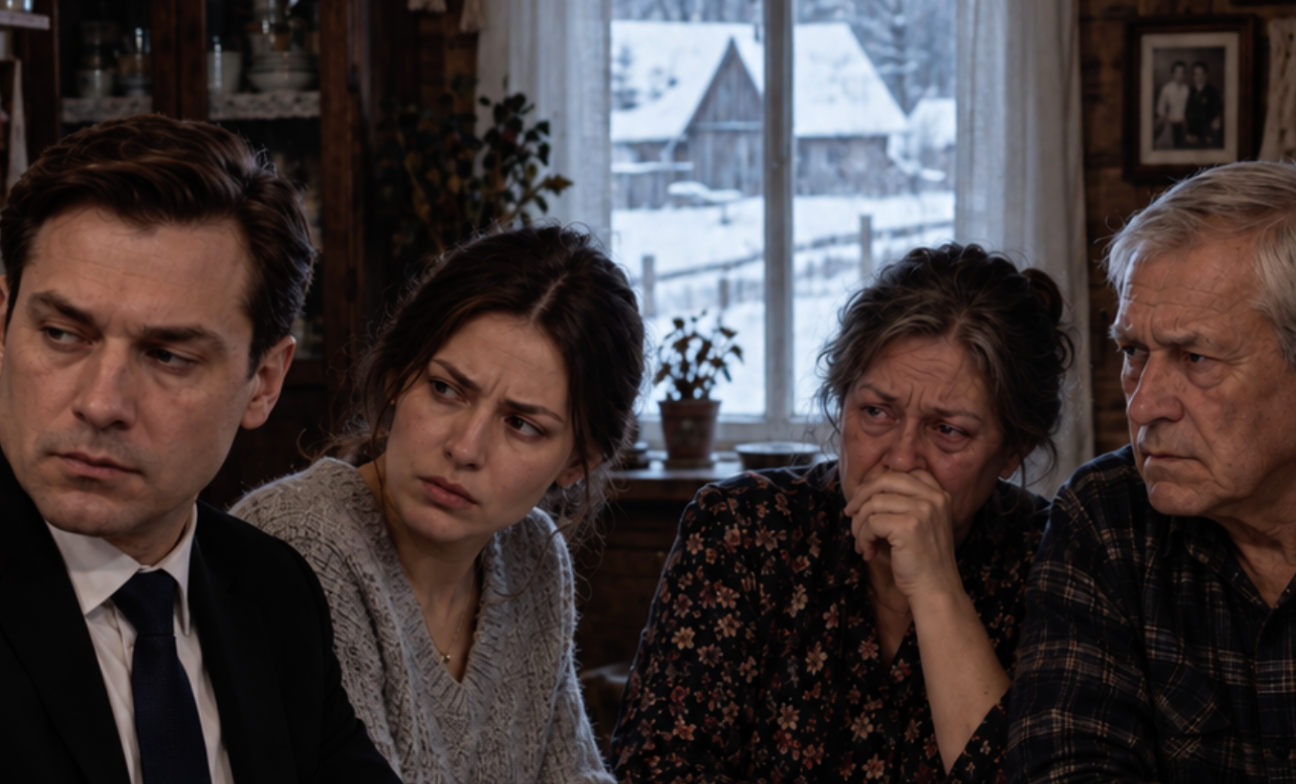
She Brought Her Big-City Fiancé to a Remote Village — One Dinner Was Enough to Make Her Mother Cry and Her Father Understand Everything
Nikolai Stepanovich Morozov, fifty-three years old, stood by the window and stared at the road. The road was empty. He had already been standing there for half an hour, even though his daughter was not expected for another two or perhaps three hours—who knew how well the navigation system worked out here.
His wife, Valentina Petrovna, was bustling around the kitchen, clattering pots, checking the oven, straightening the curtains, and asking every few minutes whether they were coming yet.
“Still can’t see them, Valya,” Nikolai Stepanovich replied. “Tell me something else—why did you make so much food? Are you planning to feed an entire platoon?”
“It’s not a platoon,” Valentina Petrovna answered. “It’s her fiancé. From the capital. Everything has to be done properly.”
“Properly means being happy to see your guest, not working yourself to death,” Nikolai Stepanovich grumbled, though there was no real irritation in his voice.
He was not an ill-tempered man by nature. He had spent his entire life working on the farm—first as a machine operator, and later, when his knees began to fail him, in the repair workshop.
His hands were heavy, covered in dark cracks stained with diesel fuel and grease that no soap could fully wash away. His face was weather-beaten and deeply lined around the eyes. His eyes themselves were pale and attentive, with that peculiar squint common to people accustomed to looking into the distance—across fields, rivers, and roads.
Katya was their late and only child. She had been born when Nikolai Stepanovich was almost thirty and Valentina Petrovna was twenty-seven.
They had poured their whole souls into raising her.
And she had grown up intelligent and beautiful. She graduated from school with honors, moved to the capital to study, earned her degree, and found a job—at a bank or perhaps an insurance company; her father had never quite remembered.
And now she was coming home.
Not alone.
She was bringing her fiancé.
“What did you say his name was?” Nikolai Stepanovich asked for perhaps the tenth time.
“Artyom. Artyom Andreyevich. His last name is Strelnikov. Please remember it this time, Kolya.”
“I remember. Strelnikov. Like a machine gun.”
“It’s not a machine gun. It’s his surname. He comes from a good family. His father is a professor, his mother is a doctor. And he works for some company—he’s either a director or something like that.”
“So he’s rich.”
“Probably. Katya said he has his own apartment and a good car.”
Nikolai Stepanovich sighed.
An apartment. A car.
Those things sounded like words from a completely different world.
He lived in a wooden house on the edge of the village, a house he had built and repaired with his own hands. He had a vehicle too—an old UAZ that he used to go mushroom picking or drive to the district center for spare parts.
Maybe once a month.
No more than that.
A fiancé from the capital.
Nikolai Stepanovich did not quite understand what that meant.
And because he did not understand it, it worried him.
He spotted the car from far away.
It was not a Niva or a UAZ coming down the road but something black, gleaming, and low—nothing like it had ever appeared in their village before.
It carefully maneuvered around the potholes, practically crawling, and Nikolai Stepanovich suddenly felt something resembling embarrassment.
Not for himself.
For the road.
“They’re here!” he shouted. “Valya, they’re here!”
Valentina Petrovna rushed onto the porch still wearing her apron, her hands dusted with flour, her cheeks flushed.
She stood beside her husband, and together they watched the black car pull up to the gate.
Katya stepped out.
For a moment Nikolai Stepanovich froze.
She had changed so much.
Not in a bad way, no.
She was simply different.
A fashionable haircut, a city coat, heeled boots, a handbag over her shoulder.
Her familiar features were still there—the same gray eyes, the same smile—but everything else seemed unfamiliar.
He hugged her and caught the scent of her perfume, delicate and strange, and suddenly realized that his daughter no longer belonged entirely to him.
Part of her life was now somewhere else.
In the capital.
In an apartment.
In an office.
And he would have to get used to that.
“Dad! Mom!” Katya laughed as she hugged her mother. “Meet Artyom!”
Artyom got out of the car.
He was tall and slim, wearing an expensive coat and polished shoes that immediately sank into the snow-dusted mud.
His light-colored hair was perfectly styled. Thin-framed glasses sat neatly on his face.
His smile was straight and white, like something from a toothpaste commercial.
“Hello!” Artyom said. “I’m very happy to finally meet you!”
Nikolai Stepanovich shook his hand.
Artyom’s hand was soft and warm, without a single callus.
The kind of hand suited for holding a phone or an expensive pen, Nikolai Stepanovich thought.
Not an axe.
Not a hammer.
Not a wrench.
“Welcome,” Nikolai Stepanovich said. “Come inside.”
For the first half hour, everything went well.
Artyom smiled, said pleasant things, and complimented the house.
“It’s so cozy,” he said, looking at the log walls.
“So authentic,” he added when he saw the traditional Russian stove.
Valentina Petrovna practically glowed with pleasure.
Nikolai Stepanovich remained silent and watched.
Then Artyom asked where the electrical outlet was so he could charge his phone.
After that, he asked for the Wi-Fi password.
They explained that there was no Wi-Fi in the house. They used mobile internet, and even that only worked properly near the window.
Artyom smiled, but his smile became slightly strained.
“No problem,” he said. “I’ll survive. Katya, you never told me this place was so… cut off from civilization.”
“It’s not cut off,” Katya said. “It’s just a village.”
“Yes, yes. Of course.”
They sat down to eat at one in the afternoon.
Valentina Petrovna had gone all out.
There were dumplings, fish pies, aspic, pickled mushrooms, potatoes with meat, cloudberry compote, and many other dishes.
The table was overflowing with food.
“Wow!” Artyom said, looking at the spread. “There’s enough here for an entire week!”
“Eat, eat,” Valentina Petrovna fussed. “You’ve had a long journey.”
Artyom sat down, carefully unfolded his napkin over his knees, and picked up his fork and knife, holding one in each hand in a foreign manner.
Nikolai Stepanovich glanced at him but said nothing.
After all, everyone ate the way they were used to.
For the first ten minutes, they ate mostly in silence.
Artyom prodded a dumpling with his fork, carefully cut off a small piece, put it into his mouth, and chewed for a long time.
“Very delicious,” he said. “Homemade food. That’s rare nowadays. In the city, everyone orders delivery.”
“Have you ever tried cooking yourself?” Valentina Petrovna asked.
“No time. Work. I’m in IT. We have irregular hours. You know—startups, investors… Cooking is an unaffordable luxury when it comes to time.”
Nikolai Stepanovich thought that repairing tractors in an unheated workshop also took ten or twelve hours a day.
And somehow, despite that, he still managed to heat the stove, carry water, and chop firewood.
But he kept quiet.
Little by little, the conversation became livelier.
They talked about the city and work.
Artyom spoke about his business, showering them with expressions such as “venture investments,” “product scaling,” and “expansion into new markets.”
Valentina Petrovna nodded with a polite smile, clearly understanding none of it.
Katya looked at Artyom with admiration.
Nikolai Stepanovich listened and waited.
What exactly he was waiting for, he could not have said himself.
But some instinct developed over decades of working with machines and people told him:
Don’t rush.
Watch.
Listen.
A part that does not belong will always reveal itself eventually.
And this one did.
“Artyom Andreyevich,” Nikolai Stepanovich said while pouring himself some compote, “tell me something. You seem to be a successful man. Everything is going well for you. So why do you need my Katya? What attracted you to her?”
Valentina Petrovna froze with her spoon in her hand.
Katya blushed.
It was a village-style question—direct, without delicacy or beating around the bush.
Artyom smiled.
The same smooth, practiced smile.
“That’s a good question. Katya is special. She’s sincere. Genuine. You understand, in the city everyone is somehow artificial. Everyone chases status, money, likes on social media. But Katya is different. She comes from a simple family, from the countryside. She has this sort of… natural purity. Innocence. That’s very rare.”
He spoke smoothly and confidently, as though he had said these words before.
But Nikolai Stepanovich suddenly stopped chewing.
“A simple family.”
“From the countryside.”
“Natural purity.”
The words sounded correct.
Beautiful, even.
But there was something hidden inside them that slowly made Nikolai Stepanovich clench his jaw.
“And another thing,” Artyom continued. “Katya is very capable. She simply lacked… let’s say, the right environment. Opportunities. When we get married, I’ll help her reach her full potential. Improve her language skills, find a stylist, perhaps get another degree. I have connections. I can get her a position at a respectable company. The important thing is that she wants to develop, and Katya does.”
Valentina Petrovna put down her spoon.
Katya stared at her plate.
The flush on her cheeks was no longer caused by embarrassment.
It was something else now.
“What exactly is wrong with Katya as she is?” Nikolai Stepanovich asked evenly.
Artyom did not notice the trap.
In fact, he seemed not to notice many things.
“How can I explain it… She’s wonderful, don’t misunderstand me. But you have to understand too: the capital has a certain level. Different standards. Different expectations. A person has to meet them. Katya cooks beautifully, she’s caring, she’ll make an excellent homemaker. In that sense, a village upbringing is actually an advantage. But in other areas she needs to… improve a little.”
“Improve,” Nikolai Stepanovich repeated. “Up to your level.”
“Up to the general level of our social circle.”
Silence fell over the table.
They could hear the crackling firewood in the stove and the wind moving the bare birch branches outside.
Katya looked up at her father.
There were tears in her eyes.
She had heard it too.
Perhaps in the city, in cafés filled with traffic noise and music, those words had sounded different.
But here, in the silence of her childhood home, sitting at a table covered with an embroidered tablecloth, their true meaning had been exposed.
“Artyom,” Katya said quietly, “do you really think I need to be ‘improved’?”
“Katya, don’t take it the wrong way,” Artyom said, finally sensing that the atmosphere had shifted. “That’s not what I meant. You’re very smart. You learn incredibly quickly. I just want you to have the best of everything. So you don’t have to… well… settle for less. Like here.”
And he gestured around the room.
That careless, almost disdainful gesture said more than all his previous words.
The wooden walls.
The simple furniture.
The embroidered curtains.
The old stove.
All of it, apparently, was “less.”
Something a person had to “settle for.”
Valentina Petrovna began to cry.
Quietly.
Soundlessly.
Her lips trembling.
Nikolai Stepanovich said nothing.
He looked at Artyom and thought.
He thought about how this young, handsome, successful man failed to understand the most important thing.
He did not understand that Valentina Petrovna had embroidered those curtains late at night when Katya was a little girl.
That Nikolai Stepanovich had built this table himself, with the same hands that now smelled not of perfume but diesel fuel.
That he had heated that stove through every illness Katya had suffered as a child—croup, tonsillitis, colds.
Every object in the house had been built, bought, repaired, or preserved through labor, sweat, and love.
And that was not “less.”
That was everything.
“Artyom Andreyevich,” he finally said, “have you ever cut grass?”
“What?” Artyom asked, confused.
“Grass. With a scythe. By hand.”
“No. Why would I? There are lawnmowers for that. Or gardeners.”
“Have you ever heated a stove?”
“No. We have central heating in the city.”
“Ever dug potatoes?”
“I don’t understand where these questions are going.”
Nikolai Stepanovich stood up from the table.
He was not a tall man, but at that moment he somehow appeared much larger to Artyom than he had a minute earlier.
“I’ll tell you where they’re going. You came into a house where every single object is part of someone’s life. This table took me ten evenings to build. Those curtains cost your future mother-in-law her eyesight while she embroidered them. This stove got my daughter through fifteen years of childhood illnesses. And you sit here and call all of this ‘less.’ You say she needs to ‘improve’ to reach some level of yours. Do you understand, Artyom, that your level is measured only in money, while ours is measured by something else?”
Artyom remained silent.
His glasses reflected the light from the lamp.
“I didn’t mean to offend anyone,” he finally said. “I respect your way of life and your traditions. But life changes. You can’t live in the past forever.”
“Who told you we live in the past?” Nikolai Stepanovich asked. “We live in the present. Our present. And Katya grew up in this present. She knows what work means. She knows what family means. She knows what it means to help each other, not because it’s fashionable, but because there is no other way to live. And what do you know? Besides your ‘venture investments’?”
Artyom removed his glasses and wiped them.
His hands were trembling.
“I love your daughter,” he said.
“Maybe you do. But love isn’t about remaking someone into what you want them to be. Love is accepting them as they are. Without all this ‘improving.’”
Katya suddenly stood up.
She walked over to the window and stared at the river for a long time.
Her shoulders trembled.
“Katya,” Artyom said, “let’s go outside and talk.”
They left.
Nikolai Stepanovich and Valentina Petrovna remained alone.
Her mother wiped her tears with the corner of her apron.
Her father sat with his hands folded on the table, staring at one point.
“Kolya,” Valentina Petrovna whispered, “maybe you shouldn’t have done that. Maybe it was too much?”
“What would have been wrong was staying silent,” Nikolai Stepanovich replied.
Katya and Artyom stood beside the car.
The wind blew Katya’s hair around and slipped beneath her coat.
Artyom was saying something quickly and passionately, gesturing with his hands.
Katya said nothing.
Nikolai Stepanovich watched them through the window and thought that perhaps he had just lost his daughter.
That she would climb into that black car and drive away to the place with its different standards, different expectations, and different life.
And it would be his fault.
He had failed to control himself.
He had interfered with his blunt village honesty.
He had ruined everything.
But then Katya said something to Artyom.
Something short.
Just a few words.
Artyom froze.
Then he abruptly turned around, got into the car, and drove away.
Alone.
Katya stayed.
For a while, she stood watching the car disappear.
Then she turned and walked back toward the house.
She came inside.
Took off her coat.
Sat at the table.
Looked at her mother.
Then at her father.
“Dad,” she said, “pass me the dumplings. I’m still hungry.”
Nikolai Stepanovich pushed the plate toward her.
Valentina Petrovna, still sniffling, poured her some compote.
“How are you?” her father asked.
“I’m okay. To be honest, I’ve been feeling for about a month that something wasn’t right. And today… it was like a veil suddenly lifted from my eyes. Thank you, Dad.”
“For what?”
“For saying to him what I was afraid to admit even to myself.”
Nikolai Stepanovich said nothing.
He watched his daughter eat the dumplings—the same homemade dumplings her mother had made—and felt a strange sense of relief.
Not happiness.
Happiness was still far away.
But relief.
As though a heavy stone had fallen from his chest, one whose existence he had never even noticed before.
That evening, the three of them sat together by the stove.
Katya talked about work, the city, and her friends.
Valentina Petrovna laughed, asked questions, and reacted with surprise.
Nikolai Stepanovich remained mostly silent, but his silence was warm.
He looked at his daughter and thought that she had grown up.
Not simply moved away to the city.
Truly grown up.
Because real growth meant being able to hear the truth and accept it.
Even when the truth was bitter.
“Dad,” Katya said when her mother went to put the kettle on, “do you really believe love means accepting someone exactly as they are?”
“I do.”
“What if that person wants to change? If they want it themselves?”
“That’s different. Then help them. But not so they can fit somebody else’s standard. Help them become more truly themselves.”
Katya thought about that.
The stove hummed.
Outside, snow was falling in large, soft flakes, just like when she had been a child.
“You know,” she said, “when I lived in the city, I was constantly trying to prove something to someone. That I wasn’t some country bumpkin. That I could measure up. That I was just as good as everybody else. And today I suddenly realized something: I don’t have to prove anything to anyone. I’m me. This is who I am. With dumplings and a wooden table. And if somebody doesn’t like that, that’s their problem.”
Nikolai Stepanovich nodded.
Then suddenly he asked:
“Did you even really like him?”
Katya remained silent for a long time.
“I thought I did. But now I understand I wasn’t in love with him. I was in love with his life. It looked beautiful. Easy. I thought something like that would never happen to me. And when it finally did, I became afraid. I thought if I turned him down, I would never get another chance. So I tolerated things.”
“What things?”
“The way he was rude to waiters. The way he talked about my friends. The way he said my education was ‘just for show.’ I put up with all of it and kept convincing myself it was normal.”
“It isn’t normal,” Nikolai Stepanovich said.
“I know that now.”
Valentina Petrovna returned with the tea.
She poured it into mugs, sat beside her daughter, and wrapped an arm around her shoulders.
The three of them sat together beside the hot stove, drinking tea with cloudberry jam in silence.
But this silence was not heavy like the silence during dinner.
It was light.
The kind of silence that exists between people who understand each other without words.
The next day Katya was leaving.
Nikolai Stepanovich walked her to the bus stop.
They crossed the entire village on foot, following the snow-covered road past old wooden houses, a crooked fence, and birch trees whose branches bent beneath the weight of the snow.
“Listen,” Nikolai Stepanovich said, “don’t disappear on us when you’re in the city. If anything happens, come home.”
“I will. Definitely.”
“And don’t forget your mother. Call her. She waits for you.”
“I do call.”
“Call more often.”
Katya smiled and hugged her father.
He smelled of diesel fuel and wood smoke, exactly as he had throughout her entire life.
“Dad,” she said, “have you ever regretted spending your whole life here? In the village? Never moving to the city?”
Nikolai Stepanovich thought about it.
The bus was already visible in the distance—old and rattling, its sides covered with advertisements.
“You know, sweetheart,” he finally said, “maybe I haven’t seen much of the world. But I stood in my own place. I built a house. I raised you. And I never bowed my back to anyone. And you know what? That’s worth more than many a city.”
The bus arrived.
Katya hugged her father one last time and climbed aboard.
Nikolai Stepanovich stood by the roadside and watched the bus disappear along the snow-covered road.
Then he turned around and walked home.
His heart was peaceful.
More peaceful than it had been in a very long time.
He knew his daughter would return.
Maybe not to the village—she had her own life in the city.
But she would return to herself.
To the Katya who loved dumplings and was not ashamed of a wooden table.
To the Katya who did not need to be “improved,” because she was already exactly where she belonged.
And everything else would fall into place.