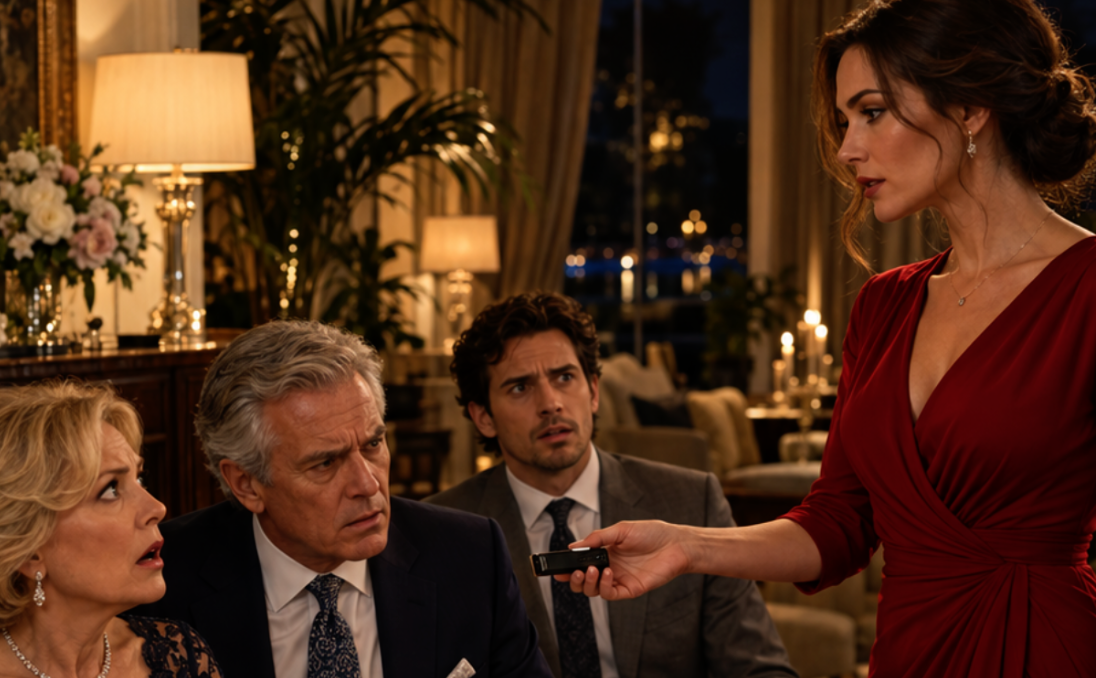
My Wealthy Future In-Laws Thought I Was Poor, and I Didn’t Correct Them. I Showed Up in a House Dress — and Turned the Entire Dinner Upside Down
“Are you seriously wearing that?” Allina Viktorovna looked me over from the doorway, from my collar all the way down to my sneakers, making no attempt to hide her disappointment.
I was wearing a simple house dress covered in tiny flowers—the same one I usually wore when gluing veneer or taking old dressers apart. I knew exactly what I was doing. I had even deliberately skipped makeup.
“Sorry, I got held up at a job site,” I replied with a smile.
Dmitry stood beside her, his face red as though he were the one being scolded. We had been dating for a year and eight months, and in all that time I had never seen him look so uncomfortable. He took my hand, but immediately let go when his mother turned toward him.
“Come in already,” Gennady Pavlovich, Dmitry’s father, grumbled from somewhere deeper inside the apartment. He rarely spoke at all. I had noticed that during our first meeting at a café a month earlier.
The Ilyins’ apartment was enormous, with decorative molding on the ceilings and paintings that probably cost more than a year’s rent on my workshop. In the hallway stood a vase filled with dried roses, and for some reason my first thought was that our workshop would have refused to restore a vase like that—it was too obviously a modern imitation.
Allina Viktorovna owned her own real estate agency, a fact she managed to mention three times during the evening even when nobody asked. Gennady Pavlovich had once worked for the same agency but now existed only as a partner on paper.
We entered the living room.
A woman of about forty-five was already sitting at the table. She introduced herself as a family friend and immediately began asking me about the wedding date and various wedding superstitions, as though she had known me for years.
Olga was sitting nearby. I had deliberately invited her to come with me, although Dmitry had initially been surprised that I wanted to bring my business partner to what was essentially an inspection by his family.
But I felt calmer knowing that someone who understood every detail of my work was sitting beside me.
There were also two people I didn’t recognize, apparently business associates of Gennady Pavlovich. There were about seven people around the table in total, and I immediately understood that this wasn’t simply a family dinner.
It was an audition with an audience.
They didn’t seat me beside Dmitry. They placed me opposite Allina Viktorovna so she could clearly see my face and every reaction.
The table was covered with so much cutlery that I was afraid I might use the wrong piece. Three forks on one side of the plate, two knives on the other.
At home, Dmitry and I usually managed just fine with one spoon and a good mood, but here dinner seemed to have been arranged as an examination rather than an introduction.
Behind Allina Viktorovna, I counted three framed certificates hanging on the wall—apparently awards from her real estate agency, carefully displayed for guests to admire.
“Dmitry said that you… do something for work?” Allina Viktorovna asked as she poured wine, deliberately skipping my glass.
“I work with my hands,” I answered honestly.
“Well, imagine that.” She smirked and exchanged a glance with her friend. “Nowadays it’s rare to find a young woman who isn’t afraid of physical labor. Admirable.”
I said nothing.
Something tightened inside me, but I had already made a firm decision: tonight, I would answer only what I was asked and say nothing more.
Olga, my business partner, had warned me that morning.
“Are you sure you want to go looking like that? Maybe you should at least wear a nicer dress?”
I had said no.
If Dmitry’s family was going to accept me because of who I was rather than what I was wearing, then I wanted to find out.
“So where did you two meet?” one of Gennady Pavlovich’s business associates asked, looking at me with the curiosity usually reserved for a museum exhibit.
“At a crafts fair,” Dmitry answered for me. “Marina restores furniture.”
“Restores furniture,” Allina Viktorovna repeated in the tone someone might use to announce a diagnosis. “So you paint chairs?”
“Not exactly,” I replied gently. “We work with antiques, rare woods, historical pieces.”
“We?” she repeated with another little laugh. “Are you an employee, or…?”
“I have my own business,” I answered briefly.
For the first twenty minutes, I stuck to that strategy: short answers, no details, no arguing.
During that time, Allina Viktorovna commented on my appearance twice. First my dress, then my “simple” earrings.
I didn’t react.
Instead, I silently counted the little insults in my head.
One. Two.
I wasn’t even sure why I was counting them. Probably so I wouldn’t lose my temper too soon.
“Your own business,” she repeated, as though she had just tasted a dessert she disliked. “Well, God willing, I hope it earns enough to at least pay the rent. Dima, your salary is decent, isn’t it? I hope you aren’t planning to live on her income.”
Dmitry opened his mouth to say something but stopped.
He had always become strangely helpless around his mother. I had noticed it long ago and usually forgiven him for it. You don’t immediately see every side of a person’s character, and Dmitry was kind and attentive when we were alone.
But sitting at that table, his silence hurt more than usual.
“Speaking of income,” Allina Viktorovna continued, clearly beginning to enjoy herself, “Gennady and I have wanted to ask you something. Are you expecting us to help pay for the wedding? Of course, we’re prepared to cover the expenses, since the young couple apparently doesn’t have much money.”
That was the first crack in my patience.
After twenty minutes of polite silence, I finally decided to give more than a one-word answer.
“We’re perfectly fine financially,” I said calmly. “I simply don’t think it’s appropriate to discuss income at the dinner table with people I barely know.”
“Barely know?” She raised an eyebrow. “We’re going to be one family soon.”
“We’ve known each other for only a few hours,” I pointed out. “And income is a personal matter, even within a family.”
One of Gennady Pavlovich’s associates gave a quiet snort into his wineglass, while the family friend immediately found a reason to change the subject to the weather.
Allina Viktorovna pressed her lips together, but she didn’t retreat.
She simply changed tactics, clearly preparing her next attack.
Over the next twenty minutes, she managed to comment on my hands.
Apparently, the calluses from my work weren’t “feminine.”
After that remark, I went silent again, returning to my previous strategy: short answers, no opportunities for her to grab onto anything.
The truth was that I worked with my hands every day.
I sanded wood, applied lacquer, matched stain shades to old timber.
And I found it strange that I should be embarrassed about that in front of someone who had already bragged about her own real estate agency three times during dinner.
The only difference was that my work left marks on my hands, while hers left marks on business cards.
“You know,” Allina Viktorovna suddenly said, brightening as she poured herself another glass of wine, “I recently had an experience with furniture restoration myself. I had an antique table restored—it belonged to my grandmother. I gave it to some workshop six months ago, and you wouldn’t believe how much they charged me!”
“How much?” her friend asked curiously.
“Two hundred and sixty thousand!” Allina Viktorovna threw up her hands as if she had been robbed in broad daylight. “I was furious. I called them, argued with them, told them it was highway robbery. And they kept saying the restoration was complicated, the wood was rare, everything was done by hand. What difference does it make whether it’s handmade or not? I think it’s simply outrageous to take advantage of someone because the table has sentimental value.”
I froze with my glass of water in my hand.
Something familiar stirred in my memory.
A table.
Oak.
Late last year.
A client who had arranged everything through our manager and spent ages arguing about the price over the phone. She never came personally to collect the finished piece and sent a driver instead.
Olga had laughed about her afterward.
“What a personality. She called ten times and bargained as if she were at a street market.”
My fingers suddenly turned cold despite the warmth of the room.
Could this really be that same customer?
I quickly calculated everything in my head.
Three weeks of work.
The most complicated carving we had handled all year.
A crack running all the way through the tabletop that had to be pulled together manually.
Olga and I had agreed to accept the job only because the wood was unusual—bog oak, the kind you could hardly find anymore.
“Which workshop did you use, if you don’t mind me asking?” I said, trying to keep my voice steady.
“Oh, I don’t even remember the name. Somewhere on the outskirts,” she said dismissively, waving her hand. “I only know that some young girl was running the whole place. Can you imagine? Her own workshop, and yet she charged prices like she was in the capital.”
Dmitry glanced at me.
He was the only person at the table who had already begun to understand that something strange was happening, although he hadn’t quite put the pieces together yet.
“Allina Viktorovna,” I finally said, “don’t you find it strange to pay that kind of money to a workshop you didn’t even bother learning anything about? Two hundred and sixty thousand isn’t exactly pocket change to hand over blindly.”
She stared at me in surprise.
“How do you even know the amount? I never told you the number.”
“You said it out loud a couple of minutes ago, in front of everyone,” I replied. “I simply repeated it.”
“That’s different,” she brushed me off, apparently not embarrassed in the slightest. “Quality work is one thing. The source of income of my future daughter-in-law is another.”
“I think they’re exactly the same thing,” I said. “You simply still don’t know where the quality work on your table came from.”
Her eyes narrowed.
Instead of answering, she turned toward her son.
“Dima,” she said in a different voice now, quieter and harder, “perhaps you should seriously think about this wedding again. Why rush when you haven’t even figured out who the person in front of you really is?”
That was the moment something inside me finally tightened completely—not from hurt, but from a cold, clear realization.
There was no point in politely tolerating this anymore.
My fingers closed around my glass, but when I spoke, my voice was unexpectedly calm.
“Allina Viktorovna,” Olga said suddenly, pulling out her phone, “was that table made of oak, by any chance? Carved legs, with a crack running down the center of the tabletop?”
The woman stared at her in confusion.
“Yes, exactly… How do you know?”
Olga held out her phone.
On the screen was a photograph of the finished restoration together with a delivery document dated November of the previous year.
The amount was two hundred and sixty thousand.
Everything matched down to the last ruble, and the crack in the photograph looked exactly as Allina Viktorovna had just described it.
“That was an order from our workshop,” Olga said calmly. “Marina personally supervised the restoration of this table. Bog oak, hand-carved legs. We don’t accept projects like that very often because they require so much work.”
The table fell silent.
Allina Viktorovna looked from the phone to me and back again, as though trying to decide whether we were playing some elaborate joke on her.
“So you…” she began.
“Co-owner,” I answered. “For three years now. We have four workshops in the city and twelve employees. I personally handle the complicated projects—antiques, rare wood, historical pieces. I worked on that particular table myself, and the price we gave you was fair.”
A murmur immediately went around the table.
Gennady Pavlovich’s business associate coughed awkwardly.
The family friend lowered her eyes toward her plate, suddenly finding something there incredibly fascinating.
Since I had already begun, I decided I might as well finish. There was no reason to stop halfway.
“But why did you…” Allina Viktorovna tried to regain her composure. “Why didn’t you say something immediately?”
“Did you ask?” I looked straight into her eyes. “All evening, the only time you asked what I do for a living was so you could laugh at the answer. You decided I was poor before I had even stepped through your doorway—because of my dress, my earrings, my hands. And even when I honestly told you I had my own business, you didn’t want to know anything more. It was easier for you to assume I was planning to live off your son.”
“Marina,” Dmitry said quietly.
But I didn’t stop.
“I deliberately came here wearing this dress,” I continued. “I wanted to see why I would be accepted into this family—because of who I am, or because of what I appeared to be on the outside. I had my answer even before the story about the table. You criticized my clothes and my hands twice without once asking what I actually do with my life.”
For the first time that evening, Gennady Pavlovich lifted his head from his plate and gave his wife a long look.
But he said nothing.
Just as he always did.
“You could have warned me,” Allina Viktorovna finally managed, although she no longer sounded nearly as confident.
“Warned you about what?” I asked. “That I don’t dress to impress people? Or that I earn my own money instead of waiting for an inheritance from my husband?”
She opened her mouth but couldn’t find an answer.
For the first time that evening, true silence settled over the table.
Not the polite kind that comes between courses, but a heavy, uncomfortable silence that makes you want to stand up and leave.
Under the table, Dmitry took my hand.
His fingers were cold.
Mine, on the other hand, felt as though they were burning, like I had just finished a physically exhausting job.
And in a way, I had.
I had finished the work of finally saying aloud everything I had been holding inside all evening.
“I think it’s time for us to go,” I said, standing.
Nobody tried to stop us.
Even the family friend who had been questioning me about wedding superstitions an hour earlier was now carefully studying the tablecloth.
Dmitry followed me out, still holding my hand.
Only when we were inside the elevator did he finally exhale.
“I’m sorry. I should have stepped in sooner.”
“You don’t have to apologize for your mother,” I replied. “But you shouldn’t sit there silently next time either. If there is a next time.”
He nodded, but somewhat uncertainly, as though he still hadn’t fully processed what had happened at dinner.
At that moment, I actually felt sorry for him.
He had found himself caught between two women, each convinced that she was right.
Outside, the air was cool, and for the first time all evening I took a deep breath.
My shoulders relaxed on their own, as though some invisible weight had finally been lifted from them.
My hands were no longer trembling.
Apparently, my body had understood before my mind did that it was over.
Two months passed.
Allina Viktorovna hasn’t called or written to me.
Not a single message.
Dmitry visits his parents alone, usually on weekends, and comes back tired and unusually quiet.
Through mutual acquaintances, I’ve heard that Allina Viktorovna tells everyone that her son’s fiancée created an absolute circus in her home.
Meanwhile, I opened my fifth workshop.
And I still work with my hands—the very same hands someone once considered insufficiently feminine.
In the evenings, the air still smells of varnish and wood stain.
And I’m perfectly happy with that.
Sometimes the truth about a person isn’t revealed by an expensive outfit.
It’s revealed by the way they treat someone before they know who that person really is.
That evening simply showed me why I would be accepted into that family—and that was enough for me to stop proving anything at all.