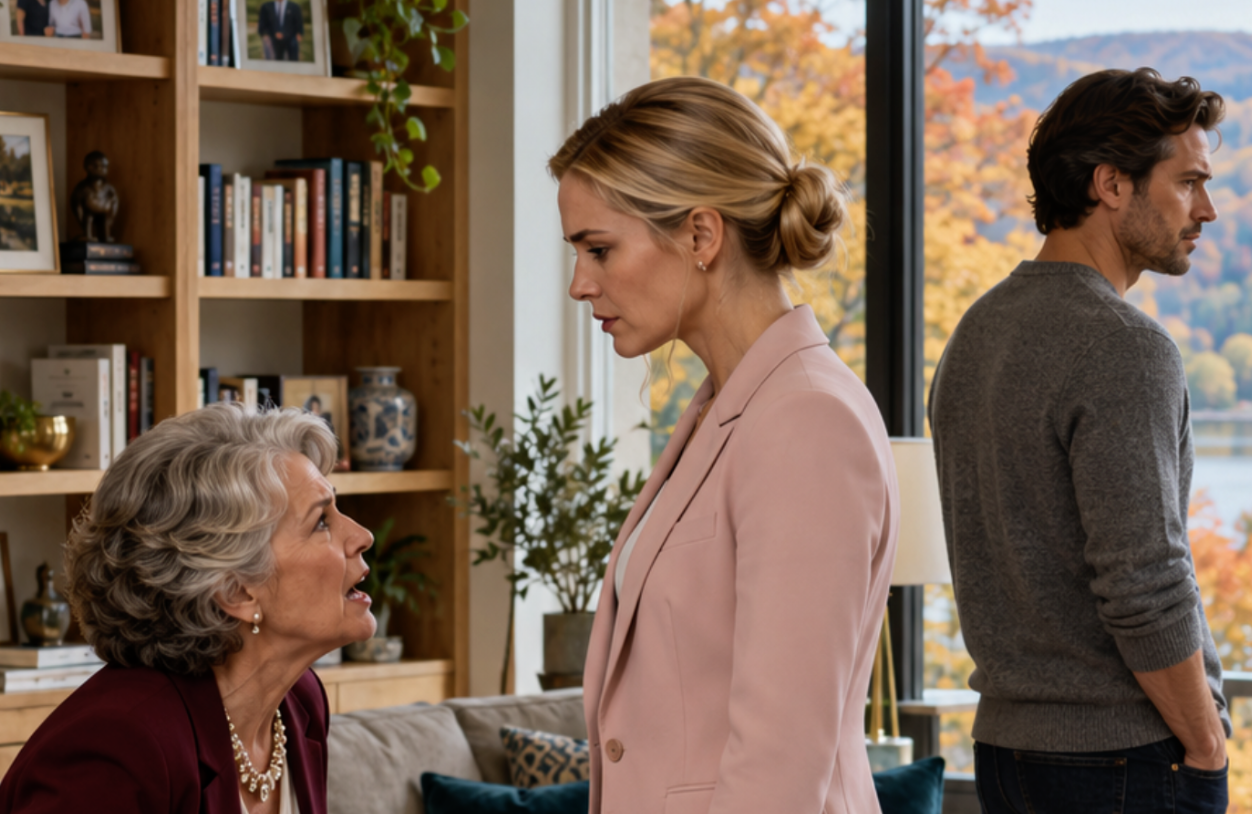
“Move your registration out of the apartment. It was bought with our family’s money!” my mother-in-law demanded. I did. Along with everything that belonged to me.
Nadezhda Sergeyevna stood in the middle of the living room in a burgundy suit, chin lifted, hands planted firmly on her hips.
“Just look at you,” she said. “You’ve settled into someone else’s apartment as if you own the place. This apartment was bought with our family’s money. Ours. So be so kind as to unregister yourself. The sooner, the better.”
Sonya stared out the window.
The September trees outside were already turning gold. One leaf broke loose and floated slowly toward the pavement.
For some reason, she watched it and thought: That’s me. Breaking away.
But where to?
Igor stood in the kitchen doorway with his hands in his pockets.
He always became silent when his mother was around. A tall, broad-shouldered thirty-four-year-old man suddenly turned into a piece of furniture.
“Igor,” Sonya said. “Do you hear what your mother is saying?”
He avoided her eyes.
“Mom has a point. The apartment was bought with—”
“With what?” Sonya turned around. “With the money both of you borrowed from me for three years?”
His mother immediately stiffened.
“What money? What nonsense are you inventing now?”
Then she turned to her son.
“Igor! Defend your mother. Tell this woman who the real owner is here.”
This woman.
Sonya noticed the phrase.
Not “your wife.”
Not “Sonya.”
Just this woman.
Three years of marriage, and she was still treated like an outsider.
She had met Igor in line at a notary’s office. He had seemed quiet, reliable, a little lost. She helped him with some paperwork. Coffee followed, then walks, then marriage.
He had once described his mother by saying, “She’s strict, but kind. You just don’t see it immediately.”
Sonya had eventually discovered that the kindness was difficult to see because it barely existed.
At their wedding, Nadezhda Sergeyevna wore a dress brighter than the bride’s. Her toast was entirely about how hard she had worked to raise her son.
Later, she approached Sonya and said softly, almost affectionately, “Don’t hurt my boy.”
That had been the beginning.
A year after the wedding, they bought the apartment.
Igor’s mother contributed part of the down payment, but Sonya contributed just as much. She sold her car and used savings she had built over six years.
The mortgage was registered in Sonya’s name because Igor had poor credit history—something he had mentioned only after they had started the process.
“It doesn’t matter,” he had said. “We’re family.”
Sonya had once believed that word meant partnership.
After moving in, Nadezhda Sergeyevna began visiting constantly.
Every visit became an inspection.
“There’s dust here.”
“That curtain is hanging wrong.”
“I wouldn’t put this table there.”
She opened cupboards, checked the refrigerator, criticized the furniture.
Igor only laughed.
“Mom, stop acting like you’re at work.”
Then he poured her tea, sat beside her on the sofa, and listened while she talked.
Sonya often stood nearby thinking: I live here too.
This is my home too.
Isn’t it?
That evening, instead of arguing with her mother-in-law, she said quietly, “I’ll think about it.”
Nadezhda Sergeyevna looked almost disappointed.
She had expected shouting.
“What do you mean, think about it?”
“I mean I’ll think about it.”
After Igor and his mother left together, Sonya sat alone in the darkening apartment.
Then one clear thought appeared in her mind.
Fine.
I’ll unregister.
The next day, she called her friend Larisa, who worked in real estate.
“I need your help.”
Larisa arrived with coffee and a notebook.
Sonya explained everything: the apartment, the payments, the mortgage, the fact that Igor was registered there as her husband but was not the primary borrower.
Larisa listened carefully.
“So the mortgage is in your name?”
“Yes.”
“And you’ve been paying it?”
“Yes.”
Larisa closed her notebook.
“Sonya, I don’t think they understand the position they’ve put themselves in.”
That same week, Larisa introduced her to a lawyer.
Sonya didn’t immediately ask about divorce.
“I just want to understand my rights,” she said.
The lawyer explained that because the apartment had been purchased during the marriage, it was considered marital property. The mother-in-law’s financial contribution could be considered, but it did not magically make the apartment hers.
More importantly, Sonya was the main borrower.
She carried the financial responsibility.
When Sonya left the lawyer’s office, something inside her had changed.
For the first time, she no longer felt trapped.
A few days later, she spoke to Igor.
He was sitting on the sofa watching television.
Sonya muted it.
“We need to talk.”
He sighed.
“About what?”
“The apartment. Your mother. Us.”
Igor immediately began defending his mother.
“She’s just worried. She invested money.”
“I’m not discussing her feelings,” Sonya said. “I spoke to a lawyer.”
He went quiet.
“Why?”
“Because your mother asked me to unregister from my own home.”
Igor stared at her.
Sonya continued.
“If she asks me again, I will do exactly what she wants. I’ll unregister. But I’ll also take everything that belongs to me.”
Igor said nothing.
The next morning, his mother called.
“So now you’re hiring lawyers?”
“Good morning, Nadezhda Sergeyevna.”
“Don’t get clever with me. Igor and I have already discussed it. The apartment will be transferred. There are ways.”
“All right,” Sonya said.
“That’s all you have to say?”
“Yes. Have a good day.”
She hung up.
Ten days later, Larisa called.
“I found buyers.”
Sonya felt her heartbeat change.
“A family with two children. They’re ready to close in three weeks.”
That evening, Sonya told Igor over dinner.
“I found buyers for the apartment.”
His fork stopped halfway to his mouth.
“What?”
“We’ll sell it. The mortgage will be paid off from the sale, and the remaining amount will be divided according to the legal process.”
He stared at her.
“You’re serious?”
“Completely.”
“But Mom—”
“Your mother told me to unregister. I’m doing exactly that.”
An hour later, Nadezhda Sergeyevna stormed into the apartment.
“This is our apartment! I invested money! Igor is registered here! You can’t sell it!”
Sonya stood in the kitchen doorway.
“Please take off your shoes. I just washed the floor.”
Her mother-in-law froze.
“What?”
“Take off your shoes. Or we can talk in the hallway.”
For once, Nadezhda Sergeyevna obeyed.
Then she launched into threats about bank transfers, witnesses, proof of her contribution.
Sonya remained calm.
“No one is denying that you contributed. Your contribution can be addressed during the division. You can confirm that with a lawyer.”
Her mother-in-law went silent.
Then, more quietly, she said, “You’re going to ruin us.”
“No,” Sonya replied. “I’m simply unregistering. Just like you asked.”
The apartment was sold at the end of October.
The mortgage was paid off.
Sonya received her share.
By then, she had already moved temporarily into Larisa’s spare room.
Soon she rented a small apartment of her own in an older building on a quiet street.
She moved her books, dishes, clothes, and work desk.
Everything fit.
Igor sent one message.
“Mom is very upset.”
Sonya replied, “I know.”
He didn’t write again for months.
In November, she finally enrolled in the advanced corporate law course she had postponed for years.
She found a better job.
She met new people.
She started walking to work through a park in the mornings.
The strangest thing was how light she felt.
For years, tension had lived inside her so constantly that she had stopped noticing it.
Only after it disappeared did she understand how heavy it had been.
Six months later, Sonya sat in a café with Larisa.
Outside, early spring wind pushed against the windows.
Larisa glanced up from her phone.
“Have you heard about Igor and his mother?”
“No.”
“They bought a small studio on the outskirts. Apparently they couldn’t afford anything bigger.”
Sonya wrapped her hands around her coffee.
“I feel sorry for them.”
Larisa raised an eyebrow.
“You actually mean that?”
“Yes,” Sonya said. “They could have lived differently. They chose not to.”
Her course had ended in March, and she had finished at the top of the group.
Her new job paid better.
Her life was quieter.
Igor eventually sent another long message full of explanations and excuses.
She read only half of it.
Then she closed it.
Some doors did not need to remain open.
“So,” Larisa asked, “how are you?”
Sonya thought before answering.
Not the automatic “fine” people say when they don’t want to explain.
She really thought about it.
“I’m good,” she said.
Then she smiled.
“Actually, better than good.”
Outside the café, a gust of wind caught a young woman’s umbrella and carried it several meters down the street.
The woman ran after it, laughing.
She caught it, picked it up, and continued walking.
Sonya watched her through the window.
And smiled.
She had unregistered from the apartment.
But somewhere along the way, she had also removed herself from a life that had never really felt like hers.