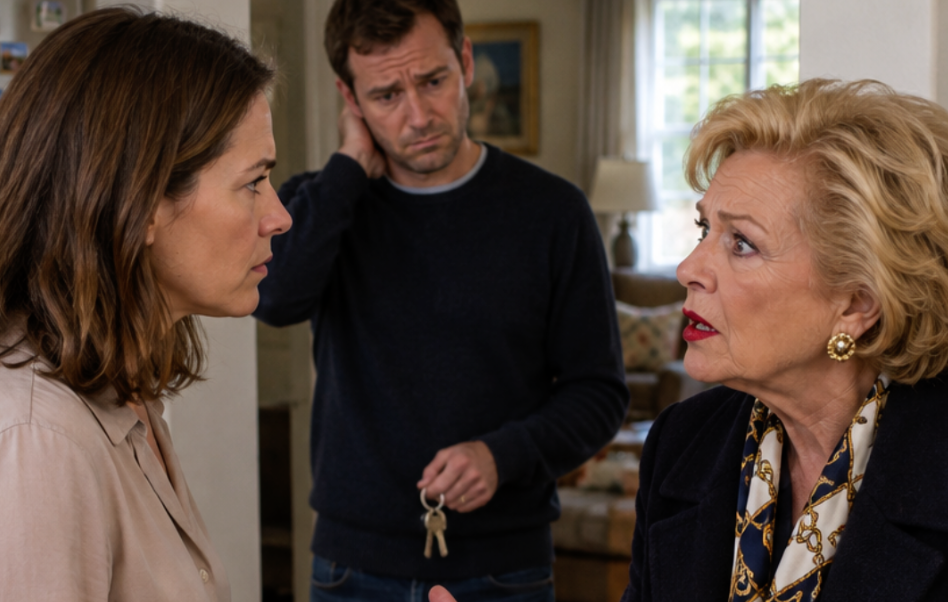
For five years, I kept hearing that I wouldn’t have my own home if it weren’t for her money. The family legend turned into a written demand, and after that, I stopped arguing with words.
“I’ve hired a lawyer, and I’ll sue for the apartment,” Galina Petrovna announced as she set her fork on the edge of her plate. “You got it into your head way too quickly that everything belongs to you.”
Conversation at the table stopped.
We had gathered at Mikhail’s relative’s place for a family lunch. Nothing special: twelve people squeezed into a small kitchen-living room, someone always asking for the salad, someone else talking about their dacha. I was sitting opposite my mother-in-law, and until that moment, I thought the worst thing I’d have to endure was yet another lecture on my spending habits.
But Galina Petrovna came prepared.
She unzipped her bag, pulled out a clear folder, and took out a piece of paper.
“Here. Nine hundred thousand. Withdrawn from the account back when you were buying the apartment. Did you think I don’t keep documents?”
Mikhail let out a heavy sigh.
“Mom, that’s enough.”
“Enough what?” she turned to her son. “Do you even understand what your wife did? She took my money, put the apartment in her name, and now acts as if I’m a nobody.”
I looked at the paper she held between her fingers.
It really was a bank statement. I saw the amount and the line about the cash withdrawal. Five years ago, Galina Petrovna withdrew nine hundred thousand rubles.
But I never received that money.
“You did withdraw money,” I said. “I’m not disputing that.”
My mother-in-law’s face changed instantly. She leaned back in her chair, as if I’d just admitted the debt.
“Did everyone hear that? She just confirmed it.”
“I confirmed that you withdrew it. Not that you gave it to me.”
“Then who did I withdraw it for?”
“I don’t know.”
“Of course you don’t. How convenient.”
Mikhail looked at me, then at his mother.
“Lena, Mom really did say she wanted to help us back then.”
“Wanting to help and actually giving money are two different things.”
“Tell that to the lawyer,” Galina Petrovna cut me off. “Pavel Andreevich is a serious man. He’s already looked at the documents. He said we’ll sort this out. And don’t hope the apartment will just stay with you.”
One of the relatives coughed. The woman sitting next to me started fixing the napkins, even though they were already perfectly straight.
It wasn’t the stares from others that bothered me. Over the years, I’d gotten used to Galina Petrovna announcing family decisions as if she were chairing a meeting. But what bothered me this time was something different.
For the first time in five years, her favorite phrase, “You’d never have bought this apartment without us,” now came with a lawyer’s name and a folder of documents.
I bought the apartment even before I married Mikhail. Back then, we’d only been dating for just over a year.
I saved money for several years. It wasn’t glamorous or heroic. I simply transferred part of my salary into a separate account each month, picked up side jobs at the end of each quarter, and didn’t touch my savings. When I finally found a suitable two-bedroom apartment, I had enough for the down payment. The rest, I took out as a mortgage.
At that time, Galina Petrovna repeatedly told Mikhail:
“If anything happens, your mother won’t abandon you. I’ve got money.”
I thanked her and always replied that I could handle it on my own.
After the purchase, the story slowly started to change. At first, it was: “We wanted to help you.” Then, “We helped you at that time.” A couple of years later, it turned into: “I gave you almost a million.”
I didn’t argue every time. It felt silly to turn a family dinner into an audit of banking transactions from five years ago.
Now, staying silent started to feel like the stupid thing to do.
“Alright,” I said. “If your representative contacts me, I’ll respond.”
“Oh, you will respond,” my mother-in-law smirked. “You definitely will.”
On the way home, Mikhail barely said a word.
Behind the wheel, he stared straight ahead. I didn’t start the conversation, either. I needed to separate my annoyance from the facts first.
When we finally got home, he turned off the engine and said:
“Maybe she’s just trying to scare you.”
“Maybe.”
“You know what my mom is like.”
“I do. That’s why I’m waiting for the lawyer.”
He turned to look at me.
“But what if she really kept something?”
I opened the car door.
“Then let’s see exactly what it is.”
Two days later, I found a notice for a registered letter in my mailbox.
I picked up the envelope after work. It was from a law office, with the name of Pavel Andreevich on it.
At home, I didn’t even take off my jacket. I put my bag on a stool in the hallway, walked straight to the kitchen, and used a letter opener to slice open the envelope.
The letter’s tone was much more careful than Galina Petrovna’s words had been.
The lawyer explained he represented her interests. According to his client, she gave me nine hundred thousand rubles to pay part of the initial down payment for the apartment. I was invited to settle the matter voluntarily: either reimburse the amount stated or discuss a property agreement. Otherwise, his client reserved the right to take the matter to court.
Not a word about the apartment “almost” belonging to her.
No threats of “taking it all in court.”
Just the facts, as his client had shared them with her lawyer.
There was a copy of the very bank statement attached. Galina Petrovna had withdrawn nine hundred thousand in cash.
I looked at the date.
Then I got the gray folder with all the apartment documents out of the closet.
Mikhail arrived when the purchase agreement, mortgage contract, and old bank papers were already spread out on the table.
“Did you decide to go through the whole archive?”
“Come here.”
He took off his jacket and sat down across from me.
I slid the payment order over to him.
“This is the initial down payment.”
“I see.”
“Look at the date.”
He read it.
I placed his mother’s statement copy next to it.
“Now look at this one.”
Mikhail frowned.
“Hold on.”
“I’ve already waited five years.”
He compared both documents again.
The initial payment left my bank account three days before Galina Petrovna withdrew her nine hundred thousand.
“Maybe she was planning to reimburse you later?” Mikhail said.
“Maybe. But her lawyer says she gave me the money for the down payment.”
“Yeah, that doesn’t add up.”
“And that’s not the only thing that doesn’t add up.”
I opened my bank’s app and ordered a detailed transaction report for the period before and after the deal. I didn’t have all the old documents, and I wanted to see the whole money flow.
The next day, the bank sent me the report.
I printed it at the office and that evening, laid the pages out on the table.
Two weeks before the deal, I already had enough in my account for the down payment. Then the payment went to the seller. There was never any transfer or cash deposit of the 900,000 from Galina Petrovna.
I opened the mortgage agreement. I was listed as the borrower.
The purchase agreement—again, I was the buyer.
The date of registration of ownership was before my marriage to Mikhail.
I didn’t even have to make up a defense. All I needed to do was gather everything that had been stored in separate files over the years into one place.
At the bottom of Pavel Andreevich’s email, he left a contact address for replies.
I kept my reply brief.
I stated that I had never received any money from his client, and attached documents: the purchase agreement, mortgage contract, the initial payment confirmation, a bank statement for the relevant period, and proof of registered ownership.
Before sending, I read over the email twice.
I didn’t add a word about Galina Petrovna’s character.
I didn’t mention that she’s always rewriting the past to suit her version of events.
I didn’t ask the lawyer to ‘set his client straight.’
Just dates, amounts, and documents.
Mikhail stood by the kitchen table.
“Did you send it?”
“Yes.”
“So what happens now?”
“Now the person your mom hired can look at everything, not just half the story.”
He rubbed his chin with his palm.
“I don’t want this to go to court.”
“Neither do I.”
“Maybe you should’ve talked things over with Mom again first?”
I closed my laptop.
“We’ve spent five years talking to her. Now she talks to me through her representative. I answered her representative.”
On the third day, Galina Petrovna called Mikhail.
He didn’t put the call on speaker right away. For about five minutes he paced from room to room, giving short answers. Then he walked into the kitchen and placed the phone on the table.
“Mom, tell Lena yourself.”
“I said that Pavel Andreevich is preparing the documents,” my mother-in-law’s voice came sharply and clearly from the speaker. “So your wife shouldn’t think that a letter full of pictures will scare everyone.”
I kept sorting receipts into the folder.
“Galina Petrovna, did you get a copy of my reply?”
“I don’t need to receive anything from you.”
“Then how do you know I sent the documents?”
She paused for a second.
“The attorney told me.”
“So he received them.”
“He did. And so what? I have documents too.”
“You do.”
“Are you admitting it again?”
“That you withdrew the money? Yes. I’ve never denied it.”
She started speaking faster:
“This money was for you! Mikhail knows. The whole family knows. I didn’t take it for myself.”
Mikhail closed his eyes.
“Mom, I know you said it was meant to help.”
“Exactly!”
“But I never saw you actually give Lena the money.”
“That’s because you never notice anything when your wife is around.”
He picked up the phone from the table.
“Let’s talk later.”
“There is no later. Then you’ll be paying court costs and blaming me.”
The call disconnected.
Mikhail set the phone down, screen side down.
“Maybe we should give her part of the money?”
I stopped shuffling papers.
“For what?”
“Not the whole amount. Two hundred, three hundred thousand. Just so she calms down.”
“And what will we write in the payment description?”
“Lena, I don’t know.”
“‘Compensation for money I never received’?”
“Don’t twist it.”
“I’m not twisting your words. I’m just trying to understand exactly what you’re asking me to pay for.”
He got up and walked over to the fridge.
“To make this all go away.”
“It’s not going to go away.”
“How do you know?”
“Because five years ago she said she just wanted to help. Today she’s saying she gave nine hundred thousand. If I send her three hundred now, next month that’ll be ‘proof’ I accepted the rest.”
Mikhail ran his hand over his face.
“You turn everything into paperwork.”
“I didn’t start it.”
He wanted to answer, but stayed silent.
I asked:
“Have you ever actually seen her with those nine hundred thousand in her hands?”
“No.”
“Did she ever hand it over to you?”
“No.”
“Did you see her give it to me?”
“No.”
“So what exactly do you know for sure?”
He stared at the table for a long time.
“That she took out the money back then. And that she said it was for us.”
“That’s all you really know.”
He sat back down.
“She won’t back down.”
“That’s her choice.”
“You do realize she’s going to tell the whole family, right?”
“She already has.”
“And you don’t care?”
I did care.
It made me angry that people who didn’t even know which bank my mortgage was with were now dissecting who gave me money. It infuriated me that Mikhail had spent days looking at me like there was suddenly a question between us that never existed before. I was even annoyed that I kept double-checking my memories, despite having the documents right in front of me.
But what irritated me most was the actual price of “peace” that they were offering.
For Galina Petrovna to stop accusing me of taking her money, I was supposed to pay her for something I never did.
“I do care,” I said. “But I’m not going to buy her approval.”
Mikhail said nothing.
The days that followed were worse than a direct argument.
Pavel Andreevich didn’t write.
Galina Petrovna called her son every evening. Sometimes she asked if I had ‘come to my senses.’ Sometimes she said the relatives were on her side. Other times she warned that, after court, I’d regret ‘going against the family.’
I didn’t answer.
One night, I checked my email late and saw a new message from the law office. It turned out to be just an automatic notification about my attachments being received.
I closed my laptop and, for the first time, wondered: what if this really does go to court?
I had the documents. But a court would mean time, money, answering more questions, and having to prove the obvious again and again.
And then there was Mikhail.
He didn’t openly take his mother’s side, but any talk about ‘finding a compromise’ left a bitter taste.
On the sixth day, he finally came to me.
“I asked mom again.”
“About what?”
“Who she gave the money to.”
I looked up.
“And?”
“First she said you. Then she said me, and that I was supposed to give it to you.”
“Did she give it to you?”
“No.”
He sat down on the edge of the couch.
“I told her that.”
“And what did she say?”
“She said I’d just forgotten everything.”
I couldn’t help but smirk.
“How convenient.”
Mikhail looked at me and also realized whose words I was echoing.
But that didn’t make things any easier.
On the seventh day, Galina Petrovna showed up herself.
We were both at home. Mikhail was gathering tools on the balcony, I was replying to work emails.
The lock in the hallway spun.
I knew instantly who it was.
For years, Galina Petrovna had the spare key. It made sense back then—who knows, we might lose ours, or travel, or need someone to water the plants. Lately, she hardly ever used it.
The door opened.
My mother-in-law walked in without ringing the bell. She had a bag in one hand and a folded piece of paper in the other.
“Well, are you happy now?” she asked.
Mikhail came out of his room.
“Mom, why didn’t you ring the bell?”
“Because I have the key. Or is that a crime now too?”
She tossed the paper onto the table.
Her red lipstick was perfectly applied, but one edge of the paper was so crumpled that it wouldn’t lay flat.
“You manipulated him, didn’t you?”
“Who?” I asked.
“Don’t pretend. Pavel Andreevich.”
I stood up.
“I sent him the documents in response to his letter.”
“He dropped the case!” she exclaimed.
Mikhail stopped in the kitchen doorway.
“What do you mean?” he asked.
“Exactly what I said. He called today. Then sent this,” she replied.
She jabbed a finger at the paper.
“He said he won’t file a lawsuit. He refunded the retainer. Can you believe it? I went to him as a professional and after just one letter from her he gave up.”
“Let me see,” Mikhail asked.
“There’s nothing to see,” she replied.
“Mom.”
She grabbed the paper, but Mikhail was closer. He took it from the table and unfolded it.
I didn’t go closer.
He read the first page, then the second.
“It says here he doesn’t see any proof of the transfer of funds.”
“That’s because she lied to him.”
“It’s not about what was said. It’s about the dates.”
Galina Petrovna turned sharply toward me.
“What dates?” she demanded.
“The ones in your own documents,” I replied.
“I have a bank statement!” she insisted.
“Yes. Showing you withdrew the cash.”
“Nine hundred thousand!”
“You withdrew it three days after my initial payment had already been sent to the seller.”
She opened her mouth, but I continued:
“Two weeks before the deal, the required amount was already in my account. It’s clear in the statement. There were no deposits from you. I didn’t deposit nine hundred thousand in cash. The payment was made as a bank transfer from my account.”
“I could have given the money to Mikhail.”
Mikhail lowered the paper.
“You didn’t,” he said.
“What?” she asked.
“You never gave me that money, Mom.”
“I gave it to you both!”
“You said you withdrew it for us, I remember that. But you never handed me any money.”
My mother-in-law looked at him as if it was his betrayal that hurt most.
“It’s been five years. You’ve forgotten it all,” she insisted.
“I would have remembered nine hundred thousand,” he replied.
“Of course. Now both of you remember things the way it suits you.”
I picked up my folder from the table, but didn’t open it.
“Galina Petrovna, I don’t need you to believe me. Your representative asked for my position, and I gave it to him.”
“You drowned him in paperwork on purpose.”
“He’s a lawyer. Paperwork is part of his job.”
“He said there’s not enough evidence. Not enough! And what about my statement, then?”
I looked at her.
“You have a statement showing you withdrew your own money. I have mine showing where my funds came from and where they went.”
She looked at me for a few seconds, then turned to her son.
“And you’re going to allow this?” she asked him.
Mikhail folded the letter in half.
“Allow what exactly?” he asked.
“She’s making me out to be a thief and a liar.”
“No one called you a thief.”
“So, a liar then.”
“I’m saying you never gave us the money.”
“How can you say that!” she exclaimed.
“Because I never gave it to her.”
His voice sounded tired, without its usual hint of peacemaking.
Galina Petrovna grabbed her bag.
“Fine. Go on, live your lives. But don’t come to me for anything later.”
She took a step toward the door.
“Mom, wait.”
She stopped, her face suddenly full of anticipation. She clearly thought her son was about to apologize.
Mikhail reached out his hand.
“Hand over the key.”
“What key?”
“The apartment key.”
“Are you serious?”
“Yes.”
“I’m your mother.”
“You are my mother. But the apartment belongs to Lena.”
Galina Petrovna turned to look at me.
“Did she make you do this?”
“No.”
“Don’t lie to me.”
“Mom, you just let yourself in without warning, after spending a week talking about suing us over the apartment. Give back the key.”
“I’ve had that key for five years.”
“Not anymore.”
She pulled a keyring from the side pocket of her bag. Three keys dangled from it, along with a small metal keychain. She took off one key—the one with the blue plastic tag.
But she didn’t hand it to her son.
She placed it on the cabinet.
“Take it. And don’t ask me for anything ever again.”
“Alright,” Mikhail replied.
That simple “alright” hurt her more than any previous argument.
She walked out.
Mikhail closed the door and stood quietly in the hallway for a few moments.
Then he picked up the key from the cabinet and brought it to me.
“This is yours.”
“It’s our spare.”
He shook his head.
“No. I mean the decision—that was yours.”
I looked at him.
“I don’t need you to choose between me and your mother.”
“I’m not choosing,” he said. “I just spent too long pretending you don’t have to choose between facts and a more convenient story.”
He set the key down on the cabinet in front of me.
On the table sat a gray folder. Inside were a contract, a bank statement, a payment order, and a letter from our representative—someone who had thankfully decided not to turn a family legend into a court case.
Right next to it lay the spare key.
For five years, Galina Petrovna had kept it ‘just in case.’
That moment had finally come.