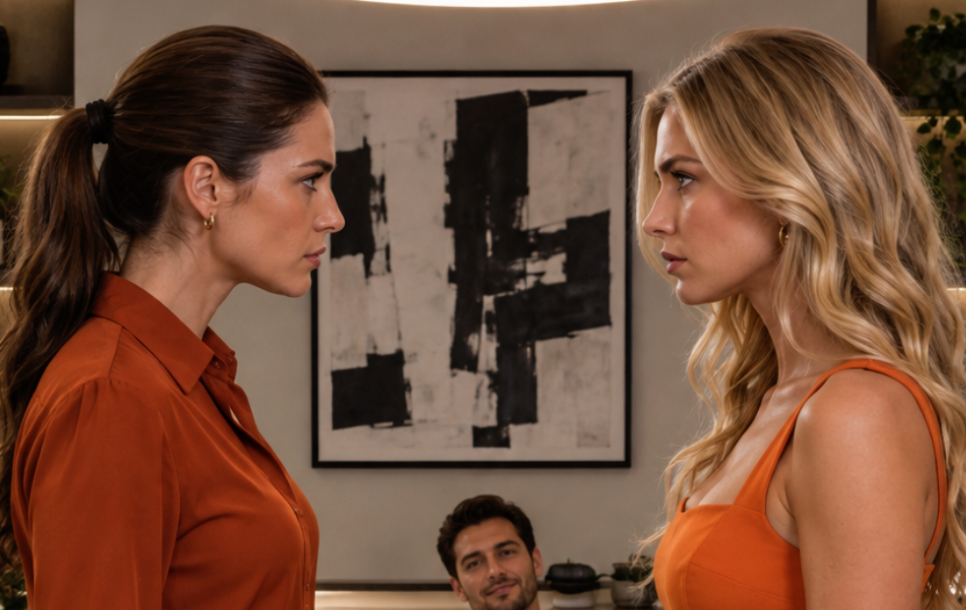
The cup slipped from my fingers and shattered on the tiles. Shards scattered under the table, hot tea poured across the floor, but I didn’t even move. I just stared at Sveta, sitting on my kitchen chair, wearing my robe, calmly stirring sugar into my favorite mug.
“What did you just say?” I asked quietly.
“You heard me perfectly well.” Sveta took a sip and grimaced. “This is my apartment now, too. Stop staring at me, Varya. The apartment is in Maxim’s name, and I’m not a stranger to him. Far from it.”
I turned to my husband. Maxim stood in the kitchen doorway, leaning against the frame, staring at his shoes. He always did that when he didn’t know how to get out of a situation. But now, his silence felt different. He didn’t try to smooth things over, he didn’t rush to comfort me, he didn’t scold his sister. Instead, he met my gaze, and I saw a calm, heavy determination in his eyes. From that look, I realized she wasn’t joking.
The floor seemed to shift beneath me. Suddenly, I became painfully aware that I was standing in the middle of the kitchen we’d spent years paying the bank for, and I couldn’t tell who was really in charge here.
It all started so differently.
Maxim and I searched for a place to live for nearly a year. We spent weekends touring apartments, stayed up late on listing websites, argued about layouts and neighborhoods. Maxim wanted to be close to work, I dreamed of a big kitchen with an east-facing window so the morning sun would flood the sill. When we finally found this apartment, I fell in love with it on the spot. The kitchen was spacious and bright, the hallway wide, and there was a room with a bay window. Out the window you could see an old park with lindens.
We couldn’t afford to pay the full price, so we took out a mortgage. The bank approved the loan for Maxim since he had a steady, official salary and a long tenure. My job at a small design studio paid less, but I contributed my share every month and saved money for renovations. We trusted each other. It never even crossed my mind to insist on putting my name on the paperwork. We were husband and wife—why keep score?
The first year felt like a fairy tale. We put up wallpaper, picked out curtains, argued over paint colors for the bedroom. I filled the windowsills with pots of basil and geraniums. In the evenings, Maxim unpacked boxes while I made dinner, and at night we’d fall asleep, legs entwined, happy, exhausted, and endlessly confident in our future.
Sveta came into our lives that fall.
Maxim brought it up over breakfast, staring into his plate:
“Varya, listen… My sister had a fight with our parents. A serious one. She doesn’t have anywhere to stay until things cool down. Can she crash with us? Just for a bit.”
“Sister?” I echoed. “I thought you said you didn’t have anyone but your parents?”
“Cousin,” he corrected quickly. “We grew up together, almost like siblings. She just lived in another city for a long time, so we didn’t see each other much.”
I was surprised but didn’t argue. How could I say no to someone with nowhere to live? Especially my husband’s family. I was even glad for a chance to be hospitable and maybe become friends with her.
Sveta arrived in the evening with two massive suitcases and a bag, a hair dryer poking out of the top. Tall and striking, with long dark hair and a heavy-lidded stare, she glanced around the hallway, then at me, and gave me a half-smile.
“Well hello, Varya. I’ve heard a lot about you.”
I reached out my hand, and she shook it limply, as if she was doing me a favor. Maxim scurried around, dragging her suitcases in, offering her tea, while she glided through the apartment, touching things with her fingertips, inspecting them like a shopper at a store.
I made up the room with the bay window for her, the one we’d been saving for a future nursery. I bought new linens, set out fresh towels on the bed, and placed a little vase of chrysanthemums on the nightstand. Sveta glanced at the flowers with indifference:
“I like lilies. These smell like a graveyard.”
I decided not to react. She was obviously stressed, fighting with her family, on edge. I told myself I needed to be patient.
For the first few weeks, I endured. Sveta would get up late, come to the kitchen around noon, leave dirty dishes in the sink, and then drift off to watch TV shows. I’d come home from work, wash her cups, wipe up her crumbs, and quietly eat dinner with my husband. Maxim would shrug apologetically: just hang in there, she’s having a tough time.
Then Sveta started moving things around. At first, just little things. She moved my plants off the windowsill—they were blocking the light, apparently. She took down our wedding photos and hung up some tacky reproduction in their place. She rearranged the food in the fridge and threw out my yogurt because it was “almost expired.”
“Sveta, those are my groceries,” I said as gently as I could. “Please ask me before you throw anything out.”
“Oh come on, Varya, don’t be stingy. Just get a new one.”
I swallowed my irritation again.
Then things got worse. Sveta started inviting her friends over. In the evenings, there would be music and clinking glasses in the kitchen. When I complained to my husband, he brushed it off:
“Why are you nitpicking? The girl’s just relaxing, she’s going through a lot. You’re kind, aren’t you?”
And I really was kind. That’s why I stayed quiet for so long.
One day I came home earlier than usual and found Sveta in our bedroom. She was sitting at my vanity, trying on my earrings—the ones my mom gave me for my thirtieth birthday. The jewelry box was open, and her trinkets were scattered all over the tabletop.
“What are you doing?” My voice shook.
“Just looking,” Sveta replied, turning her head to look in the mirror instead of at me. “You have nowhere to wear them, anyway. They look good on me.”
“Put them back where you found them.”
“You’ve gotten so jumpy. Maxim said you used to be more chill.”
She slowly, unwillingly took the earrings out and tossed them onto the table before leaving, brushing past me with her shoulder. The cloying scent of her perfume lingered in the room.
I sat on the edge of the bed for a long time, clutching my mom’s gift in my hand. My throat tightened. I couldn’t understand what was happening, why my husband didn’t see what was so obvious, why I felt like a guest in my own home.
That evening, I tried to talk to Maxim. He listened, frowned, and then said:
“Varya, these are just little things. Just hang in there a bit longer. She’ll move out soon.”
— When is “soon” exactly? She’s been living with us for months now. She doesn’t pay for electricity, never buys groceries, doesn’t clean up after herself. She acts like she owns the place.
— Don’t exaggerate.
That night, I went to bed with a heavy heart. But the real explosion happened later.
It was a typical Sunday morning. I got up early to make breakfast, took my favorite mug with blue cornflowers out of the cupboard, and turned on the kettle. Sveta walked into the kitchen in my robe, her hair a mess, yawned, and, without even a hello, opened the fridge.
— It’s empty, — she announced. — Didn’t you go grocery shopping?
— I did go shopping. Yesterday. I bought everything Maxim and I need. If you want anything special, get it yourself.
— Oh, don’t start. — Sveta rolled her eyes. — Maxim said I could have anything I want.
— Maxim said? — I felt something inside me tighten and tremble. — Sveta, let’s have a serious talk. You’ve lived here for a long time. I let you stay out of respect for my husband, but enough is enough. You don’t clean up, you use my things, you invite strangers over. I’m tired of it.
Sveta slowly shut the fridge door and turned toward me. Her expression changed in an instant. The lazy, mocking look vanished, and her gaze turned sharp and cold.
— You’re tired of it? And do you think I enjoy seeing your sour face every morning?
— Then don’t look at it. Find yourself another place to live.
That’s when she sat down in my chair, took my mug, poured herself tea, and said those infamous words. After that, everything unfolded just as I’ve already described: the shattered cup, tea spilled on the floor, and Maxim’s heavy stare.
— Maxim, — I managed to say, barely moving my lips. — Tell her it’s not true. Tell her she can’t say things like that.
He pushed away from the doorframe, walked over to the table, pulled out a chair, and sat down. Quietly, as if it had suddenly become too much effort to stand.
— Varya, we need to talk.
— We are talking.
— No. — He rubbed his face with his hands. — We need to really talk. Sveta isn’t my sister.
For a moment I didn’t understand the meaning of his words. They sounded separate, just a jumble of sounds.
— What?
— She’s not my sister. Not a cousin, nothing. We went to school together. Back then, we were in love. Life took us different ways, she moved away, I married you. Recently, she reached out to me. Things went badly for her, and well… here we are.
I stood there listening as flashes of memories lit up in my mind—scenes I’d never noticed before. I remembered family holidays, mother-in-law’s birthdays, New Year’s at Maxim’s parents’, our wedding. All the relatives were there, close and distant. I recalled long tables, toasts, photos. In none of those pictures was Sveta. Not once, in all the years Maxim and I have been together, had I ever heard her name. She only appeared recently, out of nowhere, and he introduced her as his sister. And I believed him. Because I loved and trusted him.
— You lied to me, — I said. — You lied this whole time.
— I didn’t want to hurt you.
— Didn’t want to hurt me? — I laughed, and the sound was dry and strange, not my own. — You brought your old school love into our home, called her your sister, I fed her, washed her towels, made her bed, and you just stayed silent?
“Varya, stop yelling,” Sveta said lazily, leaning back in her chair. “You need to do something about those nerves.”
I turned to her. My hands were shaking, but my voice suddenly became steady and cold.
“Pack your things. Right now. And get out.”
Sveta glanced at Maxim. He was silent for a moment, then sighed heavily:
“Varya, no one’s going anywhere. Sveta and I have decided to live together. I wanted to tell you more gently, to prepare you, but it didn’t work out. I’m sorry.”
It felt like the air in the kitchen thickened, turning heavy, almost like jelly. I stared at my husband and couldn’t recognize his face. The familiar features, the mole above his eyebrow I knew so well, but the person behind it was a stranger.
“What do you mean ‘decided’? We’re married.”
“We’re getting a divorce. Everything will be fair, no scandals. But you’ll have to move out. The apartment is in my name, Sveta is staying here. We’ll sort out the paperwork.”
“This is our home,” I whispered. “I paid for it with you. I picked out every single tile.”
“Sure, you paid,” Sveta chimed in, stirring her tea. “But all the documents are under Maxim’s name. So if you decide to go to court, it’s going to be long and nasty. Just a heads up. If you try to take even a meter from us, I’ll make your life so much fun you’ll regret it. I know where you work, I know where your parents live. We can play games if you want.”
She smiled. Wide, triumphant. And that’s when I realized: I wasn’t dealing with a hurt young woman who had a fight with her parents, but with a calculating woman who had planned this all out long ago.
I didn’t argue. Not because I gave in, but because I felt completely hollow inside. I quietly walked to the bedroom, grabbed a bag from the closet, and stuffed in clothes, documents, a charger, my mother’s earrings. My hands moved on their own, and the only thing pounding in my head was: don’t cry, not here, not in front of them.
Maxim stood in the hallway, watching as I put on my shoes.
“Varya, let’s not make this a drama…”
I looked him in the eyes and said nothing. Then I closed the door behind me and walked down the stairs, listening to the echo of my footsteps.
I made it to my parents’ place on the last bus. Mom opened the door in her nightgown, saw my face, and just pulled me into the entryway without a word. I collapsed onto her shoulder and finally cried, deep and raw, in a way I hadn’t since I was a child. Dad came out of his room, stood silently nearby for a moment, then just as silently went to put the kettle on.
In the morning, my brother Dima arrived. He’s a few years older, works as a lawyer for a construction company, someone the family respects—and honestly, fears a little. Mom must have called him during the night. He entered the kitchen, looked me over, and sat across from me.
“Tell me everything. From the beginning.”
I told him. Jumbled, between sobs, jumping from the earrings to the teacup, and then to Sveta’s words. Dima listened without interrupting, his face growing harder with every word. When I finished, he put his hand on the table and said:
“Here’s the deal. You’re not giving them anything.”
“Dima, they said everything’s in his name. That there’s no point going to court.”
“That’s what they think,” he said with a slight, unfriendly smile. “The apartment was bought during the marriage. That means it’s shared property, no matter whose name is on the deed. You contributed money, you have transfers, receipts, bank statements. We’ll gather everything you need. You have every right to your share.”
“But Sveta has been threatening…”
“Let her threaten,” he replied, leaning in and looking me straight in the eyes. “Varya, listen to me. Do you want to hide and forget this ever happened, or do you want what’s legally yours? I’ll be here for you, no matter what. But the decision is yours.”
I stayed silent for a long time. The kitchen clock ticked, Mom quietly sorted groats, Dad stared out the window. I was terrified. Scared and in pain, wishing I could just close my eyes and wake up in my old life. But that life was gone for good.
“I want to,” I finally said. “I want what’s mine.”
Dima nodded:
“Then let’s get started.”
He took control of everything. We gathered all the statements, receipts, contracts. Dima drafted our legal claim, and soon, the first court summons rang at Maxim’s house. After that, Sveta went into a rage.
She called me in the middle of the night, screamed into the phone, called me all sorts of names, promised I’d “never see a penny.” She sent messages, each one scarier than the last. She even came to my parents’ house, beating on the door and yelling across the entire building. Neighbors peered into the hallway, my mom went pale and clutched her chest.
Dima didn’t argue with her. He calmly took screenshots, saved the voice recordings, downloaded video footage from the entrance camera and brought a report to the police the very next day. Then he filed another one. And another. Every new incident from Sveta, he documented with precision and zero emotion, as if he was laying each brick in a wall.
“Are you filing complaints against me now?” she hissed at him when they met outside the courthouse. “I’ll show you all…”
“Go on,” Dima replied calmly. “Everything is being recorded. There are real legal consequences for threats and harassment. I fully intend to see this through, Svetlana. You should think very carefully about your next moves.”
I watched her from behind my brother’s shoulder and saw her face change—first pure rage, then confusion, then caution. She realized she wasn’t dealing with a broken, helpless woman anymore, but with someone who couldn’t be scared off. And the game she thought would be easy was turning into real trouble.
After the latest police report and visit, Sveta suddenly went quiet. The calls stopped. The messages disappeared. At court hearings, she sat next to Maxim, lips pressed tight, staring at the floor. Throughout, he barely looked at me. One day in the corridor, our eyes met for a moment, and I thought I saw a flicker of shame in his. But it changed nothing.
The court case dragged on for ages. We had to endure countless hearings, expert assessments, and endless paperwork. I lost weight, looked haggard, and couldn’t sleep. My mom kept baking my favorite pies, but I barely touched any of it. Every evening, Dima would come over, sit next to me, and patiently talk me through what would happen next. I clung to his confidence like it was a handrail on a swaying train carriage.
The court’s decision declared our apartment to be jointly acquired property. My share was determined fairly, taking all the payments I had made into account. Since living together was out of the question and it wasn’t possible to physically divide the property, Maxim agreed to buy me out. He signed the papers in silence. Sveta stood behind him, pale and tight-lipped, not saying another word.
When everything was finally over, I stepped out onto the courthouse steps and, for the first time in ages, took a deep breath. The air smelled of wet asphalt and autumn leaves. Dima followed me outside and quietly stood next to me.
“Thank you,” I said. “Without you, I would have given up.”
“You wouldn’t have given up,” he replied, putting his arm around my shoulders. “You were just exhausted. That’s not the same thing.”
He was right. A few weeks later, when the money came through, Dima and I sat down at the table to do the math. He chipped in some of his own savings and insisted that I accept, and together we started searching for a place for me to live. A small studio, something of my own, with no strangers and no secondhand stories.
We found it in a quiet building on the edge of town, near a park. Tiny, but bright, with one big window looking out onto the trees. The first time I stepped inside, the place smelled of fresh paint and emptiness. I stood in the middle of the room and suddenly burst into tears. Quietly, without falling apart. These were different tears than before.
“Well,” Dima said awkwardly, “don’t you like it?”
“I love it,” I sniffled and laughed. “I really do.”
Now I live here. I’ve put basil and geranium on the windowsill, bought a new mug with bright yellow sunflowers. In the mornings, sunlight floods the room as I drink tea and look at the trees. I think about how strange life is—sometimes everything has to fall apart for you to see what’s real, and what was just an illusion.
I wear my mother’s earrings every day. They remind me that there are people who truly love you. And that you can lose a house, but you should never lose yourself.
Sometimes I remember that kitchen, the cup that shattered on the tiles, and Sveta’s triumphant, smug face. It doesn’t hurt anymore. All that’s left is quiet amazement at how easily I let a stranger take up space in my life. That won’t happen again.
I’ve learned to say “no.” I’ve learned how to protect what’s mine. Now I know for sure: a true home isn’t made of walls or paperwork, but trust. And when trust is gone, no walls can hold it all together.