Reading mode
Larisa Ivanovna’s phone rang at 9:20 on Saturday morning, just as she was about to finally sit down with her coffee and finish watching a show about transforming dacha gardens.
It was Tamara Petrovna—the neighbor of Denis and Alyona from the fourth floor. She was always observant but never a busybody; whenever she reported something, her accuracy was on par with an airport dispatcher.
“Larisa, did you know your folks are moving or something?” she asked, skipping any greeting. “They’re carrying boxes all over the apartment. They took an armchair and a folding table out into the hallway. Looks like they’re getting ready to move.”
Larisa Ivanovna set her cup down.
“Which armchair?”
“The old one. Brown. I think it used to be yours.”
Within a minute, the gardening show lost its last viewer.
Larisa Ivanovna got dressed in a hurry and called a taxi. While she waited for the car to arrive, she mentally kicked Alyona out of the family three times, let her back in twice, and even pictured her tossing out the china set that ‘the kids could use one day’ without asking anyone.
But it was the armchair that upset her the most.
Nobody had wanted that armchair for eight years, really. But it’s one thing to not want something yourself, and a whole different matter when someone else decides it’s not wanted—without your permission.
Outside the entrance, Oksana was just coming out of the building with a box in her arms. Several items were already waiting by the door, ready to be loaded up.
Larisa stopped in her tracks.
“And what is this, exactly?”
Oksana glanced at her mother and wasn’t the least bit surprised.
“Good morning.”
“I’m asking you what’s going on?”
“This is what Denis told you about on Tuesday.”
“He said he wanted to sort through some things.”
“No. He said, ‘We’ll bring everything to you on Saturday.’”
“Oksana, don’t start. I told him I was busy on Saturday.”
“That’s why we decided not to bother you.”
Larisa Ivanovna’s mouth actually dropped open at that logic.
She walked inside, climbed up to the fifth floor, and pressed the doorbell as if the apartment owed her money.
Denis opened the door.
He was wearing sweatpants, an old t-shirt, and—inexplicably—a piece of scotch tape stuck to his elbow.
“Hi, Mom.”
“What’s going on in here?”
“A sort-out.”
“I can see you’re not playing solitaire.”
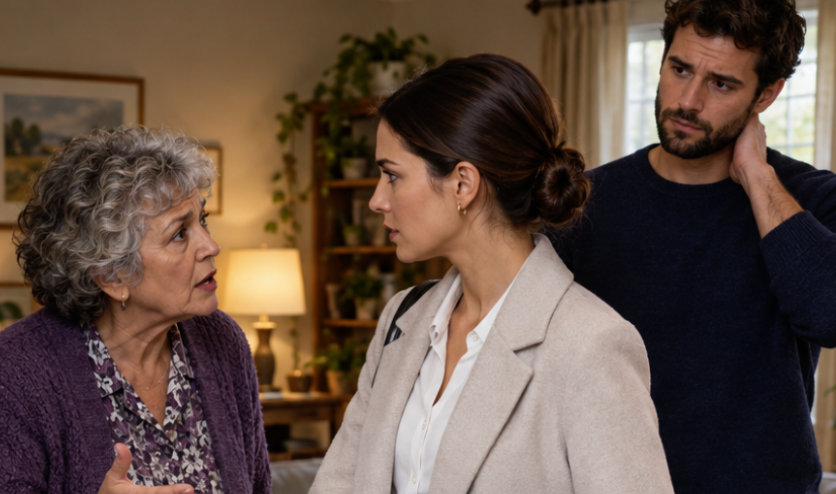
She walked into the living room—and was genuinely taken aback for a few seconds.
Boxes stood on the floor. A rolled-up rug was propped against the wall. Through the doorway to the other room, Oksana could be seen coming back for another load. And in the middle of all this, Denis sat with a roll of tape, a marker, and a sheet of paper listing the boxes in neat handwriting.
Alyona was nowhere to be seen among the bags.
She was sitting in the kitchen, laptop open and headphones on, checking a spreadsheet and sipping tea.
When she noticed her mother-in-law, Alyona removed one earbud.
“Good morning, Larisa Ivanovna.”
“So, you’re working?
“I have to finish a report by noon.”
She put her headphones back on.
For some reason, this stung Larisa Ivanovna even more. She had braced herself for a family showdown—and the main suspect had no intention of participating.
“Denis, where are you taking my things?”
“To your place.”
“And you didn’t think to ask me?”
“I told you ahead of time.”
“Telling and asking aren’t the same thing.”
“For almost four years, we asked. Now we’re just letting you know.”
He said this calmly, without any irritation, and bent over the box again.
Now this was something new.
Usually, Denis would jump in to smooth things over in situations like this.
“Mom, let’s talk about it later.”
“Alyona, let’s just leave it for now.”
“We’ll figure something out.”
Over four years, what they mostly figured out was how to squeeze between the boxes without knocking over a stack of old curtains.
When Denis married Alyona, he moved in with her. She had inherited the two-bedroom apartment from her grandmother several years before the wedding. Denis never had any claim to the apartment, not that there was any need—everything was simple between them. They split all the bills, groceries, and big household purchases, but the apartment stayed in Alyona’s name.
They made one of the rooms into a bedroom. The second was supposed to become a study with a sofa for guests.
That didn’t happen.
Half a year after their wedding, Larisa Ivanovna started renovations at her place and asked to leave two boxes with her children.
“Just for a week. Two at most.”
The boxes turned out to be very well-behaved and ended up living with Alyona for almost four years.
Then came the winter jackets.
Next was a set of china.
Then a carpet, which Larisa Ivanovna didn’t want to throw out because “they just don’t make them like that anymore.”
Later, a folding table joined the collection.
A month later, a chair appeared, supposedly intended for their summer cottage.
But the chair never made it to the cottage. Apparently, its path and the cottage just weren’t compatible.
Two years in, the room was filled with bags of bedding, jars, a box of Christmas decorations, old kitchen tools, a few desk lamps, and a plastic container of buttons about the size of a bucket.
Once, Alyona tried to find just the right button for her coat in that container.
Twenty minutes later, she closed the lid and decided it’d be easier to just buy a new coat.
Every attempt to return these things to their rightful owner went about the same way.
In spring, it was too muddy.
In summer, it was too hot.
Autumn brought endless rain.
And in winter, it was too icy.
Whenever Denis suggested renting a car, Larisa Ivanovna would reply that it was silly to spend money when Oksana might come by in her own car one day.
But whenever Oksana could actually come, it always turned out to be inconvenient that day.
Once, the move was postponed simply because Larisa Ivanovna was waiting for the final episode of a crime series.
Alyona looked at her husband that time and said:
“I won’t even argue. Losing our room to a TV series—that’s a whole new level.”
Denis laughed, promised to sort everything out in a week, and—once again—did nothing.
At first, Alyona was frustrated. Then she just got tired. In the end, they simply shut the door to the second room and only went in to grab the drying rack or the vacuum cleaner.
But at the beginning of September, everything changed.
Alyona worked as an analyst for a big retail company. She’d previously gone to the office almost every day, but starting in October, her department switched to a hybrid schedule: three days a week from home.
She had no intention of spending eight hours a day working from the kitchen.
Especially since Denis, who worked as a service engineer, would sometimes come home in the middle of the day between jobs.
There was only enough kitchen space for either Alyona’s work meeting or Denis with his cutlets at any one time.
Trying to make that work never went well.
And then Larisa Ivanovna called with a new suggestion.
Her aunt was redoing her kitchen and planned to throw out her old dishes.
Larisa Ivanovna was totally against such barbaric methods.
“Those are good pots. Enameled. You can’t find prices like that nowadays. I’ll bring you two boxes, we’ll put them in the cupboard.”
At first, Alyona thought she’d misheard.
“Which cupboard?”
“In the back room.”
“That cupboard is already full.”
“Well, just clear off a shelf.”
Alyona paused in silence.
“No.”
“No what?”
“Don’t bring anything else here.”
Larisa Ivanovna took offense.
“It’s just two boxes.”
“Half the room already consists of ‘just two boxes.'”
After the call, Alyona waited for Denis to come home.
She didn’t shout or lay down any ultimatums over dishes.
She simply opened the door to the second room.
“Look.”
“I see.”
“No, you’re used to it. Really look, right now.”
Denis stood in the doorway for a moment.
To his right were stacks of boxes. To his left was an armchair. Behind the armchair, a folding table. You could only reach the window if you squeezed sideways.
“Starting October, I’m working from home three days a week,” Alyona said. “I need a desk, a proper chair, and a door I can close. By the end of September, this room needs to be a room again.”
Denis nodded.
“Alright.”
Alyona looked at him with some skepticism.
“‘Alright’ like the past four years?”
That stung.
Because it was fair.
That evening, Denis called his mom himself and told her that next Saturday he and Oksana would bring all the stuff over to her place.
Larisa Ivanovna replied she’d be busy.
“Then we’ll just move it into the spare room.” Denis had a spare key to his mom’s apartment for years—for emergencies—so access wasn’t an issue.
“There isn’t a spare room.”
“Mom, there’s an empty room.”
It had been three years since the death of Larisa Ivanovna’s mother. She’d spent her final years living with her daughter, occupying a small room in the three-room apartment. After her passing, all that was left was a bed and a dresser, which Larisa had long since given away.
The space was barely used.
“I’m planning something else for it,” her mother said evasively.
“What?”
“I’ll tell you later.”
“Alright. But the stuff is coming either way.”
Larisa Ivanovna thought her son would cool down.
He didn’t.
Now she stood in the middle of the apartment, watching the kids tape up another box.
“I really don’t have any space,” she said.
Oksana peeked out of the room.
“What about grandma’s old room?”
“I already said: I have plans for it.”
“What kind of plans?”
Larisa Ivanovna hesitated.
“I want a walk-in closet.”
Oksana set the box down on the floor.
“Wait. So you want a closet for yourself, but you expect Alyona to use her office to store your jars?”
“Not just jars.”
“That changes everything.”
Denis grinned.
Larisa Ivanovna gave her daughter a stern look.
“Alyona has two rooms.”
“Mom, she has a two-room apartment,” Denis corrected her. “That’s not quite the same.”
“You’re family.”
“Exactly. We’re family. Which is why I feel especially awkward that I’ve kept half her apartment full of your stuff for four years.”
Larisa Ivanovna wanted to argue, but Denis had already picked up the next bag.
“What’s in this one?”
“Don’t touch that! There’s equipment in there.”
Turns out, the ‘appliances’ were actually four electric kettles.
Oksana lined them up on the floor in a neat row.
“Why are there four of them?”
“One actually works.”
“What about the rest?”
“Spare parts.”
Denis picked up a kettle without a lid.
“Spare parts for what exactly?”
“You never know.”
Alyona showed up in the kitchen doorway, holding a mug.
“Does this one work?”
Larisa Ivanovna took a look.
“No, that one doesn’t.”
“Has it been broken for a long time?”
“Well… since before your dad passed away.”
Oksana checked the sticker on the bottom.
“Mom, we bought this one in 2017.”
“See? It’s basically brand new.”
Alyona quickly turned away, but Denis saw she was trying not to laugh.
And things only got more interesting from there.
Eleven curtain sets.
A box of wires.
Two ski boots.
Both for the left foot.
“Where are the right boots?” Denis asked.
“They must be somewhere.”
“There aren’t any here.”
“Then they’re probably at my house.”
“Mom, why keep two left boots here and two right boots at home?”
“I didn’t know they’d gotten separated.”
Next, they found a dinner set for twenty-four people.
“Don’t touch that,” warned Larisa Ivanovna.
“We’re not throwing anything out,” Denis reminded her. “We aren’t throwing anything out at all.”
Then came the jars.
Small ones.
Big ones.
With screw-top lids.
Without lids.
Some had lids that didn’t fit any jar.
Oksana counted thirty-seven before she gave up counting.
“Why so many?”
“Where else will you pickle cucumbers?”
“I haven’t canned a single cucumber in the last ten years.”
“That’s why there aren’t any jars.”
“We still have them. Alyona has them all.”
The grand finale was a folding table.
Denis dragged it over to the door.
“Where should this one go?”
“Careful! That one is dear to me, holds a lot of memories.”
Oksana suddenly frowned.
“What kind of memories?”
“Family memories.”
“Mom, we bought it at the hardware store next to the market.”
“I don’t remember that.”
“I do. You even made me carry it all the way to the car because delivery was four hundred rubles. It was a special deal. Only two tables left.”
Denis looked at his mother.
“What kind of family memories are tied to it?”
Larisa Ivanovna paused for a moment.
“Memories of a great hardware store.”
Even she couldn’t help but smile at that.
The moving truck arrived right at one o’clock.
Alyona was done with work, but made a point not to help with loading. Not to spite her mother-in-law, but because Denis had said:
“This is my story. I’ll finish it myself.”
He and Oksana carried out the boxes, an armchair, the table, a rug, and bags.
Nothing went missing.
Nothing was thrown away.
Denis checked the list: twenty-three boxes, five bags, an armchair, a table, and a rug.
Larisa Ivanovna didn’t ride in the moving truck, instead she took a taxi home ahead of everyone else.
She made sure to announce loudly:
“I’m not unpacking anything today.”
“No one’s asking you to,” Denis replied.
“Or tomorrow.”
“Perfect.”
“Honestly, I don’t know when I’ll get around to it.”
Oksana slammed the truck’s cargo door shut.
“Mom, the important thing is, now everything is waiting for you at your own place.”
Larisa Ivanovna couldn’t come up with a good retort to that.
For the first four days, she didn’t call the kids.
On the fifth day, she called Oksana.
“Do you need any curtains?”
“What kind?”
“Beige ones.”
“No.”
“Gray ones?”
“No.”
“The ones with flowers?”
“Even less so.”
A week later, she called Alyona.
“Do you need any jars?”
Alyona cautiously asked:
“How many?”
“About ten.”
“No, thank you.”
“Good. I thought so too.”
That was the first troubling sign that things were about to change.
Two weeks later, Larisa Ivanovna really got into it.
Three kettles ended up at the electronics recycling center.
The curtains were taken by a neighbor for her country house.
Larisa kept the tea set, but moved it to a proper shelf.
She gave some dishes to a young family from the next building.
A few things were put up on a classifieds website.
Even the armchair was unexpectedly sold for two thousand rubles to someone furnishing a rental apartment.
The folding table went for one thousand two hundred.
When Denis came over to help take out empty boxes, his mother showed him the now much clearer room.
“I did the math,” she said. “I’ve made seven thousand four hundred rubles.”
“Congratulations on your newfound wealth.”
“Don’t be sarcastic. I’m going to buy a wardrobe.”
“For the dressing room?”
“Yes. But this time, a proper one.”
Denis looked around the room.
“So where will you take the next batch of things you don’t need?”
Larisa Ivanovna looked at him.
“Nowhere.”
“Want me to write that down?”
“Write it on your forehead.”
Meanwhile, much more pleasant changes were happening in Alyona’s apartment.
They bought a desk for twelve thousand eight hundred rubles from their shared budget. Alyona paid for the office chair herself—she’d been wanting a specific model to support her back and didn’t think it was fair to make Denis pay extra for her work preferences.
Denis assembled the bookshelf.
They placed a small sofa by the window, which could be turned into a bed for guests.
Once everything was ready, on her first workday, Alyona closed her office door, joined a meeting, and came out to the kitchen an hour later.
Denis was just making tea.
“Well?”
“Would you believe it, I didn’t have to discuss a report next to a bag of buckwheat even once today.”
“A loss of ambiance.”
“I’ll survive.”
The story quickly earned a family nickname—’The Great Jar Migration.’
Even Larisa Ivanovna eventually stopped being upset about it.
And at the end of November, she showed up at her kids’ place again, carrying a box.
Denis saw her and immediately grew wary.
“What’s in the box?”
“Old Christmas decorations. They’re good ones.”
He looked silently at his mother.
Larisa Ivanovna raised her hand.
“Don’t start. I just came to ask.”
Alyona peeked out from her office.
“About what?”
“Can I leave them here until December? They’re assembling my wardrobe and I’m afraid the decorations might get broken.”
Denis glanced at the calendar.
“Until December first?”
“Until the fifth.”
“Alright.”
He took the box, carried it to the office, and stuck a note on top:
“Return to Larisa Ivanovna on December 5th.”
His mother read it.
“Seriously?”
“Absolutely.”
“Does your own mother need receipts now?”
Denis adjusted the box on the bottom shelf.
“Nope. Just storage deadlines.”
Alyona burst out laughing.
Larisa Ivanovna wanted to protest, but ended up smiling too.
On December fifth, Denis really did take the box back.
No reminders needed.
And Larisa Ivanovna actually took it home.
After four years of being the family storage unit, they finally found out that the word “temporary” works just fine.
As long as you put an actual date next to it.