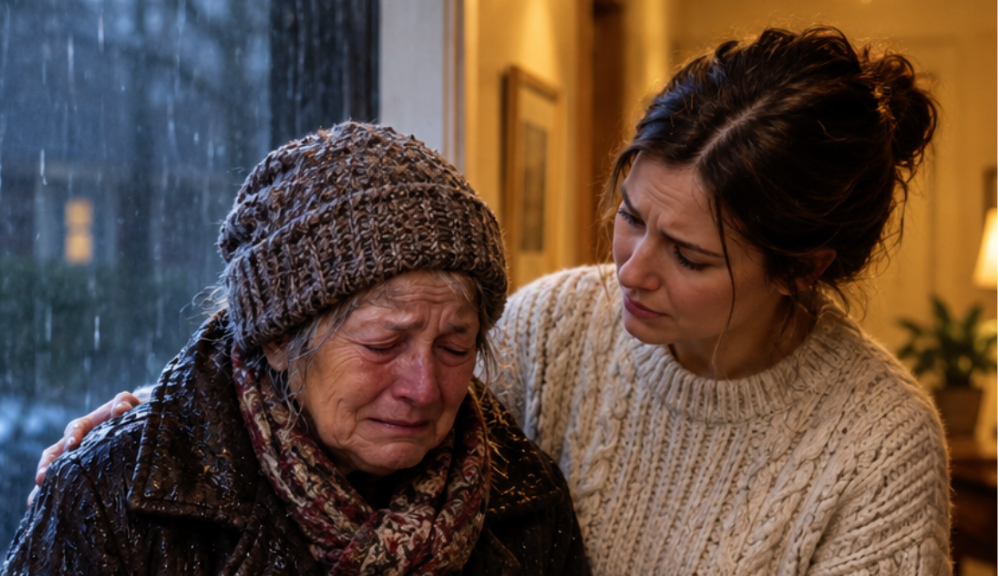
Zinaida stood in the rain with just a single bag. Galina opened the door, let her mother-in-law in, and dialed the notary. What happened next changed both of their lives.
The doorbell rang at 9:45 PM. Galina wiped her hands on a towel and froze. She wasn’t expecting anyone.
She peeked through the peephole. On the landing stood Zinaida Pavlovna, wearing a beige trench coat soaked to dark patches on the shoulders. In her right hand was a plastic bag with the ‘Pyaterochka’ logo. Her left hand was empty.
Galina opened the door.
“Galya,” her mother-in-law said, and then fell silent.
Her lips were trembling—not from the cold, but in a small, convulsive way, as if she was struggling to keep something in and couldn’t. Her mascara was smudged under her left eye, but her right eye was clean, like only one side of her face had been crying.
“Come in,” Galina said.
She stepped back into the hallway and let her mother-in-law inside. Zinaida stepped in, set her bag on the floor, and started unbuttoning her coat. Her fingers wouldn’t cooperate. The buttons were wet and slippery, and Zinaida Pavlovna fumbled with them for a long while, until Galina finally came over and undid them herself.
“Thank you.”
“The slippers are over there.”
Galina hung the coat on a hook by the door. Water immediately began to drip onto the linoleum. She laid down a rag she usually used for shoes and went to the kitchen to put the kettle on.
While the water was heating up, she stood by the window, counting raindrops on the glass. Not out of nerves, just needing something to do with her hands and eyes while she processed what she’d just seen on her doorstep.
Zinaida Pavlovna hadn’t visited them in four years.
Four years ago, everything was different. Back then, Galina still believed she could work things out with this family. That her mother-in-law, for all her stubbornness, could eventually accept her as a daughter-in-law. That Boris, caught between his mother and his wife, would someday choose.
He never did. He left.
Not for another woman. Not to drink. He got a rotational job on Sakhalin, coming home every three months for two weeks. At first, Galina waited—she cooked, cleaned the apartment, bought his favorite blue cheese at ‘Azbuka Vkusa.’ Then she stopped. She didn’t fall out of love—she just grew tired of waiting for a man who chose an oil rig over a family dinner.
Back then, Zinaida Pavlovna had told her:
“It’s your own fault. A proper wife doesn’t drive her husband out of the house.”
“I didn’t drive him out.”
“But what did you do to make him stay?”
Galina stayed silent. She could have replied: I made dinner every night, washed his uniforms, put up with his mother coming over unannounced and rearranging the kitchen cabinets. She could have said: I worked, raised Nastya, paid the rent while he decided if he wanted this life. But she didn’t say any of that.
After that conversation, Zinaida Pavlovna stopped calling. Sometimes Boris would relay a message: “Mother asks about Nastya.” Galina would answer, “She’s fine.” He’d nod, and then fly off again.
Then he stopped coming back at all.
The kettle clicked off. Galina took out two mugs. The white one, hers, with a chipped rim. And the blue guest mug that hadn’t been used in ages.
Zinaida Pavlovna sat at the table with her hands folded in her lap. She was about five-foot-two, but always seemed taller because of her straight posture and the habit of holding her chin high. Right now, her back was hunched and her chin was down. She looked small somehow, as if someone had shrunk her.
“What would you like with your tea?”
“Whatever you have.”
Galina placed a tea bag in a cup, added boiling water, and set it in front of her mother-in-law. Then she took a jar of gooseberry jam out of the fridge. Nastya loved it, and Galina always made it, though she never ate it herself.
“Galya.”
“Yes?”
“Boris sold the apartment.”
Galina sat down. Not because her legs gave out, but because the chair was close and she simply sank into it the way you do when you hear something you weren’t prepared for.
“Which apartment?”
“Mine.”
Zinaida Pavlovna looked up. Her eyes were red, not from tears, but as if all the tears had already been cried.
“He had me sign a power of attorney two years ago. I didn’t read it. I thought it was for utilities. He said he needed to re-register something.”
Galina stayed silent. The jar of jam sat open, filling the air with that sour-sweet scent of summer and berries and something simple and normal. But sitting at the table was a woman whose son had sold her apartment.
“When did you find out?”
“Today. A letter came from the registry office: new owner, new property registration. Someone named Kravtsov D.A.”
She said the name the way people say the name of a disease: detached, with a bit of effort.
“I called Boris. He isn’t answering.”
Galina nodded. She wasn’t surprised. Boris never picked up when there was something serious to answer for. He always said cell service was bad in Sakhalin. Very convenient service.
Nastya was asleep in her room. She was twelve, went to bed early, and slept soundly, like any child who still doesn’t know that the world is unfair. Galina closed the kitchen door a little tighter.
“Zinaida Pavlovna, do you have somewhere to stay?”
“No.”
Just one word. No explanation, no complaints, no “You see, Galya, this is how things are.” Just no.
“You can stay here. For now.”
“I won’t be long. Just until I figure things out.”
Galina looked at the bag in the hallway. The edge of a towel and something wrapped in newspaper stuck out. Everything that was left of a two-room apartment in Biryulyovo.
She picked up her phone and stepped into the hallway.
She found the notary’s number in her notes. Irina Sergeyevna Lapko, Academician Pilyugin Street. Galina had saved it a year and a half ago, when she was drawing up a will just in case. The notary had seemed calm and businesslike then. That’s exactly what you need when you’re panicking inside.
It was almost eleven o’clock at night. She sent a message:
“Irina Sergeyevna, hello. I have an urgent question about a real estate transaction. Power of attorney, possible fraud. When can I come in?”
A reply came three minutes later: “Tomorrow, 9:00 a.m. Bring any documents you have.”
Galina went back to the kitchen. Zinaida Pavlovna was sitting in the same position. Only now the tea had gone cold and a wrinkled skin had formed across the surface.
“We’ll go to the notary in the morning.”
“Why?”
“To figure things out.”
“Galya, I don’t want to press charges against my son.”
“I’m not suggesting we press charges. I want to find out what he did, and if there’s a way to undo it.”
Zinaida Pavlovna looked at her. For a long time, the way you look at someone you’ve seen for the first time, even though you’ve known them for fifteen years.
“Why are you helping me?”
Galina put the jam in the fridge. She wiped down the table. She straightened the salt shaker that had been sitting crooked.
“Because there’s no one else who can.”
She made up a bed for her mother-in-law on the living room sofa. She pulled out fresh sheets, a blanket, and a pillow from the closet. Zinaida Pavlovna stood nearby, watching as Galina tucked the sheets in, folding the corners neatly, habitually, just like her own mother once taught her—the hospital way.
“Your hands are like a nurse’s.”
“I am a nurse. Or was. Before Nastya.”
Zinaida Pavlovna sat down on the edge of the sofa. The springs creaked.
“I didn’t know.”
“You never asked.”
She didn’t say it with anger. Just a fact. Like the temperature outside or a bus number.
Galina turned off the overhead light, leaving just the floor lamp on.
“If you need anything, I’ll be in the bedroom. Right through the wall.”
“Thank you, Galya.”
“Goodnight.”
She closed the door and leaned against the hallway wall. The wallpaper was old, with a small floral pattern, and it smelled dusty and slightly sweet, just like her grandmother’s dress used to. She stood there for a minute. Maybe two.
Then she went to her room, lay down, pulled the blanket over herself, and stared at the ceiling.
Boris sold his mother’s apartment. Not his. Hers. The very one she had lived in for thirty-seven years. The one with the yellow tile in the kitchen, and the curtain rod that never hung quite straight. The place where Galina used to come when she was still just his fiancée, sipping tea from those same blue mugs—one of which now sits in her own cabinet.
She closed her eyes. It was dark and hot behind her eyelids.
In the morning, Nastya came into the kitchen and saw strange slippers by the door.
“Mom, do we have someone here?”
“Grandma Zina has come.”
“Which Grandma Zina?”
Galina set a bowl of porridge in front of her daughter. Oatmeal with banana, just like every morning.
“Dad’s mom.”
“Oh. The one who doesn’t love us?”
Galina froze, the spoon in her hand. Nastya said it calmly, without resentment, the way you mention rain or a traffic jam. Just a fact.
“She does love us. She just doesn’t know how to show it.”
“Okay.”
Nastya started eating. Zinaida Pavlovna appeared in the kitchen doorway a minute later. She was still wearing yesterday’s clothes, but her hair was neater and her face washed. Without makeup, she looked older: the wrinkles around her mouth deep, like cracks in dry earth.
“Good morning.”
“Hi,” Nastya said, not looking up.
Galina set down a third bowl.
“Take a seat. We need to leave by nine.”
Zinaida Pavlovna sat down. She looked at the oatmeal. She took a spoonful.
“It’s good.”
“It’s the banana,” Nastya said. “Mom always adds banana. Without it, it’s not good.”
She said it as if explaining how the world works.
They arrived at the notary’s office at five minutes to nine. It was on the ground floor of a residential building, with its own entrance and a frosted glass sign. Inside, it smelled of paperwork and something floral. On the windowsill sat a pale pink orchid, its stem dried out.
Irina Sergeevna turned out to be a woman of about fifty, with short hair and glasses on a chain. She listened to Zinaida Pavlovna without interrupting, jotting things down in her notepad.
“Did you sign the power of attorney at the notary?”
— Yes. It was at Fedorov’s, on Kashirskaya.
— Do you remember exactly what was written?
— No. Boris just said it was for the communal apartment.
Irina Sergeevna took off her glasses.
— Zinaida Pavlovna, a general power of attorney gives someone full rights over your property. They can sell, gift, or mortgage it. If you signed it voluntarily and were competent at the time, it will be difficult to revoke the transaction.
— But I didn’t know he would sell it.
— You’ll need to prove that. There are two options. First: dispute the power of attorney if you can show you were misled. Second: challenge the deal in court.
Galina sat nearby and listened. She isn’t a lawyer. She’s a nurse who makes gooseberry jam and tucks sheets in hospital style. But she listened so intently that she remembered every word.
— What documents are needed?
— A copy of the power of attorney, an extract from the property registry, any correspondence with your son about the apartment. If there were witnesses when he asked you to sign, that’s important too.
Zinaida Pavlovna clasped her hands on her knees.
— What witnesses? We were alone.
— Were there any messages? Any calls?
— I don’t save them.
Irina Sergeevna looked at Galina. Galina nodded: I understand.
— We’ll gather whatever we have. When can we come back?
— In a week. Bring everything. And think about whether you’re ready to go to court.
On the way back, Zinaida Pavlovna was silent. She looked out the window of the minibus, holding her small brown bag with the worn latch on her lap. Galina sat beside her and noticed her mother-in-law smelled like someone else’s soap. Her own soap. Lavender, from the household goods store near the metro.
— Galya.
— Yes.
— I won’t be able to sue Borya.
— You don’t have to sue Borya. You’re challenging the transaction. It’s not the same thing.
— He’s my son.
— I know.
The minibus jolted around the corner. The bag slipped off Zinaida Pavlovna’s knees and she caught it with both hands, holding it close.
— When he was little, he was afraid of thunderstorms. He’d crawl under my blanket and say, ‘Mom, don’t turn off the light.’ And I didn’t. I kept it on all night.
Galina didn’t reply. She stared at her hands. There was still a mark on her ring finger where she’d taken off her ring two years ago.
The days felt strange. Not good or bad. Just strange.
Zinaida Pavlovna became quiet. Not the kind of quiet when someone is waiting for the right moment, but the quiet of someone who has run out of words. She woke up early, before Galina, and by the time Galina came to the kitchen the kettle was already hot and the table wiped clean.
— You don’t have to clean.
— I have nothing else to do.
She washed the dishes slowly, each plate separately, as if it were a very important job that required all her attention. And Galina suddenly thought: maybe it is. Maybe this is the only thing left where she feels like she’s still useful.
On the third day, Nastya came home from school and found Zinaida Pavlovna in the living room. She was sitting on the sofa, going through the contents of a bag. There was a towel. A passport in a cover. Three photos: a wedding photo, where young Zinaida wore a white dress with a lace collar. Boris in his school uniform, a bow on his chest. And the third: Zinaida with her late husband Pavel Andreevich, the sea in the background.
“Who is this?” Nastya asked.
“Grandpa. You never met him.”
“Why are you crying?”
Zinaida Pavlovna wasn’t crying. Her eyes were dry. But there was something in her face that made the twelve-year-old girl think she saw tears.
“I’m not crying.”
“Okay. Do you want me to show you my phone? There’s a game with kittens on it.”
Zinaida Pavlovna looked at her granddaughter. Nastya stood in the doorway, one strap of her backpack on her shoulder, her braid messy, a band-aid on her nose because she ran into the horizontal bar in gym class.
“Show me.”
They sat side by side on the sofa, and Nastya explained the rules while Zinaida Pavlovna nodded, understanding nothing, but listened as attentively as if something important depended on it.
Galina stood in the hallway, watching them through the gap of a slightly open door. Something hot rose in her throat. She swallowed it and went to the kitchen.
Five days later, Boris called.
Galina saw his name on the screen and for several seconds just stared as the phone vibrated on the table. The letters jumped softly, rhythmically. She picked up.
“Galya, is Mom with you?”
“Yes.”
“Tell her to stop being ridiculous.”
“What exactly do you think she’s doing wrong?”
There was a pause. Then his voice, muffled, as if he’d turned away from the phone:
“I didn’t lie to her. She knew.”
“She didn’t know, Boris. And you know that too.”
“She’s my mother. I’ll handle it.”
“You already handled it. You sold her apartment and won’t pick up the phone.”
He was silent. Galina could hear a distant noise—maybe the wind, maybe machinery. Sakhalin. The oil rig. Another planet.
“I needed the money. I’m in debt.”
“What kind of debt?”
“It doesn’t matter what kind. It’s big. I’ll get her apartment back, Gal. I just need time.”
“How much time?”
“A year. Maybe a year and a half.”
Galina leaned against the door frame. In the next room, Nastya laughed—Zinaida Pavlovna must have finally figured out the kitten game.
“Boris, we’re going to the notary. We’re gathering the documents.”
“Why? I told you I’ll return it.”
“You’ve promised a lot of things. That you’d come for Nastya’s birthday. That you’d fix the faucet. That you’d call your mother.”
“That’s different.”
“No. It’s the same thing.”
He hung up. Or the connection dropped. It didn’t make a difference.
That evening, Galina told Zinaida Pavlovna about the call. They sat in the kitchen, Nastya was already asleep. Outside, a streetlamp shone, casting a yellow rectangle of light onto the table, where tiny dust particles floated slowly.
“He said he’ll give it back.”
“I know my son, Galya.”
Zinaida Pavlovna held her mug with both hands. Her fingers were thin, her knuckles prominent, her skin dry.
“He won’t?”
“He believes he will. He always believes. And then he doesn’t do it. Just like with his father. Before Pasha died, he asked: take me to the sea one last time. Boris promised. Promised three times.”
She sipped her tea.
“Pasha died in January. He never saw the sea.”
Galina stayed silent, lost in thought. She’d known this man for fifteen years, and somehow, he still managed to surprise her every time. It wasn’t anger. It wasn’t cruelty. It was his remarkable ability to believe in his own promises so sincerely that everyone else believed them too.
“Zinaida Pavlovna.”
“What?”
“We’re taking this to court.”
Her mother-in-law set her mug on the table. The sound was dull, like knocking on wood.
“He’s my son.”
“I know. Still, we have to.”
“You don’t understand.”
“I do. I have a child too. And if Nastya decided to sell my apartment twenty years from now, I’d want someone close by to say: this isn’t right. Even if Nastya truly believed she would fix everything.”
Zinaida Pavlovna looked at her. A streetlight outside flickered, and for a moment the yellow rectangle of light on the table disappeared, then returned.
“You’ve changed, Galya.”
“No, I’ve always been this way. You just never noticed.”
A week later, just as they had planned, they went to the notary. Zinaida Pavlovna brought her passport, three utility bills from her previous address, and a printout from the Rosreestr registry. Galina added screenshots of her chat with Boris: those exact messages where he wrote, “Mom, just sign this, it’s for the utilities” and “Don’t worry, it’s just a formality.”
“Where did you get those?” Zinaida Pavlovna asked.
“Boris sent them to me. Two years ago. He wanted to know if they looked normal.”
She didn’t mention that back then, she hadn’t thought much about it. That she hadn’t read them carefully. That, maybe, she could have prevented this if she had paid attention.
Irina Sergeyevna spread the documents out on the table.
“Now, this is something. There’s a message specifying the power of attorney was for utilities. But in reality, it was used for the sale. That’s grounds for a claim to have the deal declared invalid under Article 178 of the Civil Code. A mistake about the nature of the deal.”
“Will that really work?” Galina asked.
“There are no guarantees. But there’s a chance. Especially with this correspondence.”
Zinaida Pavlovna sat up straight. Her back straightened, chin lifted. Just like she used to, as if some old mechanism inside her for holding it together had kicked in again.
“What do I need to sign?”
“Nothing yet. First, I’ll draft the statement, you’ll read it, we’ll discuss it together. There’s no need to rush.”
“I’m not in a hurry. I waited four years for him to call. I can wait another week.”
She said it calmly, without bitterness. But Galina noticed how her left hand clenched into a fist on her knee, then slowly opened.
That evening, Nastya asked:
“Mom, is Grandma Zina going to live with us now?”
“For now, yes.”
“For a long time?”
“I don’t know, Nastya.”
Nastya was sitting on her bed, scratching the knee where a scab was just starting to dry. Her room was small: a bed, a desk, a wardrobe, and a shelf of books. There was a poster of some band on the wall, one whose name Galina could never remember.
“She’s actually nice, you know.”
“What do you mean?”
“Well, today she helped me with my math. She explains things really well. Better than you.”
Galina wanted to be offended, but couldn’t. Instead, she smiled. For the first time in ten days.
“Good night.”
“Mom.”
“Yes?”
“Does Dad know she’s here with us?”
“He knows.”
“And what does he say?”
“Nothing.”
Nastya nodded, as if she hadn’t expected any other answer.
A month went by. Then another.
Zinaida Pavlovna got used to their apartment, and the apartment got used to her. Her slippers stood by the door next to Galina’s slippers and Nastya’s sneakers. Her mug—the blue one that used to be for guests—was hers now. On the kitchen windowsill, a little pot of basil appeared: her mother-in-law had bought the seeds at the subway for forty rubles.
She cooked on Tuesdays and Thursdays. Borscht, what she called “real borscht, not that stuff from a packet.” Galina never argued. The borscht really was good: thick, deep red, with meat that melted in your mouth.
“Zinaida Pavlovna, did you add garlic?”
“Of course I did. What’s borscht without garlic?”
“Nastya doesn’t eat garlic.”
“Nastya will eat it. She’s a growing girl.”
Nastya ate it. And even asked for seconds.
Galina washed the dishes and thought: how strange. Four years ago, this woman used to rearrange her kitchenware without asking and tell her she couldn’t manage a household. And now, here she was standing beside her, drying plates with a towel she’d washed that very morning.
They didn’t become friends. And they didn’t become mother and daughter. They became something else, something for which Galina had no word. Two women, both left behind by the same man in different ways, but with the same result.
The court date was set for March.
Galina took a day off work. She worked at the clinic’s front desk: medical files, waiting lists, “pass this to room seven.” Her supervisor looked at her over her glasses and asked:
“Is it something serious?”
“It’s family.”
“Take the day.”
That morning, Zinaida Pavlovna was ironing her blouse. The one from the bag, the only decent one she said she had. Blue, with pearly buttons. The iron hissed, sending up clouds of steam from the cloth. The smell of hot cotton filled the kitchen.
“Are you nervous?”
“No.”
But she was nervous. Galina could see it in the way her mother-in-law fastened the buttons: top to bottom, one at a time, slowly, like a ritual.
The courthouse was chilly and echoed with every step. The corridor was long, lined with wooden benches. They sat and waited. Zinaida Pavlovna held a folder of documents on her knees with both hands.
“Galya.”
“Yes?”
“If we lose…”
“We won’t lose.”
“If we lose, I’ll go live with my sister in Tula. I don’t want to be a burden to you.”
“You’re not a burden.”
Her mother-in-law turned to her.
“Do you really think so?”
“Nastya has gotten used to your borscht. I could never make it like you do.”
Zinaida Pavlovna suddenly laughed. Quietly, almost without a sound, just a slight shake of her shoulders. And Galina realized she’d never actually heard her mother-in-law laugh before.
The judge was young, about thirty-five, with smooth hair and an even voice. She looked over the documents, listened to the lawyer—whom Galina had found through a friend—and then asked:
“Plaintiff, you assert that you were not aware of your son’s intention to sell the apartment?”
“Yes.”
“Do you have any proof?”
“There’s our correspondence. He said the power of attorney was for utility issues.”
The judge looked at the screen.
“To the defendant, the buyer Kravtsov D.A. is not present at this hearing. His representative maintains the deal was legal.”
The lawyer stood up. Galina clenched her hands under the bench.
He spoke for ten minutes. He talked about Article 178, about misunderstandings, about the messages that were exchanged, about how Zinaida Pavlovna signed the power of attorney for one reason, but it was used for another. Galina listened, and suddenly thought: four years ago, she wouldn’t be sitting here. She would’ve let Boris handle everything. She would have waited. She would have trusted.
Now she didn’t trust. And she didn’t wait.
The court called a recess. There would be another hearing in two weeks.
They stepped outside. March carried the scent of melting snow and exhaust fumes. Zinaida Pavlovna buttoned her coat. The same one—beige, dry, and freshly cleaned.
“Well? So?”
“The lawyer says our chances are good.”
“But what do you think?”
“I think we should go home. The basil still hasn’t been watered.”
The second hearing lasted two hours. Boris sent in written testimony through his representative: “My mother knew about the sale, she agreed to it, and the plan was to return the money later.” No evidence. Just words.
The lawyer laid out screenshots of the chat for the judge. The date on the power of attorney. A printout from the property registry. A note showing Zinaida Pavlovna continued paying utilities at the apartment’s address for three months after the sale—because she didn’t know the apartment was no longer hers.
The judge withdrew to make a decision.
Zinaida Pavlovna sat up straight. Her hands rested on her knees. Her chin was lifted. She stared ahead, and Galina suddenly saw in her that same woman who, fifteen years ago, opened her door to a young daughter-in-law and said, ‘Slippers are over there.’ Not kindness or anger. Just a fact.
The decision was announced forty minutes later.
The deal was declared invalid. The apartment had to be returned.
Zinaida Pavlovna didn’t get up. She sat and looked at the judge, as if she hadn’t heard. Galina touched her shoulder.
“Zinaida Pavlovna. That’s it. We won.”
Her mother-in-law turned to her. Her face was still, except for a small twitch under her right eye.
“We won?”
“Yes.”
“And Borya?”
“That’s his problem. Not yours.”
They walked out of the courthouse. Zinaida Pavlovna stopped on the steps. The sun shone directly into her face, and she squinted.
“Galya.”
“What?”
“You’re a good person.”
“I’m ordinary.”
“No. I know ordinary people. Ordinary people don’t let their mother-in-law into their home after four years of silence and don’t take her to a notary.”
Galina adjusted her scarf. The March wind was cold, with the promise of a warmth that hadn’t arrived yet.
“Let’s go home. Nastya will be home from school, and she’ll be hungry.”
It took two more months to get the apartment back. So many documents, the state registry, another round of registration. Galina went with Zinaida Pavlovna to every meeting: she waited in the corridors, carried folders, explained whatever her mother-in-law couldn’t understand.
Boris called once. Not his mother. He called Galina.
“Are you happy now?”
“No. I’m just tired.”
“Why did you even get involved in this?”
“Because you didn’t.”
He hung up.
In May, Zinaida Pavlovna received a new property certificate with an updated registration date. Owner: Kozlova Zinaida Pavlovna. She held the paper, reading her name over and over, as if she had to make sure it was real.
“I can come home now.”
“You can.”
They stood in the kitchen. The basil on the windowsill had grown tall and now leaned to one side. Sunlight was spread across the table, exactly where, two months ago, a yellow rectangle from the streetlamp used to shine.
“Nastya is going to miss you.”
“I will too.”
Zinaida Pavlovna looked at her. Then she stepped forward and gave her a hug. It was brief and a little awkward, the embrace of someone not used to such gestures. Her hands rested on Galina’s back, her palms warm and dry.
Galina didn’t move. She could smell lavender soap. Her soap—or rather, now it was theirs.
Zinaida Pavlovna left on Saturday. Nastya helped carry things: the same bag from Pyaterochka, but now it was joined by a bag of dishes that Galina gave her, and a math book that her mother-in-law had bought for her granddaughter at the shop on the corner.
Her slippers were left in the hallway. Galina didn’t put them away. Not on purpose. She just hadn’t gotten around to it.
In the evening, after putting Nastya to bed, she sat in the kitchen. The kettle was still warm. She poured tea into a white mug with a chipped rim. The blue one was in the cupboard. In its place.
Her phone beeped. A message from Zinaida Pavlovna: “I made it. Everything’s here. The curtain rod is still crooked.”
Galina smiled. Then she replied: “Come visit on Sunday. Nastya asked for borscht.”
The answer came a minute later: “With garlic.”
Galina set her phone on the table. It was dark outside. The streetlamp shone steadily, its yellow light spilling onto the windowsill where the basil stood.
She still hadn’t put the slippers away.