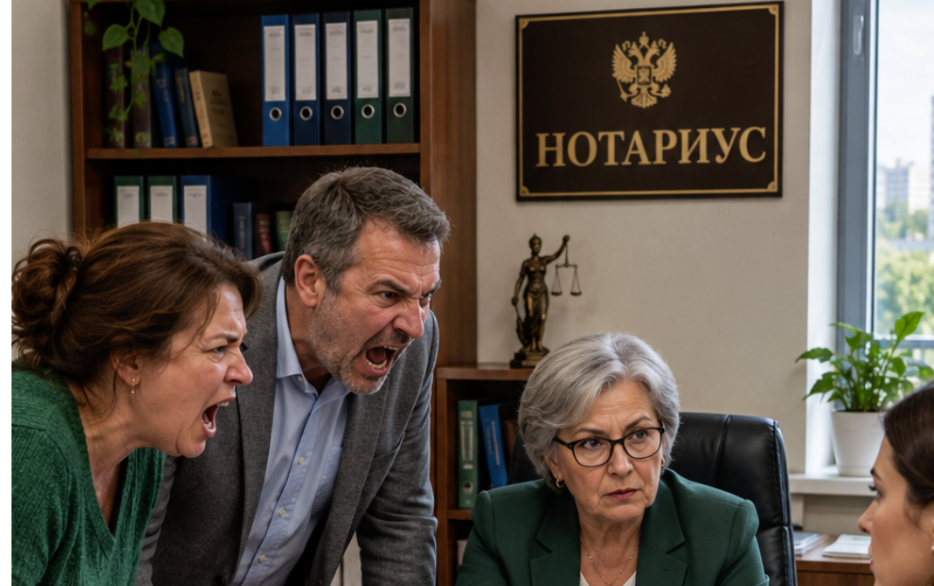
“Just try it!” Denis slammed his fist on the high counter, making the mug with handles jump and roll toward the edge. “Do you even realize what you’re doing? This is my apartment! My mother’s apartment!”
The notary—a middle-aged woman with a neat bun and a soft, quiet voice—slowly lifted her gaze from the papers. She didn’t look scared. Just tired, like someone who has seen this a hundred times before.
“Sir,” she said, “I’m asking you to calm down.”
“I will NOT calm down!” Denis yanked at his tie like it was choking him. “She won’t sign anything! Do you hear me? Nothing!”
Vera stood a little off to the side, by the window. Outside was a typical September courtyard—gray asphalt, poplar trees with yellowing leaves, parked cars. Everything seemed so normal. So far from the turmoil happening in that office.
“Denis,” she said evenly, “look at the document.”
“Look at what? I SAID you’re not signing anything!”
The notary sighed and turned the folder toward them.
“Young man. The signature is already there. Right here.” She pointed at the line. “This is your wife’s signature. The deal is done.”
Denis stared at the paper. Then at Vera. Then back at the paper—as if hoping the letters would somehow change, blur, or disappear.
“When…” he started to say.
“Three days ago,” Vera answered. “While you were at your mother’s.”
They met seven years ago—at a mutual friend’s birthday party. Back then, Denis seemed simple and straightforward to her. Broad-shouldered, always laughing, loud and talkative—the kind that fills any space. Vera was used to quiet, to people who were careful and reserved, which is probably why he caught her attention. He was different. Alive. Unfamiliar.
It took her a while to realize that the liveliness in him wasn’t really his. It was his mother’s.
Lyudmila Sergeevna entered their lives before their honeymoon even ended. First, there were the three calls a day: “Denechka, did you eat? Denechka, don’t forget your pills.” Then came the advice on everything—from how to cook buckwheat to where to store documents. Then Lyudmila Sergeevna simply started treating the apartment as her own territory—not physically, she lived across the city—but mentally. Everything within those walls seemed to belong to her.
They bought the apartment with Vera’s money. Everyone knew it, but Lyudmila Sergeevna preferred to overlook that fact. She would say, “our apartment,” “my Denechka lives here,” “I want the renovation done like this,” and Denis always nodded. He could nod in such a way that looked thoughtful, but really he just waited for his mother to finish so he could agree.
For a long time, Vera wasn’t sure whether to be angry or to feel sorry. Eventually, she stopped wasting time on that question.
The idea came to her in August, when Lyudmila Sergeevna once again announced that “this apartment should stay in the family”—meaning Denis, meaning herself. They were sitting in the kitchen, drinking tea, and her mother-in-law said it so casually, in between talking about curtains and sharing stories about the neighbors, that Vera almost missed it.
But she didn’t.
“Which family?” she asked quietly.
“In our apartment,” replied Lyudmila Sergeyevna, giving her a look as if the question was silly. “You understand, Vera, life is unpredictable. You have to think ahead.”
Denis looked down into his cup.
Vera looked into her cup too. And she smiled.
“Of course,” she said. “You have to think ahead.”
The next day, she called a lawyer.
Everything turned out to be easier than she expected. The apartment was already in her name—years ago, Lyudmila Sergeyevna insisted on it to “save on taxes,” not realizing that it could work both ways. Vera consulted a specialist, gathered the documents, and made an appointment with the notary. Meanwhile, Denis spent those three days at his mother’s—she complained about her blood pressure and demanded that her son be there. He went willingly; they fed him, pampered him, called him “sunshine.”
In the meantime, Vera completed the deed of gift. She made her sister Oksana the recipient—a doctor living in the next city, someone who never asked for anything. Just a quiet, reliable person. Exactly the sort you could trust with something important.
When she got back from the notary, her hands were perfectly steady. She entered the apartment, put the kettle on, opened the window—the cool breeze drifted in from the courtyard, somewhere a crow cawed, and the leaves on the poplars quivered. Just an ordinary September evening.
Denis arrived an hour later, cheerful and carrying a bag of his mother’s pies. Apparently, Lyudmila Sergeyevna had recovered enough to bake.
“Mom sent these,” he said, setting the bag on the table. “She says you haven’t visited in a while.”
“Yes,” Vera agreed. “It’s been a while.”
He didn’t notice anything. Not that evening, not the next day. Lyudmila Sergeyevna only called two days later—with some question about the renovation they were “planning to do.” Vera replied briefly, without extra words. She hung up and wondered: when will they find out?
Turns out—it was soon.
Someone they knew, who worked at the same notary office—not a notary, just someone from the neighboring office—happened to mention something to Lyudmila Sergeyevna. Or maybe it wasn’t by accident. In small-town life, things rarely happen by chance.
Denis found out in the morning. He called Vera at work—she didn’t answer. He sent three messages—she read them and put her phone back in her bag. Then he showed up at the notary’s himself, unannounced, with a look that said he intended to fix everything right then and there.
Vera came there too—not out of fear, but because she wanted to see his face. She wanted him to realize: this wasn’t an accident, not a mistake, not something that could be undone.
And now he stood in the middle of the office, staring at the signature. Her signature. Neat, clear, made without trembling.
“You couldn’t have,” he finally said. Quiet, almost bewildered. “It was our apartment.”
Vera picked up her bag from the chair.
“No, Denis,” she said. “It was my apartment.” She paused. “Was.”
The notary gently shifted the papers. Outside, the city bustled—cars, voices, the distant sound of a tram. September carried on, as if nothing had happened.
And somewhere across the city, a phone was already ringing. Lyudmila Sergeyevna, still unaware of everything, was picking up the receiver.
Lyudmila Sergeyevna opened the door before Denis could ring the bell a second time. She stood in the doorway wearing a bathrobe with tiny flowers, holding her phone—clearly, she’d been waiting.
“Come in,” she said, and looked at her son the way someone looks at a wounded animal—with sympathy and superiority at the same time.
Denis went inside and sat down on the couch just like he always had since he was a kid—slightly hunched, with his elbows on his knees. His mother brought him tea, sat across from him, and he told her everything. About the notary, the deed of gift, and about Oksana.
Lyudmila Sergeyevna listened in silence. This was unusual—she rarely went more than three minutes without speaking. But now, she sat, looking out the window, and something slowly changed in her expression. It wasn’t grief. It was something else.
“So, Oksana,” she finally said.
“Mom, we have to do something. A lawyer, court, I don’t know—isn’t it possible to challenge this?”
“We can try,” Lyudmila Sergeyevna replied. “But first, answer me this.” She turned to face him. “Did you know the apartment was entirely in Vera’s name?”
“Well… yes. You said yourself it would be easier that way.”
“I said—it’s less taxes.” She pursed her lips. “And you nodded and went to watch football.”
Denis opened his mouth.
“Don’t speak,” his mother cut him off. “You should’ve thought about this sooner.”
At that moment, Vera was sitting in a café on Prostrornaya—a small place with wooden tables and the scent of cardamom. She liked it because no one rushed her or cared about the time. She ordered a cappuccino, pulled out her phone, and texted her sister:
“Everything went fine. Thanks for agreeing”
.
Oksana replied quickly:
“I still don’t get it. Why do you need this? You’re living there!”
.
Vera smiled and put her phone away. Explaining would take too long. And she didn’t need to—not yet.
She looked out the window. People were walking by; someone was pushing a bike, two students were laughing over something on their phone. Life outside looked light and carefree. Vera finished her coffee, slipped a bill under the saucer, and left.
Outside, it smelled like autumn—damp leaves, wet asphalt, something subtly reminiscent of farewells. As she walked, her thoughts weren’t about Denis or her mother-in-law. She was thinking about stopping by the dry cleaner’s to pick up her coat, then calling her mom—they hadn’t really talked in a while, there was never enough time.
Her phone vibrated. An unknown number.
She stopped in front of a flower shop window, where late asters—burgundy and white—stood in buckets, and she pressed answer.
“Vera Andreevna?” The voice was unfamiliar, male, very calm. “My name is Pavel Igorevich. I’m a lawyer. I’d like to talk to you about a certain matter. How about tomorrow?”
“What matter?” she asked cautiously.
“A matter that will probably surprise you,” he replied. “It concerns an inheritance. Not your husband’s. Yours.”
Vera barely slept until nearly two in the morning.
She lay in the darkness, staring at the ceiling and going over everything she knew about her relatives. Her parents were alive and well, living in Pskov. Her maternal grandmother had died eight years ago, her paternal one even earlier. Uncle Grisha—her dad’s brother—had left somewhere in the early 2000s, maybe to Yekaterinburg, and they’d barely stayed in touch since then. A New Year’s card every few years, and even that wasn’t guaranteed.
So what does any of this have to do with an inheritance?
Denis was sleeping beside her—his breathing heavy, like someone who’d spent the whole day on edge. During the day, he’d come home, quiet and without any drama, only saying:
We’ll talk.
Vera had replied:
Alright.
And they never brought it up again.
In the morning, she went to a law office—a small space on the third floor of an old building by the park. Pavel Igorevich turned out to be a neat man of about fifty, wearing thin-rimmed glasses. He offered her coffee, but she declined and got straight to the point:
“Please explain everything to me from the very beginning.”
He nodded and opened a folder.
Uncle Grisha had died three months ago. In Yekaterinburg, where he’d lived for over twenty years. He had no wife, no children. But he did have other things: a small business he built himself—making wooden goods, modest but still running. An apartment. And a plot of land just outside the city—about thirty acres, with a small house on it.
“He left a will,” the lawyer said. “To you.”
Vera stayed silent.
“Not to my father?” she finally asked.
“No. To you personally. He wrote—and I’m quoting directly—”
to my niece Vera, because she’s the only one who wrote to me just because, for no special reason”
.
Vera remembered. A few years ago, one random evening, she had found his number in an old address book and sent a message—just simply:
Uncle Grisha, how are you doing?
He replied. Sometimes they’d message, rarely, about nothing in particular. She had practically forgotten about it.
Turns out—he hadn’t.
“You have six months to accept or decline the inheritance,” the lawyer said. “Three months have already passed since his death. You still have time.”
Vera sat, looking at the folder of documents. She felt something odd—not joy, not bewilderment, but a kind of quiet amazement. As if life had suddenly turned inside out—and what she found there was nothing like what she expected.
“I need to think about it,” she said.
“Of course,” Pavel Igorevich nodded. “But there’s one more thing.” He paused for a moment. “Your husband already called our office. Last night. How he found out, I don’t know. But he did.”
Vera slowly lifted her gaze.
“And what did he want?”
The lawyer folded his hands on the table.
“He wanted to know if the inheritance could be changed to joint marital property.”
Outside, the park was alive with noise. Somewhere far off, children were laughing. September was calm, golden, and absolutely unshakable.
Vera took a business card from the table, carefully put it in her bag, and stood up.
“I’ll call you tomorrow,” she said evenly.
And she left.
She walked through the park, not in any hurry.
Leaves rustled underfoot—yellow, copper, veined like an old map. The benches were empty, except for one where an old man dozed off, newspaper resting on his knees. Vera walked slowly, hands stuffed in her jacket pockets, lost in thought.
So, Denis had known. He already knew last night—and said nothing. He sat through dinner, watched TV, went to bed. And stayed silent. She tried to recall his face at the table—just his usual, a bit tired, nothing extra. He really knows how to keep a straight face when he needs to.
Or maybe it was his mother who taught him—not to rush, to wait things out, to act quietly?
She stopped by the fountain—it wasn’t running anymore, drained for fall, just some coins and a couple of leaves settling at the bottom. Vera looked at the coins and suddenly thought: that’s what someone else’s wish looks like. You toss it in and just wait, hoping it’ll come true.
Her phone buzzed. Denis.
She stared at the screen until the call stopped. Then she texted briefly:
I’ll be there tonight. We’ll talk
.
Lyudmila Sergeyevna showed up without warning—her usual habit, which she insisted was family spontaneity, not rudeness. She just arrived, rang the doorbell, and when Vera answered, there she was with a bag and that look that meant she was here to solve things.
“We need to talk,” her mother-in-law announced.
“Come in,” Vera replied.
They sat in the kitchen. Denis was home—he lingered in the hallway, then finally came in and sat by the window, like a spectator invited but not given a part to play.
Lyudmila Sergeyevna placed her hands on the table—firmly, like she owned the place.
“Verachka, I understand you and Denis are going through a rough patch. It happens. But a family isn’t just about feelings, it’s about what’s shared. Shared property, shared decisions.” She paused. “That inheritance you got—that’s shared now too. By law.”
“By law,” Vera repeated.
“Exactly. You’re married. So it’s jointly owned.”
“Lyudmila Sergeyevna,” Vera said calmly, “an inheritance isn’t considered joint property. Even if you get it while married. It’s personal property.”
Her mother-in-law blinked.
“Well, that’s one way to see it. A lawyer might think differently…”
“The lawyer told me the same thing,” Vera interrupted. “Yesterday. At that meeting Denis called about ahead of time.”
The kitchen went quiet. Denis by the window stopped moving.
Lyudmila Sergeyevna pursed her lips, and for the first time in seven years, Vera saw not her usual authority, but uncertainty in her face. Only for a second—but she saw it.
“You misunderstood everything,” her mother-in-law began.
“Maybe,” Vera agreed. “But I accepted the inheritance this morning. Everything’s signed.”
Denis didn’t speak until after his mother left. He stared silently out the window for a long time, then turned around—and Vera noticed something on his face she’d hardly seen before. Not anger. Something close to shame.
“You could’ve just talked to me,” he said.
“I’ve been talking to you for seven years,” she replied, without bitterness. Just as a fact. “You always agreed. And then just did whatever your mom said.”
He didn’t answer. That was an answer, too.
“Denis, I don’t want to fight.” Vera leaned back against her chair. “But there’s one thing you need to understand. Everything I’ve done these last months—the apartment, the inheritance, the paperwork—none of it was revenge. It’s just… I stopped waiting for things to change on their own.”
He looked at her for a long time.
“So what now?” he finally asked.
“I don’t know,” Vera answered honestly. “That’s up to you.”
A week later, she went to Yekaterinburg.
She went alone, for three days—to sort out documents, see what was left of her uncle’s business, and talk to the people who used to work for him. The lawyer had warned there was a small rent debt and she’d need to deal with the manager, but overall, things were okay.
The city greeted her with gloomy skies and the scent of the season’s first rain. Vera checked into a small hotel, had dinner alone in the ground floor restaurant, ordered a glass of wine, and for the first time in ages, she felt like she wasn’t in a rush.
In the morning, she went to the workshop—a wooden facility on the edge of the industrial district, old but well-kept. The manager, a big man around forty-five named Viktor, greeted her with reserve, led her through the shop, and showed her the paperwork. The air smelled of wood shavings and varnish, workers moved around the machines, and in one corner finished pieces stood ready—cutting boards, picture frames, small boxes.
“Grigory Andreevich was a good man,” Viktor said. “He ran this place honestly. Our people have been here a long time—nobody ever left.”
Vera looked at the frames leaning against the wall—carved, with delicate patterns. She picked one up. The wood felt warm, smooth, alive under her fingers.
“Are you planning to close down?” Viktor asked. There was caution in his voice, and something like worry behind it.
“No,” Vera said. She was surprised herself at how easy that sounded.
She came home on Sunday evening.
Denis was at home. Dinner was already on the table—awkwardly but thoughtfully set: bread, cheese, an open jar, two plates. It was clear he had made an effort. Vera put down her bag, took off her coat, and washed her hands.
“Sit down,” he said.
She sat down.
They ate in silence, but it was a different kind of silence—not hostile or tense. Just quiet. Rain rumbled outside, drops trickled down the window, there was a single lamp lighting the room, and everything felt simply human.
“I called my mother,” Denis said, not looking up. “Told her not to meddle in our business.”
Vera looked up.
“And what did she say?”
“She was offended,” he replied. “But I didn’t call her back.”
It wasn’t much—in seven years’ terms, it was hardly anything. But Vera knew that for him, it was like making a first step over a line he’d never crossed before.
She didn’t say anything. She just poured more tea—for herself and for him.
The rain continued outside. In Yekaterinburg, at the wooden workshop, the shift was ending, and the craftsman was carefully placing finished frames in a neat row—one by one. Uncle Grisha always said a good frame shouldn’t outshine the painting.
Now, Vera thought this rule worked well for more than just frames.
Four months passed
December brought with it short days, early dusk, and the sweet scent of tangerines filling the stores. Vera would come home from work when it was already dark, but it didn’t bother her—she’d long ago learned to find something cozy in these winter evenings. The warm lights in the windows, a cup of hot tea, and a silence that didn’t press in, but instead wrapped her up gently.
She decided not to sell the property in Yekaterinburg.
Viktor sent a report for November—modest, but consistent. The rent debt had been cleared, two new workers had joined the team, and just recently, an order had come in from a small chain of souvenir shops. Vera read through the numbers, thinking that Uncle Grisha would have been pleased. He never cared for flashy success stories—he liked it when things were simply good and honest.
And Vera believed in that, too.
Her conversations with Denis had changed—they spoke more slowly now, more carefully, like people who had once tripped on the same step and now always look where they’re going. It wasn’t easy. Lyudmila Sergeevna still called her son often, and he still picked up—but something about it had shifted, there was a new angle to it all. Vera never asked for the impossible. She just observed.
Oksana came to visit over the weekend—she brought gooseberry jam and a new scarf she had knitted herself. They sat together in the kitchen until midnight, talking about everything and nothing at once, laughing about old memories. Then, in the hallway as she was putting on her coat, her sister suddenly said:
“You know, you’ve changed somehow.”
“How?” Vera asked.
Oksana thought for a moment.
“You’re calm. Really calm.”
Vera closed the door behind her and stood for a while in the hallway—in the quiet, in the dim light. She looked at her reflection in the mirror. An ordinary face, an ordinary evening.
But something in that reflection finally felt right.
She went back to the kitchen, put the kettle on, and took out her uncle’s picture frame from the shelf—she’d brought it back from Yekaterinburg, set it out for no particular reason, without putting a photo in it. The wood felt warm, the ornament was delicate, the craftsmanship neat.
I should put something in there, Vera thought. Something that’s mine.