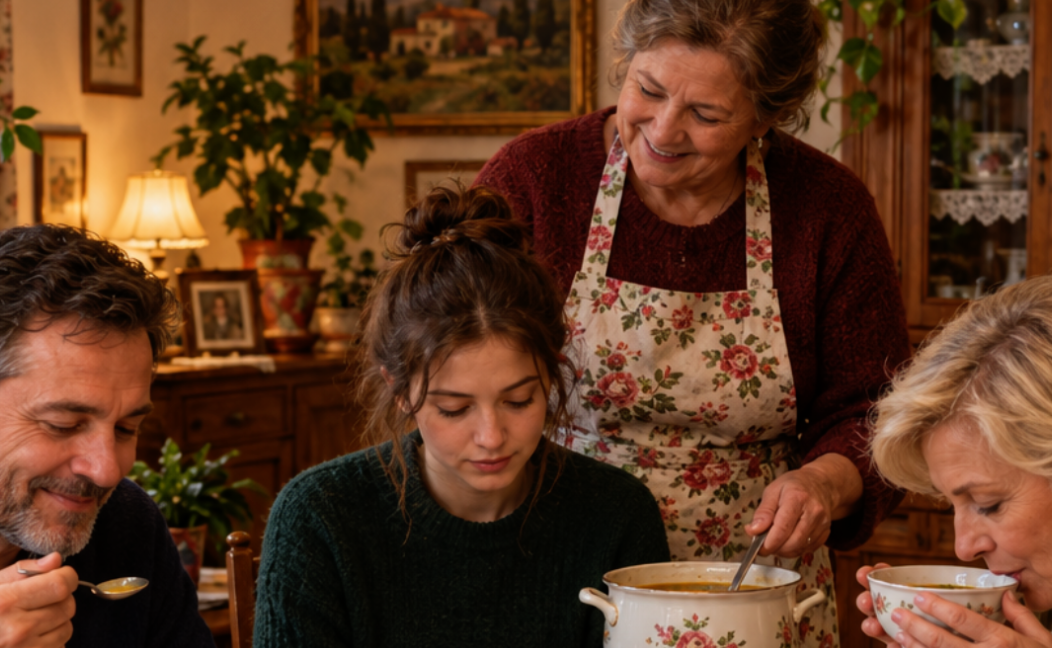
Valeria Pavlovna decided to serve the in-laws that very same soup she cooked twenty years ago, back when there were three days left until payday and only forty hryvnias rattling in her wallet.
Yulia found out about this on Saturday morning. She came down to the kitchen still sleepy, wearing her mom’s sweater, and saw two processed cheese wedges, three potatoes from the cellar, a carrot, and an onion on the table. Next to them sat a mushroom bouillon cube in a yellow wrapper.
“Mom,” Yulia said slowly, “tell me you’re planning to eat this yourself.”
“This is for lunch,” Valeria Pavlovna replied without turning away from the sink. “For five people.”
“They’re arriving at one o’clock!”
“I know exactly what time they’re coming,” Valeria Pavlovna answered calmly.
Yulia sank onto a stool and covered her face with her hands. For the third day in a row, a cold October rain was drizzling outside the window. Wet black leaves from the walnut tree kept falling into the yard, and the road from the main street was probably so muddy by now that Andrey’s parents would have to clean their shoes right at the gate.
“I did suggest we order food from the café near the bus station,” Yulia said without uncovering her face. “They have decent stuffed cabbage rolls, potato pancakes, meat in French style. I would have paid myself.”
“No, you wouldn’t have,” her mom replied.
“Mom!”
Valeria Pavlovna wiped her hands on a towel her mother once embroidered with red poppies and sat down across from her daughter.
“Yulia, do you trust me?”
Yulia looked first at her, then at the processed cheese, then back at her mother.
“I trust you. But as for Margarita Sergeevna—not so much.”
“That’s good,” Valeria Pavlovna said calmly. “Then we’re on the same page.”
They’d met the future in-laws a month ago at a restaurant in the regional center. The venue had been chosen by Margarita Sergeevna. There were snow-white tablecloths, waiters in long aprons, and menus without prices listed.
“In respectable places, prices aren’t discussed out loud,” Andrey’s mother explained at the time.
Valeria Pavlovna arrived by minibus in her best blue dress and brought a box of homemade cookies. The box spent the whole evening next to her chair. Margarita Sergeevna only glanced at it once—about the same way someone looks at a stranger’s umbrella accidentally left in their car.
At the table, she did most of the talking. She told stories about the three-room apartment that “Andryusha bought himself,” about the new crossover vehicle, and how her son now manages an entire department at his company.
Then the conversation turned to vacations, an acquaintance with her own beauty salon, and how Yulia would, of course, need to “improve a bit,” because in their circle, people were used to a certain standard.
“You understand, Valeria Pavlovna,” Margarita Sergeevna said, tapping her glass with a fingernail, “our Andrey isn’t used to plain food. Borscht, potato pancakes—those are cute, of course. But a person needs to grow.”
Valeria Pavlovna nodded. Yulia sat there, blushing and silent. Andrey stayed silent too, which was the worst part.
When dessert was served, Valeria Pavlovna excused herself to wash her hands. On her way back, she stopped behind a column near the coat check, having heard the future in-law’s voice. Margarita Sergeevna was speaking quietly to Semyon Arkadyevich, but it was clear enough—like people speak when they’re sure no one will overhear. Continued in the comments.
— The girl seems alright. As long as she doesn’t try to drag her whole village along. Did you see that box of cookies? What an embarrassment.
Semyon Arkadyevich mumbled something in response.
Valeria Pavlovna stood there for another minute, then returned to the table and calmly finished her dessert.
At the end of the evening, Margarita Sergeyevna cheerfully suggested:
— Let’s split the bill European style. Everyone pays for themselves.
Without saying a word, Valeria Pavlovna paid for her salad and tea—an amount she earned at the post office over several days.
She didn’t say anything to Yulia.
Only on the bus, when the fields were passing by the window, did her daughter finally break the silence:
— Mom, Andrey isn’t like that. He’s a good person. He just gets quiet around his mother for some reason.
— Let them come to us, — answered Valeria Pavlovna. — Then we’ll see their standards, and your Andrey too.
Valeria Pavlovna made soup the same way she always did: no recipe, no rush, no exact measurements.
She put potatoes and carrots into the water. Fried some onion in a drop of sunflower oil until it turned golden. When the veggies were cooked, she added chopped processed cheese, a bit of salt, and a bouillon cube.
Next, she took out the blender Yulia had given her for her birthday. It had stood in its box almost all year, but now Valeria Pavlovna turned it on and blended the soup until it was thick and creamy, a bright, sunny yellow.
She cut yesterday’s bread into small cubes and toasted them in a pan with garlic. Into every bowl she placed a little chopped dill—the last harvest of the season, picked just before the frost—and topped it with a spoonful of sour cream.
The kitchen filled with an aroma that made Yulia’s chest unexpectedly tighten.
— Sunny, — she whispered quietly.
Her mother smiled, but said nothing.
That’s what Yulia called the soup when she was four. Back then, it was just the two of them in this house, with a tiny room, old furniture, and floral wallpaper Valeria Pavlovna could only afford to replace by Yulia’s graduation.
There was barely enough money for anything. Valeria Pavlovna sorted mail at the post office, knit socks to order in the evenings, and every Sunday, she made that soup with just two processed cheese triangles.
Little Yulia would sit at the table, see the yellow bowl, and clap her hands:
— Sunny!
And her mother would laugh, as if everything in their life was just fine.
Yulia had almost forgotten those days. But Valeria Pavlovna remembered every detail.
A silver crossover pulled up by the gate around half past one. Andrey got out first, wearing a light jacket, and immediately stepped into a puddle. Next came Semyon Arkadyevich—a gray-haired man in a leather cap.
Lastly, Margarita Sergeyevna stepped out carefully, as if she were descending from an airplane ladder. She wore a cream-colored coat and heeled shoes.
— Your roads are something else, — she said instead of a greeting. — Senya, did you see what happened to the wheels? I told you, we should have taken a taxi.
— Good afternoon, — Valeria Pavlovna greeted them calmly. — Please come inside, or you’ll catch a chill.
In the entryway, Margarita Sergeyevna took her time looking around. In the living room stood an old display cabinet filled with a festive china set, a ficus grew in a large pot, and apples were carefully laid out on newspapers atop the wardrobe to keep them fresh until winter.
She wasn’t in a hurry to take off her coat.
“It’s cozy,” she finally remarked. “Simple, of course. Yulechka, did you have your own room here?”
“I did,” Yulia replied.
“Well, now you’ll have an apartment. Three rooms. Andrey bought it himself, I told you about it before.”
“Two rooms, Mom,” Andrey quietly corrected her as he took off his wet boots. “And there are still nine years left to pay the developer.”
Margarita Sergeyevna looked at her son as if he’d just spilled a full salt shaker on the floor.
“What’s the difference? The important thing is that it’s in the city.”
Everyone gathered in the kitchen. Valeria Pavlovna had fired up the stove there early in the morning, since it was chilly in the living room. Margarita Sergeyevna carefully spread a napkin across her lap.
“I hope you didn’t go to too much trouble,” she said. “We won’t be long. And as you know, Andrey prefers light meals. No fried bacon or potatoes with meat.”
“Don’t worry,” Valeria Pavlovna replied. “Nothing too heavy today.”
She set a deep white bowl in front of each person.
Yulia stared at the tablecloth, too nervous to look up.
Margarita Sergeyevna leaned over her soup, inhaled the aroma, and her eyebrows slowly climbed upward.
“Oh,” she exclaimed. “Cream soup.”
Semyon Arkadyevich picked up his spoon, tasted the soup, then took another scoop.
After his third spoonful, he fished out a crouton from his bowl and bit into it with obvious pleasure.
“Mushroom,” he declared confidently. “Porcini mushrooms. I can tell. And there’s some aged cheese. Parmesan, maybe?”
Valeria Pavlovna just shrugged.
“You’ve really surprised us,” said Margarita Sergeyevna, momentarily forgetting her caution as she quickly finished her soup. “Honestly, I was expecting borscht. But here, it’s almost French cuisine. We tried a similar soup in France, remember, Andryusha? In a tiny restaurant near the cathedral. They used cream and truffle oil.”
“Mom,” Andrey said without lifting his head, “we’ve never been to France. We took the bus to Czechia. And had goulash.”
Margarita Sergeyevna waved her hand dismissively.
“Czechia, France—what’s the difference? It’s all Europe. You know what I mean.”
Andrey stayed silent. Yulia noticed his neck under the sweater collar was blushing.
Meanwhile, Semyon Arkadyevich finished his soup and handed his bowl to Valeria Pavlovna.
“Could I have some more? And tell me, where do you get these mushrooms? We buy them at the market for six hundred hryvnias a kilo, but they don’t have this aroma.”
Valeria Pavlovna served him a second helping. Then she added some soup for Margarita Sergeyevna, who first refused and then said:
“Well, just a little.”
After that, she poured some for Andrey.
“You have to give me the recipe,” her mother-in-law insisted once the second bowl was empty. “My friend runs a café, and I’ll pass it along. You used homemade cream, didn’t you? Cheese from a private dairy?”
Valeria Pavlovna placed her spoon down on her saucer.
“The recipe is really simple,” she said. “Three potatoes from the cellar, a carrot and an onion from the garden. Two processed cheese blocks from the store by the bus stop—I got them on sale, thirty-four hryvnia each. A mushroom bouillon cube for ten. Croutons made from yesterday’s bread. Fresh dill from my own garden. The whole pot cost about eighty hryvnia. No cream. No mushrooms—unless you count what’s in the bouillon cube.”
The kitchen got so quiet you could hear a log crack in the stove.
Semyon Arkadyevich froze with his spoon in the air. Margarita Sergeyevna slowly set her spoon down on the tablecloth.
“You must be joking,” she said.
“No, I’m not.”
“Did you do this on purpose?” her co-mother-in-law’s voice went shrill and high. “Did you want to make us look ridiculous? Serve soup made from cheese blocks and watch as we ate it?”
“I wanted you to understand what I fed your future daughter-in-law,” Valeria Pavlovna replied calmly.
She spoke softly, but every word sounded especially clear.
“When Yulia was four, it was just the two of us. I worked at the post office and spent evenings knitting. There were months when this soup was basically the only thing on our table. But Yulia loved it. She called it sunny soup. She grew up on it, finished school, moved to the city, and found a good job.”
Valeria Pavlovna looked straight at Margarita Sergeyevna.
“I raised a wonderful daughter on cheese spread from a sale, Margarita Sergeyevna. And in the restaurant, you told your husband you didn’t want Yulia to bring her village roots with her. I was standing behind a column—I heard everything.”
Red blotches appeared on Margarita Sergeyevna’s face.
“That’s not what I meant. You misunderstood me. Semyon, explain to her.”
But Semyon Arkadyevich stayed silent. He stared at his empty plate for a long moment and then suddenly let out a quiet laugh, covering his mouth with his hand.
“Zatiruha,” he said.
“What?” his wife didn’t understand.
“My mother used to make zatiruha. Flour, water, maybe a little milk if we had some left. There were three of us kids, and our father worked all day at the farm. Until I was seventeen, I never tasted anything better.”
He looked at Margarita Sergeyevna.
“And then we moved to the city, and you told me not to mention the village around people, because it was embarrassing. I stayed quiet for thirty years. And, honestly, I still can’t tell parmesan from any other cheese.”
Semyon Arkadyevich turned to Valeria Pavlovna.
“Forgive us. And for that restaurant too.”
Margarita Sergeyevna looked at her husband as if seeing the real him for the very first time.
Then Andrey spoke up. He took Yulia’s hand under the table, then placed their joined fingers openly on the tablecloth so everyone could see.
“Mom,” he said, “you need to apologize.”
“Andrey!”
“I’m serious. I’ve been quiet for a month, hoping everything would just blow over. But I can’t forget. After that night, Yulia barely spoke to me for a week. I don’t want that to keep happening for the rest of our lives.”
Margarita Sergeyevna stood up abruptly, grabbed her purse, and walked out to the porch. She said she had to make an urgent phone call.
The conversation lasted about twenty minutes, although Yulia could see through the window that her mother-in-law didn’t even take her phone out of her pocket the whole time.
The in-laws left after dark.
Semyon Arkadyevich finished his third bowl of soup, drank two glasses of thyme tea, and took home a three-liter jar of sauerkraut that Valeria Pavlovna insisted he have.
By the car, he shook her hand for a long time and promised to come back in the spring to help with the fence.
Margarita Sergeyevna was already sitting in the front seat. When Valeria Pavlovna approached the open window, her matchmaker was gazing past her, focused on the wet walnut tree in the yard.
“Thank you for lunch,” Margarita Sergeyevna said evenly.
She paused for a moment.
“The soup really was delicious.”
She didn’t say anything more. But honestly, that was enough for Valeria Pavlovna.
Andrey and Yulia lingered a little longer at the gate, sharing an umbrella.
“Your mom is a strong woman,” Andrey said.
“I know,” Yulia smiled. “And you turned out even stronger today than I thought.”
Two weeks passed.
On Tuesday evening, Yulia called her mom and burst out laughing instead of greeting her.
“Mom, guess who messaged me.”
“Who?”
“Margarita Sergeyevna. Just one message. Listen: ‘Yulia, ask your mom if she needs two cheese bars or three? My pot is bigger.’ That’s it. No ‘hello’ or ‘goodbye.’”
Valeria Pavlovna sat down on a stool by the stove and laughed for a long time, wiping her eyes with her apron.
“Tell her two,” she said at last. “And don’t let her skimp on the dill.”
She was quiet for a second and then added:
“And at the wedding, I’ll make that soup myself. For everyone.”