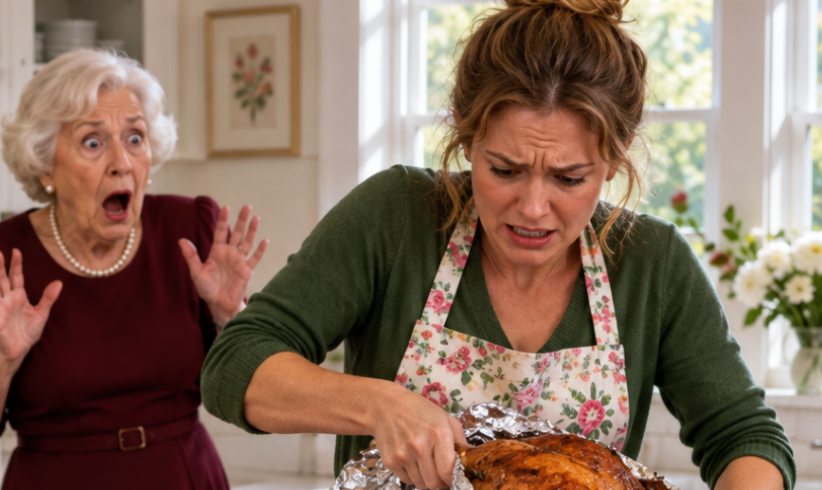
I put the ducks in my bag first: one right in the roasting pan, the other in a baking dish, both covered with foil.
I could hear the clinking of forks from the other side of the wall. My mother-in-law was laughing in that special voice she reserved for guests: just a tad higher than normal, with a pause at the end so everyone could appreciate her.
I took the salad bowls from the windowsill, still wrapped in plastic, and packed them into a second bag. Tongue with horseradish, pickled herring, smoked chicken salad. A cabbage pie went on top. The Napoleon cake wouldn’t fit anywhere, so I carried it out to the hallway on a baking tray.
The kitchen door opened right as I was wrapping the zander in foil.
“Miss, the hot dishes,” my mother-in-law called from the doorway, and quickly corrected herself: “Lida. What are you doing?”
“I’m packing,” I said.
“What are you packing? Arkasha has asked about the hot food twice now.”
She stood there in a burgundy dress, wearing the dragonfly brooch she only put on for big occasions. She turned 65 today, and she’d changed her earrings twice already this morning.
“The hot dishes are leaving,” I said. “And the salads. And the cake.”
“Leaving where?”
“With me.”
Rimma Leonidovna looked at the bags, the empty windowsill, the open fridge. Just an hour ago, there were dishes covered in plastic film, stacked two rows deep, each labeled for the right course. I’d emptied out the fridge even before packing the ducks.
“Are you out of your mind?” she whispered. Even her whisper sounded like it was for company—clear, the kind you’d use to announce failing grades at a teachers’ meeting. “There’s a whole table full of people. My brother’s here from the train. Lida, people will think—” she began, then stopped.
“Think what?” I asked.
My mother-in-law didn’t answer. She closed the door behind her and leaned against it, as if she thought I might try to fight my way out of the kitchen.
On the other side of the wall, her brother tapped his knife on a glass and announced to the room that a toast without hot food wasn’t a toast at all, but a misunderstanding. Someone burst out laughing.
“Gleb,” my mother-in-law called, still standing guard by the door. “Gleb, come here. Your wife is in here.”
I zipped up the second bag. Just a month ago, this same woman had held my hands on a garden bench, telling me they were as good as gold.
***
A month before the big birthday, we were digging up potatoes at the summer house. Or rather, I was digging, and Gleb carried the buckets to the shed, stopping every other time to check something on his phone.
Alisa swayed in the hammock stretched between two apple trees. My sister-in-law had spent the past two summers lying in that hammock while I weeded, whitewashed trunks, and made jars of lecho. We had forty jars in the cellar, and I’d written the contents and dates on each lid in my own handwriting.
My mother-in-law came out of the house wearing a straw sunhat, holding a notebook, and sat on the bench at the edge of the garden bed. I straightened up and stuck my shovel in the ground.
“Lidochka, leave those potatoes for now,” she said. “I need to talk to you. It’s serious.”
She’d never spoken to me like that before. In two years, I had only heard, “Lida, wash this,” “Lida, bring that,” and “Lida, why is Gleb’s shirt wrinkled?” To get both “Lidochka” and “serious conversation” in one sentence was a first.
“October twelfth is my birthday,” Rimma Leonidovna said. “Arkasha will come from Moscow, with Tamara. He’s my brother, you haven’t met him—he couldn’t make it to the wedding. The Krasnovs, the Lyovins, Alisa and her boyfriend will be there. About sixteen people all together.”
“That’s a lot,” I replied.
– A lot. I don’t want a restaurant—everything there tastes the same and bland, and you’re basically just paying for a tablecloth. – She took both my hands, right over the dirty ones, and turned them palm up. – You’ve got golden hands. Will you make the food for the party?
I looked down at my hands in hers. There was dirt under my fingernails.
– The whole spread?
– Everything. Appetizers, salads, mains, cake. You know how to cook for a crowd, it’s your job. – My mother-in-law let go of me and opened her notebook. – I jotted down what Arkasha likes. He loves tongue. Fish, too. You’ll buy the groceries yourself—I’ve got bad legs, you know I can’t walk the market. Keep the receipts, I’ll pay you back to the last penny.
– Okay, – I said.
– Just, Lidочка, no mayo. – She smiled and adjusted her sun hat. – This isn’t a cafeteria, after all.
I’d been working as a cook in the bus depot cafeteria for fourteen years. My mother-in-law knew it. At the wedding, she asked my mom twice if it was really a cafeteria, not a café, and both times my mom confirmed, yes—a cafeteria.
– No mayo, – I said. – Got it.
Gleb set the bucket down by the shed and gave me a thumbs up. Alisa, lying in the hammock, rolled over to her other side.
We drank tea on the veranda when the potatoes were already bagged. In the morning, while everyone was still asleep, I made some dough and baked an apple pie: last weekend, my mother-in-law complained there were too many apples this year. While it baked, Rimma Leonidovna shuffled into the kitchen in her robe, broke off an edge and said the dough was too thin.
Her friend called. Rimma Leonidovna didn’t like holding the phone to her ear, so she put it on speaker and leaned back in her wicker chair.
– Larochka, we’re at the dacha, having tea, – she said. – With pie. Apple pie. What do you mean, homemade? It’s from the bakery on Sadovaya, that pastry chef there is wonderful. We don’t fuss with dough; you’d be at the stove all day.
All the while, I was cutting that very pie into slices, with her knife, on her board.
Gleb took a second slice and stayed quiet. Alisa stayed quiet too—her mouth was full.
– Lida, – my mother-in-law said, putting her phone face-down on the table, – pack something up for Alisa, like always. There are cutlets, some soup. She never cooks in the city, she just doesn’t have time.
Every Sunday, I packed containers for Alisa. Cutlets, soup, stuffed cabbage if there was any. She never gave the empty containers back, and every couple of months I’d buy new ones at the market from the same lady, who by now greeted me by name.
I brought in a stack of clean containers from the kitchen and placed it in front of Alisa, between her cup and the sugar bowl.
– Here you go, – I said. – The cutlets are in the pan, soup’s on the stove. Ladle’s in the left drawer.
Alisa looked at the stack, then at her mother.
– Mom. Is she upset?
– Lida never gets upset, – my mother-in-law replied, patting my wrist. – Lida’s a gem. Lidочка, it’s no trouble for you, is it?
– Not a bit of trouble, – I said. – Which is why Alisa can do it herself.
Alisa huffed, got up from her chair and went inside. She packed the cutlets slowly and noisily, banging the lid against the side of the pan just loud enough for us to hear out on the veranda.
On the way home, Gleb drove with one hand, drumming his fingers on his knee with the other.
“Do you realize what just happened today?” he asked. “Your mom asked you for something for the first time. She didn’t tell you, she asked you. That means everything, Lid. You’re one of us now.”
“But the pie was from the bakery on Sadovaya,” I said.
“Come on, that’s just how Mom talks. She likes everything to sound fancy.”
I stared out the window at the field, the power poles, the gas station, and mentally counted how much money I had until payday.
I spent three evenings putting the menu together. Gleb would peek over my shoulder, munching on an apple, reading it out loud like it was someone else’s shopping list.
“Duck with apples, two of them. Boiled beef tongue with horseradish. Jellied pike-perch,” he whistled. “Lid, can’t we do something simpler? Mom didn’t pick a restaurant because she didn’t want to overspend.”
“Mom said Arkady Leonidovich likes tongue and fish,” I replied.
“Right,” Gleb said, sitting down across from me. “So how much is all this going to cost?”
I added up the column for the third time. I had already gone to the market on Thursday after my shift and written down all the prices.
“Twenty-six thousand. If the cake is made with butter, not margarine.”
“How much?” Gleb choked a little on his apple. “Are we feeding a wedding? You could eat out at a café for that much.”
“You can’t seat sixteen people at a café for that amount. Not even half that.”
“Okay, okay,” he said, raising his hands. “Mom will pay you back, she said she would.”
“What if I remind her myself? Beforehand?”
Gleb stopped chewing.
“Just don’t bring up money with her. Lid, please. She’s nervous, it’s her birthday. And she’s on her own.”
He always said “she’s on her own” when she called at eleven at night asking us to come move the wardrobe. Or when we spent our vacation putting new tile in her bathroom instead of going to the seaside.
“Okay,” I said. “I won’t bring it up.”
On Saturday, I bought almost everything with my own card. With so little left until payday, I stopped buying myself lunch and started eating leftovers in the cafeteria after my shift—the ones the drivers left behind.
A week before the birthday, I brought my mother-in-law the layers for the Napoleon cake. Thin sheets, separated by parchment paper, in a box from my winter boots. Rimma Leonidovna insisted I assemble the cake at her place: “You can’t possibly take it across the whole city all ready.”
She took the box, peeked inside, and nodded.
“They’re perfectly even,” she said. “Well done.”
“Rimma Leonidovna, I’ve bought almost everything,” I said. “The ducks, the tongue, the fish. Only greenery and cream left, that’s for Friday. I have all the receipts in my wallet.”
My mother-in-law placed the box on top of the fridge and adjusted the parchment, even though it was already perfectly straight.
“Lidochka, don’t worry. It just feels awkward to talk about money in the family. I’m not refusing, of course not. We’ll sit down and settle up after the birthday, okay?”
“After the birthday,” I agreed.
There was a bang in the hallway. Alisa walked into the kitchen, still in her shoes, finished a call on her phone, and tossed it into her bag.
“Oh, Lida, perfect timing,” she said, opening the fridge and grabbing a yogurt. “Hey, we’re throwing a farewell for my boss on Friday. Can you make about forty tartlets for me? With caviar and crab. You’ll be cooking anyway, so it doesn’t make a difference to you.”
“On Friday I’ll be chopping and marinating for your mom’s birthday,” I replied. “No, I won’t do it.”
“What do you mean, no?”
“I mean exactly that. I won’t do it.”
Alisa licked her spoon and turned to her mom.
“Mom, did you hear that? Now I’m going to be embarrassed at work.”
“Alisa, leave Lida alone, she has an important moment right now,” my mother-in-law said. “Buy something at the bakery. On Sadovaya Street.”
Alisa went to her room and closed the door behind her. Rimma Leonidovna watched her go, then turned to me.
“And another thing, Lida. Come over at seven in the morning on Saturday. We need to discuss a few things. About the seating arrangement.”
“What seating arrangement?” I asked.
“The usual, who sits where,” she smiled. “It’s nothing serious. Just come.”
***
At seven in the morning on Saturday, my mother-in-law’s kitchen smelled like coffee and hairspray. Rimma Leonidovna was already groomed, wearing her robe, and on the back of a chair by the window hung a crisp white blouse and a sharply pressed black skirt.
“Is that for me?” I asked.
“For you. Your size, I got it from Alisa,” she said, pouring me coffee. “Sit down, Lidushka. Let’s take it easy.”
I sat down. My mother-in-law sat across from me and folded her hands on the table, probably the same way she had folded them for thirty years at faculty meetings in the gymnasium.
“Arkasha and Tamara are not simple people,” she said. “Tamara is a Doctor of Science, Arkasha has worked in the ministry his whole life. The Krasnovs are no slouches either. At the table, they’ll start asking: where do you work, who are your parents, which institute did you go to. You’ll get flustered, you don’t like that. You’ll start talking about the cafeteria and your cutlets. Everyone will smile politely, but then I have to explain everything.”
“And what do you suggest?”
“You’ll be in the kitchen today. Don’t sit at the main table, you’ll be serving. It’ll be more convenient for everyone—especially you.”
The coffee was too hot, so I set my cup on its saucer.
“Does Gleb know?” I asked.
“I know,” Gleb said.
He was standing in the kitchen doorway, already wearing a shirt, tie in hand. He’d said yesterday he’d spend the night at his mom’s to arrange the chairs in the morning. The chairs were lined up along the hallway wall, still not set out.
“Lida, seriously,” my husband said. “You hate being interrogated. Remember New Year’s at the Krasnovs’? You were quiet all evening.”
“I was quiet because Krasnov was telling jokes about milkmaids in front of me,” I replied. “My mother is a milkmaid.”
“Exactly. And it’ll be even worse here.” Gleb came over and crouched beside my chair, like you do with a child. “Just this once. For me. Mom only has one birthday like this.”
I looked at the blouse. Stand-up collar, tiny buttons all the way to the neck, just like the waitresses at the hotel café. Would any of the guests recognize me as one of the family in that?
“Alright,” I said. “I’ll stay in the kitchen.”
My mother-in-law exhaled and immediately switched to business mode.
“Serve everything course by course, as it should be. Cold appetizers first, I’ve already sliced them. Then salads. Then the hot dish, then cake. Keep everything here, don’t put it on the table ahead of time or it’ll dry out. And put on the blouse, please. It looks neater this way.”
“I’m not wearing the blouse,” I said. “I’ll wear my own dress.”
“Lida, it’s just a blouse.”
“Then all the more reason not to wear it.”
I took it, still on the hanger, off the chair and hung it on the hook behind the door, next to my mother-in-law’s robe. Rimma Leonidovna glanced at the hook, then at her son.
“As you wish,” she said. “But take off your apron when you come out to the guests.”
Alisa arrived just in time for lunch, took a whiff of the roast ducks in the oven, and told me she’d like a piece to go later—breast, not leg. Then she headed off to the bathroom to do her makeup and ended up staying there for an hour.
The guests started ringing the doorbell at three. My mother-in-law was darting between the mirror and the living room, so it was up to me to answer the door.
Arkady Leonidovich turned out to be tall and broad-shouldered, with a beard trimmed in a point, wearing a coat that probably cost as much as half my yearly salary. Behind him followed a small gray-haired woman with a rolling travel bag—Tamara Ivanovna.
“Hello,” I greeted them. “Come on in.”
Arkady Leonidovich looked me up and down, noticed my apron, and—without a word—removed his coat and handed it right to me.
“Rimma,” he called into the depths of the apartment. “Well, sis, I didn’t expect this. The restaurant girl is opening the door. Now that’s what I call service, that’s top level.”
My mother-in-law flew out of the room, pinning on her dragonfly brooch on the way.
“Arkasha! Tamarochka!”
“Glad I sent you that seventy,” said Arkady Leonidovich as he hugged her. “At least, for once in your life, you’re not stuck in the kitchen for your own birthday. What’s the name of this restaurant? Tamara says we should remember it—my granddaughter’s getting married this spring.”
“Later, Arkasha, later! Come in, wash your hands, everything’s getting cold.”
She linked arms with her brother and led him to the bathroom. She didn’t give me so much as a glance.
So there I stood in the hallway, clutching a stranger’s heavy coat. The coat smelled like a train ride.
So that’s how it is. Rimma Leonidovna told her brother the table was booked at a restaurant, and he sent her the money for it. But the ‘restaurant’ was actually me—my ducks in the oven, my tongue, my cakes in a shoebox, all bought with my own money, which my mother-in-law promised to repay after the party. How many times in the last two years have I been the deli on Sadovaya? Now I’m not just a deli—I’m a whole restaurant, complete with a waitress in an apron so the guests don’t get confused.
Gleb came out of the room, saw me holding the coat, and quickly took it from me to hang it up.
“Did you know?” I asked.
“Know what?”
“About the restaurant. About uncle’s money.”
Gleb glanced toward the bathroom, where the sound of Arkady Leonidovich’s laughter was coming from.
“Lida, that’s something Mom arranged with Arkasha. Please, just let it go for one night.”
He left for the living room. I returned to the kitchen, put on my oven mitts, and checked on the ducks. They were almost ready.
I could’ve taken off my apron right then and there, gone to the living room, and chosen any empty seat next to Arkady Leonidovich. Waited for the first toast and announced who the real restaurant was. But I closed the oven. I just couldn’t bring myself to sit at a table where I wasn’t invited, not even for the sake of truth. Back home in Sosnovka, we had our own kind of pride—the kind that’s called ‘simplicity’ around here.
The cold appetizers made their way to the living room at half past three. I was the one carrying them in.
***
Mother-in-law had plated the appetizers that morning: cheese fanned out, sausage arranged as roses, olives in a crystal boat. I brought in two dishes and started setting them down between the glasses.
At the table, everyone was chatting about Moscow, country house prices, and someone’s dissertation. No one looked at me, which was oddly comfortable. Alisa sat at my mother-in-law’s right hand in a new green dress, helping herself to cheese before I could even finish setting down the plates.
“Miss, please bring us some bread,” my mother-in-law said, not even turning her head.
I brought the bread. As I leaned over to place the bread bin at the far end of the table, Tamara Ivanovna gently touched my sleeve.
“Miss, what’s the name of your restaurant?” she asked. “We’d like to book it for my granddaughter’s wedding.”
My mother-in-law tapped her fork against her plate.
“Tamarochka, I’ll give you a business card later. Arkasha, please pour some for Tamara.”
Gleb stared into his plate as if something was written there in tiny print.
Arkady Leonidovich poured a drink for his wife, then turned to me. He reached into his breast pocket, pulled out a bill folded in quarters, and slipped it into the pocket of my apron with two fingers.
“This is for you, dear,” he said. “For your good manners. You don’t see many young women like you these days.”
Five hundred rubles. I said “thank you,” went to the kitchen, and pulled out two large checkered bags from under the sink—the ones I always took to the market.
While my mother-in-law, with her back to the door, called out to her son, I had already zipped up the second bag.
Gleb squeezed past his mother into the room, immediately noticing what was happening when he saw the empty windowsill.
“Lida, what are you doing?” he asked. “Uncle Arkady is in there.”
“I know who’s in there,” I replied. “I hung up his coat.”
“Put the bags down. Do you hear me? Put them down, and we’ll talk about this later, at home.”
I picked up the bags, one in each hand, and headed toward the door. My mother-in-law didn’t try to stop me; she just stepped aside so I wouldn’t brush her burgundy dress with my bag. I could have gone into the hallway to put on my shoes, but instead I turned into the room.
It went quiet in the room as I stopped by the table.
“Arkady Leonidovich,” I said. “You asked about the restaurant. There is no restaurant. I made the entire spread myself, as Gleb’s wife—ducks, tongue, pike, cake. I bought all the groceries with my own 26,000 rubles; Rimma Leonidovna promised she’d pay me back after the anniversary. As for the 70,000 rubles for the restaurant, you transferred that to your sister. That’s something for the two of you to sort out.”
Someone from the Krasnov family coughed softly. Arkady Leonidovich turned his whole body, along with his chair, to face his sister.
“Rimma, what’s going on?” he asked. “Is this true?”
“Arkasha, she’s confused,” my mother-in-law said, following me and stopping behind him, her hands resting on the back of his chair. “The girl is just simple, she got nervous. Lida, put the bags down, we’ll talk later.”
“At seven this morning, I was told I wasn’t allowed to sit at the table because I’m just a simple girl,” I said. “I’m only here to serve. Since I’m considered hired help and nobody paid me, then the food is mine. If you hire someone and don’t pay them, the food leaves with them.”
“Lida, you’re embarrassing me,” Gleb said quietly behind me. “In front of everyone. Then just sit at the table if you want. Sit, just leave the food.”
“I’m not sitting,” I replied. “I wasn’t invited.”
I set one of the bags on the floor, took the five hundred ruble note out of my apron, and placed it next to Arkady Leonidovich’s plate, right on the napkin.
“This is yours,” I said. “Thank you for your politeness.”
Tamara Ivanovna took off her glasses and placed them by her wine glass.
“We just got off the train,” she said softly, not looking at anyone. “We haven’t eaten anything all morning.”
I paused for a moment. What could I possibly say to her? I untied my apron and hung it over the back of Gleb’s empty chair. Alisa hadn’t said a word this whole time. She finished her cheese and reached for the sausage.
The ‘Napoleon’ cake was waiting for me in the hallway on a baking sheet. I ordered a taxi as I was putting on my shoes.
The car arrived in six minutes. I made two trips downstairs: first with the bags, then with the cake. The driver helped me put the bags in the trunk, and I kept the cake on my lap the entire ride, holding it tightly with both hands so the frosting wouldn’t slide.
“Where to?” the driver asked, glancing at the baking sheet.
“The bus depot,” I said. “By the repair zone entrance.”
The evening shift was in full swing. Zoya Petrovna was in the dispatcher’s office doing a crossword, two mechanics in the repair zone were changing a tire on bus number forty-one, and the drivers were coming in to turn in their route sheets.
“Lidok?” Zoya Petrovna stood up to greet me and took off her glasses. “What are you doing here on a Saturday? Isn’t your mother-in-law’s celebration today?”
“The party moved,” I said. “Call the guys, Zoya Petrovna. We’ll grab plates from the cafeteria, I have the key.”
“Is all of this for you? Who does it belong to?”
“It’s mine. I bought it, I cooked it.”
Zoya Petrovna looked at the ducks, at the cake, at me in my clothes without the apron, and didn’t ask anything else. Ten minutes later, there were twelve people in work jackets sitting in the cafeteria, and Misha the mechanic, not waiting for a main dish, was eating the jellied pike-perch right out of the tray with a spoon.
Gleb called around nine, when all that was left of the ducks were the bones.
“Where are you?” he asked. “Arkady and Tamara went to their hotel. Mom’s lying down because of her blood pressure. Lida, where’s the food?”
“The night shift at the bus depot is finishing the food,” I said. “They really like the pike-perch, and they asked me to say thank you to the birthday girl.”
He was silent for a moment.
“You gave mom’s birthday meal to the drivers?”
“It was my groceries,” I said. “My people.”
“Mom will never forgive you for this.”
“She can pay for the groceries first,” I said, and hung up.
Zoya Petrovna took the last plates and the teapot back to the dispatcher’s office. I stayed behind in the empty cafeteria, at the sink, holding the roasting pan. The water ran hot, bubbles rising to the top, and I scrubbed the cast-iron bottom, not in a hurry. My shoulders finally dropped—I hadn’t realized I’d been tensing them all morning. No one was telling me what to serve next anymore.
***
Gleb stayed the night at his mom’s that Saturday and never came back home. We were renting the apartment—the landlady wouldn’t wait—so within a week I moved my things to a room near the depot while he was at work. By February, we were divorced.
In March, I handed in my notice at the bus depot. By April, I registered as self-employed and rented the kitchen of a closed-down cafe near the market: two stoves, an oven, a fridge counter, and a serving line with chipped edges. Lunches in containers, pies, catering. My first regulars were the repair zone and the dispatcher’s office—Zoya Petrovna gave my number to everyone she knew.
Gleb showed up in September, right at lunchtime, while I was portioning out buckwheat with gravy.
He stood in the doorway, looked over the stoves, the stack of pie boxes, the list of orders on the fridge.
“Not bad,” he said. “Mom said you couldn’t handle it.”
“Mom says a lot of things,” I replied.
“I’m here on business.” Gleb sat down on the stool by the door, not taking off his jacket. “Uncle Arkady has a big birthday coming up in November. He wants to celebrate at Mom’s place, at home. Nothing fancy, no restaurants. About twenty people. Mom told me to find the best homemade food in the city, and everyone says it’s you.”
“Does your mom know it’s me?”
“She knows.” He looked down at his shoes. “She said, name your price. We’ll pay whatever you want. Upfront, the whole amount.”
“No,” I said.
“Lida, it’s just a job. This is what you do now.”
“I only cook for people who respect the work I do,” I said. “And your family isn’t on that list.”
“You’re still upset about that night? It’s been a year.”
“Nobody ever paid me back for the groceries,” I said. “So yeah, it’s been a year.”
Gleb got up, stood there for a moment, and zipped his jacket all the way up to his chin.
“Uncle and Mom didn’t speak for half a year after that, all because of the money. Does that make you happy?”
“I don’t have time,” I said. “I have a delivery at two.”
He left without closing the door behind him.
Rimma Leonidovna won’t even say hello to me, even when we run into each other at the meat stall at the market. I still feel sorry for Tamara Ivanovna, who arrived from the train hungry that time—maybe I was too harsh with her.
There are two months left until November. I have no idea who will be in Rimma Leonidovna’s kitchen for her brother’s birthday.
I washed my hands, tied my apron, and got back to the buckwheat. Zoya Petrovna is coming at two, and her containers need to be hot when she arrives.