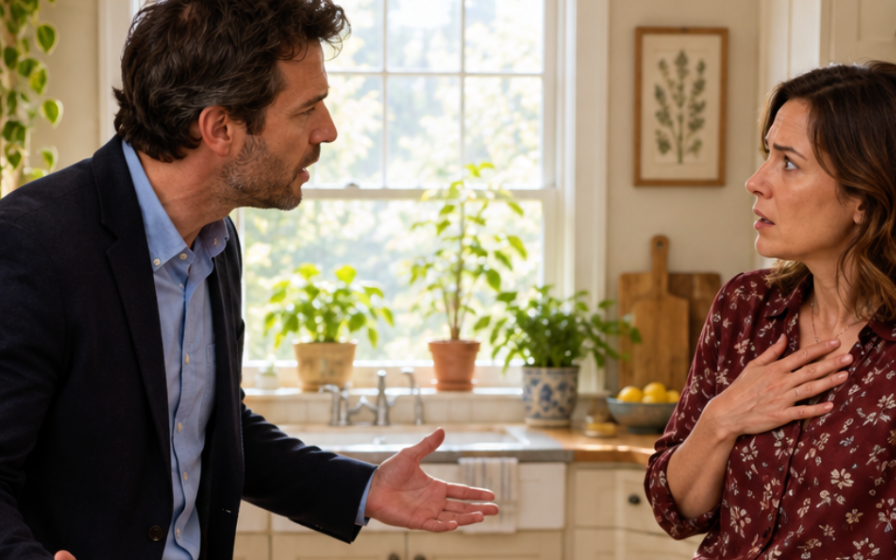
“I’m leaving you for someone else, don’t bother making dinner!” Oleg set a bag with my things down on the table.
The bag was from a hypermarket, blue, with a torn handle. My cardigan sleeve and the edge of my nightgown were sticking out. Right on top was my toothbrush in its plastic case. He packed it separately, carefully, as if he was being thoughtful.
The cutlets were almost done on the stove. I stood nearby, looking not at my husband, but at that bag. Fourteen years of marriage fit inside it with room to spare.
“Are you listening to me, Vera?” Oleg leaned against the fridge. “I don’t want to lie to you. Her name is Inna. It’s serious between us.”
He waited. I could tell by how he held his hands: spread apart slightly, as if ready to catch me if I collapsed. He probably expected tears, shouting, a “how could you,” maybe a call to his mother.
I turned the stove knob until it clicked. The cutlets sizzled and then went quiet.
“Alright,” I said. “When will you come for the rest of your things?”
He blinked. Then smirked, quickly and unpleasantly.
“My things will stay here for now. That’s your stuff in the bag. I thought it’d be easier for you to stay with your dad at first. Fresh air, vegetable garden. Dasha can come on weekends.”
“Dasha will live where she studies,” I replied. “And she goes to school here, the one next door.”
“Well, we’ll discuss that,” he said lightly, taking a piece of bread from the plate. “I’m not heartless. I’ll give you until the end of the month.”
He left the room and I heard him whistling. He always whistled when he felt he’d settled something.
I sat down on the stool. The bag sat in front of me. Time until the end of the month. For me. In my own home.
My dad had given me the apartment as a gift. It was his two-bedroom on the fifth floor, the one I grew up in. In 2016, a year after my mom died, he said the city felt stuffy and moved to our family house in a village near Tver. Before he left, we went to the public service center and signed the deed of gift in my name.
Back then, Oleg walked through the empty rooms saying, “This will be the kids’ room, we’ll tear down this wall.” We never tore down the wall, but we did the renovations together. He put up tiles in the bathroom; I picked out the wallpaper. A year later I registered him here and registered myself and Dasha, too. I thought it was the right thing to do. A family.
Why did I put up with everything lately? Maybe because the house was quiet. Oleg didn’t drink, didn’t fight. He just gradually stopped noticing me. He’d come home late, eat in silence, stare at his phone. If I asked anything, he’d say, “I’m tired, Vera, let’s talk later.” And I’d wait for later. I worked at the clinic’s front desk, Dasha was in seventh grade, Dad with his blood pressure out in the village. Later always got postponed.
And in the spring I noticed he was transferring less to our shared card. First he said his bonus was delayed. Then it was because he’d loaned money to Sergey from the garage. I didn’t check. I knew Sergey—he was always in debt.
In the morning, Oleg left for work like nothing had happened. Dasha, still sleepy, peeked into the kitchen.
“Mom, why did Dad sleep on the couch?”
“He was snoring,” I Said. “I kicked him out.”
She made a little sound and went to wash up. I watched her go and thought that I wasn’t ready to tell her the truth until I figured it out myself.
There was a lot to process. Oleg was far too calm when he told me the deadline. A man leaving for another woman usually packs his own suitcase. But he packed mine. And the way he talked, it felt like he had some secret paperwork tucked in his pocket that I didn’t know about.
That evening, my mother-in-law came over. Nina Arkadyevna never called before she dropped by—she had her own key. I’d given it to her myself years ago, back when she used to help pick up Dasha from preschool.
“Verochka, I know what’s going on,” she said from the doorway, not even taking off her coat. “Just try not to get too worked up. Men are like that. He’s forty-six, having a crisis.”
“Did he tell you he’s kicking me out of here?”
Nina Arkadyevna glanced away, her eyes landing on the shoe rack.
“He said you’ll settle everything nicely. Olezhek says all the paperwork is done properly. You signed something once, remember? That’s what he told me—I don’t understand these documents.”
“What did I sign?”
“How should I know, Vera?” She threw up her hands. “I just came to tell you not to make a scene. Don’t go to her, don’t call. He’ll come back, you’ll see, if you don’t start a scandal.”
She left after ten minutes, putting a bag of cabbage pies on the table, like she was visiting someone in the hospital.
And I was left with her words: “You signed something once.”
That night, I remembered.
The previous fall, in 2024, I’d had gallbladder surgery. Things didn’t go smoothly; I was in the hospital almost three weeks. During that time, the car needed re-registration after an accident, the insurance had to be collected, and some papers submitted to the bank. Oleg brought a notary right to my hospital room. A young woman in a beige blazer read the text quickly in a steady voice. I was hooked up to an IV and just signed. I didn’t care, I just wanted to be left alone.
A power of attorney. Was it a general one or just for the car? I couldn’t remember.
At six in the morning, I was already standing on a stool by the hallway closet. We kept a shoe box with documents up there: certificates, insurance policies, warranty cards. I sorted through everything. Dasha’s birth certificate. My gift deed in a clear plastic sleeve. Receipts for major repairs.
There was no copy of the power of attorney.
But there was a receipt from a notary office on Chapaeva Street, dated October 2024. ‘Certification of power of attorney.’ Amount, registry number. Nothing else.
I sat on the hallway floor, holding that slip of paper, feeling my mouth go dry. If he could sell the apartment behind my back… No, he wouldn’t. Or would he? A man who packed up my toothbrush could do anything.
At work, I asked for two hours off. My supervisor looked at me and didn’t ask anything, just nodded.
First, I logged into the government services app right outside the clinic and ordered an extract from the property registry. The message said the document would be ready in several business days. Several days. But I couldn’t shake the feeling that everything could change in just one hour.
The notary office was on the ground floor of a typical apartment block, with a ramp and a potted ficus by the entrance. The notary, Tamara Viktorovna, a woman in her sixties with glasses on a chain, listened to my story in silence.
“Let’s take a look,” she said, fingers tapping away at the keyboard. “Here it is. A power of attorney in your name for your husband, Oleg Igorevich. For five years.”
“What does it say?”
She turned the monitor to face me. I started reading and didn’t understand it right away. “To manage and dispose of all my property, wherever it may be or whatever it may consist of… to sell, to gift, to exchange, to rent out…”
I reread the line about “to gift” three times.
“So, does that mean he could have sold my apartment?”
“In theory, he could have made such a transaction with this power of attorney,” Tamara Viktorovna replied calmly. “But I wouldn’t panic just yet. Have you requested an extract?”
“I have. It will come in a few days.”
“You can revoke the power of attorney right now. The cancellation will be entered into the unified notarial system; any notary, bank, or registrar will be able to see it. You’ll need to notify your husband, and I’ll explain how.”
I signed the revocation order. My hand barely trembled, but my signature was so messy that Tamara Viktorovna asked me to do it again on the second copy.
“What if he’s already done something?” I asked as I reached the door.
“Then we’ll deal with whatever he’s managed to do,” she replied. “Was your apartment a gift?”
“Yes, from my dad. In 2016.”
“Property gifted during marriage is the personal property of the recipient. A spouse has no rights over it during division, no matter how many tiles he laid. But that’s if the apartment is still yours. Wait for the extract.”
On my way out, I brushed against a ficus plant with my shoulder. It was plastic.
The extract arrived three days later, and during those three days, Oleg came home like he was staying at a hotel. He ate what I left for Dasha, locked himself in the bathroom with his phone and spoke in a low voice. One time, through the door, I caught bits like “yeah, kitty, soon” and “she won’t put up a fuss, she’s quiet.”
I’m quiet.
On Thursday he came home earlier than usual, in a good mood, with a tape measure in his jacket pocket. He walked around the apartment measuring windows.
“What are you doing that for?” I asked.
“We’ll order new curtains. Inna doesn’t like it when it’s dark,” he said, noting down the measurements. “By the way, you didn’t forget, right? By the thirtieth.”
“I haven’t forgotten anything, Oleg.”
He turned around, about to say something, but right then Dasha came out of her room, one earbud in. She looked at the tape measure, then at her dad, then at me. Without a word, she went back and shut her door a bit louder than usual.
That evening, she came to me in the kitchen.
“Mom, Dad said we’re going to live with Grandpa. Is that true?”
That was the first time all week I felt like I might scream. Not at her. At him, at his tape measure, at his “kitty.” I filled a glass with water, drank it all in one go, and only then answered.
“No. You’re not going anywhere. And neither am I.”
“And what about him?”
“He’s an adult,” I said. “He can decide where to live. But not here.”
Dasha sat down next to me and rested her head on my shoulder like she did when she was little. She’s thirteen now, half a head taller than me.
The extract arrived Friday morning. I opened the file on the bus and stared at one line for a long time. Owner: Vera Nikolaevna Sokolova. No restrictions or encumbrances registered. No transactions, no transfer of rights.
The apartment was still mine. He didn’t manage it. Or maybe he never even tried?
I just couldn’t get it out of my mind. If he never tried, why was he so certain? What about the “roulette” and the talk of “until the thirtieth”? Why did Inna have plans for new curtains in someone else’s apartment? Oleg wasn’t stupid—he knew about the gift deed, he even took Dad to the service center himself.
I sent Oleg a message, just like the notary advised: “The power of attorney from October 2024 has been revoked by me at the notary office. The apartment belongs to me. Please remove your things from it by the end of the month.” He read the message. There was no reply all day.
That evening, he showed up angry, tossing his keys onto the cabinet as soon as he walked in.
“What are you doing?” he snapped, not even taking off his shoes. “What power of attorney? You’re embarrassing me in front of people!”
“In front of which people?”
“It doesn’t matter!” He marched into the room, still in his shoes. “I’ve lived in this apartment for fifteen years…”
“Fourteen years married. Ten years here.”
“I did the renovations! I replaced the pipes! And for your information, I’m registered here, so you can’t just kick me out!”
“Registered, yes,” I agreed. “For now. After the divorce, an ex-family member of the owner loses the right to live here. If you don’t unregister yourself, the court will do it. I filed for divorce today through the government services portal.”
He stopped in the middle of the room. For the first time, I saw his cheek twitch.
“You don’t understand what you’re getting into,” he said quietly. “You’re going to ruin everything for me.”
“Ruin what exactly?”
He didn’t answer. He grabbed his jacket and left, slamming the door so hard that Dasha’s scarf fell off the rack.
I picked up the scarf and realized I hadn’t really won anything. He said I’d “ruin” things. Not “break up the family” or “regret it”—just ruin. Like someone talking about a deal that was almost done.
Saturday afternoon, the doorbell rang. On the doorstep stood a young woman in a light trench coat, a folder under her arm and a roll of fabric swatches. Next to her was a man in a work jacket, holding a toolbox.
“Hello,” she said a bit awkwardly. “I’m Inna. Oleg said you were moving your things out today, so we could start taking measurements. My contractor is only available for two hours.”
I looked at her. About thirty-five, neat, tired. Not a homewrecker straight out of a magazine. Just an ordinary woman who took time off on a Saturday and hired a contractor.
“Oleg told you that?”
“Well, yes.” She frowned. “You already made a deal. He paid you your share.”
The contractor discreetly stepped over to the staircase and lit a cigarette, even though smoking in the stairwell was prohibited.
“Come in,” I said. “Let the contractor wait. You and I need to talk.”
In the kitchen, I put the kettle on. Inna sat on the edge of a stool, resting the folder on her knees.
“What share did he pay me for?” I asked.
“Half. For the apartment.” She spoke slowly, weighing every word. “He told me the place was bought during your marriage, so by law it’s fifty-fifty. That you wanted to move in with your father, and he was buying your half out, so the apartment would be his. He was short on money, so I… I sold my car. Eight hundred thousand. He said you took the cash because you don’t trust banks.”
She pulled out her phone and showed me their messages. I read: “Kitten, it’s done, I gave her the money. She signed. She’s moving out by the end of the month, you can go ahead and order the curtains.” The date was two weeks ago. Three days before he put my documents on the table.
The kettle clicked off and we both jumped.
“He never paid me anything,” I said. “I didn’t sign anything. And the apartment wasn’t bought during our marriage. My father gave it to me as a gift.”
I brought the gift deed and a printed statement from the room and set them in front of her. Inna read for a long time, tracing her finger along the lines. Then she looked up at me.
“What about a power of attorney? He told me he had one from you, that he could handle everything himself.”
“I did—had one. I canceled it on Monday. But even with it, he didn’t sell anything. Here’s the statement.”
And then I realized why he needed that power of attorney in his pocket and the tape measure in his jacket. He was showing Inna a paper with my signature, stating he could manage all the property. For her, it looked like permission for everything. And the money, eight hundred thousand, went to the same place as his transfers in the spring. I remembered Seryoga from the garage, the constant “loaned him some,” and how Nina Arkadyevna eyed the shoe rack.
“Did he tell you about his debts?” I asked.
Inna shook her head. Then, suddenly, she looked down at the table and said:
“He borrowed more from me. A hundred and fifty in June. For some microloans, he said it was a loan for your renovation and he wanted to pay it off to start fresh.”
We sat in silence. The handyman coughed on the stairs.
“Do you have a receipt?” I asked.
“There are transfers. Card to card. And these messages.”
“Keep all of it. And go see a lawyer. That’s your money, you can demand it through court.”
She stood up, shoved the fabric samples back in the roll. At the door, she turned around.
“I’m sorry,” she said. “I really thought you were leaving of your own will.”
“I had my own assumptions too,” I replied. “Fourteen years worth.”
Oleg came in the evening. He didn’t call, just let himself in with his key. He sat in the kitchen, silent for a long time.
“She told me everything,” he started. “You must be pleased.”
“Where is Inna’s money, Oleg?”
He rubbed his face with his hands.
“I wanted to settle everything at once. I have a debt. It was a lot. I thought, since there was an apartment, we’d figure it out later, you always gave in. You’d move to your father’s, cool off, then we’d see.”
“So you sold my apartment to Inna, one you had no right to sell, for money you spent on your debts. And you were pushing me out so she wouldn’t find out before moving in.”
“It’s not as harsh as that…”
“How is it, then?”
He couldn’t answer. For the first time in years, he had nothing to say to me, and he knew it. He sat there, staring at his blue bag. I never got around to unpacking it—it stood by the wall, now filled with his sweaters and his razor.
“The key,” I said, holding out my hand.
He stared at my palm for a long time. Then he placed the set of keys in it.
“I’m changing the locks anyway,” I added. “Your mom has a spare set, and I have no idea how many others you’ve made. Move your registration out yourself, or I’ll do it through the court. I’ll be filing for child support for Dasha. Handle things with Inna without me.”
He grabbed his bag and his gym duffel. In the hallway, he lingered by Dasha’s door, but she didn’t come out.
After that, everything moved slowly and without any beauty—just as life tends to be. The locksmith changed the lock cylinder on Monday, it took twenty minutes. Nina Arkadyevna called me once, told me I had “broken a person,” and didn’t call again. The divorce was scheduled for November. As I later learned from a mutual friend, Inna sued Oleg, and apparently, now he’s living at his mother’s place again, in a one-bedroom across town, sleeping on a foldout bed in her room.
He officially moved out in early October. He went to the passport office without me, quietly, and later sent a short message: “It’s done.” I replied: “Thank you.” That was probably the most honest message we’d shared in years.
On Saturday, Dasha and I went to see Dad in the village. That evening, I told him everything out on the porch. He listened, turning his glasses in his hands, and then he said:
“That’s why, Vera, I gifted it instead of leaving it in a will. So it would be settled while I was still here, and no one could interfere.”
He said it so simply that I wanted to laugh and cry at the same time.
On Sunday evening, we came back home. I opened the door with the new key, which still turned a bit stiffly. Dasha went straight to her room, and I put a pan on the stove and took out some ground meat.
“Mom, are you making cutlets?” she yelled from her room.
“Yes, I am.”
“How many people are they for?”
I thought for a second and smiled.
“For us two. And there will be some left for tomorrow.”
Sometimes the hardest thing isn’t leaving, but finally saying for the first time: “You can’t treat me like this anymore.”