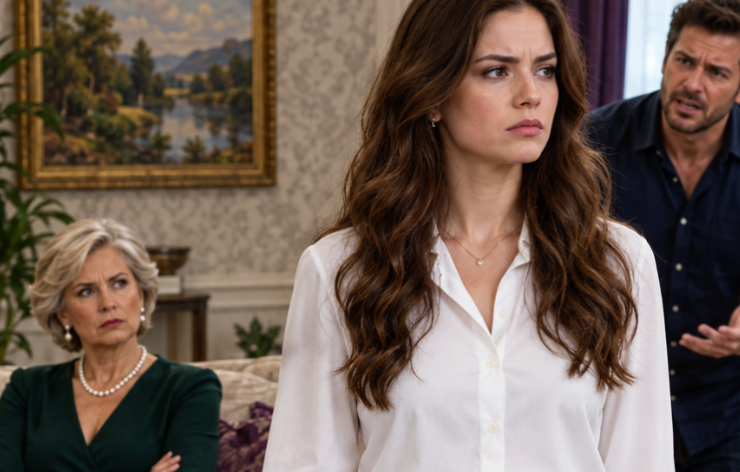
“Anya, did you even have any books in Krasny Yar? Or just a farmer’s calendar?” Galina Petrovna smiled and glanced around at the guests gathered at the festive table. “I’m only joking, of course. Anya’s a pharmacist. She sells pills. Well, somebody needs that too.”
Laughter erupted around the table. Kira, Nikolai’s cousin, stifled a giggle into her napkin. Nikolai himself smiled and placed a reassuring hand on his wife’s shoulder, as if to say, don’t take it to heart, it’s just Mom being affectionate.
Anna sat on a stool by the door to the kitchen. She was holding a dirty plate that she was just about to take to the sink. She paused for a moment and looked at her husband. He was smiling.
“Yes, Galina Petrovna,” Anna replied calmly. “We had books. My grandmother taught me to read when I was four. She was a rural school teacher and worked at the school for thirty-eight years.”
“Oh wow, really,” her mother-in-law raised her eyebrows. “A teacher. In the village. Well, that’s pretty much the same as a librarian, just in a barn.”
The guests burst out laughing again. Anna stayed silent. She had been staying silent for six years now.
Anna grew up in Krasny Yar, a small settlement 300 kilometers from the regional capital. Her mother worked as a milkmaid on a farm, and Anna never knew her father. She was raised by her grandmother, Valentina Stepanovna, a former village teacher of Russian language and literature. It was her grandmother who taught her to read at four, to knit at six, and at sixteen sent her off to the city to study in a medical college—even though Anna’s mother cried and said she wouldn’t let her daughter go to the city alone.
“Let her go,” her grandmother had said then. “She needs to see life. She can take care of herself. I taught her.”
Anna became a pharmacist. She worked at a pharmacy chain near the metro, serving customers through a small window surrounded by shelves of medicine. She met Nikolai there—he came in for some headache pills, they started talking. Nikolai was an engineer at a design institute, polite, well-read, from a ‘good family,’ as he liked to joke with a touch of irony.
His family really was good—at least, as far as they were concerned. His father, now living separately with his new wife, was an associate professor at the technical university. His mother, Galina Petrovna, had spent thirty years as a department head in the regional library and considered herself a woman of high culture. She lived alone in a large three-room apartment in the old city center, with ornate molding and high ceilings. The apartment belonged solely to Galina Petrovna.
After the wedding, Nikolai and Anna moved in with her.
“Just for now,” Nikolai would say. “Until we save up for our own place. Mom has three rooms, plenty of space. And she gets lonely by herself.”
“Just for now” lasted six years.
From day one, Galina Petrovna made it clear she didn’t think her daughter-in-law was good enough. She never said it outright. Galina Petrovna never said anything outright. She’d say things with a smile, softly, as if joking.
“Anya, did you buy your blouse at the market? Of course, where else could you?”
“Anya, do you know what an oyster fork is? No? Well, that’s all right. No oysters in Krasny Yar.”
“Anya is so practical. That country upbringing. We city folk just aren’t like that.”
During the holidays, Anna was the one serving all of her husband’s family. Aunt Nina and her husband, Kira with her fiancé, cousin Stas, Galina Petrovna’s friends from the library—about twelve to fifteen people in all. Anna started cooking early in the morning: salads, main dishes, pies. All evening she ran between the kitchen and the living room, serving food, clearing dishes, bringing out clean plates. She only managed to sit down at the table by dessert—on a stool in the corner by the kitchen door, so she could get up more easily.
One time, on International Women’s Day, Anna gave her mother-in-law a set of nice French skincare creams that cost four thousand rubles. Galina Petrovna turned the box over in her hands and said, “Thank you, Anechka. This isn’t right for me, my skin is sensitive. I’ll give it to Kirochka.” Then she immediately handed it over to Kira, right there at the table.
Anna tried talking to her husband.
“Kolya, it hurts me. Your mom is always making fun of me. In front of everyone. Jokes about the village, about my job, about my clothes. You hear it, don’t you?”
“Anya, it’s just humor. That’s just how Mom jokes. You take everything too much to heart.”
“And the cream she gave to Kira right away—was that supposed to be a joke too?”
“Well, maybe she just didn’t like it. Don’t be so sensitive.”
She tried again. A year later. Two years. Nikolai would get annoyed and say she was nitpicking at his mother, that she was an elderly woman and deserved respect, that Anna was always ‘looking for a reason.’ Eventually, Anna just stopped trying. She stopped expecting anything.
The only person who always stood by her was her grandmother. Anna called her every Sunday. Grandma lived alone in Krasny Yar, in an old wooden house with a vegetable patch. At eighty-two, she still dug up potatoes herself and pickled mushrooms.
At Anna’s wedding, her grandmother was the only one from Anna’s side who sat at the table next to Galina Petrovna. Later, Anna learned that her mother-in-law had said something like, “Well, Kolya’s got his own mind, he chose for himself.” But Grandma calmly replied, loud enough for everyone, “He chose right. My girl is pure gold. Just make sure you don’t drop her. I’ll find out if you do.”
Galina Petrovna blushed and went silent. Anna still remembered that moment.
Two years ago, Anna’s grandmother sold her house in Krasny Yar. She said it was hard living alone, and moved in with Anna’s mother in the neighboring village. The money from the sale and all her savings, whatever she had, she put in a deposit. At the bank, she made a will for the deposit—to Anna.
“This is for you, Anyuta,” she told her granddaughter on the phone. “I’ve already arranged everything. For your own place. So you won’t have to live at someone else’s mercy. Not with your mother-in-law, with no one.”
That winter, Anna’s grandmother passed away. Anna had to go to the notary to take care of the inheritance paperwork. In the spring, after everything was finalized, the money went to her. Two million and eighty thousand.
Anna sat in the kitchen for a long time, holding her phone. Then she went to the bathroom, turned on the water so no one would hear, and cried for twenty minutes.
In the evening, she told Nikolai. Briefly, with no details. That her grandmother had left her some money. That she wanted to buy an apartment. Even a small one, but her own.
Nikolai listened very carefully. Then he hugged her.
“Anya. I really feel for you. Your grandmother was a wonderful person.”
Anna was surprised. He had never spoken kindly about her grandmother before. In fact, he’d never talked about her at all.
Three days later, Galina Petrovna called her daughter-in-law herself. For the first time in six years.
“Anya, hello, dear. Are you free on Saturday? I just baked a cherry pie, come over for lunch. Let’s sit down and talk, like family.”
Anna almost dropped her phone. They lived in the same apartment, but her mother-in-law called her cell phone like she was a guest. And she was inviting her to lunch, as if they lived in different cities.
On Saturday, Galina Petrovna set the table in the living room, with crystal and napkins. She seated Anna not on the stool by the door, but in a soft armchair. She offered her pie. Asked about her work. Complimented her blouse.
“What a beautiful color, Anya. It really suits you.”
It was the very same blouse that, six months ago, she had called “cheap market stuff.”
A week later, her mother-in-law invited her to lunch again. Then again. Then suggested going to the theater together. Suddenly, Nikolai started coming home on time, brought flowers, did the dishes, asked her about her day. Kira, Anna’s cousin, sent her a friend request on social media.
Anna didn’t understand what was going on. And there was this unpleasant, nagging feeling that she didn’t want to understand.
A month later, on a Sunday morning, Nikolai put his tablet on the kitchen table in front of her.
“Anya, look. A Camry. Brand new. White. I’ve had my eye on it for three years.”
“It’s beautiful,” Anna said cautiously.
“Three million one hundred. I have nine hundred thousand—I saved it myself for the car, all these years. And together, we still haven’t saved up for an apartment, six years.” Nikolai looked into her eyes. “Anya. Well, if you could add from yours… about one million eight hundred. And I’ll take out a loan for four hundred thousand. It’s for the family. We’ll go to the dacha, visit your mom in the village. I’ll drive you to work. So you won’t have to take the subway.”
Anna silently closed the tablet.
“No, Kolya. Grandma left me that money for an apartment. I won’t spend it on a car.”
“Come on. We’ll buy the apartment later. Together. We’ll save up.”
“We’ve been saving for six years, Kolya. We have nothing. No. That’s grandma’s money. And it will go to what she asked.”
Nikolai pulled away. His face changed. The kindness disappeared in an instant, like a torn-off wrapper.
“I see,” he said. “So you’re stingy, huh.”
That same evening, Anna heard him on the phone from the other side of the wall. With his mother, of course. Even though she was in the next room, he called her, probably so Anna wouldn’t hear. But Anna heard anyway.
The next day, on Monday, when Anna came home from work, Galina Petrovna was waiting for her in the living room. Nikolai was sitting next to his mother on the couch. Her mother-in-law didn’t offer her a seat.
“Anna,” she said, skipping any “dear” or pet names. “We need to talk.”
“I’m listening, Galina Petrovna.”
“Kolya told me everything. You turned your husband down. Denied him his dream. For six years he’s given you a roof over your head, in my house, by the way. And you begrudged him a car.”
“Galina Petrovna, it’s my money. My grandmother left it to me. For an apartment.”
“Your money,” her mother-in-law smirked. “You’re married, my dear. You don’t have ‘your’ money. It’s family money. You must give your inheritance to Kolya. He knows better what to do with it. He’s the man, he’s the head of the family.”
“Mom’s right,” Nikolai said.
“I fed you for six years,” Galina Petrovna continued, raising her voice. “For six years you lived with me! In my house! Everything was laid out for you! Just last month, I treated you like family—I gave you lunches, baked you pies, took you to the theater! And this is how you repay me? So ungrateful!”
“Yes, Anya,” Nikolai added. “Mom did everything for you. And you…”
Anna stood in the middle of the living room, looking at both of them.
Lunches. Cherry pie. Crystal dishes. A soft armchair instead of a stool by the door. “What a beautiful color, Anechka.” Flowers. Clean dishes. A friend request from Kira.
Everything came together at once. Like a kaleidoscope picture when you finally stop turning it.
For six years they laughed at her, and now they were trying to buy her off. A pie for a million eight hundred.
“And don’t you dare think about my inheritance!” Anna said.
She barely recognized her own voice. It was firm, almost unfamiliar.
Galina Petrovna jumped up from the couch.
“What?! How dare you talk to me like that?! In my house! Who do you think you are?! Apologize right now!”
“Anna!” Nikolai jumped up too. “Stop insulting my mother! Apologize to her this instant!”
“No, Kolya.”
“What do you mean, ‘no’?!”
“Exactly that,” Anna looked her husband straight in the eyes. “Six years, Kolya. For six years your mother made fun of me. In front of everyone. About Krasny Yar. About my job. About my clothes. Even about the cream she immediately gave to Kira. For six years I sat on a stool by the door, running dishes back and forth while you all ate. And you always laughed along with her. Every time. I told you. Many times. You called me sensitive. That it was just a joke.”
Her voice trembled, but she finished what she wanted to say.
“It hurt me, Kolya. Every time. For six years.”
Nikolai winced.
“Anya, it’s all nonsense. Some cream—that’s what you remember? You’re making a mountain out of a molehill.”
“Nonsense,” Anna echoed.
“Kolya!” Galina Petrovna’s face went pale with rage. “Do you hear what she’s saying?! In my house! After everything I’ve done for her! Get her out! Right now! I don’t want her here!”
Nikolai turned to his wife. His face looked hard, like that of a stranger.
“Anna. Here’s how it’s going to be. You either apologize to Mom right now and give up the money for the car, or we get divorced. Your choice.”
He said it with confidence, like someone who already knows what the answer will be. Anna could see he was sure she’d be scared. Where would she go? Back to Krasny Yar? To her pharmacy job and her salary? Without a husband from a good family, without an apartment with fancy moldings?
“Fine,” Anna said. “Let’s get divorced.”
Nikolai blinked.
“What?”
“I agree. We’re getting divorced.”
He opened his mouth and closed it again. He looked at his mother, as if waiting for her to tell him what to do.
Galina Petrovna was the first to recover. She burst out laughing—loud and deliberately.
“Oh, you’re so scary! Getting divorced, are you? Where will you go? You’ll be crawling back in a week. On your knees. Begging for forgiveness. Who would want you, country girl, with all your millions? The first crook you meet will rob you blind!”
Anna didn’t reply. She walked into her and Nikolai’s bedroom. She took a suitcase out of the wardrobe—a big blue one she’d once brought with her from Krasny Yar to college. She put it on the bed.
Nikolai followed her in.
— Anya. Are you serious? Come on, stop it. Just apologize to Mom, and that’ll be it. What does it cost you? And the money… Well, alright, maybe not 1.8 million. One million. I’ll cover the rest—a million two hundred—on credit.
Anna silently packed her things. Sweaters. Jeans. Work blouses. Underwear. Documents from her desk drawer: her passport, diploma, certificate of inheritance, deposit agreement.
— Anya, I’m talking to you! Apologize to Mom!
She didn’t answer.
As she packed, the memories came flooding back all at once. How, in the first year, she learned her mother-in-law’s favorite aspic recipe just to please her. How she dyed her hair because Galina Petrovna said red “looked cheap.” How she accompanied her to library nights and pretended to be interested. How she read classics so she’d have something to talk about at dinner. How she learned the right way to set the table, which glasses for wine, which ones for water. For six years, she tried to earn respect in this house. And in those six years, not once did she get it. Not once.
But now, with the millions, she got it in a month. Lunches, pies, the favorite chair. Because it was never about her. Not then, not now. It was always about what they could get from her.
Anna zipped up her suitcase.
On the shelf in the closet, in the far corner, was her knitting bag: needles, yarn, an unfinished sock. She took it too. Grandma had taught her.
Then she took off her wedding ring. She placed it on the bedside table, next to Nikolai’s alarm clock.
— Anya…
She walked out into the hallway. Galina Petrovna stood in the living room doorway, arms crossed, looking at her with a smirk.
— Go on then, let’s see how you like it in a week.
— Goodbye, Galina Petrovna, Anna said. And she closed the door behind her.
The first week, she stayed with Tanya, her colleague from the pharmacy. After that, she rented a small studio not far from work.
On her first evening at Tanya’s, Anna called her mother in the village. She told her everything. About the six years, the cream, the car, the whole “don’t open your mouth too wide” thing.
Her mother was silent for a long time. Then she said:
— Oh, Anyka. Your grandmother would have been so proud of you.
— You think so?
— I know it. She told me at your wedding: “That mother-in-law will try to break our girl. But she won’t succeed. She picked the wrong one to mess with.” And she didn’t break you.
Anna hung up and, for the first time in many days, fell asleep right away.
A week after leaving, Anna filed for divorce. Nikolai refused to confirm it. She had to go to court.
He called every day. At first, he yelled that she’d destroyed the family. That she was ungrateful. That his mom couldn’t sleep because of her. Then he accused her of “planning it all” to leave with the money. Then he complained that his mom was “nagging him morning to night” and that “life at home was unbearable.”
Anna answered his calls every other time. She listened in silence.
A month later, on the eve of the hearing, Nikolai called with a different tone. Soft, almost gentle.
— Anya. Let’s meet. Let’s talk. I understand a lot more now.
They met at the café near her pharmacy. Nikolai came with flowers. He sat across from her and took her hand.
“Anya, I’m a fool. I was wrong. My mom was wrong, too. Let’s start over. I love you. Truly, I do. Let’s get an apartment, live just the two of us, away from my mom. Just like you always wanted.”
Anna looked at him. He sounded sincere. Or almost sincere.
“And what about money?” she asked.
Nikolai hesitated.
“Well… Anya. I was thinking. If we live together, everything will be shared, right? Let’s buy an apartment together. With your money, and I’ll add a mortgage. We’ll put both our names on it. That’s fair, isn’t it? We’re family. And maybe a car later… someday.”
Anna gently pulled her hand out of his.
“Kolya. I understand now.”
“What do you understand?”
“That you haven’t changed. Not one bit. You’re just trying to get the money in a different way now.”
She stood up, placed two hundred rubles on the table for her coffee. She left the flowers.
“Anya! Wait!”
She didn’t look back.
They divorced in September. Nikolai didn’t show up at the hearing.
In October, Anna bought an apartment. A one-bedroom, thirty-four square meters, in a brick five-story building on a quiet street, just two bus stops from the pharmacy. Third floor, windows overlooking the courtyard with old lindens and a bench with a broken backrest. The price was 1.9 million. Anna used the remaining 180,000 to pay for the transaction fees, and spent what was left on a kitchen table, a sofa, and new curtains.
She purchased the apartment after the divorce, using inherited money, and registered it solely in her name. Alone. No more ‘for two.’
Through a friend from the pharmacy, who had a girlfriend living in the same building as Galina Petrovna, Anna found out that Nikolai was still living with his mother in her three-bedroom apartment. He still hadn’t bought that Camry. Galina Petrovna now checks what time he comes home from work and picks out his shirts for him. Kira got married again, and apparently at the wedding, Galina Petrovna spent the whole night complaining about how ‘daughters-in-law these days are so ungrateful.’
Anna listened and nodded. She didn’t ask any more questions.
On the first evening in her new apartment, she sat on the sofa for a long time, doing nothing. She just sat and listened to the silence. No one was laughing at her from the next room. No one was calling her to set the table. No one said ‘Anechka’ in that particular tone that made her want to disappear into the floor.
Then she took out her knitting bag. She put the unfinished sock aside and reached for a new ball of yarn: gray, soft wool with cashmere. Bought it yesterday—she just couldn’t resist.
She cast on stitches. Cable pattern, with a border at the edges. Just like her grandmother taught her.
She knitted all evening and into the night. Then for two more evenings. By the fourth day, the scarf was finished. Anna put it on in front of the hallway mirror. Wrapped it around her neck twice, just like her grandmother used to do. She looked at herself.
The scarf looked good on her.
The next morning, she wore it to work.
A few months passed. Anna was still working at the pharmacy, but now people had started to notice her. The manager offered her a promotion to senior pharmacist—with a pay bonus and free training from the company. Anna agreed. In the evenings, she took professional development courses, and on Sundays she called her mother in the village. Sometimes, she visited Krasny Yar to tend to her grandmother’s grave, keeping it tidy and planting flowers. She told her grandmother about her new apartment, about the scarf, and how she finally slept peacefully now.
One day, an older woman in an expensive coat with a perfectly styled hairdo walked into the pharmacy. Anna looked up from the register and didn’t recognize her at first. It was Aunt Nina, her husband’s relative—the same one who had laughed at her “homemade” gift during the New Year’s holidays.
Aunt Nina recognized Anna as well. She stopped and stayed silent for a moment.
“Anechka,” she said quietly. “Hello.”
“Hello, Nina Arkadyevna.”
“I’m here for some heart drops. The doctor prescribed them.”
Anna found the medicine and rang up the purchase. Aunt Nina paid, and then said, without looking at her:
“You did the right thing by leaving, Anechka.”
Anna raised her eyebrows.
“That New Year’s, I wondered to myself—why was Galina like that with you? The scarf was nice, it was warm. Afterward, she put it in Baron’s basket, and he slept on it. I saw. I thought maybe I was imagining things. Then Kolya told me you’d left. And do you know what? I asked him, ‘Kolya, did you stand up for her?’ And he said, ‘Why should I? Mom was just joking.’ What kind of joke is that, Anechka? Six years.”
She sighed and continued:
“Galina has always been like that, even before you. Back at university, she always looked down on everyone. After Kolya got married, she became even worse. She was jealous, Anechka. Honestly. You did everything yourself, through your own hard work. She got everything from her husband and later from her parents. That apartment wasn’t something she earned—her parents left it to her. But you—you did it on your own. That’s why she was angry. Not at you, but at the fact you could manage without her. Do you understand?”
Anna stood there, holding the box of heart drops in her hands, not knowing what to say.
“What about Kolya?” she asked.
“Kolya is spineless,” Aunt Nina said bluntly. “I’m sorry, but it’s true. He was always like that, even as a kid. His mother told him what to do and he’d do it. If she was upset, he’d lower his eyes. When you left, I told him, ‘Kolya, you didn’t lose your wife because she was bad. You lost her because you never stood up for her.’ He cried, right in front of me. But it was too late, Anechka. Too late.”
She took her medicine, thanked Anna, and walked toward the door. At the entrance, she turned back.
“Most importantly, don’t be angry at all of us,” she said. “We have nothing to do with it. That was their family, not yours. You just lived there for six years. Now you have your own family—a good one. You built it yourself. Your grandmother would be so proud.”
The door closed behind her.
Anna stood still for a moment, then returned to the register. People were waiting in line: a woman with a child, an old man clutching a prescription, a young woman with a sore throat. Anna smiled and picked up the next prescription.
That evening, Anna went home, made herself some tea, and sat on the sofa by the window. Snow was falling outside—quiet, heavy February snow. In the yard, children were building a snowman. On the bench with the broken backrest, an elderly man sat feeding pigeons.
Anna took out her phone. She found Nikolai’s number in her contacts and stared at it for a long time. Then, she deleted it. Not out of anger—just because she didn’t need it anymore.
She remembered what Aunt Nina had said: ‘You only lived in her house. Now you have your own.’ And it was true. For six years, she tried to become part of someone else’s family, to follow someone else’s rules, to earn someone else’s respect. But she had never started her own life. Until she had no choice.
The reason for the divorce wasn’t the incident with the car or the inheritance. That just revealed a truth she hadn’t wanted to see for far too long.
She glanced at the scarf hanging on the hook in the hallway. Gray, soft, with braided patterns along the edges. She had knitted it herself. For herself. And it suited her perfectly.
Anna finished her tea. She reached into her bag for her knitting needles and a new skein of yarn—this time, blue. Maybe mittens? Or a hat? She hadn’t decided yet. But one thing was certain: she’d make something nice. For herself. And she wouldn’t give it away to anyone.
A year later, she happened to see Nikolai by chance in the metro. He was standing on the platform with his mother. Galina Petrovna was saying something to him loudly, irritably, waving her hand toward the train. Nikolai was silent, his head down. He looked older. His face was tired and gray. He didn’t notice Anna. Or maybe he pretended he didn’t.
The train arrived. Anna got into a different car and sat by the window. As the train started moving, the lights of the station, faces of people, and other lives slipped past the glass.
She took out her phone and checked her email. There was a message from the head manager: ‘Anna, good afternoon. We confirm your appointment as branch manager. Congratulations!’ Anna smiled. Her grandmother would have been proud.
At home, she brewed some coffee, turned on music, and sat down to knit. Blue wool on her needles, the braid pattern along the edges—just as her grandmother taught her. Anna knitted and thought about how life doesn’t end when one door closes. It begins when you open another, your own, one you unlock yourself. And you let in only those who cherish you. The others stay outside, with their suitcases, their complaints, and their pies.
She realized that the reason for the divorce was not that incident. It only showed her the truth she had refused to notice for too long.
Half a year later, Anna received a promotion—she became the head of the pharmacy. Her salary increased, and so did the workload, but she was happy. In the evenings, she went to yoga at a nearby studio. On Sundays, she visited her mom. Sometimes, they went together to Krasny Yar to visit her grandmother. They’d sit on a bench by the grave, sip tea from a thermos, and talk. It felt like her grandmother was listening. Maybe she really was. Who knows.
One day, late in the fall, Stas—Nikolai’s cousin—came into the pharmacy. The same Stas who had sat at the New Year’s table laughing with everyone. He was with his wife and their little son. While his wife picked out vitamins, Stas stood nearby.
“Anna?” he approached the register. “Hi. How are you?”
“I’m good, Stas. And you?”
“Yeah, we’re okay too. We’re just treating our son’s cough—it’s been bothering him.”
Anna rang up his purchase. Stas paid. There was a brief silence. Then he said:
“Anya, I know it’s really not my place, but back then… on that New Year’s Eve. I saw what your mom—what Aunt Galya—did. And I didn’t say anything. I kept quiet like everyone else. I didn’t even call Kolya afterwards to check in on you, even though I knew he was being an idiot. I’m sorry, if you can forgive me. We were all scared. Family, you understand? Nobody wanted to start a fight. But now, looking back, I wonder—what kind of family is it if everyone is afraid to speak the truth?”
Anna looked at him. Stas’s eyes were tired, with a little wrinkle between his brows. She could see he was being genuine.
“I’m not angry, Stas,” she said. “Really. You’re not to blame. Nobody is. That’s just how things happened.”
“Nobody? How’s that?” he asked in surprise. “What about Kolya…?”
“Kolya is just weak,” Anna interrupted. “It’s not malice, it’s weakness. He’ll always stick to his mom and he’ll always be unhappy. Because with his mom, he’s not a man, but without her, he can’t do anything. As for Aunt Galya… she’s just envious, though she doesn’t realize it herself. She thinks she’s doing the right thing, that she’s teaching me about life. But really, she’s just scared. Scared that someone else might end up happier than she is. That fear is what makes her nasty.”
Stas listened quietly. Then he nodded.
“And you… are you happy?” he asked.
Anna smiled. A real smile.
“Yes. I am happy.”
He picked up his son, said goodbye, and left. The door clicked shut behind him.
Anna got back to work. A woman was next in line, holding a prescription for hormonal tablets. Anna smiled at her and took the prescription.
That evening, she rode home on the subway, gazing out at the flashing lights. She thought about how Stas was right: what kind of family was that? For six years, she tried to belong in a house where she wasn’t wanted. For six years she mistook mockery for humor, indifference for personality. Only when she had to leave did she finally understand: a real family doesn’t make you earn their respect. They just give it, simply because you belong.
She remembered her grandmother. Her words: “Family is where they take care of you. Where they just use you, that’s not a family. That’s a cart.”
Grandma was right. As always.
At home, Anna made some tea. She sat on the couch. She picked up her scarf—the gray one, with cables. She wrapped it around her neck. Sat quietly for a moment.
Family isn’t just where you live. It’s where you’re cared for. If you’re just being used, that’s not a family. That’s a cart.
She smiled and dialed her mom’s number.
“Hi Mom. I’m coming over tomorrow.”
“Come, honey. I’ll bake a pie—with cherries.”
“Cherry pie sounds great.”
She hung up. Looked out the window. It was snowing outside. Quiet. Peaceful.
Anna picked up her knitting needles. Cast on stitches. Blue wool. Cable pattern. Grandma’s pattern.
She knitted, thinking: how glad she was that she had left. How glad she was she hadn’t been afraid. How wonderful it was to have her own life now. Her own apartment. Her own scarf.
And no one will say to her, “You made that yourself?”
Because she’ll make it herself. And she won’t ask anyone’s permission.