“Lena, are you taking the curtains from the veranda?” Galina asked.
I was standing in the bathroom, wringing out the floor cloth. There was just one day left before the buyer arrived, and I was determined to make the summer house look as if we had always been tidy people.
“I haven’t decided yet. Why?”
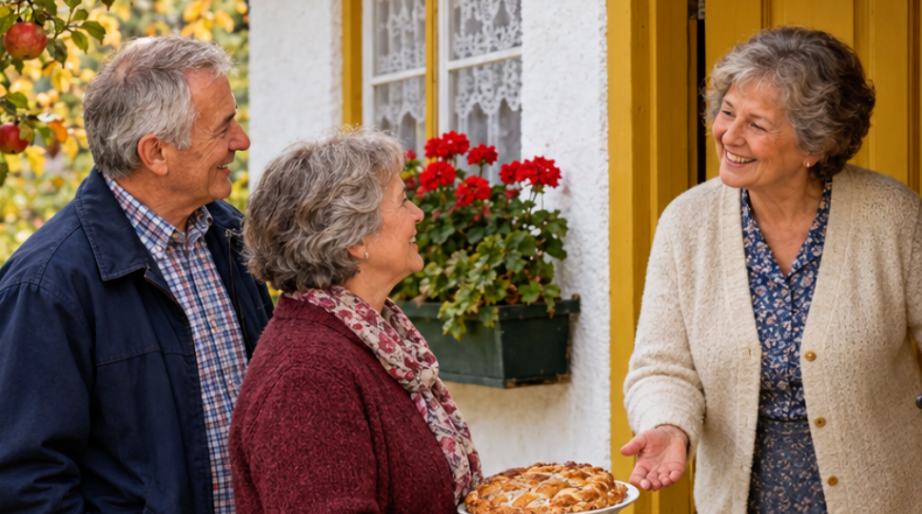
A woman in a plum-colored cardigan holds a pie next to a man in a blue jacket; an elderly woman in a work jacket greets them at the yellow door of a country house.
“Then I’d pick out other ones. I want something lighter.”
I stopped twisting the cloth.
“What do you mean ‘other ones’?”
Galina was silent for a moment.
“Did Andrey not tell you?”
A cup clinked in the kitchen. My husband was right there, just behind the thin wall. I could hear his sister through the phone, and I heard—live—the moment he stopped stirring his sugar.
***
It was Andrey who suggested selling the summer house.
At the beginning of August, I canceled a meeting with a friend for the third time that week: there was always something to do—packing, watering, hauling things. My husband watched me loading bags into the trunk and said,
“Maybe that’s enough already?”
It didn’t occur to me right away that he was serious.
We were sixty and sixty-three. Living in Vinnytsia, with the summer house not far from the city. Once, we went there for the joy of it; later, out of habit since things were already planted; and in recent years, Friday evening meant gathering groceries, finding work clothes, and not forgetting ant repellent.
I loved the mornings on the veranda. Only the mornings always ended so quickly.
Andrey said he was tired, too. He wanted free weekends and the trip we’d been putting off for three years. We agreed to sell.
We wrote the listing together. We discussed the price, too. My husband took the first calls—he had more spare time, and I was still working.
A buyer showed up quickly. According to my husband, it was a woman looking for a small house for herself. She wanted to come see it on Saturday.
“Will she be living alone?” I asked.
“Yes.”
I was even pleased. For some reason, I pictured a quiet person who might love our veranda and the old apple tree.
That quiet person turned out to be Galina. I had known her for more than thirty years.
***
“We’ll talk later,” I said into the phone.
“Lena, I thought you knew.”
“We’ll talk.”
I ended the call and walked into the kitchen.
Andrey was sitting at the table. His cup was still full.
“Did you ask her not to say anything?”
“I wanted to tell you myself first.”
“When? After the curtains?”
He rubbed his forehead.
“Don’t start. What does it matter who buys it? She’s family. It’s easier for us that way.”
“I’d have been calmer before you decided not to tell me.”
My husband stood up, then sat back down again.
“Galya has been searching for a long time. This house is right for her. Everything’s familiar, the neighbors are good people. She’s on her own now—she’ll be happy here.”
Galina buried her husband two years ago. She’d dreamed of a little house outside the city even back then, but they never found the courage to move out of their apartment.
I knew all this. And I could completely understand her desire.
“Why did you hide it from me?”
“I wasn’t hiding. I just wanted us to settle things without all the unnecessary talk.”
“And what have you already agreed on?”
He told me the amount.
It wasn’t the price we’d put in the ad.
I sat down across from him.
“You gave her a discount?”
“She’s my sister.”
“And what am I?”
He flinched, as if I’d said something inappropriate.
“Lena, don’t start with that.”
I was staring at the cabinet above his head. The door had been crooked since spring. Every time, we promised to fix it and every time we left before we could.
Suddenly, I wanted to call Galina and say: come over, take everything, just first learn how to turn off the kitchen faucet properly so it stops dripping.
Instead, I asked:
“What else did you promise?”
“Nothing special.”
***
I barely slept that night.
I’ve always liked Galina for her honesty. She could tell me my pie was a bit dry, then ask for a second slice five minutes later. When Andrey got sick a few years ago, she came over, brought groceries and put everything away herself, without waiting for me to tell her what to do.
Now, I remembered every recent thing she’d said.
A week ago, she asked if it got cold here in winter. I replied that we don’t stay here then. She asked about the neighbor’s house where people stayed all year. I thought it was just small talk.
That’s when Andrey went outside.
Now everything felt like a conspiracy.
In the morning, I put a note with our initial price on the table.
“I never promised anything. Not to her, not to you.”
My husband got dressed without a word.
“And I’m not going to pretend everything’s fine just because she’s your sister.”
“She hasn’t paid anything yet.”
“Alright.”
For the first time in a day, I felt a bit of relief from that simple word.
***
Galina showed up at ten, wearing a work jacket, a tape measure in her pocket.
“I’m just here to look,” she explained after catching my eye. “Thought I’d measure things too, while I’m at it.”
We stood at the gate. Andrey kept busy by the car, though there was nothing to unload.
“Come on in,” I said.
She stopped on the veranda.
“Lena, let’s just be honest. You don’t want to sell the place to me, do you?”
“I don’t want decisions to be made without me. Did you know I was left out of the loop?”
“No.”
She answered quickly, without looking away.
“He told me you’d discussed everything. I even double-checked about the price. It’s still less than what you posted in your ad.”
I looked at my husband. He stepped onto the porch.
“We did say that we could give a discount to family.”
“We said we’d look at all offers. That’s what we’re doing.”
Galina slowly took the tape measure out of her pocket and set it on the table. Not as a tool anymore—just to have empty hands.
“Then I’ll hold off on measuring anything for now.”
Suddenly, I was embarrassed. All night, I’d turned her into the greedy relative taking advantage of the situation. But now here she was, just a woman willing to walk away.
***
We ended up walking through the house together.
Galina asked about the heating, the damp corner in the closet, and the old wiring. Andrey answered. I pointed out things he usually missed: where to check the windowsills after heavy rain, which door swells up, what we’d fixed, and what still needed repairs.
“I’ll invite some experts to take a look later,” she said. “I’m planning to live here, not just visit on weekends.”
In the kitchen, Galina looked at the wall.
“I’d probably remove that cabinet.”
Andrey turned sharply.
“Why? It’s a good cabinet.”
“I’d find a different one more convenient.”
“I made that cabinet myself.”
“I know.”
She said it without sarcasm. Still, my husband was hurt.
I thought: that’s the first cabinet before the sale. How many will there be after?
In the yard, he led his sister to the shed.
“Here’s my workbench. I’ll be coming by from time to time to finish the shelves. I’ll leave my tools here for now—you might need them too.”
“Wait,” Galina said. “What do you mean—for now?”
“Well, I’m not going to take everything to the apartment. And we’ll leave these two garden beds. We don’t need a lot.”
I glanced at my husband.
“We?”
He gestured toward the sunny side.
“Tomatoes. You love your tomatoes.”
I suddenly felt cold, even though the sun was warming my back.
***
Galina looked from her brother to me.
“Andrei, I don’t get it. Are you selling me the house, or am I just supposed to look after it for you?”
“What do you mean, look after it? I told you—it all stays in the family.”
“But I’ll be living here.”
“Of course. Who’s arguing?”
“Will you keep a key?”
He shrugged.
“Just in case. You never know if you’ll need help.”
“But what if I don’t ask for help?”
He didn’t know what to say. After thirty-plus years of marriage, I knew that look well: when someone thinks they’re being kind, but suddenly faces uncomfortable questions.
“You said I’d be the lady of the house,” Galina continued. “That I could change things however I wanted.”
“Then go ahead and change them.”
“But not the wardrobe. The workbench is still yours. The garden beds are yours. On Saturdays you’ll come over, because you’re used to it. So what about my Saturday?”
I looked at Andrei and gradually realized he wasn’t trying to cheat anyone.
He had figured out a way to sell the dacha without letting it go.
He wanted free weekends, but still to be able to return at any moment. To give up the mandatory work—yet, for some reason, keep my tomatoes in his life.
And to his sister, he was selling an entirely different house. One that was her own.
***
“I thought both of you would be happy,” he finally said.
“You didn’t even tell me,” I replied.
Galina picked up the measuring tape from the table.
“Let’s not do this today. I don’t want to buy in the middle of a fight.”
She stopped at the gate.
“Lena, I didn’t want this house because of the discount. I really liked it. And I liked that I wouldn’t feel like a total stranger here.”
“I understand.”
Now I really did.
After she left, Andrei walked around the yard for a long time. I didn’t follow. I sat on the porch—alone for the first time that morning, with no buyers and no chores.
He came back carrying some old hand plane.
“It was my father’s,” he said.
I knew that. His father had given him the tool when we first got this plot.
My husband ran his finger over the handle.
“What am I supposed to do with all this?”
He could have asked me that back in August.
“I don’t know,” I replied. “Let’s figure it out together.”
He sat down next to me. He set the hand plane on the table carefully, like placing a cup of hot tea.
***
We didn’t take the listing down that day, and we didn’t rush Galina.
For a whole week, we discussed things we somehow hadn’t considered when we cheerfully decided to start a new life. What we’d take. What we were willing to leave. Where Andrei could store the tools he actually used. Which trips we’d choose instead of the usual Saturdays.
He admitted he’d always imagined Galina sitting on our porch, as if we’d just occasionally come visit her and everything else would stay the same.
“I just didn’t picture her taking down the wardrobe.”
I laughed. He frowned at first, but then he smiled too.
“I know how it sounds.”
We called his sister again. This time, together.
We discussed the amount again, this time without anyone making promises on my behalf. In the end, we agreed on a solution that worked for all three of us. We also settled in advance what would stay in the house. Andrey even said himself that he’d take his tools and wouldn’t keep the key after handing over the house.
Galina stayed silent.
“Then I’d like to look around one more time. Calmly.”
***
By the time the dacha became her home, I had already regretted selling it twice.
Once was when I took down the curtains on the veranda—Galina had picked different ones after all. The second time was when I noticed the empty spot where our blue bench used to be.
We took the bench with us. It found a spot at our friends’ place, where we planned to actually visit and not just work by a schedule. They were the ones who asked for it, and I was glad the wood would still be of use.
Andrey took the longest to clear out the shed. Dad’s hand planer went home with him. He gave some of the bulky stuff to a craftsman friend. It wasn’t easy to let go of everything: he unloaded one box, stood over it for a while, and in the end, took it back to the car.
I didn’t rush him.
On the last morning, we walked around the property. My husband reached toward a branch on the apple tree he’d been meaning to trim for ages, but then stopped himself.
“I’ll mention it to Galina.”
“Go ahead.”
He looked at me and added,
“When she asks.”
***
Two weeks later, my sister sent a photo. The front door was now yellow.
“But why?” Andrey started to say.
Then he zoomed in on the picture.
I waited to hear what he would say next.
“Actually, it looks pretty good,” he finally conceded, obviously making an effort.
On Friday, Galina invited us over for Sunday. She had her own plans on Saturday.
My husband agreed. He set his phone down, checked the weather for the next day, then abruptly closed it.
“We don’t have to go anywhere, right?”
“No, we don’t.”
In the morning, I met with a friend. Andrey stayed home, later called an old buddy. The day turned out completely ordinary—maybe even a bit empty. We hadn’t yet learned how to enjoy a weekend that didn’t have anywhere or anyone waiting for us.
On Sunday, just before we left, I noticed his toolbox by the door.
“What’s that for?”
My husband followed my gaze.
“I thought, just in case there’s…”
He didn’t finish his thought. He picked up the box and took it back inside.
When we pulled up, Galina was standing by the yellow door. Her sleeve was stained with paint.
Andrey got out of the car and looked at the hinge and the shiny new handle. It was obvious he wanted to say something.
“Will you show us what you’ve done?” he asked.
She threw the door open wider.
I followed them in with a pie in my hands. For the first time in many years, we showed up here not dressed for work.