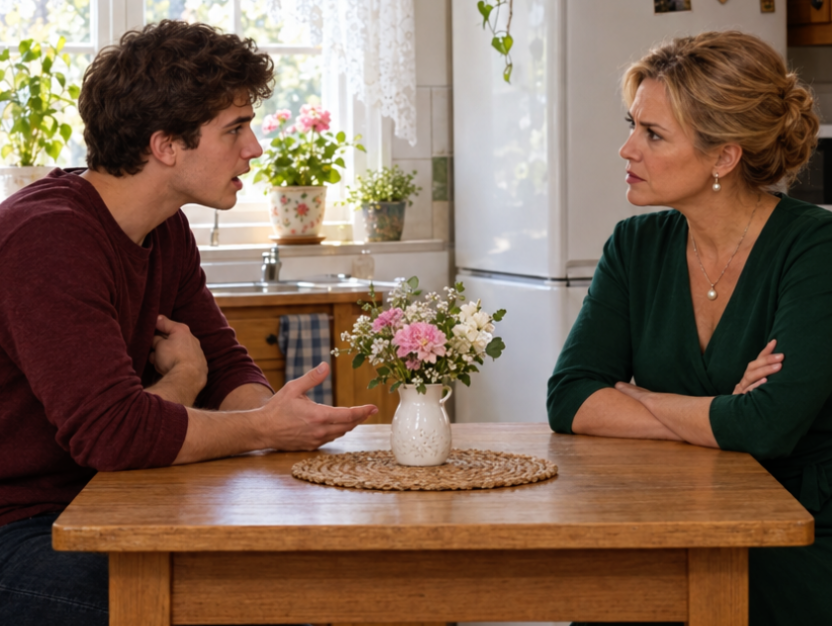
“Pack your things,” the lieutenant said wearily, looking at my son. “Since your mother is considered a threat to you and has been treating you cruelly, you’ll be sent to a group placement center. Until we figure things out.”
Matvey was sitting on the couch in his room. Just a minute earlier, he had been forcing out tears and rubbing his reddened shoulder while telling the juvenile inspector how I was terrorizing him.
But when he heard the word ‘placement center,’ his face suddenly went pale. He stopped sobbing immediately and shot me a quick, confused look.
He expected me to drop to my knees in front of the police officers. To start crying, begging them not to take my precious child away, swearing I was a good mom, and as compensation for his ’emotional trauma,’ to instantly promise him that very new iPhone—the real reason behind this whole show.
But I just stood there, leaning my shoulder against the door frame, silently watching him. Inside, I felt absolutely empty. No fear, no pity. Just the cold, ringing exhaustion of someone who finally realized: things can’t go on like this.
“Go get your backpack, Matvey,” I said calmly. “Bring a towel, your toothbrush. And a change of clothes.”
His eyes widened. The show wasn’t going according to his script.
***
This didn’t start yesterday. I must have missed the moment when my child—with whom I used to bake pancakes on weekends and watch movies—turned into a cold, calculating consumer.
I’ve been raising him alone since he was ten. My ex-husband, Matvey’s father, quickly disappeared into a new family after the divorce, leaving just the child support—which barely covered school lunches and swim classes. All the financial burdens, the mortgage, and daily life were on me. I worked as the chief accountant at a small logistics company, took on side jobs at home, balanced books for others at night, all so my son wouldn’t need anything.
I thought that was what love looked like—giving him what I never had as a kid. A good computer, expensive sneakers, branded hoodies. I excused his laziness as just adolescence. I blamed his rudeness on hormones. I swallowed my own hurt, thinking, “He’s just a teenager, it’s hard for him, I have to be wiser.”
The warning bells started ringing six months ago, when Matvey turned fifteen.
He stopped asking. He started demanding.
At first, it was small stuff.
“Mom, send me two thousand rubles, we’re going to the burger place with the guys.”
“Matvey, I gave you pocket money just yesterday,” I tried to gently explain. “I’ve budgeted everything until payday, and the mortgage is due soon.”
“Then borrow it from someone,” he threw out carelessly, not even looking up from his phone. “You’re my mom, it’s your job to provide for me. All the other guys have normal money, I’m the only one who’s broke.”
I’d sigh, feel a stab of guilt, and transfer the money.
Then his demands grew. Matvey decided he desperately needed a new gaming computer. The old one was only two years old, but it ‘couldn’t handle the graphics.’ When I refused, explaining that 150,000 rubles was way beyond our means, he threw a tantrum.
He didn’t yell. He just stopped talking to me altogether. He ignored my questions, slammed doors in my face, and would leave a pile of dirty dishes in the kitchen on purpose, knowing full well I’d be coming home tired after work.
I endured it. I tried to have heartfelt conversations with him, sitting at the edge of his bed, telling him about our finances, about how hard things were for me.
“That’s your problem,” he replied coldly one day. “You shouldn’t have had me if you didn’t have the money. The government protects teenagers’ rights, you know. I have the right to a decent standard of living. I read about it on the internet.”
That was the first time I felt a chill of fear. Sitting in front of me was a stranger who talked to me in the language of legal threats he’d picked up from TikTok videos.
***
The breaking point came three weeks ago.
I came home two hours earlier than usual—my meeting was canceled. The hallway was quiet, but from Matvey’s room, I could hear muffled voices. He was playing an online team game and chatting with friends through a microphone.
I took off my shoes and was heading to the kitchen, arms full with heavy bags, but I stopped midway. His bedroom door was slightly ajar.
“This old hag has really lost it,” my son’s voice rang out, loud and confident. “Can you believe, she wouldn’t give me the money for new Jordans? Says she’s got a mortgage. Like I care about her mortgage. I told her straight: if she doesn’t buy them, I’ll make her life a living hell. She’s required to provide for me until I turn eighteen. She’ll have no choice, she’ll complain and then give in. She’s such a pushover.”
I stood there in the hallway, holding a bag with a loaf of bread and a carton of milk sticking out. My fingers gripping the handles had turned white.
“Old hag.” “Pushover.” “She has no way out.”
I didn’t feel anger or outrage. Only a complete sense of emptiness and the heavy realization that all my effort over the past fifteen years had been for nothing. I quietly went into the kitchen, set the bags on the table, put away the groceries, and sat on the stool, staring out the window for almost an hour.
I didn’t make a scene that evening.
I simply made a decision.
***
In the morning, while Matvey was still asleep, I opened my banking app and blocked his linked card—the one I transferred daily spending money to. On the kitchen table, I left two hundred rubles in cash—enough for a school lunch and transit. Then I left for work.
By lunchtime, my phone wouldn’t stop ringing.
“What’s going on?!” Matvey yelled angrily when I finally answered. “Where’s the money? I’m at a café!”
“The money’s on the table,” I replied calmly. “Two hundred rubles. That’s enough for lunch in the school cafeteria.”
“Are you kidding me? Just two hundred? Unblock my card right now!”
“The card is blocked. Your basic needs—food and a roof over your head—are covered. Everything else is a luxury, and as your so-called ‘old hag pushover’, I won’t be paying for that anymore.”
There was a heavy silence on the other end. He realized I’d heard everything.
Then the call ended with short beeps.
That evening, I came home to an icy reception. Matvey was sitting in the kitchen, arms crossed tightly over his chest.
“Eavesdropping on other people’s conversations is a violation of personal boundaries,” he announced at the door, trying to seize control of the situation.
“Living off someone else and insulting the person who feeds you? That’s just shameless,” I replied as I took off my coat. “Starting today, things are changing, Matvey. No more pocket money for cafés, no more brand-name clothes. You have clean clothes, a bed, and food in the fridge. That’s where my legal responsibilities end.”
He jumped up, knocking over a stool.
“You have no right! I’ll make you pay, no matter what!”
A day later, the heavy artillery joined the conflict—my ex-mother-in-law, Zinaida Ivanovna. She only ever showed up to lecture me, even though she saw her grandson once every six months.
“Lenochka, what’s going on over there?” Her voice dripped with fake sympathy through the phone. “Motechka called—he was crying. Says you’re starving him. Why are you traumatizing the child? He’s going through adolescence. A boy needs understanding, and you’ve turned the place into a prison camp over some silly joke!”
“Zinaida Ivanovna,” I sighed, rubbing the bridge of my nose. “Motechka is fifteen. He calls me a hag and demands expensive sneakers. If you feel so sorry for him, take him to live with you. Let him stay at your place, and you can give him all the ‘understanding’ and fancy shoes he wants.”
“How can you say that!” my ex-mother-in-law immediately protested. “My blood pressure, my age! And anyway, he’s your son, you’re his mother, it’s your job to put up with it! We’re family—you have to know how to forgive!”
“Exactly—it’s my family,” I snapped back. “And I make the rules here.”
I hung up. Double standards were always her specialty. ‘We’re family’—but only until real responsibility appeared.
Matvey realized his grandmother wouldn’t help. So he decided to take drastic measures.
***
It happened on Friday evening. I came home after finishing a quarterly report, dreaming only of a shower and my bed. Matvey stood in the hallway, blocking my way.
“I need thirty thousand,” he announced. “My friends and I are renting a cottage outside the city this weekend for Vlad’s birthday. We’re all chipping in.”
“No,” I tried to step around him.
“What do you mean, no?! I already promised!”
“Break your promise. I don’t have that kind of money to spend on your parties. And even if I did, I wouldn’t give it to you.”
He turned pale with anger.
“Oh, really?” He stepped right up to me. “You think I’m joking? You think you’re in charge here? I read online that if I call the police and say you beat me, abuse me psychologically, and starve me—they’ll take away your parental rights. They’ll send me away, and the government will pay me benefits. I can live it up in a proper foster family or an orphanage—more freedom than with you!”
I looked up at him. My son. My own flesh and blood. The person I lost sleep over for years. He stood there, staring back with a cynical, confident smirk—a petty blackmailer.
“You wouldn’t dare,” I said softly.
“Wanna bet?” he pulled out his phone. “Come on, transfer the money. Or I’ll dial 112 right now.”
I stayed silent. I simply couldn’t believe he could actually cross that line.
Matvey took my silence for weakness. Suddenly, he swung his shoulder hard into the doorframe—so hard that he gasped in pain. Then he grabbed my favorite ceramic vase from the nightstand and hurled it to the floor. The vase shattered to pieces.
He dialed a number and put the phone on speaker.
“Police?” His voice changed instantly—thin, trembling, full of tears. “Please help me… My mom… she’s drunk, she’s throwing things and she beat me… I’m really scared!”
He gave them our address and hung up.
Then he looked at me. The tears disappeared and that same smirk returned to his lips.
“Alright then. You’ve got fifteen minutes to transfer me fifty bucks. For emotional damages. Otherwise, when they get here, I’ll show them the bruise on my shoulder and the broken pieces. You know who they’ll believe.”
At that moment, something inside me finally broke. And at the same time—everything seemed to fall into place.
I walked to the kitchen. Poured myself a glass of water. Drank it.
I sat at the table and waited.
Matvey paced the hallway, occasionally glancing in at the kitchen. He was starting to get nervous. My calmness was clearly not part of his plan.
“What, didn’t you get it?” he snapped. “Child services are coming. They’ll take away your rights!”
“We’ll wait,” I replied.
They arrived in twenty minutes. Two police officers—an older lieutenant and a young female sergeant. With them, as required for calls like this, was a duty social worker.
As soon as the door opened, Matvey put on a dramatic show. He pressed himself against the wall, clutched his shoulder, and started to sob.
“She… she told me to get out of the house! And when I said I had nowhere to go, she threw a vase! Then she shoved me into the door!”
The police officers looked at me. I stood in the middle of the hallway in a formal business suit, completely sober, calm, and tired.
“Ma’am, is this true?” the lieutenant asked, frowning.
“No,” I answered. “He hit his own shoulder on the frame and broke the vase himself.”
“She’s lying! She always does this, then pretends to be normal!” Matvey screamed hysterically. “Take me away, I’m scared to stay with her! I read you have the right to take me somewhere safe!”
The lieutenant sighed heavily and pulled out a tablet for the report. The child welfare worker gave Matvey a sympathetic look, then turned a stern gaze on me.
“You do understand these are serious accusations? If a teenager refuses to stay with their mother and claims their life is in danger, we’re required to remove them from the home and place them in a social rehabilitation center until everything is investigated. Is that what you want? Do you realize what this means for you as his mother? Registration, checks, possibly court.”
Matvey stopped whimpering and sneaked a glance at me.
His eyes radiated triumph: ‘Go on, suffer. Beg them. Beg me. Pay up.’
I shifted my gaze from the caseworker to my son.
I remembered every unpaid bill so he could have a trendy jacket. Every night spent with someone else’s reports. Every ‘old hag’ muttered into the mic.
“I confirm everything my son said,” I said loudly and clearly into the sudden silence.
The lieutenant looked up from his tablet. The social services worker blinked in surprise. Matvey froze.
“Confirm what?” the police officer asked, confused.
“That I can’t guarantee his safety. Or mine anymore. My son is out of control—he’s aggressive, he’s blackmailing me with false accusations, and demanding money. I can’t handle raising him anymore. If he’s officially claiming that living with me is a threat, then I demand you follow the law.”
I took a step toward the social services worker:
“Start the paperwork to remove him. Take him to the shelter.”
A heavy silence settled in the hallway.
“Mom… what are you saying?” Matvey’s voice suddenly lost all its drama, and real, primal fear came out.
“Pack your things,” the lieutenant said, understanding everything. He was an experienced guy, and it was clear he’d seen ‘victims’ like this before. “If your mother is a threat, you’re going to temporary care.”
Matvey went pale. He stood there, looking back and forth between me and the people in uniform.
“I was joking!” he suddenly shouted. “No one hit me! I hurt myself! I just wanted her to give me money! I don’t want to go anywhere!”
“You don’t joke with the police, kid,” the female sergeant replied harshly. “The call was registered. You made a statement about abuse. Now we have to take you, and the youth inspectors will sort it out. Go get your backpack.”
“Mom!” Matvey rushed to me and grabbed my hand. “Mom, tell them! Please, tell them everything is fine! I don’t want to go to the foster home! Please!”
I looked into his eyes, full of genuine terror. It hurt. It hurt so much. Any mother in that moment would want to hug their child and say, “Comrade officer, please forgive him, we’ll handle it ourselves.”
But I knew: if I backed down now, he’d know he could break me forever. That there were no boundaries. That I would always give in.
Gently but firmly, I pried his fingers from my sleeve.
“I won’t stand in your way, Matvey,” I said quietly. “You wanted freedom from the old witch? You got it. Go pack your things.”
Half an hour later, the door closed behind him.
I was left alone in the empty apartment. Pieces of a ceramic vase were scattered on the floor. I grabbed a broom, swept them up, and threw them in the trash. Then I went to the bathroom, turned on the water, sat on the edge of the tub, and broke down in tears. I cried harder than I did at my husband’s funeral. I mourned for the little boy I’d lost, and for the cruel teenager I’d raised with my constant giving in.
***
The next morning, hell began.
Child protective services called, inviting me to a meeting. School called, too, because the police had sent an official request on Monday.
Then in the evening my mother-in-law called.
“Lena!” she screeched through the phone so loudly I had to hold it away from my ear. “You monster! Matvey called me from the shelter! They let him have one call! How could you send your own flesh and blood to an orphanage?! Are you a mother or a snake?! Go get him back, now!”
“Zinaida Ivanovna,” I replied calmly. “Matvey himself called the police and claimed I was beating him. I didn’t send him; I agreed with his statement.”
“But he’s just a child! He only wanted some attention! How could you let him sleep in a state facility bed?!”
“If you’re so worried, Zinaida Ivanovna, you can go to child services and apply for temporary guardianship yourself. I won’t object. You can take him home as soon as tomorrow.”
My mother-in-law fell silent.
“What… guardianship? Me? But my health isn’t good… And my pension is so small… Plus, I only have a one-bedroom apartment…”
“Exactly,” I said. “It’s always easy to pity others at someone else’s expense. Goodbye.”
***
I didn’t go to pick him up on Monday or Tuesday.
I met with the juvenile investigator. I gave my statement. I explained to the psychologist from the social rehabilitation center (that’s the official name for this ‘shelter’) what had really happened.
The psychologist, a smart woman in her fifties, listened to me, reviewed the notes and nodded.
“Your son already admitted he made it all up for money. He’s in deep shock. You know, Elena, most mothers in your place would have rushed over the next day, begging for forgiveness, bringing gifts and taking him home as an apology.”
“And then what?” I asked.
“Then he would learn that blackmail is the perfect tool. You did the right thing by waiting. It was good for him to see reality. This isn’t a resort. They get up at seven, clean the grounds, phones are only allowed for an hour a day, and most of the kids here come from very troubled backgrounds. His illusions about ‘the good life on state support’ shattered the very first evening.”
***
On Friday, exactly a week after the incident, I was allowed a visit.
I arrived at the SRC with a bag of clean clothes and some homemade cookies. The facility was on the edge of the city: gray walls, bars on the first-floor windows, the smell of bleach and stewed cabbage.
Matvey was brought into the visiting room.
I hardly recognized him. Instead of a cocky, confident kid in trendy sneakers, I saw a slouched teenager in state-issued sweatpants (he’d ruined his own while on kitchen duty). Shadows hung under his eyes.
He saw me and his lips began to tremble.
He rushed to me, buried his face in my shoulder, and broke down sobbing—just like when he was little and skinned his knee.
“Mom… mommy… forgive me,” he gasped through tears, squeezing me so hard it hurt. “Please, take me out of here. I can’t take it anymore. The older guys here… they take away our phones… they make us mop the hallways… Mom, I’ve learned my lesson! I’m stupid, I’m an idiot, I promise, I’ll never ask for money again! Take me home!”
I stroked his shaggy hair. My heart felt like it was being torn apart. I wanted to just grab him, sign anything, take him home and shield him from this world.
But I pulled away and looked him right in the eyes.
“I’m glad you’ve realized everything, Matvey.”
He wiped his tears away with his sleeve, hope shining in his eyes.
“So we’re going home now, right? You brought me a change of clothes?”
“I brought you some clean T-shirts and cookies,” I said calmly. “According to the center’s rules, the minimum stay after a report of family conflict is one month. This is part of the rehabilitation program. You’ll be here for another three weeks.”
His eyes widened in terror.
“What… for three weeks? Mom, are you serious? I said I was sorry! I told you I understood everything!”
“Apologies don’t erase actions, Matvey. You called the police. You tried to ruin my life for thirty thousand rubles for a party. Grown-up actions have grown-up consequences. You wanted to live by the law, without the ‘old hag’? Now you’re living by the law.”
“Mom, please!” he started crying again, not even trying to hold back. “I’m going crazy here! They keep bossing me around, the food is awful, I’m scared!”
“I’ll come visit you every week,” I said, laying the package on the table. “I’ll bring you care packages. And you’ll have three weeks to really think about how we will live when you come back. Because there’s no going back to how it was before.”
I turned around and headed for the door.
“Mom!” he shouted after me.
I stopped, but didn’t turn around.
“You’ll only get allowance for helping around the house now,” I said in a level voice. “No new phones or sneakers until the old ones fall apart. And if I hear even one more insult directed at me—you’ll pack your things yourself and leave. I love you. But I won’t let myself be treated like a doormat anymore. See you next Friday, son.”
I walked out to the hallway, shut the door behind me, and hurried toward the exit, ignoring the tears that still ran down my cheeks.
***
Two years passed.
Matvey is seventeen now. He’s finishing eleventh grade.
He really did spend the entire prescribed month at the SRC. During that time, I managed to do a little renovation in the kitchen, finish up two work projects peacefully, and for the first time in years, just get some sleep.
When he came back home, he was a different person.
Not perfect. He still sometimes got lazy, could forget to take out the trash, or grumbled about his grades. But rudeness was gone from our house for good. The entitled attitude disappeared.
He never raised his voice at me again.
He started working as a courier on weekends to save up for a new video card. Turns out, when you have to earn a thousand rubles yourself, it’s much harder to let go of than when you’re just demanding it from your mom.
Last night, we had dinner together in the kitchen. He was eating the cutlets I’d made, excitedly telling me about the practice physics exam at school.
Then suddenly he paused, looked at me and said:
“You know, Mom… Back then, in the shelter, for the first two weeks I hated you. I thought you were cruel. But later, when I listened to the stories of the other guys who were there with me… some had moms who drank, some were beaten nearly to death, some had been kicked out of their homes entirely… I realized I’d been a complete jerk. Thank you.”
“For what?” I sipped my tea.
“For not picking me up on the first day. If you had, I’d probably have turned out a really awful person.”
He smiled, took his empty plate and went to wash it in the sink.
I watched his broad back and found myself thinking that a mother’s love isn’t always about buying the best things or protecting them from every problem.
Sometimes, the greatest act of love is letting your child fall and feel the sting of reality. It’s how they learn where other people’s boundaries are—before that reality breaks them for good.